Poisoned SERPs Six Weeks Later: What 2.3 Million Google Results Show Now

Bottom Line
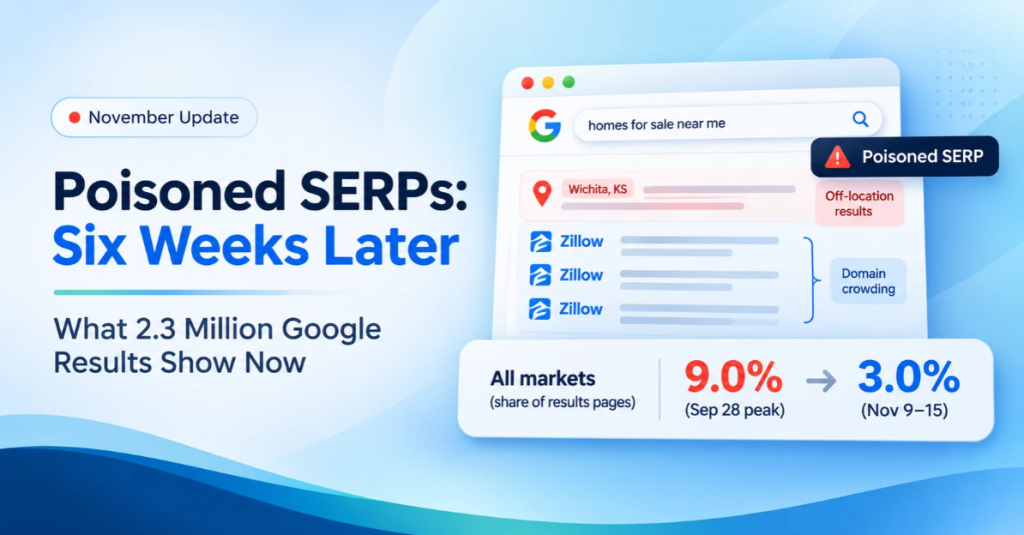
Across all five markets we track, the share of Google results pages flagged as poisoned fell from a 9.0% peak in the week of Sep 28 to 3.0% in the week of Nov 9 to 15. Ireland is the exception at 8.7%. We’ve also found two more patterns in flagged results: off-location results and domain crowding.
How are we handling poisoned SERP results in your reporting? Contact us to learn what we’re doing.
In October, we published our first analysis of poisoned SERPs. Since late September, some automated Google searches have returned complete, normal-looking results pages with most of their usual sites missing. Ireland peaked at 16.0% of results pages in the week of Sep 28. Across all five markets combined, the peak that week was 9.0%, against about 1% over the summer.
Six weeks on, the pattern hasn’t gone away, but it’s happening less often. That’s good news for rank tracking, but a 3% flag rate still means some ranking drops in your reports aren’t real, and in Ireland the share is nearly three times higher. This update tracks the trend through mid-November and covers two new patterns we’ve seen since.
Data analyzed: About 2.3 million Google SERPs, desktop and mobile, in six US cities, the UK, Ireland, Canada and Australia, from June 8 to November 15, 2026.
How we flag a page: For each keyword, device and location, we list the “usual” sites, meaning those in the top 10 in at least 60% of the previous week’s collections. A page is flagged when fewer than half of those usual sites appear. A flag is a diagnostic signal, not proof that Google altered the page.
The Numbers: Poisoned Pages Fell From 9.0% to 3.0% Across All Markets
| Period | Share of Results Pages Flagged (All Markets) |
|---|---|
| Summer baseline (Jun 8 to Aug 30) | 1.1% average |
| Peak (week of Sep 28) | 9.0% (Ireland alone: 16.0%) |
| October (Oct 5 to Nov 1) | 4.6% average |
| Early November (Nov 2 to 15) | 3.8% average |
| Latest week (Nov 9 to 15) | 3.0% |
Weekly rates ran from 4.3% to 4.9% through October, then eased to 3.0% in the week of Nov 9 to 15.
The Trend by Market: Four of Five Markets Are Back Within Their Summer Range
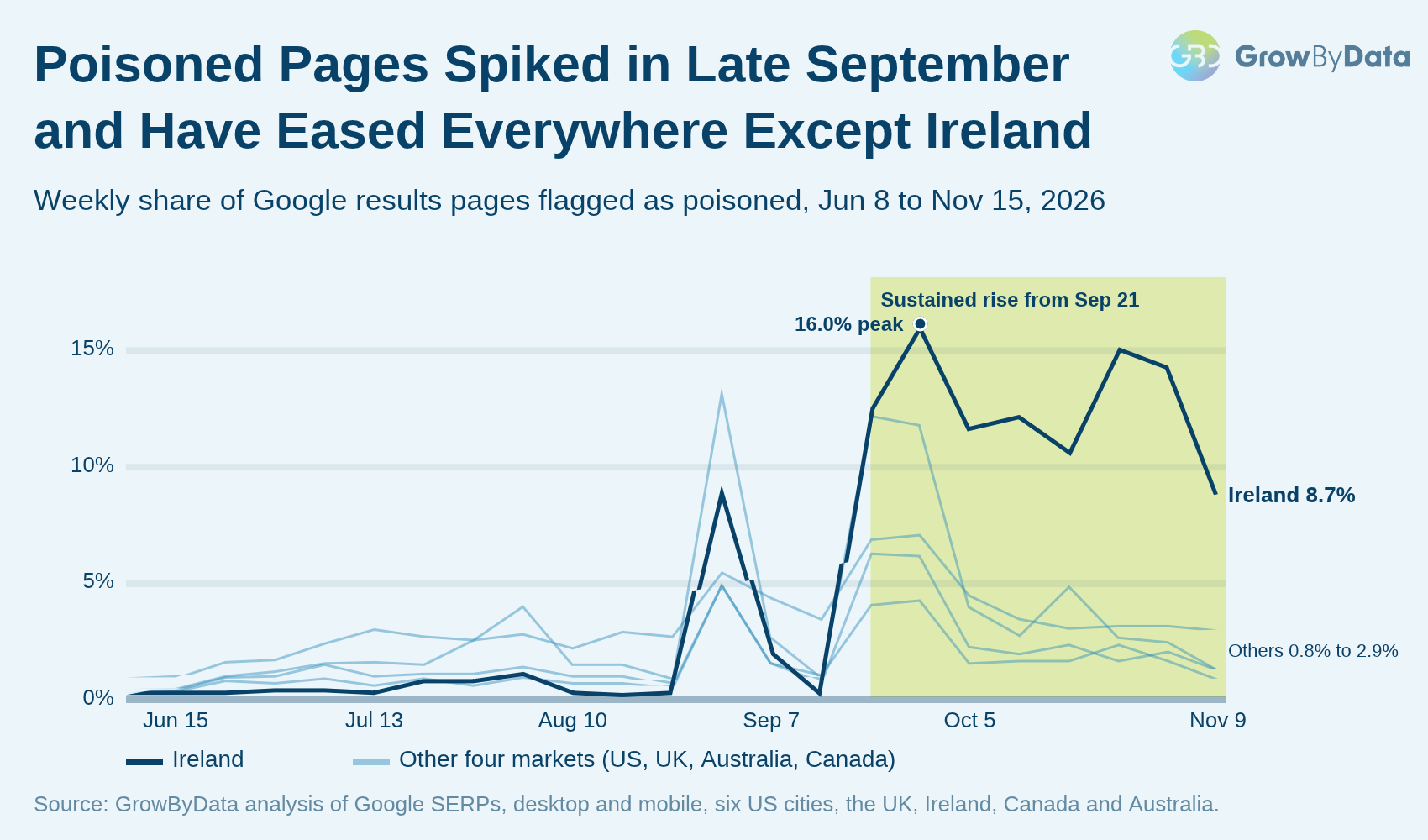
Weekly share of Google results pages flagged as poisoned, by market, Jun 8 to Nov 15, 2026
- United Kingdom: 1.2% in the latest week, down from 2.6% to 4.8% in October.
- Australia and Canada: 1.2% and 0.8%, close to their summer levels.
- United States: 2.9%, holding at about 3% since mid-October. That’s down from a 7.0% peak and back at the top of its summer range.
- Ireland: 8.7%, still the highest rate of any market we track, ranging from 8.7% to 15.0% since October.
The one-week spike from Aug 31 to Sep 6 settled the following week, before the sustained rise began on Sep 21.
The New Patterns: Two More Signs in Flagged Results
Most pages we flag are missing a keyword’s usual sites. When we looked more closely at local real estate searches in November, we also found pages that went wrong in two other ways: the results came from the wrong location, or one site took over the page.
Off-location results. These are results that don’t match where the search came from, which matters most if you rely on local and international SERP monitoring.
- On Nov 7, “houses for sale” searched on mobile from Wichita, Kansas returned Wichita listings in the first two positions. The rest were for Broken Arrow and Oklahoma City (Oklahoma), Fort Worth (Texas), Platte City (Missouri) and Overland Park (Kansas).
- On Nov 9, “Berlin real estate” searched on mobile from Berlin, New Jersey returned German property sites, including immobilienscout24.de.
Domain crowding. This is one site taking most or all of the top positions.
- On Nov 9, Zillow held all 10 organic results for “homes for sale near me” on mobile from Findlay, Ohio, leaving no room for the usual mix of sites.
We’re still measuring how often these patterns appear. Until that’s known, and collection-side causes such as location settings are ruled out, treat them as early warning signs rather than confirmed Google behavior.
What It Means for Your Data: Check Before You React to a Drop
- Check the keyword’s own history. A sudden drop that reverses on the next collection is more likely a poisoned page than a real ranking loss.
- Look at the market. A drop in Ireland, or one that shows up in only one market, deserves more scrutiny right now.
- Look for the patterns. Unfamiliar sites, results from another city or country, or one domain filling the page are all warning signs.
- Ask your SERP provider how it handles flagged pages. How are abnormal pages detected, how do they show up in reporting, and are repeat collections quality-checked? It’s one of the places where SERP monitoring and rank tracking part ways.