
Who Controlled Apparel Search Visibility Across Merchant Listings and Organic?
Executive Summary
In Q4 2025 apparel search:
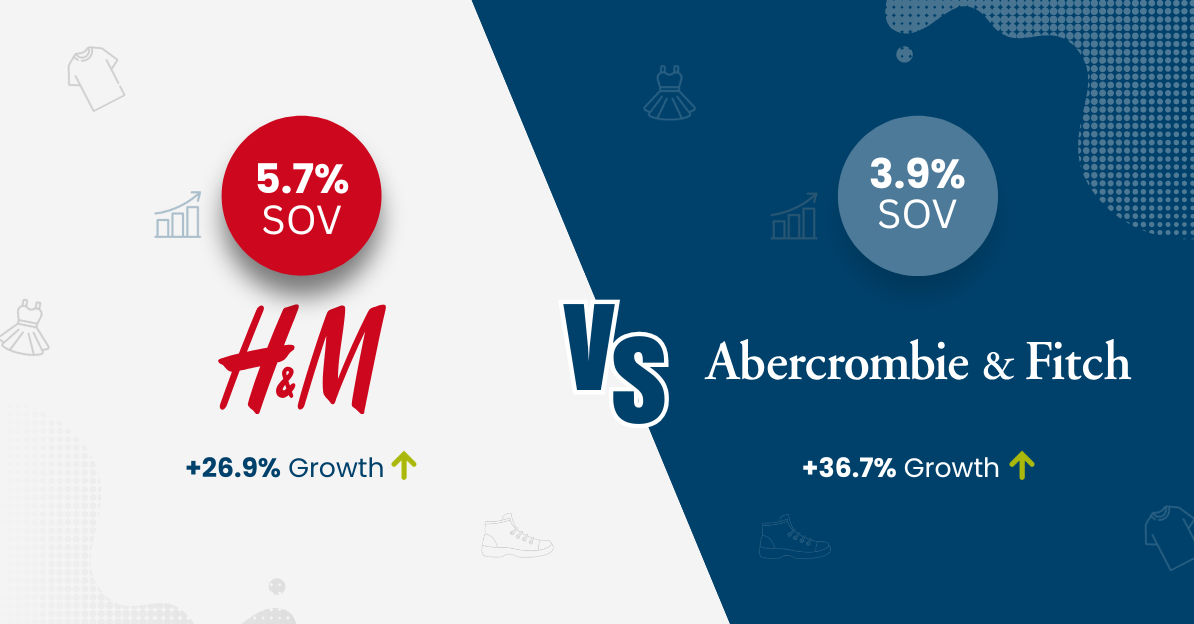
- H&M leads in Apparel Search Verticals with (5.7% SOV), driven by Merchant Listing saturation and product feed scale.
- Abercrombie & Fitch follows at 3.9%, but leads in Above-the-Fold placement efficiency.
- Both H&M and Abercrombie has over 80% of search visibility in Merchant Listing.
- Traditional blue-link organic visibility continues to decline.
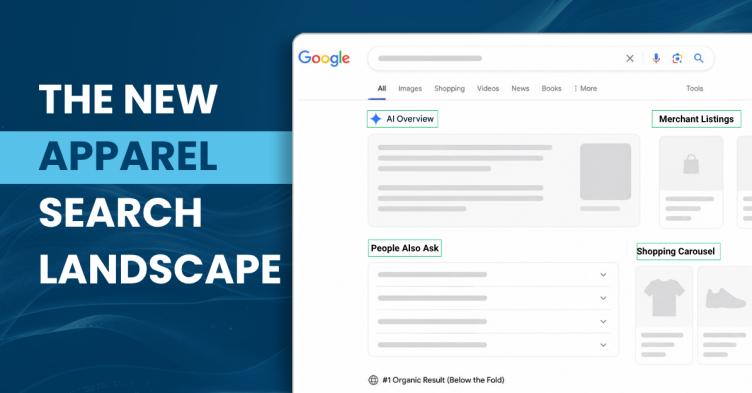
Apparel search has moved beyond the “Blue Link” era. As Google prioritizes visual-first surfaces such as Merchant Listings, Explore Brands modules, and AI Overviews, competitive advantage now depends on structured product data and feed strength.
This transition is driven by three structural shifts:
- Visual-First SERP: More than 80% of apparel visibility now lives inside image-heavy product grids.
- Feed-First Discovery: Consumers use search as a discovery engine, interacting with product modules rather than navigating to category pages.
- Organic Compression: Traditional organic listings are being pushed below product surfaces, reducing their influence on total visibility.
Who Is Winning the Battle for Screen Real Estate?
1. Holistic Share of Voice: Volume vs. Placement Efficiency
Total Share of Voice measures overall surface coverage.
Placement efficiency measures visibility inside high-intent, decision-driving modules.
H&M remains the undisputed volume leader, but Abercrombie is winning the battle for immediate user attention.
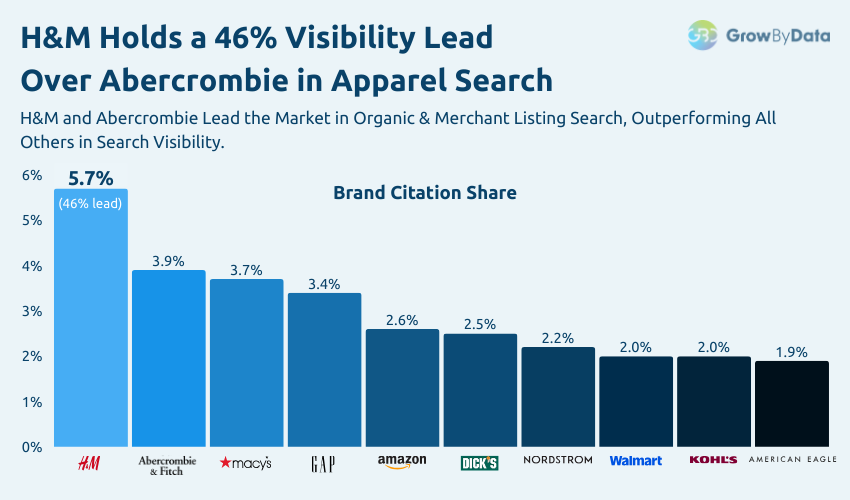
- H&M: 5.7% Total Share of Voice (SOV). H&M’s footprint is 46% larger than Abercrombie’s.
- Abercrombie: 3.9% Total SOV, but a superior 24.5% Above the Fold (ATF) rate (vs. H&M’s 20.9%).
The Strategic Takeaway : H&M owns more total space. Abercrombie owns higher-quality placement space. Abercrombie results are significantly more likely to capture the user’s eye level without a scroll, suggesting higher-quality placement despite a smaller total footprint.
2. H&M Competitive Analysis: Dominance Through Merchant Listing Saturation
H&M’s competitive advantage is built on Merchant Listing infrastructure. The brand has effectively converted its inventory scale into grid-level dominance.
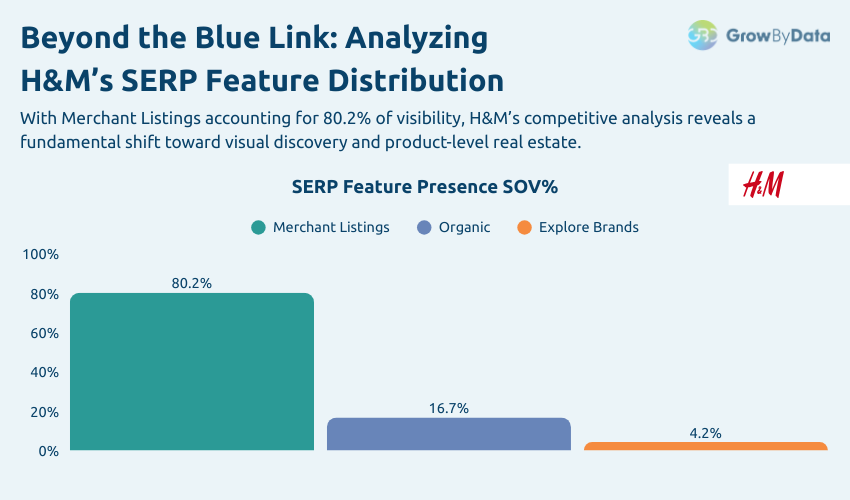
- The Biggest Factor: 80.2% of H&M’s search visibility now comes from Merchant Listings.
- Grid Supremacy: H&M holds a 10.2% Merchant Listing SOV, the highest in the category. They have 50% more listing exposure than Abercrombie and 3x that of Nordstrom.
- The Organic Crash: Despite this lead, H&M’s traditional organic visibility plummeted from 21.5% in October to 9.7% in December.
As apparel search shifts toward visual-first surfaces, brands must move beyond keyword tracking. Explore how Google Shopping Monitoring provides the granular visibility needed to defend Share of Voice in 2026.
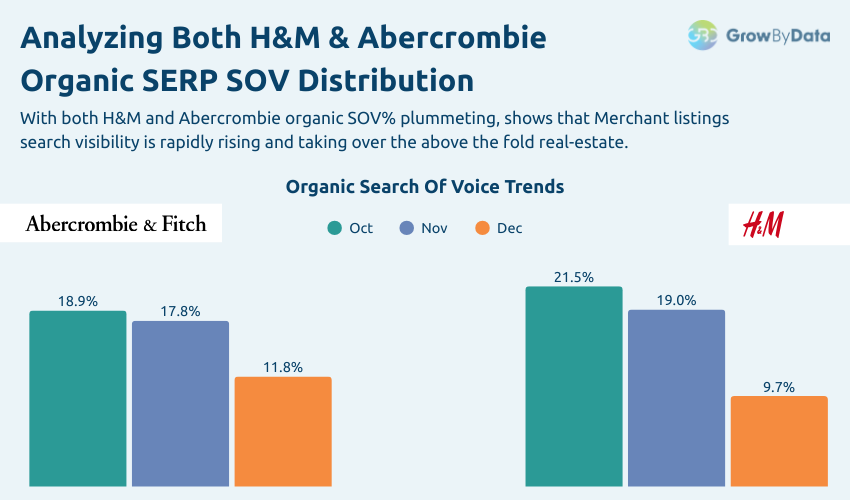
Conclusion: H&M is no longer an “SEO” brand; they are a “Popular Products/ Merchant Listings” brand. They win by saturating the grid with so much product data that they become unavoidable during the discovery phase.
3. Abercrombie Competitive Analysis: The High-Efficiency Model
Abercrombie & Fitch Co. has bypassed the “volume war” to focus on high-engagement surfaces and premium placement.
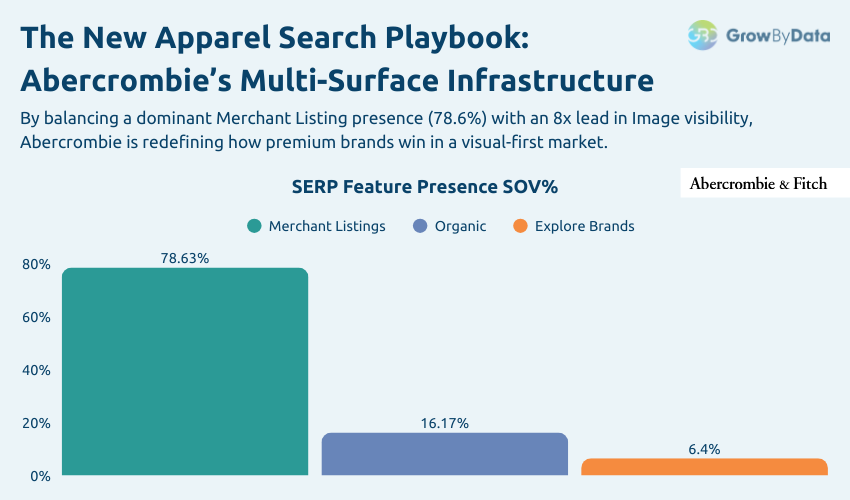
- Feature Agility: Abercrombie over-indexes in high-value modules like Explore Brands (6.4% vs. H&M’s 4.2%) and AI Overviews (AIO).
- The Hollister Engine: While the flagship brand maintains a steady premium presence, the Hollister division surged with 16% growth, acting as the primary driver for the company’s digital acceleration.
- Organic Vulnerability: Like H&M, Abercrombie is facing an organic crisis, with a -25.5% delta in traditional search visibility as you have see in above graphs..
Conclusion: Abercrombie’s model relies on Popular Product discovery and entity strength.
4: Weekly Performance Trends – Infrastructure Under Pressure
How the Search Infrastructure Held Firm During Peak Holiday Volatility
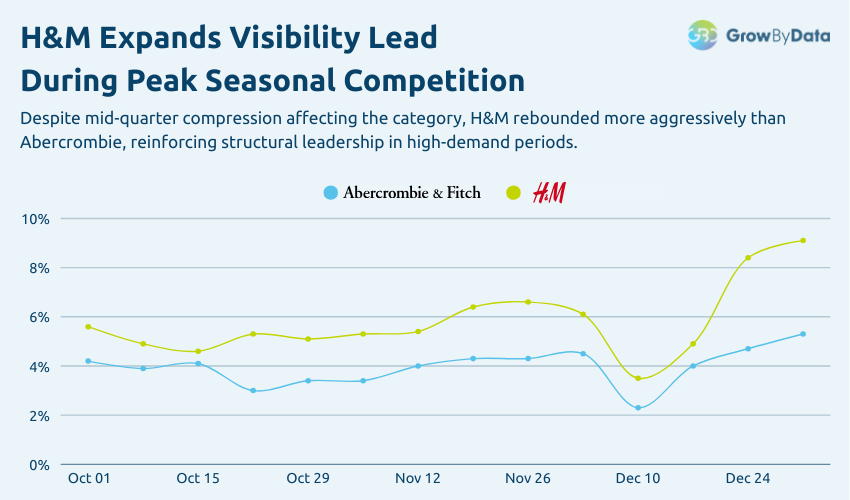
While averages tell the story of the quarter, the weekly data shows how these brands survived the “Holiday Squeeze.”
- Sustained Structural Gap: H&M’s lead was not a seasonal fluke. The visibility gap remained stable throughout Q4, proving that their leadership is built on permanent Merchant Listing infrastructure rather than short-term campaign spikes.
- Mid-Quarter Compression: In mid-November, both brands saw a temporary SOV squeeze as Gap and Old Navy aggressively ramped up their holiday product feeds.
- The Year-End Rebound: H&M showed superior resilience in late December, capturing the “long-tail” demand through its massive SKU breadth.
- Abercrombie’s Flat-Line Efficiency: Unlike H&M’s volume-driven fluctuations, Abercrombie maintained a consistent, steady presence, prioritizing Above the Fold quality over total category volume.
5. The Unexpected Challenger: Old Navy
While H&M and Abercrombie are watching each other, Old Navy emerged as the most aggressive player in the market. They aren’t just showing up; they are using a “two-pronged” strategy to take over the screen.
- The Growth Rate: Old Navy’s visibility grew by a massive 131% in just three months. They are currently growing at 5x the rate of H&M, making them the fastest-moving threat in the apparel world.
- The Merchant Listing Takeover: Gap has mastered the “free” product grid. By keeping their product data incredibly clean and vast, they show up more often when people search for general terms like “summer dresses” or “kids’ clothes”.
6. Final Verdict: 2026 Competitive Outlook
Apparel search leadership in 2025 is built on infrastructure, not narratives.
H&M is winning the war of Saturation. Their challenge is defending this free organic grid against a “Paid campaign” from Amazon (which owns 11.4% of Text Ad SOV).
Abercrombie is winning the war of Attention. Their challenge is maintaining their high “Above the Fold” efficiency as the grid becomes increasingly crowded.
The Category Reality: With 80% of visibility now controlled by product grids, the “Blue Link” is effectively dead for apparel. Brands that do not prioritize Feed Management over traditional Keyword SEO will be invisible by mid-2026.
Know Exactly Where You Stand in Search
Benchmark your brand across holistic Share of Voice, Merchant Listings dominance, and SERP feature composition.