By Devik Balami, Senior SEO/AEO Analyst. Last updated November 2026.
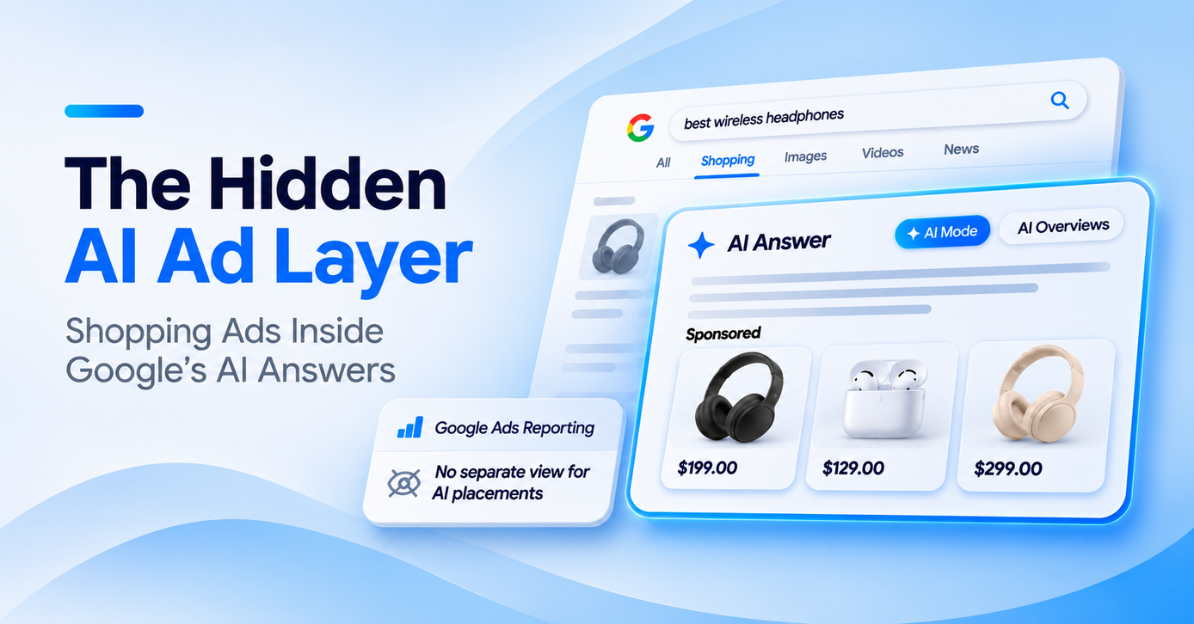
Quick answer: Google now serves Shopping ads inside AI Mode answers and AI Overviews from your existing Shopping and Performance Max campaigns. Google Ads doesn’t report those placements separately, so you can’t see from your account how often you appear there, in which slot, or which competitors sit next to you. In our retail data, AI Mode carried 109 Shopping ad units per 100 answers in October 2026, and AI Overviews went from 3.2 to 20.5 units per 100 answers between July and October.
Your Shopping campaigns are already bidding into AI answers. You didn’t opt in, and you can’t opt out of AI placements alone. Google’s position is that relevance decides when a Shopping ad appears inside an AI response, and the same campaigns power both surfaces. That’s fine until your CMO asks how much of this quarter’s Shopping spend went into AI Mode, and the honest answer is that Google Ads can’t tell you.
This piece covers what’s live, what Google’s reporting leaves out, what our retail scans show, and the metrics worth putting on a weekly dashboard. If you’re building the wider program, start with our complete guide to monitoring Google Shopping Ads.
What’s Live As Of November 2026
| Date | What changed |
|---|---|
| Oct 2024 | Search and Shopping ads start showing in AI Overviews for US mobile users |
| May 2025 | Ads in AI Overviews expand to US desktop; Google starts testing ads in AI Mode |
| Feb 11, 2026 | Google announces a Shopping ad format built for AI Mode |
| May 20, 2026 | Google Marketing Live: AI-powered Shopping ads for higher-consideration purchases, plus new conversational formats for AI Mode |
| May 27, 2026 | Google announces AI performance insights in Merchant Center |
| Aug 31, 2026 | A sponsored Shopping carousel is spotted inline within the AI Mode answer, with a second sponsored block at the foot of the page |
Eligibility hasn’t changed since 2025. If you run Shopping, Performance Max or broad match Search campaigns, you’re eligible. There’s no AI-only targeting, no separate budget and no separate bid. For the background on text and Shopping placements in summaries, see our earlier look at ads in Google AI Overviews and what Google AI Mode means for brands.
The Reporting Gap: What Google Shows You And What It Doesn’t
Google’s own help documentation on ads in AI Overviews says Google Ads doesn’t offer segmented reporting for ads that show within AI Overviews, and those ads are counted as Top Ads. Trade coverage from September 2026 reported the same for AI Mode: no segment isolates AI Mode delivery inside a Search, Shopping or Performance Max campaign.
Merchant Center’s AI performance insights help, but they answer a different question. They show how your own products surface on AI shopping journeys, with share of voice benchmarked against similar brands and a discovery, evaluation and purchase funnel. They don’t show which competitor ran an ad in which answer, how often, or in which slot.
| Question your team will get asked | Google Ads | Merchant Center AI insights | SERP-level monitoring |
|---|---|---|---|
| How often do our Shopping ads appear inside AI answers? | No | Partial (own visibility, not ad-specific) | Yes |
| Which competitors appear in the same AI answer? | No | No | Yes |
| What slot do we hold in the AI carousel? | No | No | Yes |
| What price and offer does our AI unit show vs a rival’s? | No | No | Yes |
| Is AI Mode taking share from the classic Shopping carousel on our core queries? | No | No | Yes, if both are tracked on the same keyword set |
That last column is what Google Shopping Ads monitoring is built for.
What Our Retail Data Shows
The numbers below come from the GrowByData Retail Industry Panel: 140 retail shopping prompts run daily on Google AI Mode and Google AI Overviews in the US, in logged-in sessions, from July to mid-November 2026. Categories span home and furniture, fitness equipment, electronics, apparel, beauty and luxury. We count sponsored product units, so one AI answer carrying a six-product carousel counts as six.
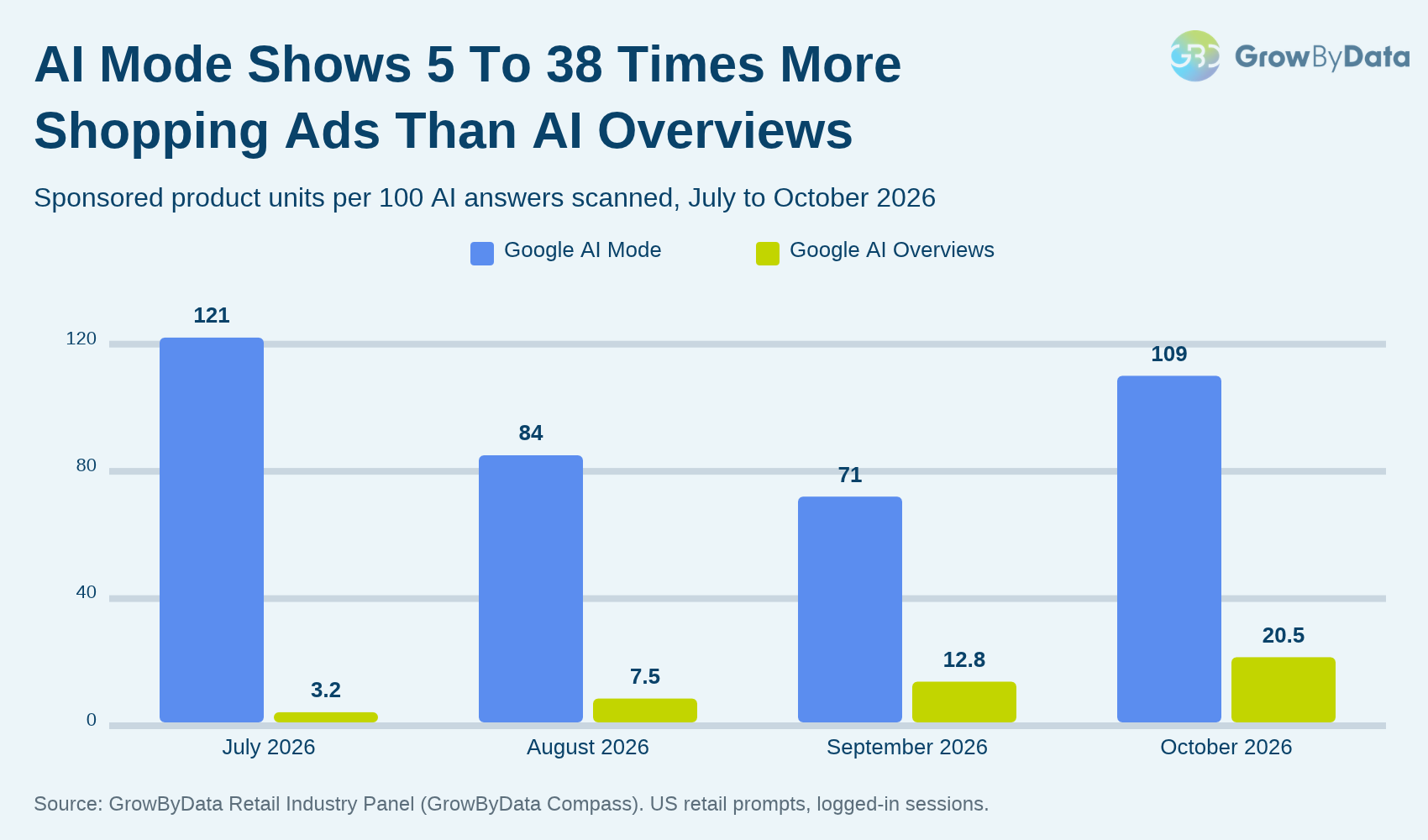
The Volume Gap: AI Mode Ran 109 Shopping Ad Units Per 100 Answers In October, AI Overviews Ran 20.5
| Month (2026) | AI Mode answers scanned | AI Mode units per 100 answers | AI Overviews scanned | AI Overviews units per 100 answers | AI Mode vs AI Overviews |
|---|---|---|---|---|---|
| July | 8,790 | 121 | 4,716 | 3.2 | 38x |
| August | 8,342 | 84 | 4,348 | 7.5 | 11x |
| September | 8,206 | 71 | 6,112 | 12.8 | 5.5x |
| October | 8,348 | 109 | 8,164 | 20.5 | 5.3x |
An AI Mode answer to a retail prompt carried roughly one sponsored product unit on average every month we tracked. That’s carousel density, not an occasional ad. If your team only watches AI Overviews, you’re watching the smaller surface.
The Fastest Mover: Shopping Ads Inside AI Overviews Rose About 6x From July To October
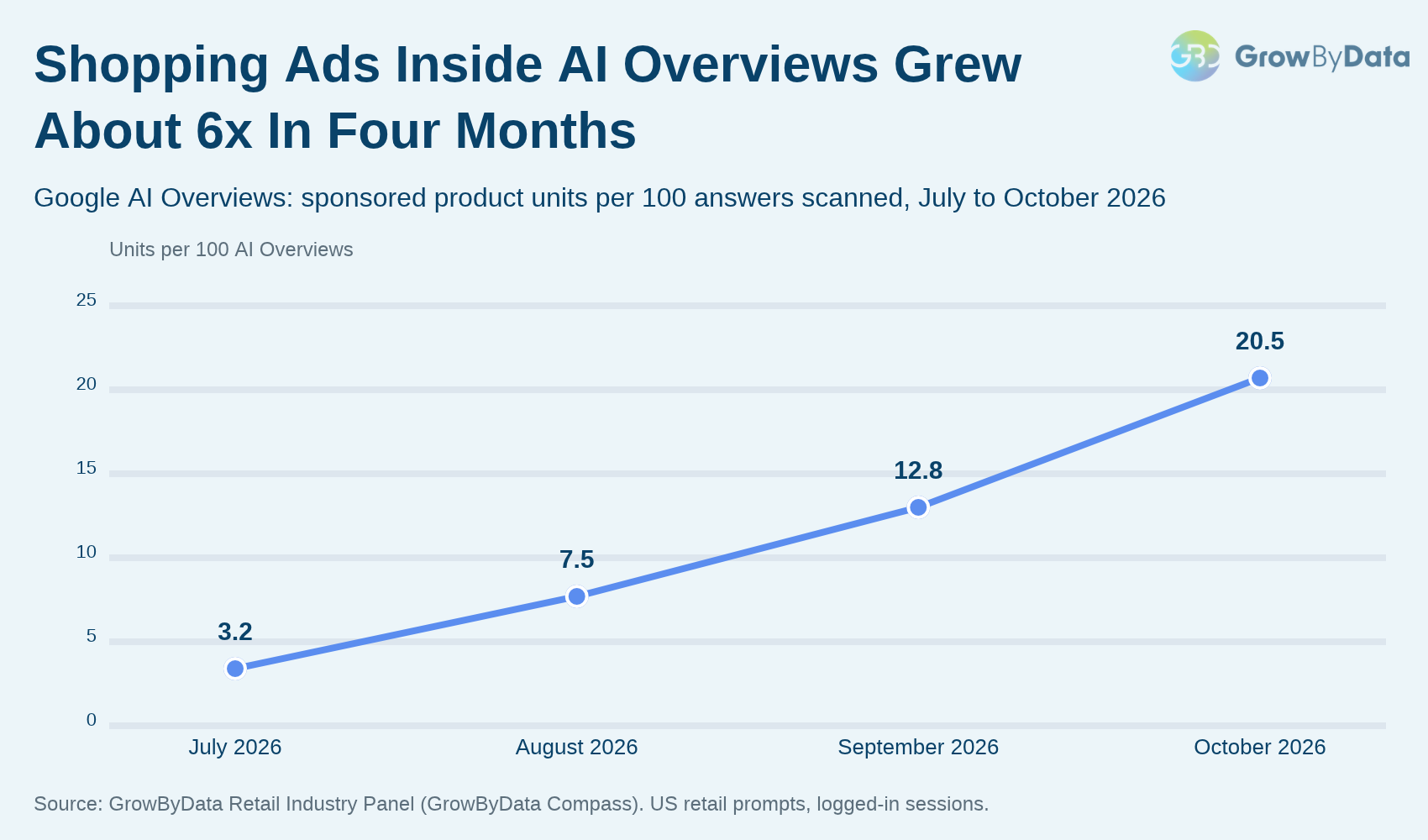
AI Mode still leads by a wide margin, but the gap closed from 38x in July to about 5x by October because AI Overviews kept climbing month after month: 3.2, 7.5, 12.8, then 20.5 units per 100 answers. AI Overviews show up on far more everyday searches than AI Mode does, so this is the line to watch going into 2027 budgets.
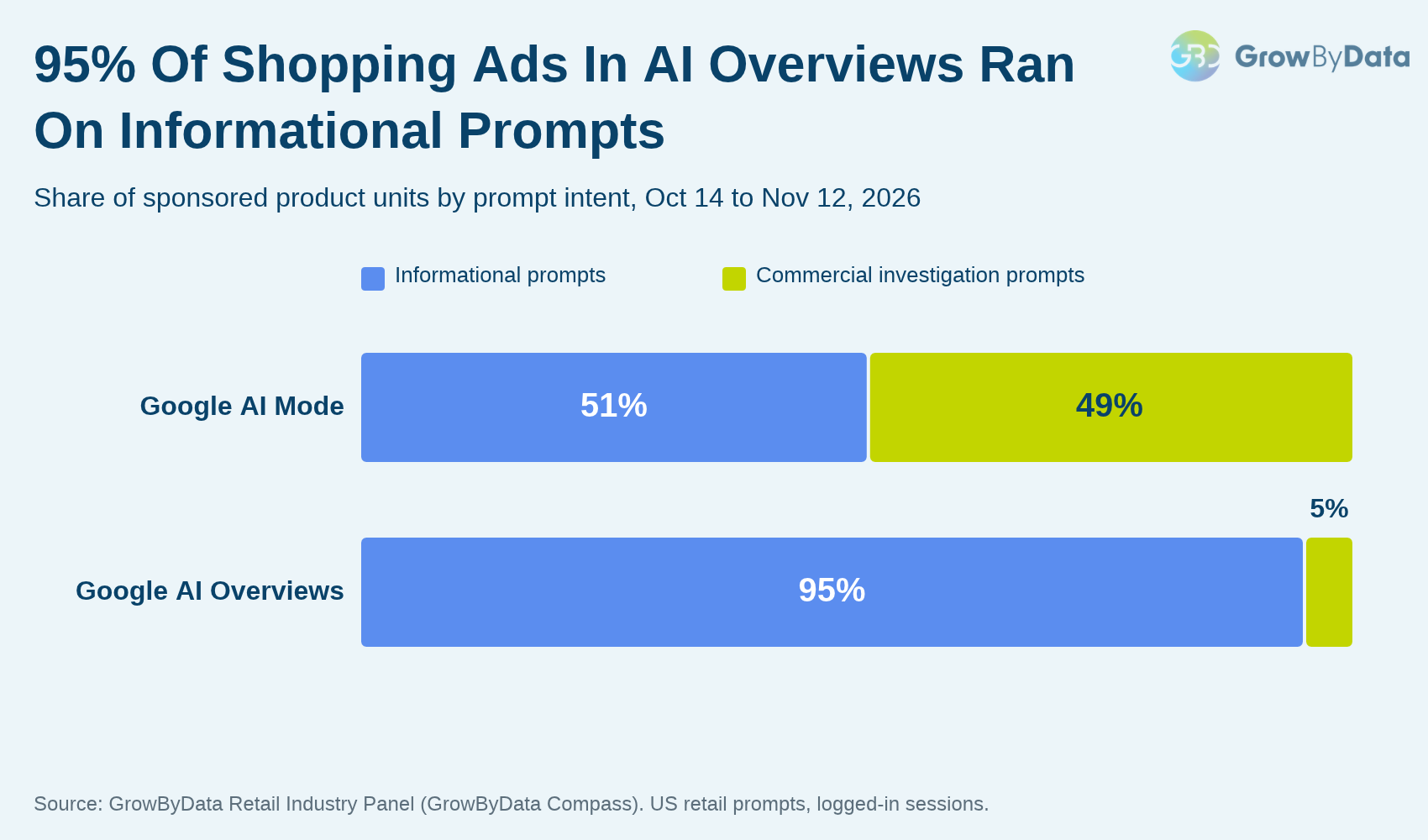
The Intent Split: 95% Of AI Overviews Shopping Ad Units Ran On Informational Prompts
| Surface (Oct 14 to Nov 12, 2026) | Units on informational prompts | Units on commercial investigation prompts | Informational share |
|---|---|---|---|
| Google AI Mode | about 1,490 | about 1,430 | 51% |
| Google AI Overviews | about 560 | about 30 | 95% |
This is the finding that should change how you build query sets. In AI Overviews, Shopping ads almost always attached to “how” and “what” style prompts, not to “best X for Y” comparisons. Keyword lists built only from product head terms will miss most of the Shopping ad inventory inside AI Overviews.
The Concentration: The Top AI Mode Advertiser Held Just 2.19% Of Sponsored Units
| Rank | Advertiser | Share of AI Mode sponsored units | Average slot | Share of units in slot one |
|---|---|---|---|---|
| 1 | Poppin | 2.19% | 4.8 | 21.9% |
| 2 | Outer | 1.98% | 8.4 | 13.8% |
| 3 | Bulgari | 1.84% | 5.2 | 33.3% |
| 4 | Chaumet | 1.74% | 13.5 | 3.9% |
| 5 | Rogue Fitness | 1.47% | 8.5 | 2.3% |
| 6 | Zuri Furniture | 1.37% | 4.9 | 22.5% |
| 7 | Country Casual Teak | 1.26% | 6.6 | 16.2% |
| 8 | LG | 1.16% | 4.0 | 23.5% |
| 9 | Lululemon | 1.16% | 8.0 | 5.9% |
| 10 | Prada | 1.06% | 10.5 | 12.9% |
Oct 14 to Nov 12, 2026. The top ten together held about 15% of AI Mode sponsored units. In AI Overviews the top ten held about 27%.
Two things stand out. First, nobody owns this inventory yet, across furniture, fitness, luxury and electronics alike. Early share is cheaper to take than to win back. Second, look at the slot columns. Chaumet appeared often but averaged slot 13.5 with almost no first-slot wins, while LG held a smaller share but averaged slot 4.0. Appearing isn’t the same as being seen, so slot position belongs next to presence on any report.
The Creative: AI Mode Shopping Units Run Your Feed Title, Word For Word
| Advertiser | Ad title as shown in AI Mode | Average slot | Share in slot one |
|---|---|---|---|
| Vekto | Cordless Vacuum Cleaner, Cordless Hoover for Pet Hair, Carpet & Hard Floor, 55kPa, 60 Min, Self-Standing, Anti-Tangle, HEPA, Vekto Vacuum V18 | 1.5 | 76.9% |
| Tonal | Tonal 2: The Smartest Home Gym, Patented Digital Weight System, All-in-One Personal trainer | 1.7 | 66.7% |
| Caretta Workspace | Executive Motorized Sit-Stand Desk, Loaded with Features | 3.4 | 27.3% |
| Zuri Furniture | Draper Modern Fully Reclining Adjustable Executive Office Chair Soft Black Top Grain Leather | 2.6 | 44.4% |
Most frequent AI Mode ad creatives, Oct 14 to Nov 12, 2026. Titles shown with the original separators replaced by commas. No description line was captured for these units.
There’s no ad copy to write here. The unit is your product title, so title structure, attributes and specs are your creative. The two units that took slot one most often in this sample both front-loaded the product type and specific attributes. The sample is small, so treat that as a pattern to test, not a rule.
The Measurement Trap: Logged-Out Scans Saw 11 AI Mode Ad Appearances In A Month
A separate logged-out retail scan set in the same 30 days recorded only 11 sponsored appearances inside AI Mode and none inside AI Overviews. The two scan sets use different query lists, so this isn’t a like-for-like comparison. But the direction is hard to miss: if your monitoring runs logged-out, generic sessions, it will tell you these placements barely exist. Personalized, logged-in sessions are where Shopping ads show up in volume.
The Classic SERP Still Matters: Shopping Ads Sat On 73.7% Of The Same Panel’s Retail SERPs
| Feature on retail SERPs (Oct 14 to Nov 13, 2026) | Share of SERPs where it appeared |
|---|---|
| AI Overview | 99.9% |
| Merchant Listings | 94.6% |
| Shopping ads (classic carousel) | 73.7% |
| Text ads | 5.0% |
GrowByData Retail Industry Panel, US, logged-in sessions, 3,080 retail keyword SERPs. AI placements are adding to the classic Shopping carousel, not replacing it yet. That’s why the AI vs classic split below is worth tracking on the same keyword set.
Methodology. Source: GrowByData Retail Industry Panel, tracked in GrowByData Compass. Scope: 140 retail shopping prompts on Google AI Mode and Google AI Overviews, US, logged-in sessions; 3,080 retail keyword SERPs for the classic SERP table. Period: July 1 to October 31, 2026 for monthly figures; October 14 to November 12, 2026 for intent, advertiser and creative tables. Units are sponsored product units counted inside AI answers. Limits: one retail prompt set, not all of Google; monthly unit totals are calculated from advertiser share of voice; intent shares depend on the prompt mix; June is excluded because scans ramped up mid-month.
See where your Shopping ads land in AI answers. We’ll show you your sponsored share, slot position and the competitors next to you in Google AI Mode and AI Overviews, in your chosen markets and devices.
Six Metrics Retail Paid Search Teams Should Track
| Metric | What it tells you | How to read it |
|---|---|---|
| AI ad presence rate | Share of your tracked queries where your Shopping ad appears inside an AI answer | Track by surface (AI Mode, AI Overviews) and by category. A drop with flat spend usually means Google re-ranked relevance, not that you lost the auction |
| Sponsored share of voice by surface | Your share of all sponsored appearances in AI answers vs competitors | Keep it separate from classic Shopping SOV. The leaders are often different brands |
| Slot position and top-slot rate | Where your unit sits in the AI carousel | Report average slot and the share of appearances in slot one |
| Competitor co-appearance | Who shows next to you in the same answer | This is your real AI competitive set. Expect marketplaces and DTC brands you don’t see in Auction Insights |
| Price and offer shown | The price, sale tag and shipping terms your AI unit displays vs rivals in the same answer | AI units are built from your feed. If your feed price lags a promotion, the AI answer shows the stale price |
| AI vs classic Shopping split | For the same keyword set, how presence divides between the AI answer and the Shopping carousel | The early warning that AI Mode is absorbing demand your Shopping reports still credit to search |
Add one more if your SEO team shares the dashboard: organic citations vs paid presence in the same AI answers. A brand that earns the citation and buys the carousel slot owns the answer. Most retailers have one or the other. Our guide to product visibility in AI shopping covers the organic side.
How To Set Up Tracking That Holds Up
Build the query set around intent, not just keywords. Google’s own example of a Shopping ad in AI Overviews was a “how to clean an oven” search pulling cleaning products, and our data shows 95% of AI Overviews Shopping units on informational prompts. Add problem-led and comparison-led queries for each category, not only product head terms.
Run logged-in, profiled sessions. Our panel data above is the reason. Generic sessions undercount.
Scan daily, in your chosen markets and devices. Ads in AI Overviews reached US mobile before desktop, and placements still vary by device. Weekly snapshots miss promotion windows like Black Friday and Cyber Monday.
Keep AI Mode and AI Overviews as separate lines. They behave differently: different volume, different prompt intent and different concentration. Google AI Mode monitoring and Google AI Overviews monitoring should report side by side, not blended.
Reconcile with Merchant Center, don’t replace it. Use Merchant Center AI insights for your own funnel and product attributes. Use SERP-level monitoring for the competitive view Google doesn’t give you.
What To Change Once You Can See It
- Fix feed titles and attributes first. AI Mode units run your Merchant Center title word for word, so missing attributes, weak titles and stale prices cost you placements you’ll never see in the account.
- Line up promotion timing with the feed. If a rival’s AI unit shows a sale tag and yours doesn’t, the fix is a feed update, not a bid change.
- Separate brand and nonbrand AI presence. Conquesting inside AI answers on your brand terms is a different problem from category share, and it needs its own alert.
- Bring the AI split into budget talks. When AI presence rises and classic carousel presence falls on the same queries, your Shopping ROAS is starting to depend on placements you can’t see in Google Ads.
Frequently Asked Questions
Do I Need A Separate Campaign For Shopping Ads In AI Mode?
No. Existing Shopping and Performance Max campaigns connected to Merchant Center are eligible.
Can I Target AI Overviews Or AI Mode Only?
No. Google decides placement based on relevance to the query and the AI response.
Does Google Ads Report AI Overviews Or AI Mode Placements Separately?
Not as of November 2026. Google’s help documentation says ads in AI Overviews are reported as Top Ads, without a separate segment.
What Does Merchant Center’s AI Performance Insights Report Show?
Your own visibility on AI shopping journeys in AI Mode, AI Overviews and the Gemini app, including share of voice against similar brands and a discovery to purchase funnel. It doesn’t show competitor ad placements.
Why Does My Monitoring Tool Show Almost No Ads In AI Mode?
Most likely because it scans in logged-out sessions. In our retail panel, logged-out scans recorded 11 AI Mode ad appearances in a month, while logged-in scans recorded thousands.
Should I Track AI Mode And AI Overviews Together?
Track them separately. In our retail data, AI Mode carried 109 Shopping ad units per 100 answers in October 2026 vs 20.5 for AI Overviews, and the two surfaces attract different prompt intents.
Are Shopping Ads Inside AI Overviews Growing?
In our retail panel, yes. Shopping ad units per 100 AI Overviews rose from 3.2 in July 2026 to 20.5 in October 2026.
See Your AI Mode And AI Overviews Shopping Ad Share
GrowByData Compass tracks Google Shopping, Google AI Overviews and Google AI Mode on the same keyword and prompt sets, so you can see your sponsored share, slot position and competitor co-appearance across both surfaces. We’ll run your categories and show you where you stand.
Sources
- Google Ads Help, “About ads and AI Overviews”
- Google, “New ways for marketers to reach customers with AI Overviews and Lens” (October 2024)
- Search Engine Land, “Google expands ads in AI Overviews, AI Mode to desktop” (May 2025)
- PPC Land, “Google unveils shopping ads in AI Mode” (February 2026)
- Google, “A new generation of ads for the AI era of Search” (May 20, 2026)
- Search Engine Land, “Google adds AI shopping visibility insights to Merchant Center”
- PPC Land, “Google tests two shopping ad placements inside AI Mode results” (August 31, 2026)