
AI shopping visibility is how often, and how high, your products get recommended when shoppers ask ChatGPT, Google AI Mode, Perplexity or Google AI Overviews what to buy. You measure it by running a fixed set of buying prompts on a schedule and logging every product each AI names, its position, and the page behind it.
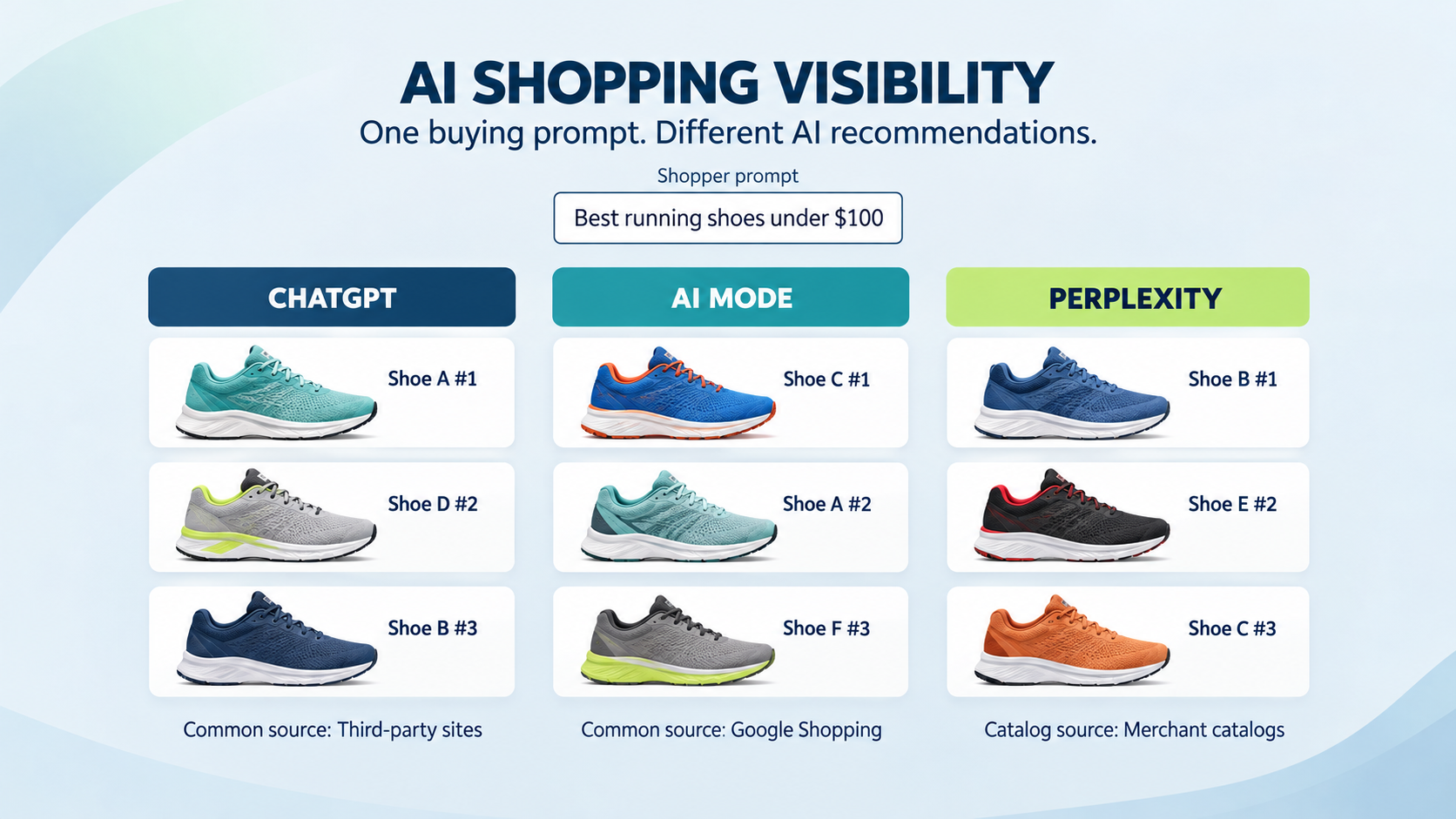
Our view: treat each AI surface as its own shelf. In a week of tracking running-shoe prompts, ChatGPT and Google AI Mode never once put the same product first on the same day.
What is AI shopping visibility?
AI shopping visibility measures whether an AI assistant names your products when a shopper asks a buying question, where they sit in the recommended list, and how often that holds across prompts, platforms and days. It’s tracked at the product level, so it shows which models or SKUs win, not just whether your brand gets mentioned.
Brand mention tracking tells you ChatGPT named your brand. Product-level tracking tells you which of your models it recommended, in what position, and which ones never appeared. For a category manager deciding where to put review outreach or feed fixes, only the second answer is useful.
Product visibility also isn’t the same as merchant visibility. Product visibility is which products get recommended. Merchant visibility is which store the shopper gets sent to, and most of this article is about the first question.
Definitions also split on what counts as “recommended.” Some tracking vendors count only products shown as a shoppable card. We count every product an answer recommends, card or not, because a product named in the text still shapes the shortlist.
How does ChatGPT shopping work?
ChatGPT shopping matches a shopper’s buying question to products from merchant feeds and the web, then shows a short carousel of picks. OpenAI says those picks are selected independently and aren’t ads. Google AI Mode and Perplexity pull from different product data, so a product can be strong in ChatGPT and missing elsewhere.
ChatGPT also offers shopping research, which builds a buyer’s guide after asking about budget and priorities. OpenAI says those results “are organic and based on publicly available retail sites” (OpenAI, November 24, 2025).
How Google AI Mode and Perplexity differ from ChatGPT
Google AI Mode draws on Google’s Shopping Graph, and Perplexity pulls from connected merchant catalogs, including PayPal merchants. In our data, ChatGPT’s picks also lean on third-party review pages, as the next section shows.
| Platform | Where product data comes from | How products appear | Checkout inside the AI | Source and date |
|---|---|---|---|---|
| ChatGPT | Merchant feeds shared through the Agentic Commerce Protocol, Shopify Catalog, and direct feed applications | A product carousel; ChatGPT may write simplified titles and labels such as “Budget-friendly” | OpenAI now lets merchants use their own checkout, after saying its first Instant Checkout version lacked flexibility | OpenAI, March 24, 2026; OpenAI Help Center, accessed October 8, 2026 |
| Google AI Mode | Google’s Shopping Graph: more than 50 billion product listings, more than 2 billion refreshed every hour | A panel of products and images that updates as the shopper refines the question | Agentic checkout for eligible US merchants, rolling out from November 2025 | Google, May 20, 2025 and November 13, 2025 |
| Perplexity | Merchant catalogs, including PayPal merchants connected through PayPal’s store sync | Product recommendations inside the answer (seen in our GrowByData Compass scans, August 2026) | Checkout in chat for US users | PayPal, November 25, 2025 |
ChatGPT and AI Mode details come from each company’s own announcements and help pages. Perplexity details come from PayPal’s launch announcement, because Perplexity hasn’t published how it ranks products.
OpenAI says ChatGPT product results “are selected independently by ChatGPT and are not ads, nor influenced by any OpenAI partnerships.” It also says merchants are ranked on factors like “availability, price, quality” (OpenAI Help Center, accessed October 8, 2026).
The same page says Shopify merchants are already integrated through Shopify Catalog, while other merchants can apply for direct feed access. So feed access gets you into the candidate pool. It doesn’t decide whether you’re recommended.
Why does the same shopping prompt return different products on each platform?
The same shopping prompt returns different products on each platform because each AI pulls from different sources and builds a fresh answer every time. In our running-shoe sample from September 15 to 21, 2026, ChatGPT and Google AI Mode never named the same product first on the same day across 19 comparable prompt-days.
What we tracked. Three running-shoe prompts, scanned daily in New York from September 15 to 21, 2026, on ChatGPT, Google AI Mode and Google AI Overviews. Source: GrowByData Retail Industry Panel, collected in GrowByData Compass.
The prompts were “What are the best running shoes under $100?”, “What are the best running shoes for beginners?” and “What are the best running shoes for marathon training?”. That gave us 56 AI answers and 355 product placements, where a placement is one product in one position in one answer.
| Surface | AI answers | Product placements | Average products per answer | What the product picks pointed to |
|---|---|---|---|---|
| ChatGPT | 21 | 159 | 7.6 | A third-party review or retail page on 118 of 159 placements; never a brand’s own site or a Google Shopping product page |
| Google AI Mode | 21 | 130 | 6.2 | A Google Shopping product page on 71 of 130 placements |
| Google AI Overviews | 14 | 66 | 4.7 | A cited page on 58 of 66 placements: runrepeat.com on 20, a Google Shopping product page on 16 |
Source: GrowByData Retail Industry Panel, 3 running-shoe prompts, New York, September 15 to 21, 2026. Google AI Overviews returned product picks on 14 of 21 prompt-days in this sample. Perplexity isn’t included because our scans returned no Perplexity answers for these prompts that week.
Five different shoes held ChatGPT’s top spot in seven days
For “best running shoes under $100,” ChatGPT’s first pick changed almost daily. The Nike Revolution 8, the New Balance Fresh Foam 680v9 (three days), the Brooks Ghost 16, the adidas Duramo SL 2 and the Nike Pegasus 41 each led at least once.
A one-time screenshot would have told you a different story depending on the day you took it.
ChatGPT and AI Mode agreed on the top brand on 6 of 19 prompt-days
Across 19 prompt-days where both ChatGPT and AI Mode named a top product, they put the same brand first 6 times. They never put the identical product first.
ChatGPT cited review sites while AI Mode linked to Google Shopping listings
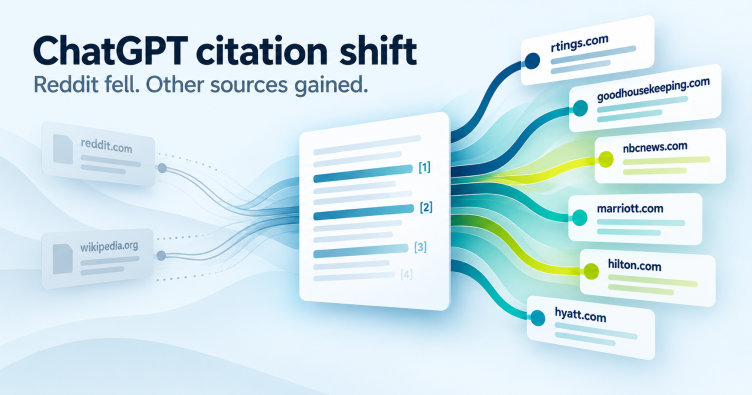
ChatGPT’s picks pointed to third-party pages such as pricehacker.com (23 placements), runnersworld.com (22), and rtings.com, fleetfeet.com and irunfar.com (16 each). Over half of AI Mode’s picks pointed to Google Shopping product pages instead.
That’s the clearest sign we’ve seen that the levers differ by platform. Third-party coverage matters on one side, and your product listing data matters on the other.
This sample has limits: one category, three prompts, one market and one week. The export doesn’t say whether each product was shown as a card or only named in the text.
Product names also vary between answers (“Fresh Foam 680v9” and “Fresh Foam 680 v9”), so counts depend on how you merge variants.
See which of your products AI assistants recommend. We’ll run your category’s buying prompts across ChatGPT, Google AI Mode and Google AI Overviews and show where your products rank against competitors.
How do you track products in AI shopping recommendations?
To track your products in AI shopping recommendations, run a fixed prompt set on each AI surface daily. Log every product named, its position and its cited source. Daily matters because AI answers change from one day to the next, and a weekly or one-time check can’t tell a trend from noise.
- Build the prompt set from buying questions. Cover category (“best running shoes”), price band (“under $100”), use case (“for marathon training”) and comparisons. Most teams we see start with brand prompts, which mostly tell them what they already know.
- Run it on each surface separately. Cover ChatGPT, Google AI Mode, Google AI Overviews and Perplexity in your chosen markets and devices. Answers can reference the shopper’s location, so keep the market fixed when comparing.
- Log product, brand, position and source. Record every product in the list, not just yours. Competitor placements are half the analysis.
- Normalize product names before you count. AI answers write “Brooks Ghost,” “Brooks Ghost 17” and “Brooks Men’s Ghost 17” for what may be the same shoe. Decide your merge rules once and keep them.
- Report a small set of numbers per platform. Use presence rate (share of answers that name any of your products), average position when present, and top-pick share (share of answers where you’re first).
- Trace the sources. For each placement, note whether the pick pointed to a review page, a Google Shopping listing or your own site. That tells you which team owns the fix.
This is more reporting than most teams expect. Four surfaces and a daily cadence mean four scorecards that won’t move together, and someone has to explain that to the VP who reads them.
The same method works at the brand level, which is how we track brand mentions in ChatGPT and track brand mentions in Perplexity AI.
What tracking can’t show yet
AI shopping tracking can’t yet reliably show which retailer wins the sale after a recommendation, how personalization changes each shopper’s answer, or how many AI-recommended products convert. Third-party tracking sees the answer a scan receives. It doesn’t see a logged-in shopper’s answer or the checkout.
Google is building first-party reporting here. According to Google, Merchant Center will add AI performance insights covering share of voice, shopping funnel performance, product terms and attribute completeness across AI Mode, AI Overviews and the Gemini app. The rollout covers the US, Canada, Australia, India and New Zealand “in the coming months” (Google Merchant Center Help, May 27, 2026).
That report will show your own products on Google’s surfaces. It won’t show ChatGPT or Perplexity, and it won’t show competitors’ products one by one. That’s why we’d treat first-party and third-party tracking as complements.
How to make AI recommend your product?
To make AI recommend your product, get it into each platform’s product data and into the sources that platform trusts. On Google AI Mode that means your Shopping Graph listing, and on ChatGPT a connected merchant feed plus presence in the third-party pages it cites. No platform has published a full ranking formula.
Here’s where we think most brands get it wrong. They treat AI shopping as a feed project, fix their attributes, and stop.
Feeds matter, but in our sample ChatGPT’s product picks pointed to third-party review and retail pages on 118 of 159 placements. If your product isn’t in the pages ChatGPT cites, a clean feed alone won’t put it first.
| Platform | Inputs a brand can influence | Evidence |
|---|---|---|
| Google AI Mode and AI Overviews | Product listing data in the Shopping Graph | Google’s AI Mode announcement; Google Shopping product links on 71 of 130 AI Mode placements and 16 of 66 AI Overview placements in our sample |
| ChatGPT | Feed access through Shopify Catalog or a direct application, plus coverage in the review and retail pages it cites | OpenAI help center; cited third-party pages on 118 of 159 placements in our sample |
| Perplexity | Connected merchant catalogs, such as PayPal’s store sync | PayPal’s launch announcement; too little data in our sample to say more |
AI Overviews appear in the first row with AI Mode because both are Google surfaces that link to Google Shopping product pages in our data. Their citation mix still differs, as the sample table above shows.
For the listing side, our guide to Google Merchant Listings covers the basics. We can’t tell you how much weight each input carries. Nobody outside these companies can yet, and anyone claiming a formula is guessing.
How do AI Overviews fit into AI shopping visibility?
Google AI Overviews are one of four surfaces where products get recommended, alongside ChatGPT, Google AI Mode and Perplexity. In our running-shoe sample from September 15 to 21, 2026, AI Overviews named fewer products than ChatGPT or AI Mode, at 4.7 per answer, and 16 of 66 product placements pointed to a Google Shopping product page.
AI Overviews also behave differently from the assistants. They sit on a regular Google results page, so they compete with Shopping ads, Merchant Listings and organic results for the same click.
Our guide to track AI Overviews on shopping and product searches covers that side in detail, and our explainer on Google AI Overviews covers the feature itself.
The measurement should still match the other surfaces: which products are named, in what position, and from what source. That way you can compare AI Overviews against Google AI Mode and ChatGPT side by side.
How GrowByData helps
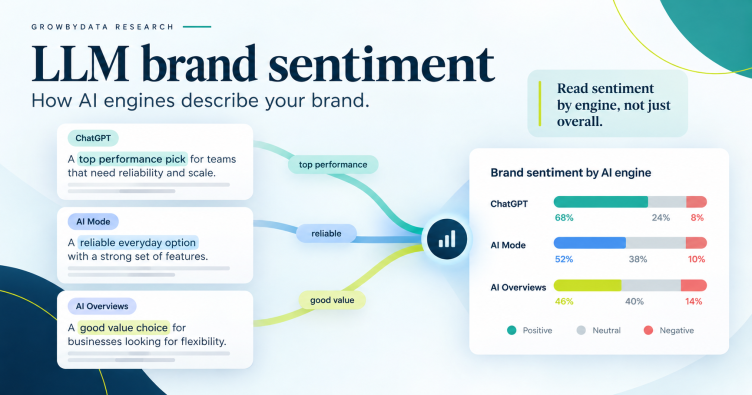
GrowByData is a search and AI visibility intelligence company for enterprise brands, retailers and agencies. Through its LLM Intelligence product, GrowByData Compass logs the products named in AI answers on ChatGPT, Google AI Mode, Google AI Overviews and Perplexity, with position, sentiment and cited source.
That sits next to the rest of the search picture: Google Shopping monitoring for Shopping results, and Google AI Overviews monitoring for the results page.
Platform-level detail is on the ChatGPT brand monitoring, Google AI Mode monitoring and Perplexity brand monitoring pages. For the broader framework, start with our guide to AI search visibility.