
For most of the last decade, ecommerce teams treated AI Overviews as someone else’s problem. They were a publisher headache, a content-site CTR story, something that hit recipe blogs and “how does X work” queries while product searches kept sending clicks to merchants. That assumption just expired. AI Overviews in shopping search are now a measurable surface on a growing share of product queries, and the teams still watching only rankings can’t see it happening.
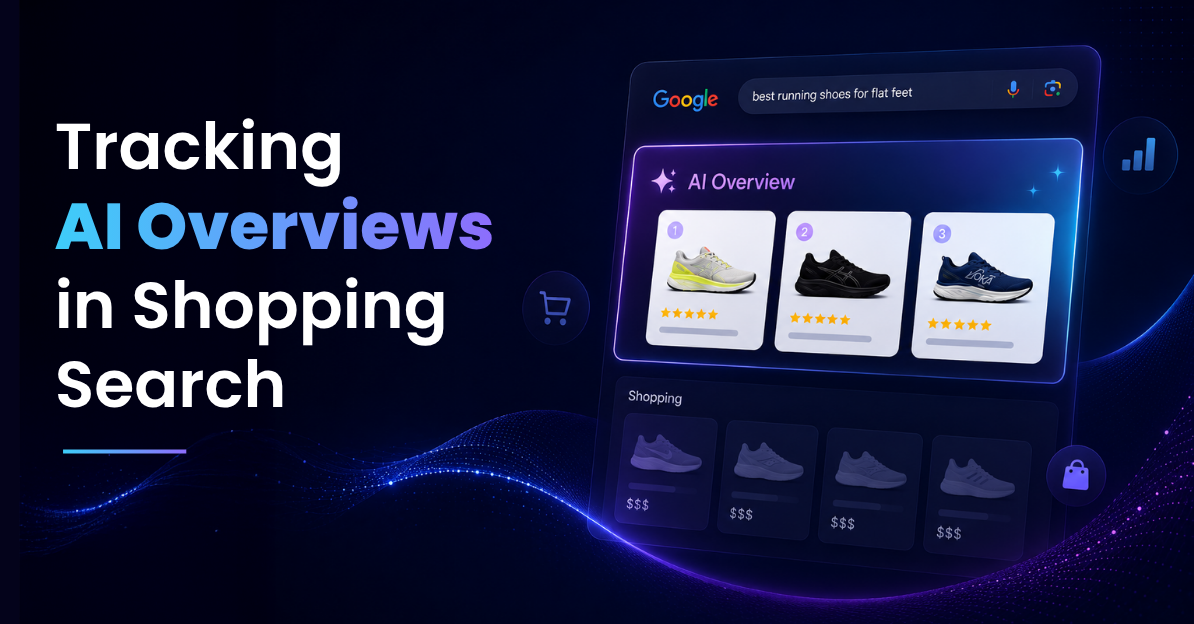
An AI Overview is the Gemini-generated answer block Google places at the top of a results page. On a shopping query, it does something specific: it synthesizes a recommendation, names products, pulls in pricing and reviews, and decides which brands get mentioned before a shopper ever scrolls to the organic listings or the Shopping carousel. It is, functionally, a new shelf. And like any shelf, the question that matters is whether your products are on it.
What actually changed in shopping search
Here’s what should reset your reporting, and it comes from Google itself. At I/O 2026 in May, Google merged AI Overviews and AI Mode into a single AI Search experience and rolled out Universal Cart, a shopping hub that pulls products from Search, the Gemini app, YouTube, and Gmail into one cart, alongside new agentic capabilities that can shop on a buyer’s behalf. Google also reports that where AI Overviews appear, they lift search usage by more than 10%. This isn’t a pilot. Google is rebuilding the shopping journey around the AI answer.
Independent measurement confirms how far it’s already spread. Visibility Labs, analyzing 20.9 million shopping SERPs, found AI Overviews on roughly 14% of shopping queries as of early 2026. And the growth isn’t evenly spread, which is the part most teams get wrong. Informational shopping queries, the “best running shoes for flat feet” and “top robot vacuum for pet hair” type, now trigger an AI Overview around 83% of the time when they start with “best,” up from single digits a year earlier. Pure transactional queries, the branded and “buy now” intent, still sit near 13 to 14%. Google has drawn an operational line between the research phase and the purchase phase, and it’s answering the research phase itself.
So the urgent surface isn’t your branded product pages yet. It’s the consideration query, the moment a shopper is deciding which three brands make their shortlist. That’s the moment retailers have always fought for, and it’s now happening inside an answer box you don’t control and most dashboards don’t track.
Why don’t standard reports show AI Overview presence on your product queries?
Because a rank tracker measures the wrong axis. It tells you that you sit at position 3 for “wireless earbuds for running.” It does not tell you whether an AI Overview sits above that position 3, what it recommends, or whether your brand is named inside it. Those are different questions, and the gap between them is exactly why SERP monitoring vs rank tracking has become a real strategic distinction, not a semantic one.
The decoupling is real and it’s measurable. BrightEdge data shows only about 17% of sources cited in AI Overviews also rank in the organic top 10 for the same query. Five out of six citations come from pages that don’t sit on page one. Ranking first and getting cited have become two separate games, which means a rankings report can look healthy while your AI Overview presence, and your Google Share of Voice inside those overviews, quietly goes to zero.
Then there’s volatility, and this is the part that breaks monthly reporting outright. BrightEdge observed shopping AIO coverage spike from 9% to 26% in a single September day before snapping back to 9%. Year-over-year, only about 18% of AI Overview keywords stayed the same. Translation: the query set that triggers an overview is reshuffling week to week. A quarterly SEO review is structurally incapable of catching a surface that can change in seven days.
This is the gap. If your visibility program reports position and traffic but not AIO presence and citation, you’re flying blind on the fastest-moving surface in shopping search.
The short version for your next SEO review
AI Overviews now appear on about 14% of shopping queries and roughly 83% of “best [product]” research queries. Only 17% of AIO-cited sources rank in the organic top 10. Rankings no longer predict citation, and the trigger set shifts weekly. You need presence and citation tracking on your own product query set, refreshed continuously, not a monthly rank report.
What an AI Overview pulls from on a shopping query
When Google builds a shopping AI Overview, it isn’t reading one source. It assembles the answer from several inputs, and knowing which ones is the difference between guessing and optimizing.
It pulls from organic content, the comparison pages, buying guides, and category content that explain product tradeoffs. It pulls from merchant feed and product data, the Google Merchant Listings signals that explain why pricing accuracy, attributes, and structured product information increasingly decide inclusion. It leans on reviews and ratings, the social proof signals it uses to justify a recommendation. And it’s beginning to fold in the ad surface itself, with sponsored placements appearing inside overviews, a shift worth tracking on its own, covered in our breakdown of ads in Google AI Overviews.
The practical implication for a VP of Ecommerce: the inputs that win an AI Overview cut across teams. Your SEO lead owns the content, your feed manager owns the product data, your paid search director owns the ad surface. No single dashboard most companies run today shows all three against the same query. That’s the coordination problem, and it starts with measurement.
See which of your product queries trigger an AI Overview, and whether you’re cited. Book a GBD Compass demo and we’ll track a live sample of your shopping queries across your chosen markets and devices.
How to track AI Overviews on your product searches
Tracking AI Overviews in shopping search is a measurement discipline, not a one-time audit. Here’s the method that holds up for an enterprise catalog.
1. Define the query set that actually matters
Don’t track everything. Track the queries that drive your category. That means your high-intent transactional terms plus the “best,” “top,” and “vs” research queries where shoppers build their shortlist. For a footwear retailer, that’s “best trail running shoes” and “Hoka vs Brooks,” not just branded SKUs. Keyword-defined tracking beats panel estimates here, because you decide which queries represent revenue. It’s the same reason keyword tracking alone isn’t enough for enterprise teams: volume tells you nothing about who owns the answer box.
2. Record presence and absence, daily
For each query, log whether an AI Overview appeared at all. Given a surface that swings 9% to 26% in a day, a monthly snapshot is noise. Daily presence data turns volatility from a surprise into a signal you can act on.
3. Track whether you’re cited, and where
Presence isn’t enough. The question is whether your brand is named inside the overview, and how high. Cited brands earn roughly 120% more organic clicks per impression than uncited brands on the same query, per Seer Interactive’s 2026 analysis. Citation position is the new rank position.
4. Track what’s cited instead of you
When you’re absent, who’s there? Competitor brands, marketplaces, review sites, Reddit threads? The substitution pattern tells you what kind of content Google trusts for that query, which is your roadmap for getting back in.
5. Segment by device and market
Mobile AI Overview saturation runs higher than desktop, and trigger rates differ by region. Tracking AIO presence with local and international SERP monitoring across your chosen markets and devices keeps you from optimizing for a desktop reality your mobile-heavy shoppers never see.
This is the layer where Google AI Overviews monitoring earns its place. GrowByData is a search and AI visibility platform that tracks your competitive presence across Google paid, organic, Shopping, Google SERP features, and AI surfaces in one view. For shopping queries specifically, that means seeing AIO presence, citation, and the Shopping carousel side by side, which is the only way to tell whether you’re losing a query to an overview, to a rival’s ad, or to both.
Where this leaves enterprise retail and agencies
A note of honesty, because senior buyers can smell a pitch that promises too much. You cannot optimize your way into every AI Overview. Some of the volatility is Google testing, and chasing every daily swing is a waste of an analyst’s week. The win isn’t perfect presence. It’s knowing your baseline, catching the shifts that matter, and proving to a CMO whether AI Overviews are helping or quietly eating your category’s clicks.
This is also where the tooling market splits, and it’s worth being clear-eyed about it. Rank trackers like Semrush and BrightEdge report position, which is necessary and no longer sufficient. AI-visibility tools built around ChatGPT and Perplexity, Profound among them, watch the standalone chatbots but miss the AI Overview embedded inside Google Shopping, where a huge share of commercial intent still lives. GrowByData’s own LLM Intelligence covers those chatbots too, but the point is that the shopping surface sits in the seam between categories. Watching it well means watching Google Shopping monitoring and AI visibility as one system, not two.
For agencies, this is a near-term wedge with retail clients. Most brands still can’t answer a basic question in a QBR: “for our top 50 product queries, how often does an AI Overview appear, and are we in it?” Walk in with that data and you’re no longer selling rank reports. You’re selling foresight on the surface Google just rebuilt its shopping experience around.
The trajectory is the argument
Fourteen percent of shopping queries today, and at I/O 2026 Google pulled the purchase itself into the AI surface with Universal Cart and agentic checkout. The direction is settled, and it’s steep. The teams that build a tracking posture now, while the surface is still legible, will know their baseline before the shift becomes the default shopping experience. That shift won’t stop at AI Overviews either: Google AI Mode turns the whole results page into a conversational shopping environment, and it’s pulling from the same product signals. The teams that wait will be reconstructing what happened after the clicks are already gone.
AI Overviews turned shopping search from a ranking problem into a visibility problem. The first step in solving a visibility problem is being able to see it.