
Key takeaways
- Ranking organically and appearing in AI answers are different problems. A brand can be strong in one and nearly invisible in the other.
- We group the tools below into three practical categories for this comparison: SEO platforms with an LLM module, standalone AI monitors, and enterprise search-plus-AI platforms.
- Mention share and citation share measure different things. Several tools on this list report only the first.
- AI platform coverage varies more than most comparison pages admit, from 3 core engines on entry-tier plans up to 10 or more on the highest enterprise tiers. Check what’s included at the price point you’re evaluating, not just the headline number.
- Last reviewed: August 2026. This category moves fast enough that pricing and platform coverage here are worth re-checking against each vendor’s current documentation before you cite them externally.
The problem: visibility fragmentation
A brand can rank #1 organically for its category, hold a strong paid share of voice, and still show up in a small fraction of the AI answers a buyer sees when they ask ChatGPT for a recommendation. Those four numbers, organic position, paid share, AI mention rate, and AI citation rate, don’t move together. A competitor ranking below you on Google can be the one an AI assistant actually cites. That gap is what ChatGPT brand visibility measures: ChatGPT doesn’t rank your website, it cites you or it doesn’t.
That’s the real problem enterprise teams are trying to solve when they go looking for an LLM visibility tracking tool, and it’s also where most vendor evaluations go wrong: teams end up comparing dashboards instead of comparing what each tool can see. Below are six tools worth putting in front of a buying committee, grouped by category, with the questions worth asking before any of them get a contract.
For a wider shortlist scored on security, deployment and support, see our ranking of 15 AI visibility platforms for enterprise brands.
How we grouped these tools
For this comparison, we sort the market into three practical categories: SEO platforms with an LLM module bolted onto an existing suite, standalone tools built specifically for AI monitoring, and enterprise platforms built to run search and AI visibility together. This is our own framework for organizing the evaluation, not a claim that the industry defines these tiers the same way. Within each category, tools are ordered by fit for an enterprise, BOFU evaluation, not by a scored ranking. For the fuller picture of what AI search visibility covers beyond tool selection, see our AI search visibility guide. Last reviewed: August 2026.
| Tool | Category | AI platforms tracked | Starting price | Native search/paid integration |
|---|---|---|---|---|
| GrowByData | Enterprise platform | 4 | Custom, enterprise pricing | Yes, same dashboard as organic, paid, Shopping |
| Profound | Standalone AI monitor | Up to 11 | $99/mo entry; Enterprise reportedly $2,000+/mo | No, separate toolset |
| Otterly | Standalone AI monitor | 4-6 | $29/mo | No, separate toolset |
| Peec AI | Standalone AI monitor | Up to 11 | $89 to $95/mo | No, separate toolset |
| Scrunch | AI content & brand monitor | 4-9 | $250 to $300/mo, sources vary | No, separate toolset; GA4 crawler-traffic integration only |
| Semrush | SEO platform + LLM module | Multiple major AI platforms | $99 to $199/mo depending on tier | Yes, native, but LLM data sits in an add-on module |
Pricing and platform-coverage figures reflect third-party research as of August 2026, not each vendor’s live pricing page. This category changes quickly and sources didn’t always agree with each other; confirm current numbers directly with the vendor before quoting these externally.
1. GrowByData
Category: Enterprise search and AI intelligence
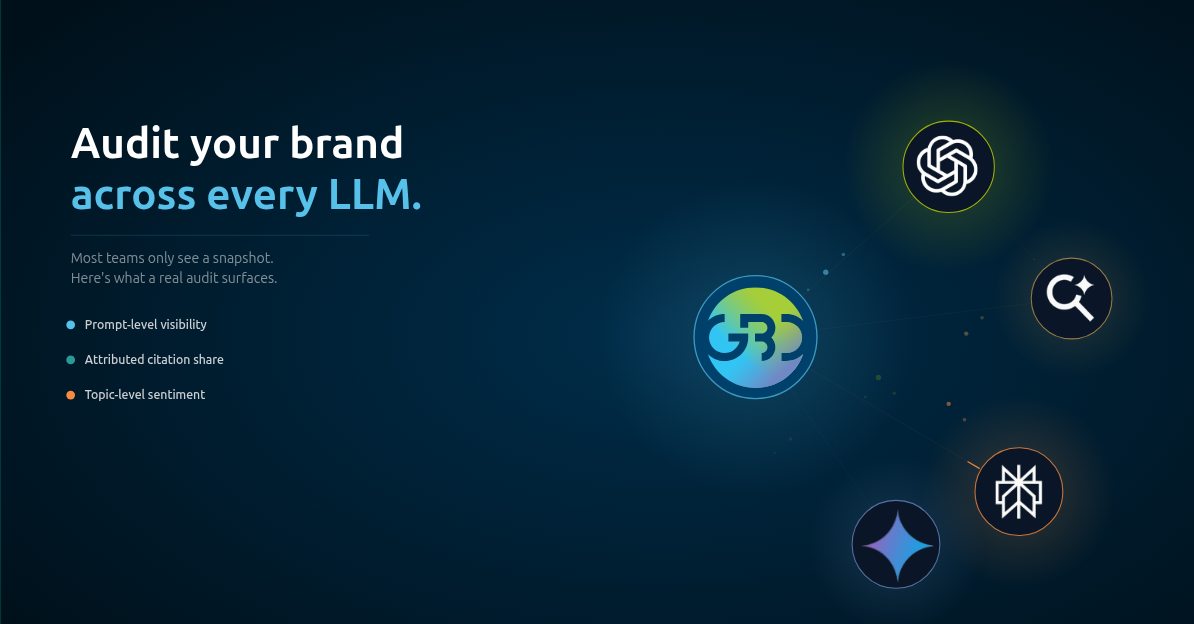
GrowByData’s LLM Intelligence tracks brand visibility, attributed citation share, and sentiment across ChatGPT, Perplexity, Google AI Overviews, and Google AI Mode, tied to the same platform that tracks organic, paid, and Shopping data. It runs thousands of prompts modeled on natural buyer language, not a fixed seed list, with multi-market and multi-language coverage built in.
Pros
- Citation share tracked as a distinct metric from mention share, not collapsed into a single visibility score
- Native integration with organic, paid, and Shopping data in one dashboard, no exporting or stitching required
- Thousands of prompts modeled on real buyer language across markets, not a fixed seed list
- Multi-market and multi-language coverage included, not gated behind a higher tier
- Competitive sets of ten or more, no artificial cap on named competitors
Cons
- Tracks 4 AI platforms (ChatGPT, Perplexity, Google AI Overview, Google AI Mode). Does not currently cover Claude, Gemini, Copilot, or Grok, platforms Profound and Scrunch track natively on their higher tiers. If your buyers lean heavily on Claude or Gemini specifically, weigh that gap directly rather than assuming unified reporting covers it
- Higher cost and longer onboarding than a standalone AI monitor
- Best suited for teams that already have some search intelligence maturity, not a first AI-visibility purchase for a team starting from zero
Best for: enterprise brands and their agencies that need AI visibility connected to organic, paid, and Shopping data in one reporting workflow, and can work within four core AI platforms rather than ten.
2. Profound
Category: Standalone AI monitor
One of the more established and best-funded names in dedicated AI visibility tracking, with real depth on prompt research and competitive benchmarking.
Pros
- Tracks up to 10 or more AI engines on Enterprise plans, including Claude, Gemini, Copilot, DeepSeek, and Grok alongside ChatGPT and Perplexity, broader coverage than any other tool on this list
- Prompt Volumes feature shows aggregate query demand behind a topic, not just a brand’s own visibility within it
- SOC 2 Type II compliance, single sign-on, and role-based access, real enterprise procurement credentials
- G2 rating around 4.6 out of 5 across 300-plus reviews as of mid-2026
Cons
- Full platform coverage and Prompt Volumes access sit behind Enterprise pricing, reportedly $2,000 or more per month; the entry Starter tier around $99/month covers ChatGPT only with a 50-prompt cap
- Runs as a separate toolset, with no built-in connection to organic or paid search data
- Reviewers consistently note a steep learning curve and occasional slow exports
In GrowByData’s own tracked-prompt data for this category (see the evidence box above), Profound’s citation share ran well below GrowByData’s over the trailing 90 days, though that comparison reflects GrowByData’s own tracked prompt set, not an independent third-party audit.
Best for: teams that want the broadest AI engine coverage available and can absorb Enterprise pricing to get it, and are comfortable running it alongside a separate SEO or paid search platform.
3. Otterly
Category: Standalone AI monitor
An early-stage tool focused on brand mention monitoring in AI outputs, per GrowByData’s competitive positioning, and one of the fastest tools in the category to get running.
Pros
- Self-serve setup, reviewers consistently cite it as one of the easiest tools in the category to adopt without a sales cycle
- Entry pricing starts around $29/month, tracking 4 core AI engines (ChatGPT, Google AI Overviews, Perplexity, Microsoft Copilot)
- Includes a GEO audit that checks whether AI crawlers can reach and extract a brand’s pages
Cons
- Full engine coverage requires add-on fees; Gemini and Google AI Mode are gated even on paid plans per multiple independent reviews
- Prompt allowances get tight at scale for brands tracking many product lines or markets, with overage fees once you outgrow the included volume
- Organic and paid search data live in a different tool entirely, and reporting is lighter on structured analytics than an enterprise-tier platform
Best for: teams that want straightforward mention monitoring without a large budget commitment, and don’t yet need enterprise-depth reporting.
4. Peec AI
Category: Standalone AI monitor
Peec AI focuses narrowly on LLM citation tracking, with a self-serve signup and prompt suggestions generated from a brand’s own site content.
Pros
- Prompt-level sentiment analysis and citation source tracking, showing which domains and URLs AI platforms cite for a given query
- Entry pricing around $89 to $95/month, positioned as one of the more affordable dedicated AI monitors
- Fast setup with same-day prompt execution reported by independent reviewers, no lengthy onboarding
Cons
- Core plans cover ChatGPT, Perplexity, and Google AI Overviews only; Claude, Gemini, DeepSeek, and Grok cost extra per platform per month
- Diagnoses visibility gaps but doesn’t include content execution to close them, multiple reviewers describe it as strong on measurement and thin on the “what do I do about it” layer
- Doesn’t connect to organic or paid search data, so AI visibility reads as one signal rather than one piece of a larger picture
Best for: teams that want a focused, affordable citation-tracking tool and are handling organic and paid visibility separately already.
5. Scrunch
Category: AI content and brand monitoring
Scrunch’s defining feature is hallucination detection, systematically flagging when AI models state incorrect information about a brand: wrong pricing, incorrect features, fabricated partnerships, outdated details.
Pros
- Hallucination detection, a differentiator most tools on this list don’t offer, genuinely useful for brands in regulated categories where AI misinformation carries real consequences
- GA4 integration for AI crawler traffic is widely cited by independent reviewers as the standout feature in the category, turning bot activity into a report a stakeholder can read without a data team translating it first
- Tracks up to 9 AI engines on higher tiers
Cons
- Hallucination detection, the platform’s signature feature, is Enterprise-only; the entry tier doesn’t include it
- Entry pricing starts around $250 to $300/month depending on source, higher than every standalone tool on this list except Profound’s paid tiers
- Organic and paid search data aren’t part of the platform; multiple reviewers describe it as strong on monitoring and thinner on the recommendation and execution layer
Best for: content and brand marketing teams in regulated or reputation-sensitive categories who need to catch AI misinformation, not primarily a competitive search intelligence buy.
6. Semrush
Category: SEO platform with an LLM module
Semrush added AI visibility tracking as a module within its existing SEO suite. The appeal is consolidation: one login for keyword data, site audits, and AI mentions.
Pros
- Sits alongside Semrush’s existing keyword database and content tools, no new vendor relationship for teams already running their SEO program there
- AI Visibility Toolkit priced from roughly $99 to $199/month depending on tier, positioned below several dedicated AI monitors
- Position tracking shows when a keyword triggers an AI Overview, feeding directly into existing content workflows
Cons
- AI platform coverage is narrower than dedicated tools; ChatGPT and Google AI Overviews at minimum, with broader multi-engine coverage reportedly still rolling out through 2026 per Semrush’s own materials
- Currently reports mentions rather than a clear citation and source distinction, per current toolkit documentation
- Geographic depth and prompt volume are thinner than a dedicated or enterprise-tier platform, since AI tracking is a module inside a broader suite rather than the core product
In GrowByData’s own tracked-prompt data for this category, Semrush’s citation share ran below both GrowByData’s and Profound’s over the trailing 90 days.
Best for: teams already using Semrush for SEO who want an initial read on AI mentions without adding a new vendor, and don’t yet need enterprise-scale LLM tracking.
Bring your competitive set and your priority markets to the call. We’ll show you what attributed citation share looks like for your brand today, not a canned demo dataset.
Five questions to ask in every vendor conversation
Most vendor demos lead with dashboards. These five questions get past the interface to the data architecture that determines whether a tool holds up after quarter one, whichever one of the six above you’re closest to signing.
1. How large is your prompt library, and how is it built?
Prompt count alone isn’t a quality score. Twenty thousand redundant or low-intent prompts can produce less useful data than a thousand carefully segmented commercial ones. Ask about intent coverage and persona variation, not just the headline number. Tools built on seed keywords alone tend to produce narrow coverage regardless of total volume.
2. How do you handle prompt variation?
“Best LLM visibility tools,” “top tools for tracking AI brand visibility,” and “which software monitors citations in ChatGPT” are semantically close but produce different AI answers. Ask how the tool accounts for phrasing variation. A tool that only tracks exact prompts will systematically undercount your visibility, and you won’t know it’s happening.
3. What exactly counts as a “mention”?
There’s a real difference between a brand appearing in a list and a brand’s content being referenced as a source. Ask whether the tool distinguishes mention types, tracks position within the response, and identifies the source domains the AI is pulling from. Several tools on this list report mentions without making that distinction, which can make a brand’s headline visibility number look better than its actual influence on the answer.
4. How are markets outside your primary region handled?
AI answers differ by geography. A brand that shows up prominently in US AI responses can be nearly invisible in UK or German responses for the identical prompt. Ask how multi-market tracking works, whether it’s included in the base plan, and whether local language variants are covered or bolted on later.
5. How does this connect to your existing search reporting?
AI visibility data in isolation is interesting. AI visibility data next to organic performance, paid share of voice, and SERP feature tracking is strategic. Ask whether the platform integrates natively or whether you’ll be exporting CSVs into a shared spreadsheet every Monday morning. If paid visibility matters to you, check whether a tool can also show paid placements your rivals run in ChatGPT, not just organic mentions.
Mention share vs. citation share
Mention share measures how frequently your brand’s name appears somewhere in an AI-generated answer. Citation share measures how frequently your website or your content gets referenced as a supporting source for that answer. They’re counting two different things, and a tool can report a healthy mention rate while your citation rate, the number that reflects whether AI systems are drawing on your content, stays low.
Neither number alone tells the full story. A brand with high mentions and low citations is getting named without being treated as a source. A brand with strong citations but weaker mentions is influencing answers without necessarily being named outright, which still shapes what the AI recommends. Of the six tools compared here, GrowByData is the only one that reports both as separate tracked metrics rather than collapsing them into a single visibility score.
What each decision needs
A business case for LLM visibility tracking works better tied to a specific decision than to a general “we should measure this” argument. Five decisions this data supports:
- Content investment. Which topics and formats should the content team prioritize, based on where AI answers currently cite competitors instead of you?
- Competitive strategy. Where is a specific competitor gaining AI citation share faster than you, and in which categories or markets?
- Brand risk. Are AI systems describing your brand, pricing, or positioning inaccurately anywhere, and how often does that come up?
- Search strategy. Where do you rank well organically but show up rarely in AI answers for the same queries, and what does that gap cost?
- Executive measurement. Is your AI share of voice trending up or down against named competitors quarter over quarter? See how leading enterprises measure ROI from AI search and LLM visibility for how other teams turn this into a repeatable report.
Take one example. A mid-size outdoor apparel brand might rank second organically for “best hiking boots for wide feet,” hold a healthy 22% paid share of voice on the term, and still show up in fewer than one in ten AI-generated answers to the same question, while a lower-ranked competitor gets cited in nearly half. Read separately, the organic and paid numbers look fine. Read together with the AI citation number, they show exactly where the gap is and which team owns fixing it.
The bottom line
If you already have a mature SEO and paid search stack and only need to add AI monitoring on top, a standalone platform like Profound, Otterly, or Peec AI can work without disrupting what’s already running, and Profound in particular is worth a look if broad AI-engine coverage matters more to you than unified reporting. If you’re still in an early exploration phase and want a first read on AI mentions before committing budget, an existing SEO suite’s LLM module, like Semrush’s, may be enough for now. If your category carries real reputational risk from AI misinformation, that’s exactly where Scrunch’s hallucination detection earns a look. If you’re responsible for enterprise organic, paid, Shopping, and AI visibility across multiple markets and need one team looking at one dataset, that’s the case for an integrated platform.
GrowByData sits in that last category.
Bring your priority categories and named competitors. We’ll walk through attributed citation share across ChatGPT, Perplexity, and Google AI Mode on your actual keyword set, not a demo dataset.
Frequently asked questions
How much do LLM visibility tracking tools cost?
It varies more than most comparison pages let on. Standalone AI monitors on this list start as low as $29 to $95 a month at entry tiers, but full AI-engine coverage on any of them typically requires add-ons or a higher plan. Enterprise platforms that combine AI with organic, paid, and SERP tracking generally price on a custom basis tied to prompt volume, market count, and competitive set size. Get current numbers directly from each vendor rather than relying on a published range, since this category’s pricing moves quickly.
How many prompts should an enterprise brand track?
There’s no fixed number that fits every brand. A better question than “how many” is whether the prompt set covers your actual buyer questions across every product line, market, and stage of research, not just your top five branded terms. A few hundred well-chosen commercial prompts, covering real buyer phrasing, will tell you more than a large seed-keyword list that never varies its wording. For retail and ecommerce brands, that prompt set should also log which products each AI names, which is how product-level AI shopping visibility gets measured.
Can these tools track ChatGPT citations specifically, not just mentions?
Some can, some only report mentions. This is worth confirming directly, since “tracks ChatGPT” and “tracks ChatGPT citations” are different claims, and a vendor demo doesn’t always make the distinction obvious. Ask to see the difference in a live account, not a slide. The same distinction applies on Perplexity; see how to track brand mentions in Perplexity AI for what that looks like in practice.
How often should AI visibility be monitored?
Continuously, not as a periodic snapshot. Major AI platforms update their underlying models and retrieval logic on a rolling basis, and in competitive categories, how AI represents a brand can shift meaningfully week over week, particularly for brands actively investing in content and citation building.
What’s the difference between GEO software and LLM visibility software?
In practice, the terms overlap heavily and are often used interchangeably by vendors. Where there’s a meaningful distinction, GEO (generative engine optimization) tools tend to focus on the action side, recommending content changes to improve AI visibility, while LLM visibility tools focus on the measurement side, tracking mentions and citations across platforms. Several tools, GrowByData included, do both.