
Type a question into ChatGPT about the best tool for your category. Your brand shows up in the answer, or it doesn’t. There’s no page two.
That’s chatgpt brand visibility: whether you get mentioned, described accurately, and recommended when buyers ask the questions they’re already asking. It has nothing to do with domain authority. It’s about what ChatGPT has learned, retrieved, or been told about you. For retail brands, the follow-up question is which of your products ChatGPT recommends, not just whether it names you.
What ChatGPT brand visibility actually measures
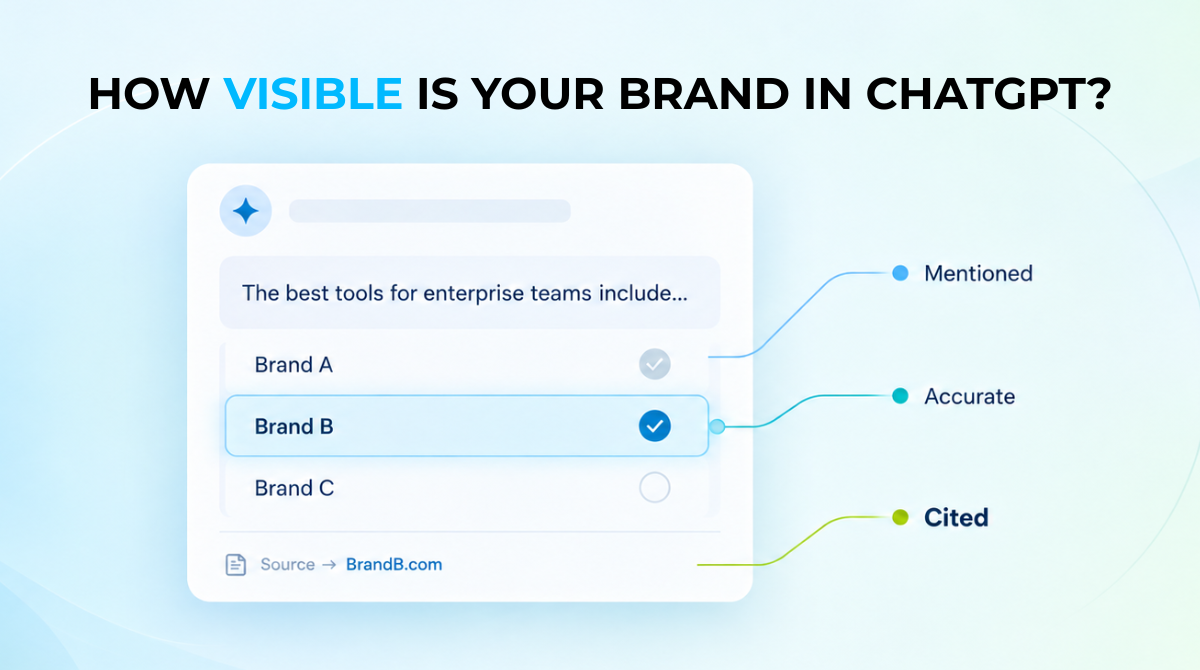
Three things, and mixing them up is the most common mistake:
- Mentions. Does ChatGPT bring you up at all, unprompted?
- Accuracy. When it does, is the description current, or running on stale training data?
- Citation. Does it link back to your site, or just describe you from memory?
Most brands that feel “invisible” actually show up. They’re just described wrong, or cited nowhere.
How does ChatGPT decide which brands to mention?
Two mechanisms feed it, and they behave differently.
The first is whatever got baked into the model during training. That’s why brands that repositioned or launched something new in the last year often get described the way they used to be. You can’t edit that on demand.
The second is real-time retrieval. When browsing is on, ChatGPT pulls from live web content, weighing signals that look a lot like classic SEO: who cites you, how clearly your site states what you do, whether roundups name you. That second mechanism is where the near-term opportunity sits.
What affects your chatgpt brand visibility
- Third-party “best of” lists and roundups. ChatGPT leans on aggregator consensus, not just your own site copy.
- G2, Capterra, and review platforms. Category tagging and review volume feed directly into how the model frames you.
- Clear, plainly worded site copy. Vague positioning gives the model nothing solid to retrieve.
- Recency of published content. Outdated pages keep old positioning alive long after you’ve moved on.
- Forums and communities. Reddit and Quora threads are increasingly pulled into live retrieval.
- Press mentions and named quotes. Third-party validation carries more weight than owned claims.
ChatGPT brand visibility vs. the related terms
These get used interchangeably, and that causes confusion in planning meetings. They’re not competing frameworks though, they’re the pieces that add up to chatgpt brand visibility itself.
| Term | What it means |
|---|---|
| ChatGPT mentions | Your brand named in the answer text, whether or not there’s a link |
| ChatGPT citations | ChatGPT linking directly to your site as a source |
| ChatGPT sentiment | Whether the mention frames you positively, neutrally, or negatively |
| ChatGPT share of voice | How often you show up relative to competitors, for the same set of prompts |
Track only one of these and you’ll misread your own position. High mentions with negative sentiment is a different problem than zero mentions at all, and neither shows up if you’re only watching citations.
Why this isn’t like Google rankings
Google is positional: #1, #7, page three. ChatGPT just gives an answer, usually two or three names. Ranking fourth on Google still earns clicks. Being the fourth brand ChatGPT considered and cut earns nothing. You’re either in the answer, or for that query, you don’t exist.
There’s no ladder to climb here, just presence and citation share, and the two don’t move together. Our own tracking makes the point:
| Tracked category | AI presence | Citation share |
|---|---|---|
| LLM (ChatGPT / Perplexity) | 21.7% | 8.21% |
| SERP (Google organic) | 30.7% | 5.03% |
| MAP | 36.1% | 5.37% |
| AI Overviews | 2.0% | 0.19% |
| Search | 9.6% | 1.15% |
| Price | 1.0% | 0.09% |
Source: GBD Compass, growbydata.com account, most recent tracking period.
MAP has the highest presence of any category we track, but a middling citation share. LLM has lower presence but the highest citation share on the list. On Google, that combination wouldn’t make sense; a page either ranks or it doesn’t, in one order. In AI answers, showing up and getting cited are two separate contests, and winning one doesn’t guarantee the other.
Common mistakes that hurt chatgpt brand visibility
- Treating it as a one-time check. Answers shift with every model update and every new piece of content ChatGPT’s crawlers pick up.
- Only testing your own branded prompts. Buyers ask category questions (“best tools for X”), not your company name.
- Ignoring third-party sites. ChatGPT trusts aggregator consensus more than your homepage copy.
- Confusing “mentioned” with “cited.” A mention with no link back is invisible in your analytics either way.
We’ll show you exactly how your brand shows up in ChatGPT today, prompt by prompt.
How to improve chatgpt brand visibility
| Tactic | What it does |
|---|---|
| Get listed and reviewed on category-relevant platforms (G2, Capterra) | Feeds the aggregator consensus ChatGPT leans on |
| Publish clear, current comparison and definitional content | Gives the model something specific to retrieve and cite |
| Earn named mentions in trade press and roundups | Third-party validation outweighs owned claims |
| Keep product and positioning pages current | Prevents ChatGPT from citing outdated facts about you |
| Monitor and re-check regularly | chatgpt brand visibility strategies only work if you can tell whether they’re working |
What our own tracking shows
We track this for ourselves, not just clients. Right now, GrowByData actively monitors 44 prompts across ChatGPT, Perplexity, Google AI Mode, and Google AI Overviews for its own brand, split roughly like this:
| Category | Share of tracked prompts |
|---|---|
| SERP-related | 41% |
| AI Overviews (AIO) | 23% |
| ChatGPT / Perplexity (LLM) | 20% |
| MAP and Search | 14% |
| Price | 2% |
That’s a deliberately narrow, curated list, not a firehose of every query that happens to mention us. A handful of well-chosen prompts, checked consistently, tells you more than hundreds tracked once and forgotten.
How to see brand visibility in ChatGPT for your own brand
| Step | Do this | Look for |
|---|---|---|
| 1 | Open a fresh ChatGPT chat, no saved memory | A clean answer, not one skewed by your history |
| 2 | Ask “best tool in your category for enterprise teams” | Are you named at all? |
| 3 | Repeat 3-4 times | Answers shift, so check consistency |
| 4 | Ask “alternatives to a named competitor” | Cited with a link, or just described? |
That’s your snapshot, and it’s roughly what a curated prompt list like ours starts from, just smaller. For the full playbook, see how to track brand mentions in ChatGPT. For ongoing tracking instead of a one-time check, that’s what ChatGPT brand monitoring is built for, fitting into a wider AI search visibility strategy beyond ChatGPT alone.
Frequently asked questions
Does ChatGPT use real-time data for every answer?
Only when browsing or retrieval is triggered. Otherwise it’s working from training data that may be a year or more out of date.
Can you pay to appear in ChatGPT’s answers?
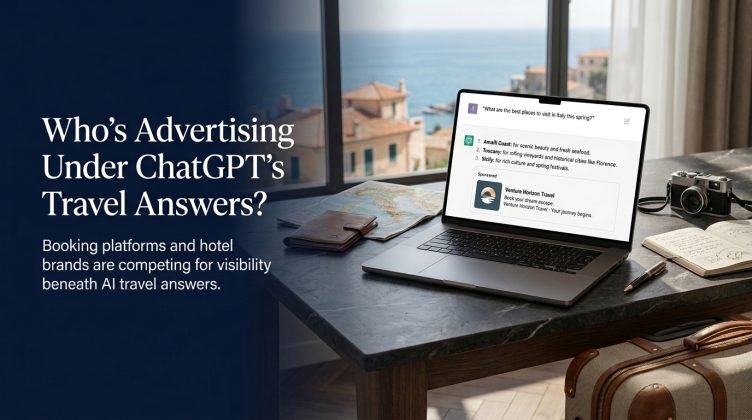
Not directly, no current ad product places brands inside standard chat answers. Visibility comes from what the model retrieves or was trained on, not media spend. Sponsored placements are a separate format from the answer itself, so it’s also worth monitoring which rivals advertise in ChatGPT.
Is chatgpt brand visibility the same as SEO?
Related, not identical. Some signals overlap (clear content, third-party citations), but there’s no ranking position to chase, and training-data lag doesn’t exist in traditional search.
How many prompts should you track to get a real read on this?
Fewer than you’d think. Our own 44-prompt set covers ChatGPT, Perplexity, Google AI Mode, and AI Overviews for one brand. Depth beats volume: a handful of prompts checked weekly beats hundreds checked once.
Find out how your brand actually shows up in ChatGPT.
Most teams find out they’re missing from the answer only after a prospect mentions it on a sales call. Let’s check first.