
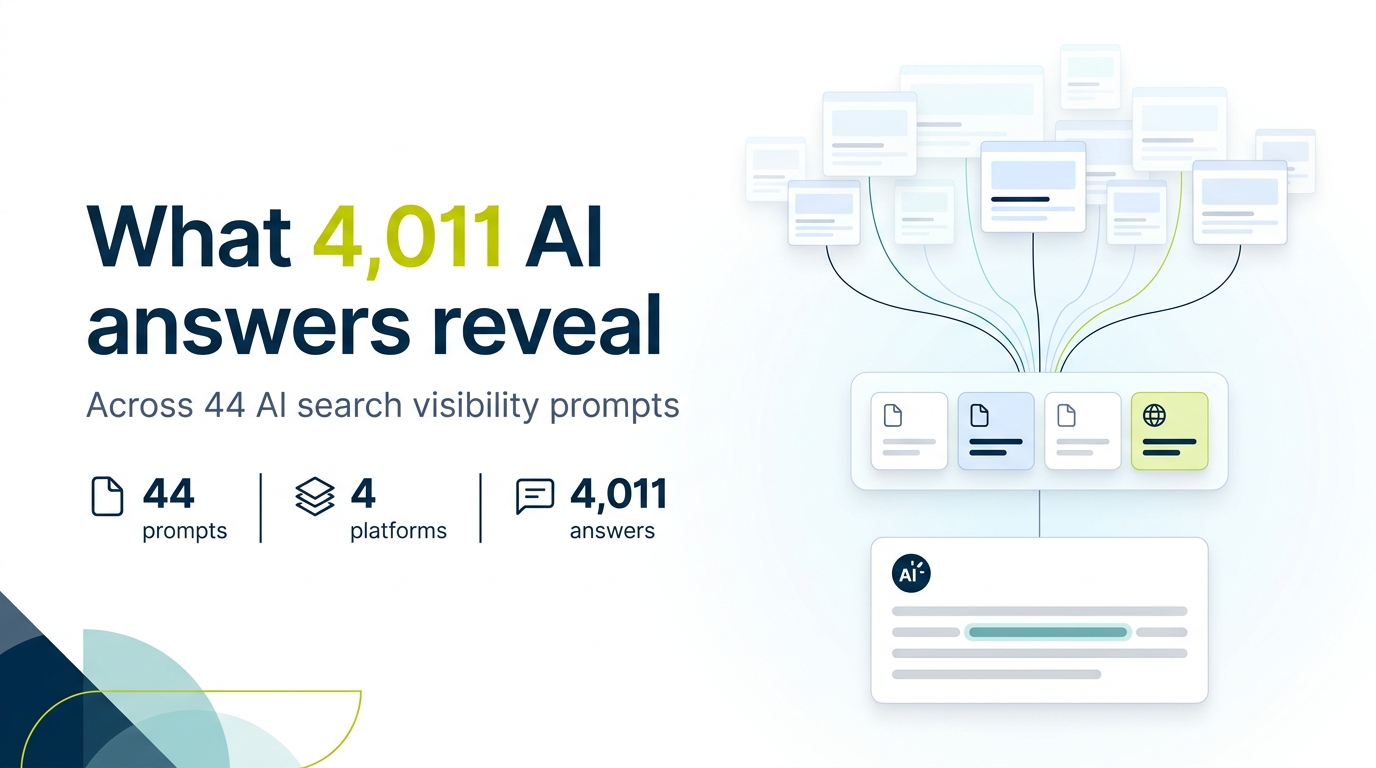
We tracked 44 prompts about search and AI visibility across ChatGPT, Google AI Mode, Google AI Overviews and Perplexity.
The result was not a simple list of software competitors.
Platforms such as YouTube and Reddit appeared often. So did trade publications, vendors outside the tracked competitor set and other third-party sites.
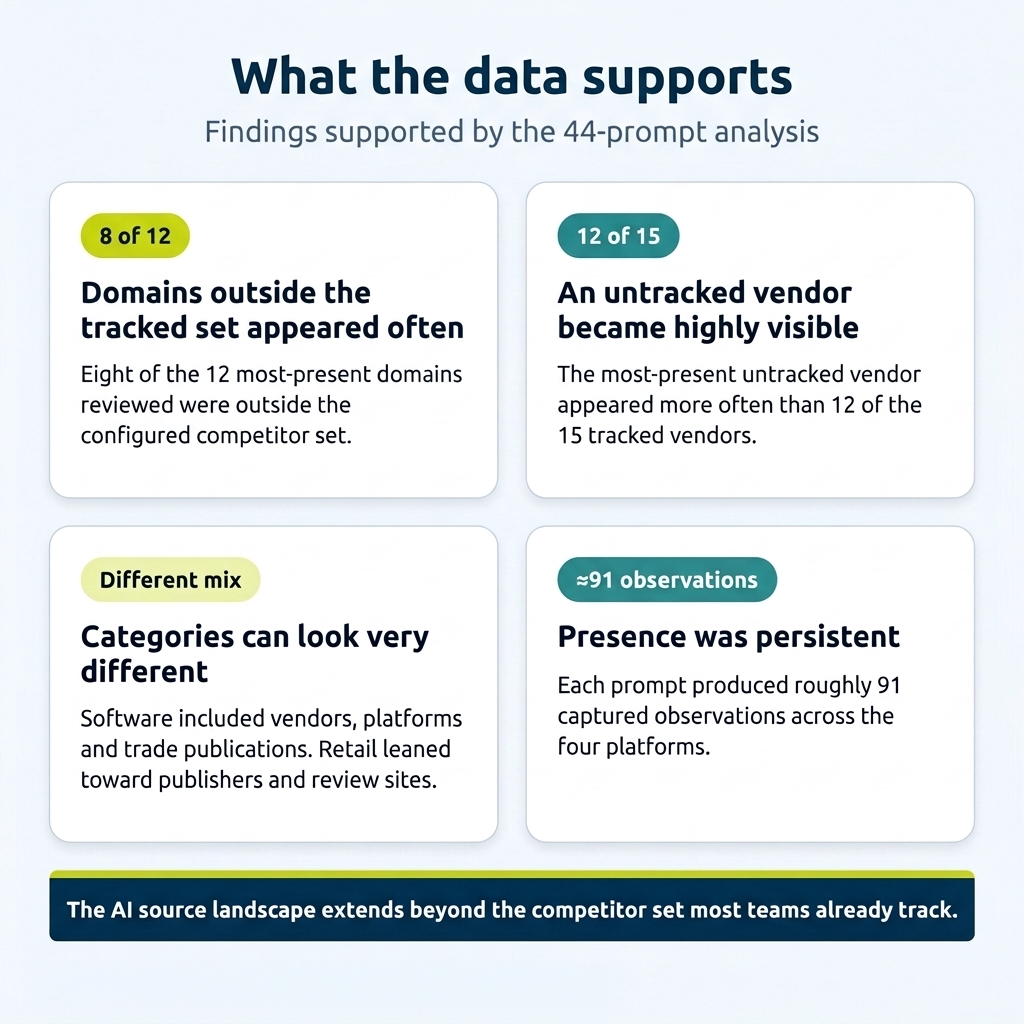
Among the 31 domains we reviewed, 8 of the 12 most-present domains were outside the tracked competitor set.
That matters because the sources shaping AI answers may be very different from the competitors your SEO team already monitors.
Key Findings
- We tracked 44 prompts across four AI platforms from August 4 to September 2, 2026. We captured 4,011 answer observations out of a possible 5,280.
- Among the domains we reviewed, 8 of the 12 most-present were outside the tracked competitor set.
- YouTube appeared in 799 observations (19.9%), Reddit in 694 (17.3%), Search Engine Land in 559 (13.9%) and LinkedIn in 412 (10.3%).
- The most-present vendor outside the tracked set appeared in 473 observations (11.8%).
- In a separate two-prompt retail spot check, every domain in the top 10 was a publisher or review site. No product brand’s own website made either top 10.
What We Tracked
The main analysis used a single set of 44 prompts related to search and AI visibility.
| Parameter | Details |
|---|---|
| Data source | GrowByData Compass, LLM Intelligence |
| Tracking period | August 4 to September 2, 2026 |
| Platforms | ChatGPT, Google AI Mode, Google AI Overviews, Perplexity |
| Location | United States (New York) |
| Prompts | 44 |
| Captured observations | 4,011 of a possible 5,280 |
| Domains reviewed | 15 tracked vendors plus 16 other domains that appeared in answers |
| Prompt intent | Mostly informational; four also had commercial-investigation intent |
An observation means one prompt answered on one platform on one day.
A domain counts as present if it was cited or linked anywhere in that answer.
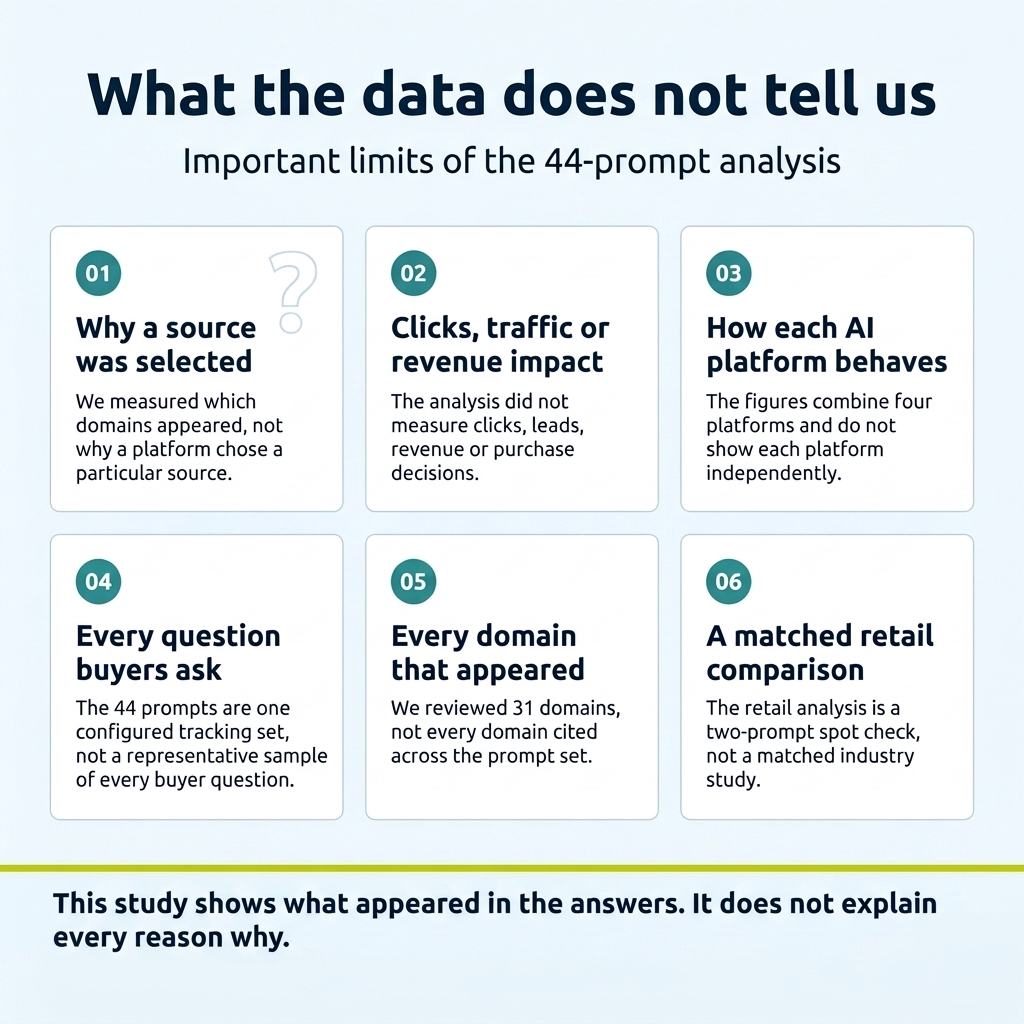
The 44 prompts were all the prompts configured in this tracking set. We did not select them after seeing the results. They should not be treated as a representative sample of every question buyers ask about search or AI visibility.
We captured 4,011 of the 5,280 possible observations. ChatGPT and Google AI Mode returned answers on nearly every scheduled observation. Perplexity returned fewer, while Google AI Overviews appeared much less often.
The data does not tell us whether missing observations came from an answer not being returned, an AI Overview not appearing, or a collection gap. For that reason, every percentage in this analysis uses the 4,011 captured observations as its base.
What Showed Up Across The 44 Prompts
The most interesting result was not which vendor came first.
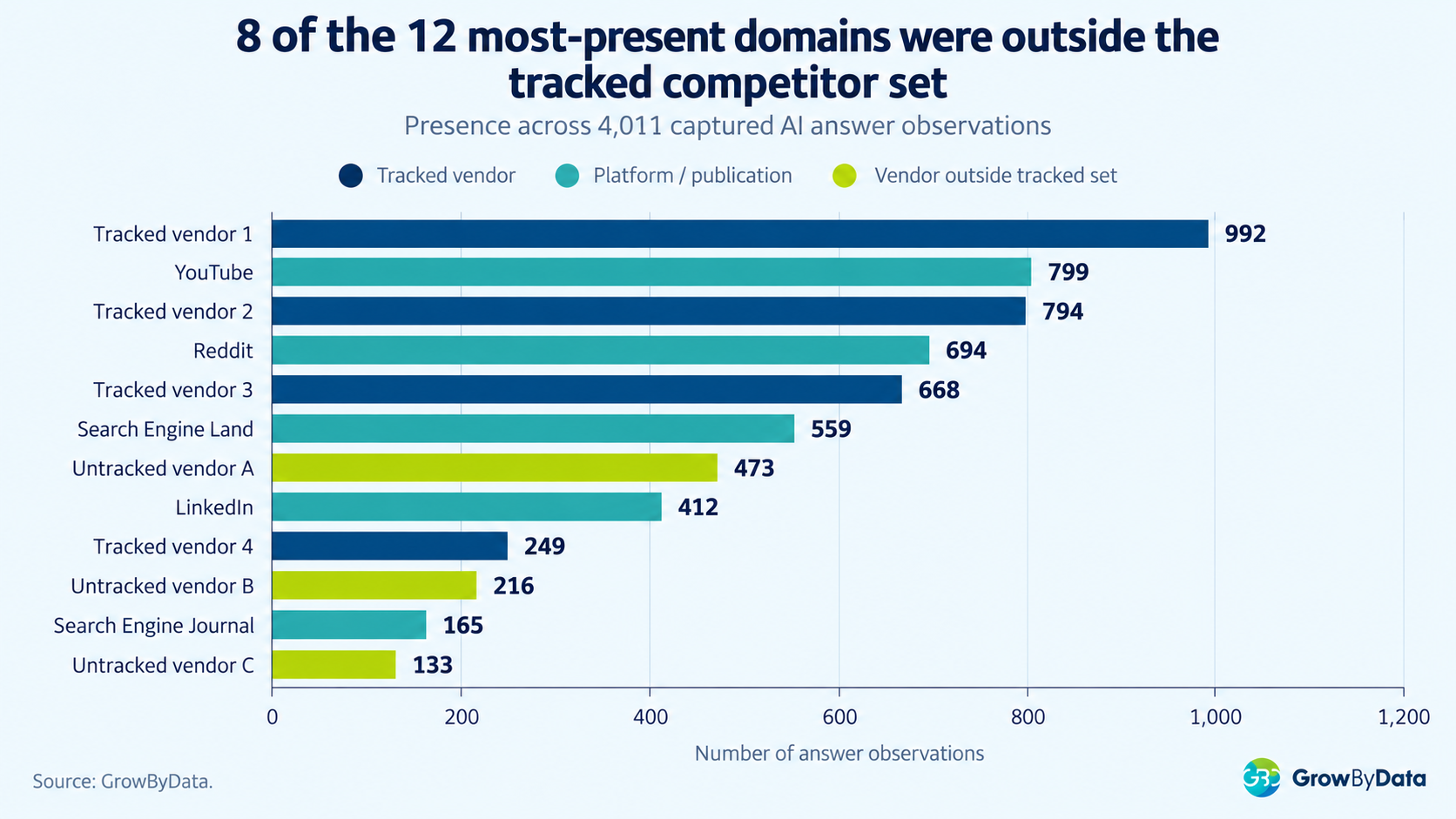
It was the variety of sources appearing near the top.
| Domain | Type | Observations with presence | Share of observations |
|---|---|---|---|
| Tracked vendor 1 | Tracked vendor | 992 | 24.7% |
| YouTube | Platform | 799 | 19.9% |
| Tracked vendor 2 | Tracked vendor | 794 | 19.8% |
| Platform | 694 | 17.3% | |
| Tracked vendor 3 | Tracked vendor | 668 | 16.7% |
| Search Engine Land | Trade publication | 559 | 13.9% |
| Untracked vendor A | Vendor outside tracked set | 473 | 11.8% |
| Platform | 412 | 10.3% | |
| Tracked vendor 4 | Tracked vendor | 249 | 6.2% |
| Untracked vendor B | Vendor outside tracked set | 216 | 5.4% |
| Search Engine Journal | Trade publication | 165 | 4.1% |
| Untracked vendor C | Vendor outside tracked set | 133 | 3.3% |
This is not a full list of every domain cited across the 44 prompts. We reviewed 31 domains in total.
But the pattern is clear:
The sources appearing often in AI answers extend beyond the competitors most teams already track.
AI Answers Draw From More Than Your Competitor List
Look at the domains outside the tracked set.
Platforms
YouTube, Reddit and LinkedIn all appeared in more than 10% of the captured observations.
These are not software competitors. But content published there can still become part of an AI answer.
Trade Publications
Search Engine Land appeared in 559 observations. Search Engine Journal appeared in 165.
Again, these are not product competitors. They are publishers whose content can influence how a category is described.
Vendors You May Not Be Tracking
Five software companies outside the configured competitor set also appeared in the answers.
The most-present one appeared in 473 observations, more often than 12 of the 15 vendors in the configured set.
The lesson is straightforward:
Your SEO competitor list and your AI-answer source list are not the same thing.
A competitor list is often built from keyword overlap or from a set of companies chosen when a program starts.
AI answers can draw from a much wider group:
- vendors
- publishers
- review sites
- community platforms
- directories
- other third-party sources
That wider group is worth monitoring.
Retail Showed A Different Mix
We also ran a small retail spot check using the GrowByData Retail Industry Panel.
We looked at two prompts:
- “Best brand of mattress in a box to buy right now?”
- “Best brand of acne stickers that actually work overnight?”
Each prompt produced 46 observations across the same four AI platforms.
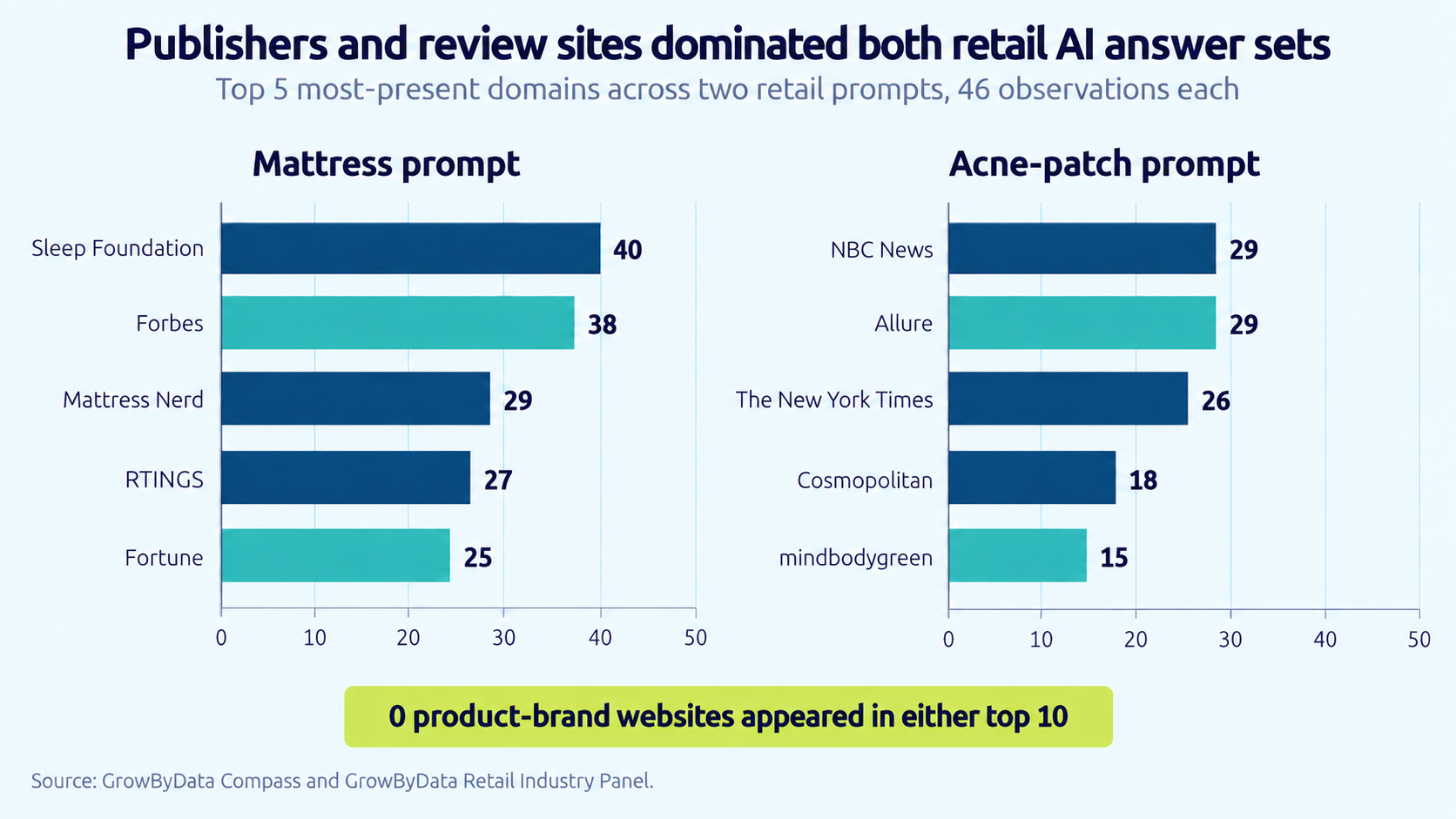
The results looked very different from the software prompt set.
- For the mattress question, the most-present sources included Sleep Foundation, Forbes, Mattress Nerd, RTINGS, Fortune, AARP, Tom’s Guide and Good Housekeeping.
- For the acne-patch question, the leading sources included NBC News, Allure, The New York Times, Cosmopolitan, Glamour, Teen Vogue and Healthline.
- No product brand’s own website appeared in either top 10.
This does not prove that every retail category behaves this way. It was only a two-prompt spot check. But it reinforces the broader point.
- In the software data, vendors appeared alongside platforms and trade publications.
- In the retail examples, publishers and review sites dominated.
In both cases, many of the sources shaping the answers were not domains a brand would normally describe as direct competitors.
Why This Matters For AI Visibility
Traditional search and AI answers are different experiences.
| Traditional search | AI answers | |
|---|---|---|
| What the user sees | A ranked list of pages | One response drawing from several sources |
| What you compete for | Search positions | Presence within the sources used in answers |
| Typical competitor set | Domains competing for your keywords | Vendors, platforms, publications, review sites and other sources |
A rank tracker is still useful. It tells you who competes with you in search results, which is the job of competitive SERP analysis. Whether you need more than that depends on who uses the data, which our buyer’s guide to rank trackers and search intelligence walks through.
But it does not automatically tell you which domains are shaping AI answers.
A Reddit thread, trade publication, comparison page or review site can influence an AI answer without being one of your traditional keyword competitors. We’ve written more broadly about how AI search is changing enterprise strategy.
We did not test why specific sources were chosen. This analysis does not isolate the effect of authority, backlinks, freshness, page structure or any other individual signal.
What we measured was simpler:
Which domains kept appearing in the answers?
What The Data Does And Doesn’t Tell Us
What AI Visibility Teams Should Monitor
A single AI search visibility score will not tell you everything.
I would monitor four things.
1. New Domains Appearing In Answers
Watch which domains begin appearing repeatedly across your important prompts.
A domain that was absent last month but now appears regularly may be becoming part of the source landscape around your category.
2. The Type Of Source
Separate your own pages from:
- third-party publishers
- review sites
- communities
- platforms
- directories
That distinction matters because the response is different.
If your own pages are missing, you may need to improve your content.
If third-party sources dominate, you may need editorial outreach, PR or partnership work as well.
3. Where Your Brand Is Missing
Look for roundups, category pages and discussions that mention several companies but leave yours out.
These pages may already be feeding information into AI answers.
4. Platform Differences
Do not assume ChatGPT, Google AI Mode, Google AI Overviews and Perplexity use the same source mix.
The numbers in this study combine all four. For ongoing measurement, platform-level tracking gives a clearer picture. Our guides on how to track brand mentions in ChatGPT and track brand mentions in Perplexity AI covers the mechanics, and LLM Intelligence tracks prompts and cited domains platform by platform.
Five Actions Worth Taking
The study did not test these actions directly. They are practical steps that follow from what we observed.
1. Revisit Your Competitor List
Compare your current competitor set with the domains that repeatedly appear across your AI prompts.
Do not assume the list you created for traditional search is enough.
2. Track Publishers And Community Platforms Too
If YouTube, Reddit, trade publications or review sites appear regularly in your category, include them in your monitoring.
They may influence the answer even though they do not sell a competing product.
3. Pay Attention To Third-Party Pages Already Appearing
When a third-party roundup or review page appears often, understand what it says about your category and which brands it mentions.
If your brand is missing, editorial outreach or digital PR may be more relevant than publishing another page on your own site.
4. Make Your Pages Easy To Understand And Retrieve
Use focused pages that answer specific buyer questions clearly.
Keep important content crawlable and indexable. Do not hide essential information behind technical elements that make it difficult to access.
These are standard technical and content practices, not findings proven by this study. Our brand guide to AI and LLM search visibility covers the page-level detail.
5. Publish Information Only You Can Produce
Original data, real customer experience, expert commentary and clear methodology are difficult for another site to copy.
That becomes more valuable as more sites publish similar explanatory content.
The Main Takeaway
AI visibility is not only about watching the companies you already consider competitors.
The sources shaping AI answers can include publishers, platforms, review sites, communities and vendors that were never on your tracking list.
That makes the first question surprisingly simple:
Who is actually showing up in the answers your buyers see?
Once you know that, you can decide what deserves your attention.