
If you just want to know where your pages rank, buy a rank tracker. They’re a dime a dozen, and you don’t have to spend much. Some trackers use the same data suppliers with their own interface on top. A fancier dashboard doesn’t necessarily mean better data.
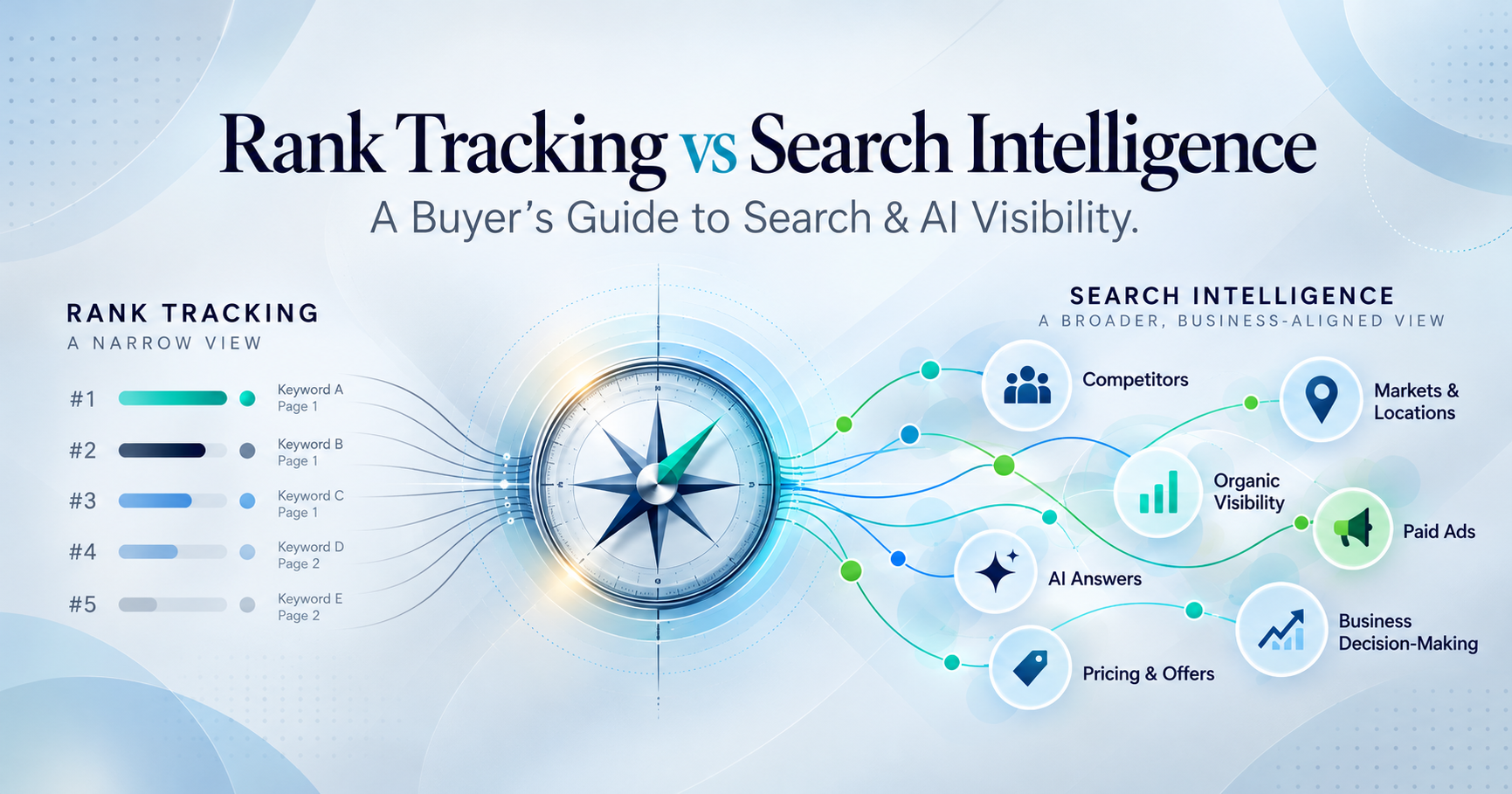
But suppose this data will inform your board, help executives decide where to invest, and guide your marketing team and agencies. A basic rank report won’t tell them enough. They’ll need data tied to your markets, competitors, products, services, and business goals. That’s search intelligence.
Go down this list and see how often you say, “Yes, we need that.” If you say yes a lot, you probably need search intelligence. If all you need is a ranking report, stick with a basic rank tracker.
Full disclosure: GrowByData provides search intelligence across SERPs and AI answers. Use this checklist to evaluate us, too.
Rank tracker vs search intelligence at a glance
| What you need to know | Typical rank tracker | Search intelligence |
|---|---|---|
| Core question | Where do my pages rank? | Are we gaining visibility in the markets and products the business cares about, and who is getting in the way? |
| Data organized by | Keywords and pages | Your markets, competitors, products, services, and business goals |
| Who it serves | Whoever reports on rankings | Executives, marketers, and agencies working from the same priorities |
| Search and AI | A ranking report | Search and AI visibility in one view |
| Ads and pricing | Usually outside its scope | Ad coverage and competitive pricing alongside visibility |
| Data collection | Standard collection | Collected around your requirements, with human validation |
| Delivery | A dashboard | A dashboard, plus feeds, APIs, and MCP for your own tools and AI assistants |
1. I need executives, marketers, and agencies measuring the same priorities
The CEO wants more market share in Chicago and Atlanta and better margins. Your marketing team or agency is celebrating more page 1 rankings. But those gains could be for low-margin products in cities you aren’t trying to grow.
Your team needs data that helps them decide what to work on next and shows leadership whether that work is paying off over time. That means organizing search data around the markets and products the business cares about. If finance groups products one way and your marketing team or agency groups keywords another, someone has to make the connection and keep it working.
2. I need search and AI visibility in one place
If you want to grow in Phoenix, you care whether customers in that city find you on Google or ChatGPT. If competitors are showing up when people look for your brand, you want to know about that in both places, too.
A search intelligence solution should let you set those priorities and follow them across search and AI in one view. You can see where you’re gaining visibility and where competitors are getting in the way. And as AI answers become part of search results, keeping the reporting separate makes less and less sense.
3. I need competitive pricing intelligence and MAP monitoring
A visibility report can show you that a competitor is gaining ground. Pricing data can help explain why. A better price can improve conversion rates. In Google Shopping, price competitiveness and predicted conversions also influence bidding, which affects how often ads appear.
For retailers and brands, a price comparison is only useful if the products match. Size, model, pack quantity, and condition matter. A bad match can send your pricing team after a discount that doesn’t exist.
GrowByData has spent more than a decade combining technology and human checks to solve product matching and competitive pricing. The work also supports minimum advertised price, or MAP, monitoring. Our stationery distributor case study reports a 39.5% reduction in MAP violations.
Having pricing and visibility data together helps your team work out whether to change the campaign, the offer, or both.
4. I need visibility in specific cities, regions, or countries
Imagine a retailer with thousands of stores across the U.S. Its marketing team and agency say search is going well and want to target new terms to grow market share.
Now break that retailer’s search visibility down by the markets the business cares about most. Some have excellent visibility. In others, the retailer barely shows up. Compare that with spending by market, and a pattern can appear: markets getting more offline advertising gain search visibility, and neglected markets lose it.
That’s the cue to revisit the marketing mix in the neglected markets. It also helps the business understand how offline advertising, search, and store visits work together, and where the marketing team and agency need to focus next.
5. I need paid ad coverage I can trust
Google has made paid ads harder for automated tracking tools to see. The reports can keep updating while missing ads your customers still see. That leaves a hole in your view of the competition.
In our published analysis of Google Shopping Ads data quality, automated searches in incognito mode captured ads in only a small share of searches. By combining our technology with real people searching, GrowByData captured substantially more.
Ask your provider for a graph of the percentage of searches where it captured ads over time. If that percentage collapsed and stayed low, its reports may still be missing much of what customers see. Ask whether they offer service level options to fill that gap, as we do.
Better coverage can cost more. Compare what you’re paying for usable ad data, not just the monthly subscription.
6. I need data I can trust as search keeps changing
By the time ad tracking became a problem, we’d spent years building relationships with our own crowd of real people. We’d worked out how to organize their work, combine it with our technology, and check the results while solving problems such as matching products across retailers. A few people manually checking Google wouldn’t give you that capability.
When automated tools stop seeing something, that experience gives us other ways to investigate and fill the gap.
If you’re judging strategy over time, you also need to know that this month’s numbers mean the same thing as last month’s. Your provider has to check new methods against old ones and fix or flag gaps in the history. Our response to a Google redirect change shows what that work involves.
7. I need to see what customers see when they interact with search results
Someone opens a People Also Ask answer and sees your competitor mentioned. Or asks an AI assistant another question and gets an answer that casually mentions a brand. A passing mention can put that business on their list before they’re ready to buy.
If your tool stops at the first set of results, you won’t see those moments. You’ll want to know what customers find as they click, expand, and ask more questions on their way to a decision.
8. I need search data my content team can use
Your team sees People Also Ask appearing more often for mortgage searches. Before writing another article, they need to know which questions come up, whose answers Google uses, and what those answers leave out.
GrowByData can pull the questions, answers, and source pages for the topics and competitors you care about. That gives your team or agency something specific to work with when deciding what to write and how to make it useful.
9. I want my team and agencies to decide what to do next
Some buyers want recommendations and automated execution. Others want measurement they can use with their own methods. You may need both.
Some of our team were helping businesses get online in 1997. Owners knew being found could bring customers. In the years that followed, a few hundred dollars bought a consultant’s help configuring WebPosition Gold to check AltaVista, WebCrawler, Yahoo, and Lycos. It also suggested changes to individual pages. Consultants made the changes, checked again, and learned. It was one way people got started in SEO.
GrowByData concentrates on measurement built around your business. Your SEO, GEO, and SEM experts bring their own approaches.
10. I need data collected around my exact requirements
Financial firms use alternative data to make trading decisions, and they ask questions a standard SaaS report can’t answer. They’re looking for an edge.
The best marketers want one, too. Your SEO, GEO, and SEM experts may have ideas that go well beyond the usual best practices. They need enough detail to test those ideas, see what happens, and decide what to try next. That can mean gathering data specifically for their questions, markets, and competitors.
An existing database may be plenty for general research. If the data needed to test your ideas isn’t there, you need someone who can gather and organize it for you.
11. I need the data in my own tools and AI assistants
A dashboard may be enough. If you want the data in your own systems, look for feeds and APIs. MCP, or Model Context Protocol, lets compatible AI assistants work with it, too.
Then try asking: “Are we gaining visibility for our higher margin products in New York, Dallas, and Los Angeles, including our products on partner sites? How do we compare with our direct competitors?”
A useful answer depends on knowing what you’re trying to grow, which products have higher margins, and who really competes with you. A retail partner’s listing for your product can help you get found. Counting that partner as a rival would tell the wrong story. Your assistant needs those distinctions before its answer is worth acting on. GrowByData’s solution is built from the ground up to address critical nuances like this, and now MCP connections put this power at your fingertips within the AI tools you’re already using.
12. I need help with data cleanup, integrations, and reporting
A standard SaaS provider can work when your needs fit the product. Custom work may need analysts and engineers.
Branch names, products, and sellers don’t always match across sources. Someone has to reconcile them before combining visibility with CRM, inventory, or margin data. Ask who will handle that work, build the reports and visuals your team needs, and keep everything working. Make sure it’s in their quote.
Before you choose
If you said yes a lot, don’t buy a tool and hope it will stretch to fit. Buy a solution built around your business, with the people and expertise to make it work.
You can’t manage what you can’t measure. When search intelligence data guides the boardroom, your marketing team, and your agencies, you’re buying a compass for the business that keeps everyone aligned.
Our platform is called GrowByData Compass for that very reason. GrowByData combines a service culture with custom data collection, human validation, and people who help make the data useful to your business.
Want to see how your own search and AI visibility holds up? Talk to an expert about a demo or an audit.