

For years, search and paid media teams treated competitive intelligence as a reliable source of truth. It helped answer critical questions: who was bidding, where competitive pressure came from, and how aggressively rivals appeared in paid search and Google Shopping.
That assumption no longer holds.
Today, much of paid search intelligence and Google Shopping Ads data is directionally wrong. Not because tools are poorly built, but because the underlying method they rely on Incognito, non-logged-in SERP scraping which no longer reflects what real users actually see on Google.
This is not an edge case.
It is a structural breakdown of paid search data quality.
👉 Google Shopping Ads visibility data shows this collapse in real campaigns
What makes this failure especially dangerous is its subtlety. Dashboards still populate. Reports still update. But the underlying ad coverage has quietly collapsed, leading teams to operate with false confidence.
The Blind Spot in Paid Search Competitive Intelligence
Most search intelligence solutions still rely on Incognito SERP scraping to collect competitive data. Over the last year, Google has increasingly restricted and distorted ad visibility in Incognito and automated environments, particularly for paid search and Shopping Ads.
The impact is measurable and consistent across categories:
- Incognito ad yield: In many verticals, traditional scraping now captures under 2% of paid ads
- Logged-in ad yield: Real-user, logged-in SERP collection restores visibility to 70%+
If you are making bid optimization, budget allocation, or brand defense decisions based on a 2% sample, you are not optimizing for the real market.
You are optimizing against a distorted SERP.
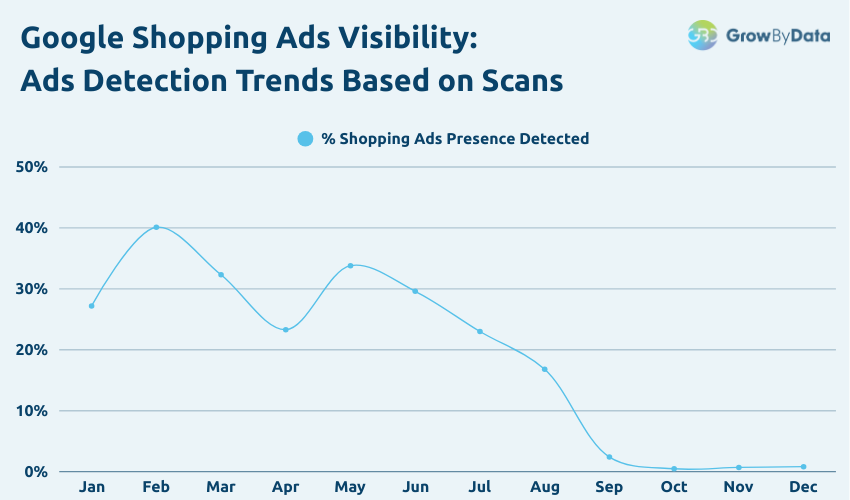
Proof: What Real-User SERP Data Shows
When SERP data is collected from logged-in, real users, paid search visibility returns to statistically meaningful levels. This approach captures how Google actually serves ads to real searchers, not scrapers.
| Date | Incognito Ad Yield | Logged-In Ad Yied |
|---|---|---|
| Nov 24 | 0.9% | 51.4% |
| Dec 1 | 1.2% | 42% |
| Dec 08 | 0.6% | 84.6% |
| Dec 15 | 0.4% | 92.3% |
Side-by-side comparison showing Incognito scraping versus logged-in, real-user ad visibility for Ashley Home Furniture Shopping Ads.
The difference between these two views is not incremental. It is foundational.
👉 A Google Shopping case study shows how much visibility standard tools miss
Why This Matters for Paid Search, Marketing, and Leadership
When competitive paid search visibility collapses, the impact spreads across the organization.
Paid Search & Performance Teams
- Reduced visibility into competitor bidding and brand term poaching
- Inability to see localized pricing and promotion pressure
- Optimization decisions based on incomplete SERP data
Marketing & Growth Leaders
- Difficulty separating internal execution issues from market pressure
- CAC and efficiency trends that are harder to explain
- Less confidence defending paid media budgets
Executives & Finance
- Capital deployed without independent verification of the competitive landscape
- Increased risk of waste
- Erosion of trust in performance reporting
This is not a reporting issue. It is a decision-quality risk.
Is Google Too Personalized for Accurate Paid Search Data?
A common objection is that Google Search is “too personalized” for any third-party competitive intelligence to be accurate.
This misses the core issue.
Incognito data is not neutral, it is suppressed. Logged-in SERP views reflect how Google actually serves ads to real users. While no dataset is perfect, directionally accurate competitive intelligence is essential.
Moving from 2% ad visibility to 70%+ visibility is not an incremental improvement. It is the difference between flying blind and operating with radar.
The Bottom Line
Paid search intelligence is at an inflection point.
Every team must now answer a fundamental question:
Is accurate competitive paid search visibility mission-critical, or merely a nice-to-have?
If it is mission-critical, the old model of Incognito SERP scraping is no longer viable. Bad data may be cheap, but it becomes the most expensive line item on the balance sheet when it drives the wrong decisions.
See How Teams Are Rethinking Google Shopping Visibility
When competitive paid search data breaks down, visibility monitoring becomes the fastest way to regain clarity in Google Shopping.