

Google Shopping Ads visibility has become increasingly opaque. As Google limits external access to SERP data and Shopping placements evolve, many advertisers are making budget and strategy decisions using incomplete signals.
This article explains what changed, why it matters, and how advertisers can regain meaningful visibility.
What Changed in Google Shopping Ads Visibility
Short answer: Advertisers no longer have a complete view of where and how Shopping Ads appear.
Google has steadily restricted third-party access to Shopping Ads placements through technical, policy, and platform changes. As a result, many traditional tools only capture partial data – missing placements, competitors, or context.
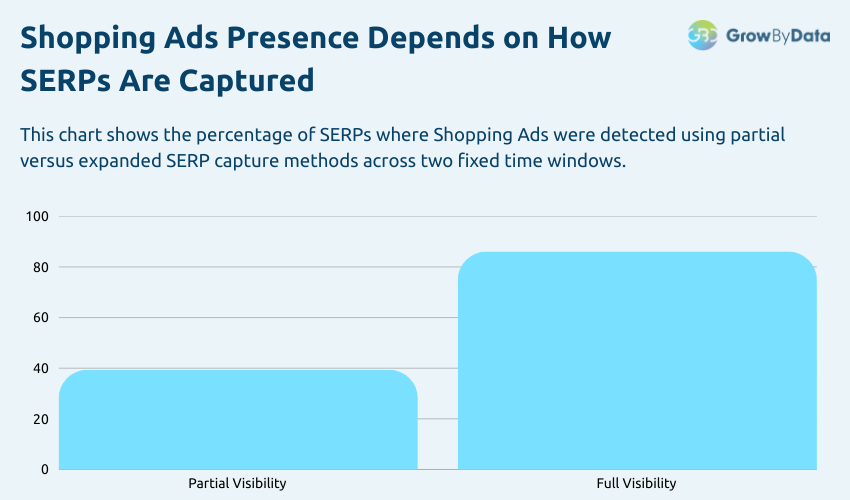
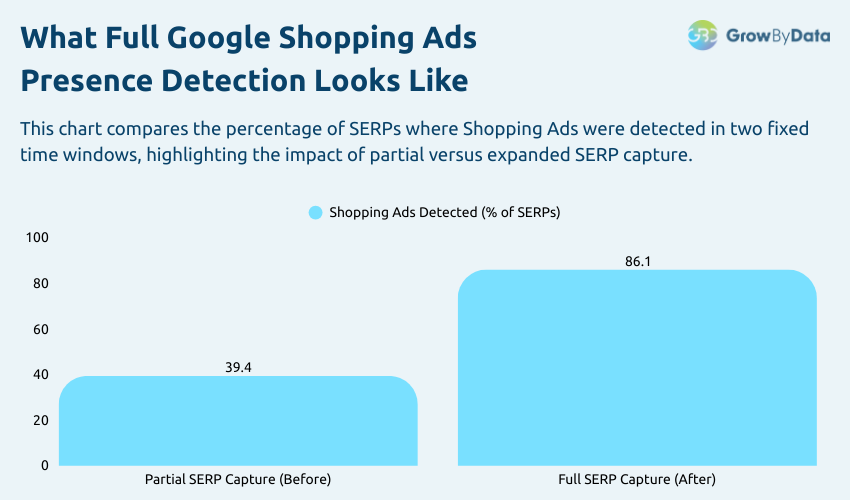
During the fixed before window (Aug 4-Aug 31), partial SERP capture detected Shopping Ads in just 39.4% of searches. After expanding SERP capture (Dec 1-Dec 25), detection rose to 86.1%, revealing that a majority of Shopping Ads were previously missed due to collection limitations rather than market change.
Why this matters: Reliable visibility depends on accurate detection data. When detection is incomplete, performance analysis becomes guesswork.
The New Blind Spot Advertisers Are Facing
Advertisers can still spend but can’t always see.
Today’s Shopping Ads ecosystem includes:
- Logged‑in vs. logged‑out results
- Personalized placements
- Merchant listings mixed with ads
- Rapidly shifting layouts
Many of these surfaces are either under‑captured or entirely invisible in standard reporting tools. Advertisers may believe they have coverage when, in reality, large portions of the SERP are unmeasured.
Common Symptoms of the Visibility Gap
Advertisers experiencing this blind spot often report:
- Budget pressure without clarity: Spend increases, but reporting cannot clearly explain why performance changes.
- Delayed competitor insight: Competitor entry or exit from Shopping Ads goes unnoticed until impact is felt.
- Unexplained volatility: CTR, impression share, or conversion rates fluctuate without a clear cause.
| Collection Method | Shopping Ads Presence Missed |
|---|---|
| Non-Personalized Collection | 99% missed |
| Logged-In Collection | 47% missed |
During the before period, a significant portion of Shopping Ads appearances were not detected due to non-personalized collection. During the after period, missed appearances were materially reduced through logged-in SERP collection.
Reactive strategy shifts: Teams respond after performance drops instead of anticipating changes.
Each of these symptoms stems from the same root issue: incomplete detection of Shopping Ads presence, which creates a visibility gap in the ads landscape.
How Google Shopping auctions work
When a user searches for a product-related keyword, Google does not automatically show Shopping ads. Instead, it first decides whether a Shopping auction should run at all, and only then determines which ads appear and in what order. This decision is made in real time, based on a combination of query intent, advertiser eligibility, and contextual signals.
According to Google, Shopping ads are selected through an auction that considers multiple factors – not just bids. You can reference Google’s official explanation of the Shopping ad auction process here.
Key factors Google evaluates in Shopping auctions
- Search intent: Whether the query signals commercial or purchase intent
- Advertiser eligibility: Which merchants have approved products that match the query and location
- Bid and budget signals: How competitively advertisers are bidding for that traffic
- Product feed relevance: How closely product titles, attributes, and pricing align with the search
- Expected performance: Predicted usefulness of the ad based on historical performance signals
- Contextual factors: Device type, location, timing, and other real-time conditions
Only when enough of these factors align does Google run a Shopping auction. This is why the same keyword can produce different Shopping ad visibility across users, locations, and search contexts even when the wording of the query stays the same.
Why Partial Data Creates Strategic Risk
Short answer: You cannot optimize what you cannot fully observe.
Shopping Ads decisions rely on understanding:
- Which retailers appear
- Where they appear
- How often they appear
- Under what conditions they surface
When data only reflects a portion of the SERP, advertisers may:
- Over-invest in underperforming categories
- Miss emerging competitors
- Misattribute success or failure to the wrong factors
This doesn’t just affect performance, it affects confidence in decision-making.
| Metric | Before Period (Aug 4-Aug 31) | After Period (Dec 1-Dec 25) |
|---|---|---|
| Avg. Shopping Ads Presence Detected | 38-45% | 70-90% |
| Lowest Daily Presence Detected | 20-25% | 65% |
| Highest Daily Presence Detected | 58% | 99% |
| Detection Consistency | Inconsistent | High |
During the before period (Aug 4-Aug 31, 2025), Shopping Ads were detected in 39.4% of SERPs using partial SERP capture. During the after period (Dec 1-Dec 25, 2025), detection increased to 86.1% following expanded SERP capture.
What Full Shopping Ads Visibility Looks Like
Full visibility goes beyond share of impressions or spend reports.
It includes:
- Complete SERP capture across locations and contexts
- Monitor Product Listing Ads
- Competitive presence tracking at the category and SKU level
- Fixed-period benchmarking to detect structural differences
This level of visibility allows teams to move from reactive optimization to proactive strategy.
How Advertisers Are Addressing the Blind Spot Today
Leading advertisers are adjusting by:
- Layering visibility sources: Combining platform data with independent SERP monitoring
- Tracking presence, not just performance: Measuring who shows up, not only clicks and conversions
- Benchmarking competitors continuously: Monitoring changes week‑over‑week, not quarterly
- Aligning visibility with spend: Connecting placement data directly to budget decisions
The goal is not more data but it’s reliable data.
What Advertisers Should Do Next
If Shopping Ads visibility feels unclear, start here:
- Audit what your current tools actually capture and what they miss
- Identify categories or SKUs where visibility gaps are most costly
- Introduce independent SERP visibility tracking to fill blind spots
- Tie visibility insights directly to forecasting and planning
Small improvements in visibility often lead to disproportionate gains in performance and confidence.
Final Takeaway
Google Shopping Ads haven’t become less important, they’ve become harder to see clearly. The data now shows that this blind spot is measurable and solvable. Advertisers who move from partial detection to full visibility will be better positioned to protect budgets, anticipate competition, and make confident, evidence-based decisions in an increasingly complex SERP environment.
See How Your Shopping Ads Visibility Looks in Today’s SERP Environment
If you want to understand how your Shopping Ads visibility compares across devices, competitors, and collection methods, request a personalized visibility assessment.