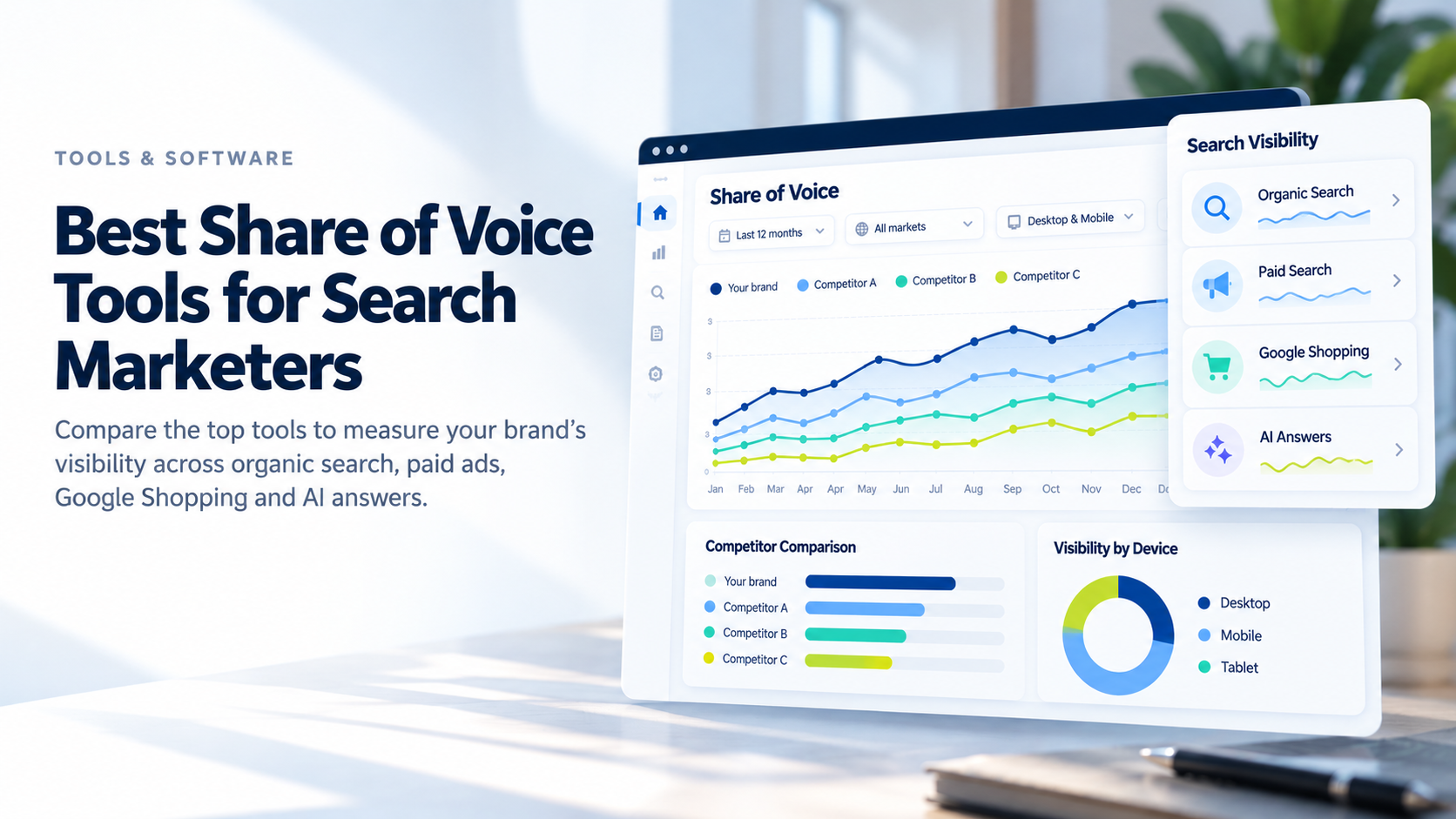
A share of voice dashboard can tell you that your visibility fell. Choosing the right tool is harder: you need to know whether the number represents estimated organic clicks, results-page positions, Shopping ad exposure, or mentions in AI answers. Those measures answer different questions. A strong-looking share on one surface doesn’t make up for weak coverage on another.
We compared seven share of voice tools for teams managing search performance: GrowByData Compass, Semrush, Ahrefs, BrightEdge, Conductor, SE Ranking and AccuRanker. This is a buyer’s guide to their documented capabilities and measurement methods, not a hands-on ranking of their accuracy.
Disclosure: GrowByData publishes this comparison and appears first. Placement is editorial, not a claim that our tool wins every use case. We’ve included limitations for GrowByData Compass alongside the other vendors and linked to documentation where claims can be checked.
What to look for in a share of voice tool
Before comparing dashboards, ask five questions:
- Which search surface is measured? Organic links, text ads, Shopping ads, Merchant Listings, Google AI Overviews, Google AI Mode, ChatGPT and Perplexity aren’t interchangeable.
- What’s in the denominator? Some tools estimate click share. Others count positions in a defined SERP window, count listings, or calculate brand presence across selected prompts. A percentage without its denominator isn’t useful for cross-tool benchmarking.
- Who controls the measured set? Check whether you can separate brand from non-brand, isolate product categories, set competitors, and keep the keywords or prompts stable.
- Can you report by your chosen markets and devices? A national desktop average can hide local or mobile competition, especially in Shopping.
- Can you explain changes over time? Check the update frequency, available history, methodology changes, and whether a trend can be investigated at keyword, URL, product or competitor level.
We included products with a documented search SOV or directly relevant search visibility measurement. We didn’t score vendors numerically or publish pricing because we haven’t independently tested identical accounts, keyword sets and reporting configurations across them.
Share of voice tools compared
| Tool | Best fit | Documented SOV basis | Search coverage relevant to this comparison | Main consideration |
|---|---|---|---|---|
| GrowByData Compass | Enterprise search and ecommerce teams comparing visibility across Google surfaces | Share of tracked SERP listings: a domain’s listings divided by all listings for the same keywords, SERP feature, market and device | Organic and paid results, Google Shopping, Merchant Listings, SERP features, plus AI answer monitoring (ChatGPT, Google AI Overviews, Google AI Mode, Perplexity) | A listing count, not a click or traffic estimate, so it won’t match click-based tools |
| Semrush | SEO teams using Position Tracking | Estimated organic traffic share based on tracked keywords and their relative search demand | Organic SOV in Position Tracking; local and AI visibility in separate tools | Different products and methods for different surfaces |
| Ahrefs | Organic SEO teams tracking click share | Target’s clicks across tracked keywords divided by clicks across the corresponding SERPs | Organic Rank Tracker SOV | Click estimation details aren’t fully described in the linked help article |
| BrightEdge | Enterprise SEO teams assessing category visibility | Search visibility informed by rankings and click behavior | Organic competitive SOV; the product page discusses AI Overview impact on the results page | AIO impact on organic SOV isn’t the same as SOV within AI answers |
| Conductor | Enterprise SEO teams needing explainable SERP position share | Weighted or unweighted share across the top 1, 5 or 10 results | Traditional search Market Share; separate AI Search Performance report | Its SERP position-share method differs from click-share measures |
| SE Ranking | Agencies and SEO teams needing project-based organic SOV | Estimated organic traffic share for tracked Google Desktop keywords, top 20 positions | Organic SOV; separate SE Visible AI measurement | Google Desktop restriction and 90 days of history in the organic module |
| AccuRanker | Rank-tracking teams seeking configurable organic SOV | Search volume combined with static or dynamic estimated CTR | Organic keyword SOV, competitor comparison, desktop and mobile | Its October 21, 2026 model update creates a step in Dynamic CTR trends |
All coverage descriptions refer to specific documented modules, not every capability offered by each vendor. A separate AI product doesn’t imply that organic, paid, Shopping and AI scores are combined into one comparable percentage.
GrowByData Compass
Best for: Directors of SEO, paid search and ecommerce who need to investigate competitive visibility beyond organic rankings, especially in Google Shopping Ads.
GrowByData Compass monitors how brands and competitors appear across Google results, paid search, Shopping ads, Merchant Listings and SERP features. Our enterprise SERP tracking page describes daily SOV analysis and reporting segmented by market, device, category and competitor. Our Google Shopping Ads monitoring page describes advertiser and product-level presence, competitive changes and historical trends in monitored Shopping results. For a wider view of the category, see our Google Shopping monitoring.
Compass reports share of voice as the share of tracked SERP listings a domain holds. The numerator is the domain’s listings and the denominator is all listings for the same keywords, SERP feature, market and device. It’s a count of listings, not an estimate of clicks or traffic. Compass also monitors AI answers in ChatGPT, Google AI Overviews, Google AI Mode and Perplexity. Read AI prompt visibility and Google SERP SOV as distinct measures unless their populations have been explicitly aligned.
Pros
- Looks beyond a single organic rank to assess competing content, ads, Shopping products and SERP features.
- States its SOV numerator and denominator plainly, which makes the number easy to audit against the underlying listings.
- Provides a dedicated competitive Shopping Ads monitoring use case, including advertiser and product presence by market and category.
- Helps teams inspect visibility changes within their chosen markets and devices instead of relying on one national aggregate.
Considerations
- A listing-count share treats every listing within a SERP feature the same. It isn’t weighted by estimated clicks, so don’t compare it directly with click-based scores from other tools.
- Coverage depends on the keywords, prompts, locations and devices configured for monitoring. Untracked demand isn’t represented in the reports.
- Compass doesn’t monitor Gemini or Microsoft Copilot.
For teams evaluating Shopping coverage, a useful demonstration is a comparison of a competitor’s Shopping ad presence against its Merchant Listings presence for a consistent category, market, device and date range.
Talk to an expert for a demo or an audit of your own share of voice in your chosen markets and devices.
Semrush
Best for: SEO teams that already run Position Tracking and need organic SOV alongside rankings and other search workflows.
Semrush defines SEO share of voice in Position Tracking as the share of estimated organic traffic a domain captures from a defined keyword set. Its Position Tracking documentation explains the role of search volume and estimated traffic. A May 8, 2026 guide also describes separate tools for local-map and AI visibility.
Pros
- Organic SOV sits alongside tracked rankings, competitors and keyword-level reporting.
- Teams can configure target domains or URLs, locations, devices and tracked keywords.
- Has documented local and AI visibility workflows beyond the organic Position Tracking metric.
Considerations
- Position Tracking SOV isn’t available for campaigns tracking ChatGPT search visibility, according to Semrush’s May 2026 guide.
- Organic, local and AI reports use different products or workflows. Don’t treat their scores as one comparable SOV.
- We didn’t establish a Google Shopping Ads share of voice calculation from the Position Tracking sources reviewed. This is a documentation gap for this comparison, not proof that Semrush lacks other Shopping capabilities.
Ahrefs
Best for: SEO teams that want a click-based organic SOV number from an existing Rank Tracker keyword set.
Ahrefs’ Rank Tracker help article describes SOV as clicks attributed to the target across tracked keywords divided by clicks across the corresponding search results. The metric appears in project and competitor views.
Pros
- The numerator and denominator are straightforward to explain to search stakeholders.
- Competitor and project views use a defined tracked keyword set.
- Provides an organic benchmark without requiring a separate AI visibility framework.
Considerations
- The metric reflects the project’s tracked keywords, not every query driving category demand.
- The cited help article doesn’t fully document how clicks are estimated for every ranking position and SERP layout.
- This Rank Tracker SOV documentation doesn’t establish paid search or Shopping Ads SOV in the same report.
BrightEdge
Best for: Enterprise SEO teams comparing search visibility across categories, device types and changing SERP layouts.
BrightEdge’s Share of Voice product page describes a competitive score that accounts for click behavior and distinguishes mobile, desktop, branded and non-branded searches. It also describes filtering competitive performance when Google AI Overviews are present and investigating the keywords and URLs behind changes.
Pros
- Connects competitive visibility shifts to keyword clusters and URLs.
- Accounts for the changing Google results page, including AI Overview presence, when analyzing organic competition.
- Has an enterprise reporting angle suited to teams managing multiple categories.
Considerations
- The public product page doesn’t provide the complete weighting formula, so validate the model before comparing scores with another provider.
- Filtering organic SOV by AI Overview presence doesn’t establish share of mentions or citations inside the AI Overview itself.
- We didn’t verify an equivalent paid Shopping Ads SOV calculation in the BrightEdge documents used for this comparison.
Conductor
Best for: Enterprise SEO teams that need to explain exactly what portion of a tracked SERP position set they own.
Conductor’s Market Share report measures visibility across selected top 1, top 5 or top 10 results. Its calculation FAQ documents two options: an unweighted share that doesn’t take search volume into account, and a weighted share that does. This makes the meaning of the denominator unusually clear. Conductor describes AI visibility in a separate AI Search Performance report.
Pros
- Publishes the weighted and unweighted calculation methods instead of only a dashboard label.
- Lets teams select the top-result window and report by tracked keyword groups, locations and devices.
- Separates traditional SERP market share from AI answer measurement.
Considerations
- A top-position share isn’t equivalent to estimated organic click share, even when the results are expressed as percentages.
- Changing from top 5 to top 10, or from weighted to unweighted, changes what the SOV number means.
- The linked Market Share sources don’t establish an equivalent Google Shopping Ads SOV measurement.
SE Ranking
Best for: Agencies and SEO teams that need competitor organic traffic-share estimates from a controlled project keyword set.
SE Ranking’s Share of Voice documentation describes estimates based on organic rankings in the top 20 for Google Desktop. The tool works from the keywords assigned to a project and offers keyword and tag filters. It keeps 90 days of history: daily for the last 30 days and weekly for the 60 days before that. Separately, SE Visible measures AI brand visibility across ChatGPT, Gemini, Perplexity, Google AI Overviews and Google AI Mode. SE Ranking also publishes an AI visibility API workflow.
Pros
- The organic SOV module clearly defines its top-20 Google Desktop measurement scope.
- Project keywords and tags support focused competitive comparisons.
- A separate AI offering covers prompt-level brand presence and competitor comparisons, including Gemini.
Considerations
- The organic SOV module isn’t a mobile SOV report. Don’t assume its percentage represents mobile results.
- History in that module stops at 90 days, which limits long-range trend reporting.
- AI visibility is measured separately from organic traffic-share estimates.
AccuRanker
Best for: Teams that want to tune how organic rank visibility is converted into a click-potential-based SOV estimate.
AccuRanker’s Share of Voice guide explains a rank-and-search-volume calculation and allows keyword exclusions, including branded terms. Its October 2026 product update introduced one configurable SOV measure for Google keywords, with a choice of static or dynamic CTR and search-volume source.
Pros
- Makes CTR-model selection a configurable part of organic SOV reporting.
- Allows branded or other unsuitable keywords to be excluded from the tracked metric.
- Provides competitor comparisons and desktop and mobile visibility views.
Considerations
- It remains an estimate of click potential rather than observed competitor traffic.
- The new CTR model applies only from October 21, 2026 onward, so Dynamic CTR charts show a step on that date without any underlying ranking change. Static CTR isn’t affected.
- The documented core SOV measure is oriented toward ranking and click potential, not a unified Google Shopping Ads and AI answer share.
Which share of voice tool should you choose?
| Your reporting problem | What to prioritize | Tools worth evaluating |
|---|---|---|
| Competitors are taking Shopping ad exposure in important product categories | Advertiser and product presence, category filters, market and device comparisons, change history | GrowByData Compass |
| Leadership wants one organic share estimate for a stable SEO keyword set | Transparent click-share methodology, reliable rank tracking, competitor trends | Ahrefs, Semrush, AccuRanker |
| The SEO program spans many product lines or markets | Category segmentation, rank and URL diagnosis, enterprise reporting | BrightEdge, Conductor, GrowByData Compass |
| Your team wants to choose between counting SERP positions and weighting by demand | Explicit top-position scope and calculation options | Conductor |
| An agency needs tracked-keyword organic SOV and a separate AI visibility offering | Project configuration, client reporting, separate AI metric definitions | SE Ranking, Semrush |
| You need to explain shifts around AI Overviews | Clear distinction between AIO effects on organic results and visibility inside AI-generated answers | BrightEdge for SERP impact; dedicated AI monitoring for answer presence |
The shortlist should follow the metric you need, not the longest list of integrations. In a paid-search review, ask a vendor to show Shopping ad presence for the same category across two dates. In an SEO review, ask for a keyword-level calculation and show what happens when a high-volume branded term is removed. In an AI visibility review, ask whether the percentage counts prompt mentions, cited sources, positions in answers, or another measure. For a closer look at the AI-only side, see our guide to the best LLM visibility tracking tools for enterprise.
Five questions to ask during a demo
- What exactly is the numerator and denominator of your SOV score for this surface?
- Can we inspect the keywords, prompts, competitors, markets and devices behind the number?
- Can we distinguish paid Shopping Ads from unpaid Merchant Listings and standard organic results?
- When the score changes, can we see the affected queries, URLs, advertisers or products?
- Have you changed the calculation or historical retention policy, and how are those changes identified in a trend chart?
Why share of voice scores don’t match across tools
Even for the same brand and category, two tools can disagree without either one being defective. A click-weighted organic metric responds differently to position changes than Conductor’s count of occupied top-result slots or a plain count of SERP listings. A Shopping ad presence metric answers a different question from Google Ads impression share. Prompt-based AI visibility can depend on which questions were tested and how brand appearances were counted.
Keep each surface’s definition beside its chart. When reporting changes, retain a stable measured set and record any changes to keywords, prompts, CTR curves or visibility rules. For the basic calculation concepts, see our guide to Google Share of Voice.
What about social and media share of voice?
If your goal is to compare mentions across news coverage or social conversations, you need media monitoring or social listening rather than SERP visibility analysis. Products such as Brandwatch and Meltwater belong to that category. This comparison doesn’t evaluate them. GrowByData Compass doesn’t measure general news or social mention share of voice.
Frequently asked questions
Is share of voice the same as share of search?
No. In its common brand-demand meaning, share of search compares searches for your brand with searches for a defined set of competitors. Search share of voice, as used in this article, measures a brand’s share of visibility within a selected search-result or prompt set. The definitions aren’t interchangeable. See Search Engine Land’s share of search explanation.
Do all share of voice tools use the same formula?
No. Ahrefs describes click share. Conductor documents a choice of weighted and unweighted SERP position share. AccuRanker combines rank position, search volume and selectable CTR assumptions. GrowByData Compass reports the share of tracked SERP listings. Before benchmarking two tools, compare their measurement rules as well as their keyword sets.
Can a share of voice tool measure Google Shopping Ads?
Some platforms document dedicated Shopping Ads monitoring. GrowByData Compass describes advertiser, product and competitive visibility in Google Shopping. For other platforms, confirm the specific Shopping Ads SOV metric in writing rather than assuming that organic rank tracking includes it.
Can I combine organic, paid, Shopping and AI share of voice into one number?
Not without a defined common method. Each surface can have a different measured population and denominator. A better executive report places the measures alongside each other, labels them clearly, and explains the competitive change on each surface.
How many keywords should I track?
There’s no universal threshold. Start with the categories, brand and non-brand segments, markets and devices tied to the decisions you need to make. Document the measured set and keep it consistent for trend analysis. A larger keyword list with poor category coverage can be less useful than a smaller, deliberately selected one.
Compare your search and Shopping visibility
If you need to understand where competitors are gaining organic, paid or Shopping visibility in your chosen markets and devices, talk to a GrowByData expert to request a demo or a share of voice audit.