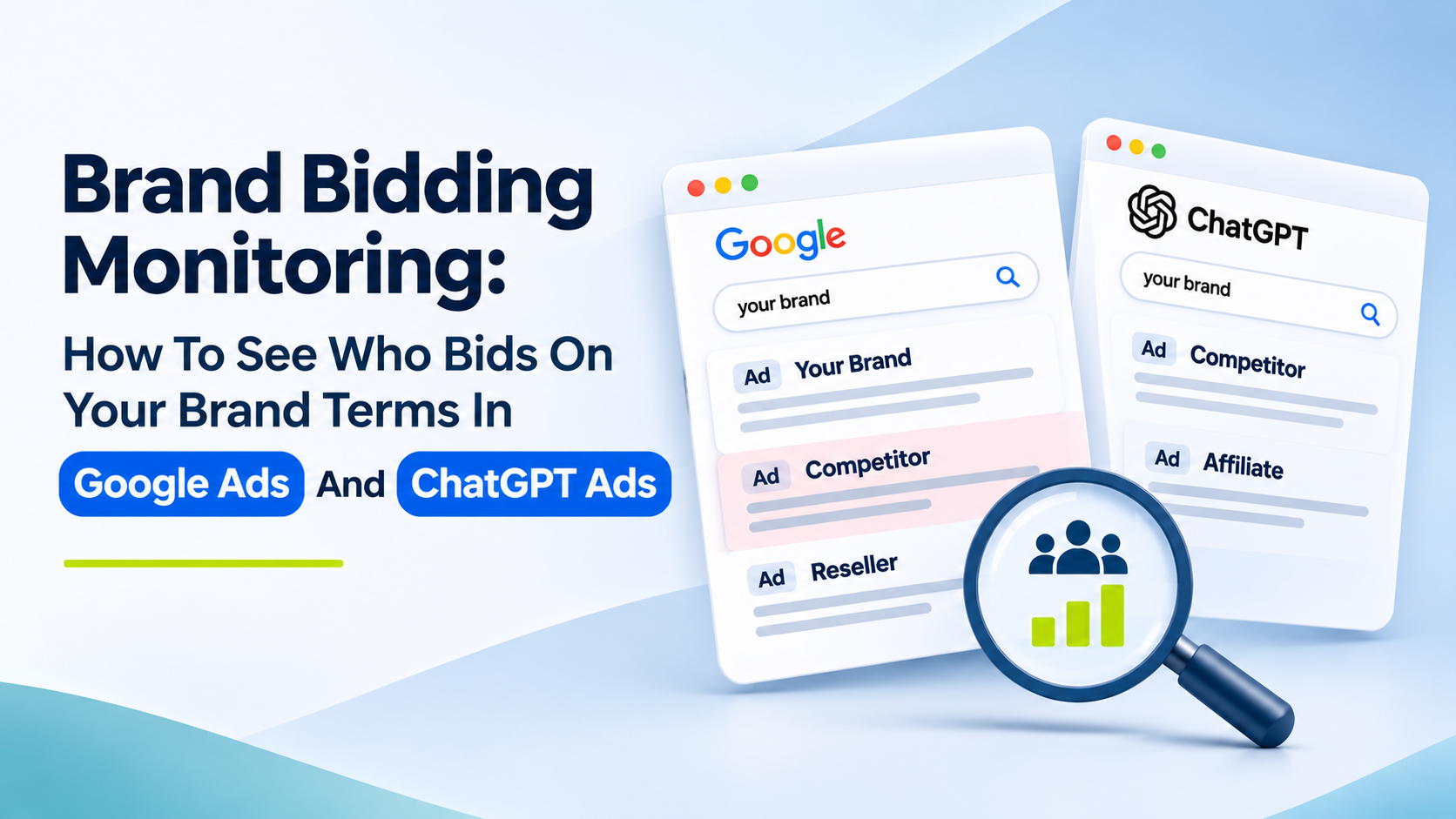
Brand bidding monitoring means checking, on a fixed schedule, which advertisers run Google text ads when people search your brand. On one large online marketplace we track, other advertisers held 40.6% of text ad appearances on its own brand keywords over 30 days. Google Ads Auction Insights shows only part of that picture.
Our view: most brands assume their brand terms are safe because they rank first organically and run a brand campaign. The data says otherwise. Rivals don’t need your name in their keyword list to show up on your brand search, so watch what the searcher sees, not what the advertiser typed.
What Is Brand Bidding Monitoring?
Brand bidding monitoring tracks every text ad that appears when people search your brand name and its variations, records who placed it, what the ad said and where it led, and repeats that check across your chosen markets and devices. It’s one part of competitive ad intelligence. The goal is evidence: a dated log of competitor, affiliate and reseller ads on your brand terms.
In practice you’re watching for three kinds of advertiser, and each one needs a different response:
- Competitors buying your brand traffic to pitch their own product.
- Affiliates bidding on your name to collect commission on customers who were already coming to you, which affiliate policy monitoring is built to catch.
- Resellers and aggregators selling your products or comparing you, which is often within the rules.
Do Competitors Bid On Your Brand Keywords?
Yes, and often more than brand teams expect. On one large online marketplace in GrowByData Compass, other advertisers took 40.6% of Google text ad appearances, a measure of share of voice, on 14 of its own brand keywords between October 16 and November 14, 2026. One ecommerce platform alone held 14.3%, and it used the marketplace’s name in its ad headlines.
The data: 4 in 10 brand-term text ads belonged to someone else
The table shows who appeared on the marketplace’s brand keywords, with company names removed:
| Advertiser type | Share of text ad appearances | Appearances | Brand keywords reached | What the ads said |
|---|---|---|---|---|
| The brand itself | 59.4% | 13,493 | 14 of 14 | Its own brand and category ads |
| Ecommerce platform | 14.3% | 3,244 | 12 of 14 | Guides on how to sell on the marketplace, using its name in headlines |
| Social video platform | 2.7% | 618 | 5 of 14 | Offers to start selling or advertising on its own platform |
| Print-on-demand service | 2.0% | 447 | 3 of 14 | Seller services |
| Small business insurer | 1.9% | 422 | 4 of 14 | Seller services |
| Gift card reseller | 1.4% | 306 | 1 of 14 | The marketplace’s own gift cards, sold through a third party |
| All other advertisers | 18.3% | about 4,200 | varies | Retailers, luxury brands, marketplaces and social platforms |
Three things stand out. The biggest conquester isn’t a direct marketplace rival; it’s a platform selling to the brand’s sellers.
The ad copy points to seller-intent brand searches (how to sell on the marketplace) as the main battleground, not the bare brand name. And the domains the brand tracks as competitors barely appear: each held under 0.2% of appearances, though one rival marketplace’s regional site reached 0.9%.
That’s the gap Auction Insights can hide, and why competitive SERP analysis of your own brand terms matters. The brand’s paid team sees advertisers in its own auctions. It doesn’t see who wins the searches where its ad didn’t show, or which modifiers rivals target.
Methodology. Source: GrowByData Compass, Google text ads on one client account’s 14 tracked brand keywords. Period: October 16 to November 14, 2026. Markets: 12 cities across the US, UK, Ireland, Canada and Australia. Share is each advertiser’s share of all text ad appearances on those keywords. Limits: one brand, not a benchmark; brand labels are the client’s own keyword tags; Shopping Ads are not included; the “all other” row is derived from the totals.
Is It Legal For Competitors To Bid On Your Brand Name On Google?
On Google, competitors can usually bid on your brand name as a keyword. Google’s trademark policy lists using trademarks as keywords among the uses it won’t restrict. What Google will restrict, after a valid complaint, is a direct competitor using your trademark in the ad text itself, or any use that’s confusing or misleading.
Here’s how Google’s policy splits the cases, according to its Advertising Policies Help page on trademarks (checked November 2026):
| Situation | Google’s treatment | What a brand owner can do |
|---|---|---|
| Competitor uses your brand as a keyword only | Not restricted | Monitor it and compete on the auction |
| Direct competitor uses your trademark in ad text | Restricted after a complaint | File a trademark complaint against that advertiser’s URL |
| Reseller whose landing page clearly sells your products | Not restricted, if the ad and page make the reseller status clear | Check the page meets those conditions |
| Informational site about your products | Not restricted | Usually leave it, unless it misleads |
| Any confusing, deceptive or misleading use | Restricted | Report it with screenshots |
Two limits matter. Google says it only accepts complaints against specific advertisers identified by URL, in the countries and industries where you’ve shown trademark rights.
The ecommerce platform in our data shows why the table matters. It uses the brand’s name in headlines, but it isn’t selling a competing marketplace product; it’s publishing how-to guides. Whether that counts as a “direct competitor” is a judgment call for your trademark counsel, not a monitoring tool.
Treat this table as a Google policy summary, not legal advice, and check local law before acting in the UK or EU. Trademark complaints are one tool inside a wider enterprise brand protection program.
How Do You See Who Is Bidding On Your Brand In Google Ads?
Start with Auction Insights on your brand campaign, then fill its gaps with independent enterprise SERP tracking of your brand terms. Auction Insights only compares you with advertisers in auctions you entered, and it hides data below a 10% impression share. Rivals who show when your own ad doesn’t, or on brand modifiers you don’t bid on, can slip past it.
| Method | What it shows | Where it goes blind |
|---|---|---|
| Auction Insights on brand campaigns | Impression share, overlap and outranking for advertisers in your auctions | Auctions you didn’t enter; anything under 10% impression share; low-activity keywords and ad groups |
| Manual searches by your team | The ads one person sees at one moment | One location, one device, one time of day, one personalized session |
| Google Ads Transparency Center | Ads a named advertiser has run | You have to know who to look up; it doesn’t list who appears on your query |
| Independent SERP monitoring of brand terms | Every text ad on your brand queries, by market, device and date, with the copy | Only the terms and markets you choose to track |
Matching makes this harder every year. Google’s help documentation says ads in Google AI Overviews are matched with AI-powered targeting, such as broad match or the keywordless matching in Performance Max and AI Max, as reported by Search Engine Roundtable (May 2025).
In practice, a rival’s broad match keyword for “sell handmade online” can surface on a search for your brand plus “sell.” Nobody on their team added your name, so a trademark complaint has nothing to remove.
That’s why most teams we see underestimate brand conquesting. They search their own brand from the office, see their ad on top, and call it clean.
How To Set Up Brand Bidding Monitoring For Text Ads
A working setup takes six steps. The order matters, because the term list and the markets decide what you’ll ever be able to see.
- Build the brand term list. Include your exact brand, common misspellings, brand plus product lines, brand plus “coupon,” “login,” “pricing,” “reviews” and “gift card,” and “brand vs competitor” pairs. If you serve two audiences, like buyers and sellers, add both sets of modifiers. In our marketplace data, the heaviest conquesting sat on the seller side.
- Pick markets, devices and times. Affiliates often geo-target and daypart to avoid the brand’s own team. Track the metros and countries where you spend, on both mobile and desktop, with local and international SERP monitoring.
- Capture evidence on every ad. Log the advertiser, display domain, headline, description, landing page, position, timestamp and a screenshot. Complaints and affiliate disputes are won on screenshots with dates.
- Classify each advertiser. Tag it competitor, affiliate, reseller, adjacent platform or unknown. The tag decides the response, and unknowns are often affiliates.
- Flag your name in their copy. Separate ads that use your brand in the headline or description from keyword-only bidding. Only the first group can lead to a trademark complaint.
- Report it as share of voice. Show the share of text ad appearances on your brand terms that belong to you, by market and week. A single “yes, someone’s bidding” doesn’t help a paid search director set budget.
One tradeoff: wider term lists and more markets mean more data to triage. Start with your top 20 brand queries and three markets, then widen once the weekly review is running.
See who’s on your brand terms right now. We’ll show you which advertisers appear in Google text ads on your brand searches, in your chosen markets and devices.
What Should You Do When Someone Bids On Your Brand?
Match the response to the advertiser type behind the ad on your brand term. A competitor using your trademark in Google ad text gets a trademark complaint, while one bidding on the keyword alone gets competed with in the auction. Affiliates get program enforcement, and adjacent platforms usually get a stronger brand campaign on the modifiers they target.
| Who’s on your brand | Typical evidence | Response |
|---|---|---|
| Competitor, your mark in their ad text | Screenshot of the ad with your trademark | Trademark complaint to Google against their URL |
| Competitor, keyword only | Their ad on your brand query, no mark in the copy | Keep a brand campaign live; watch your brand CPC and their share |
| Adjacent platform targeting your users | Ads on your brand plus “sell,” “start” or “alternative” | Cover those modifiers in your brand campaign; answer the intent on your own pages |
| Affiliate breaking program terms | Ad on your brand term with an affiliate tracking link | Enforce the program rules; withhold commission on the violating traffic |
| Authorized reseller | Ad leads to a page selling your products or gift cards | Usually allowed; check the ad and page meet Google’s reseller conditions |
Overlap note: an affiliate can also be a reseller. Classify by what the landing page does. If it sells your products directly, treat it as a reseller; if it redirects to your site with a tracking code, treat it as an affiliate.
Does Brand Bidding Happen In ChatGPT Ads Too?
Not in the keyword sense. OpenAI says ChatGPT ads are matched to the topic of the conversation, plus a user’s past chats and ad interactions, so there’s no brand keyword to bid on and no Auction Insights. A rival can still appear under an answer that names your brand, so branded prompts need their own monitoring.
According to OpenAI, ChatGPT ads launched as a US test on February 9, 2026, for logged-in adults on its entry tiers (the no-cost plan and Go), and had reached the UK, Mexico, Brazil, Japan and South Korea by August 11, 2026. Ads sit below the answer, labeled as sponsored.
Volume is still thin. In GrowByData’s own tracking of a B2B SaaS prompt set in New York, ChatGPT returned 66 sponsored placements across 1,317 searches from August 26 to September 24, 2026. On 150 travel prompts in logged-out US sessions, GrowByData logged 423 placements across 2,248 searches from September 12 to October 11, 2026.
Seer Interactive’s ChatGPT ads tracking found brands running their own ads on 2.2% of branded prompts in its first report, rising to 7.3% about two weeks later (published July 15, updated July 28, 2026). It also recorded a competitor ad inviting users to look past the named brand and try a rival.
For now, text ads on Google are where most brand traffic gets taken. ChatGPT is worth a monthly check on your top brand prompts, not a weekly war room.
What Most Teams Get Wrong About Brand Bidding
The most common mistake is turning off the brand campaign after one clean manual search. One person, one location and one moment isn’t a sample.
The second is only watching direct competitors. In our marketplace data, no tracked rival passed 1%, while a platform selling to the brand’s own sellers took 1 in 7 appearances.
The third is treating a trademark complaint as protection. It only covers your mark in ad text, not the keyword, and it won’t touch an ad that matched your brand through broad match.
How GrowByData Helps
GrowByData is a search and AI visibility intelligence company for enterprise brands, retailers and agencies. GrowByData Compass records every advertiser that appears in Google text ads on your tracked brand keywords, with the ad copy, position, market and date, and tracks sponsored placements in ChatGPT, Google AI Mode and Google AI Overviews.
For brand defense, clients get the Brand Conquest Monitor, a recurring email report on competitor ads on their brand terms. The marketplace data above comes from the same tracking.
Our competitive ad intelligence covers Google text, Shopping and map ads, and our ChatGPT Ads monitoring covers sponsored placements in AI answers. As of November 2026, ChatGPT ads monitoring covers the US market in logged-out sessions. Teams that need affiliate enforcement add affiliate policy monitoring, and the wider program sits under enterprise brand protection.
Frequently Asked Questions
Should you bid on your own brand name?
Usually yes, on the brand queries where competitors or affiliates appear, since holding the top ad slot there is cheap insurance. Where monitoring shows no other advertiser over several weeks, test pausing and watch organic clicks and total conversions. Decide query by query, not for the whole brand at once.
Can you stop competitors from bidding on your brand keywords?
On Google, not through the trademark policy alone, because Google doesn’t restrict trademarks as keywords. You can file a complaint when a direct competitor uses your trademark in its ad text. For affiliates, your program terms are the stronger tool.
Does Auction Insights show everyone bidding on my brand?
No. Google Ads Auction Insights only covers auctions your ads entered, and Google doesn’t show insights below a 10% impression share. Advertisers who appear when your own ad didn’t serve, or in markets and devices you don’t target, won’t show up in the report at all.
Which brand keywords get conquested most?
Usually the modifiers, not the bare brand name. Coupon, gift card, login, pricing and “vs” queries draw affiliates and rivals. If your brand serves sellers or partners as well as buyers, the “how to sell on” or “start with” queries can draw adjacent platforms.
How often should brand bidding be checked?
Weekly reporting is a sensible floor for most enterprise brands, with daily collection underneath it so short bursts still get captured. Affiliates and some competitors rotate brand-term ads by time and location. Infrequent spot checks tend to miss them.
Find Out Who’s Taking Your Brand Traffic
Most brands find out about conquesting when a customer service rep mentions a coupon site or a seller asks why a rival’s guide ranks above them. If you’d rather see it in a weekly report, we’ll run your brand terms and show you who appears, where and when.