

Tracking brand mentions in ChatGPT requires running a controlled prompt set against the live model on a recurring schedule, then capturing mention rate, sentiment, competitor co-occurrence, and (where available via citations or browsing) source URLs. Manual prompting is unreliable because outputs vary. Enterprise teams use API-driven monitoring tools to run hundreds of prompts per category, weekly or daily, and track citation share of voice.
Your brand is either showing up in ChatGPT answers, or your competitor is. Most marketing and SEO teams have no idea which one is happening right now.To track brand mentions in ChatGPT properly you need more than a manual spot-check. The problem is most brands are using exactly that, pasting prompts, screenshotting what comes back, and calling it a monitoring strategy. It isn’t. It’s a snapshot. And a snapshot tells you nothing about trends, competitors, or whether what you saw this morning is what a buyer in a different city sees this afternoon.
This guide covers what actually works in 2026: the manual approaches that are better than nothing, the tools purpose-built for this problem, the signals worth measuring, and what influences whether ChatGPT mentions your brand at all.
See your brand’s ChatGPT visibility now
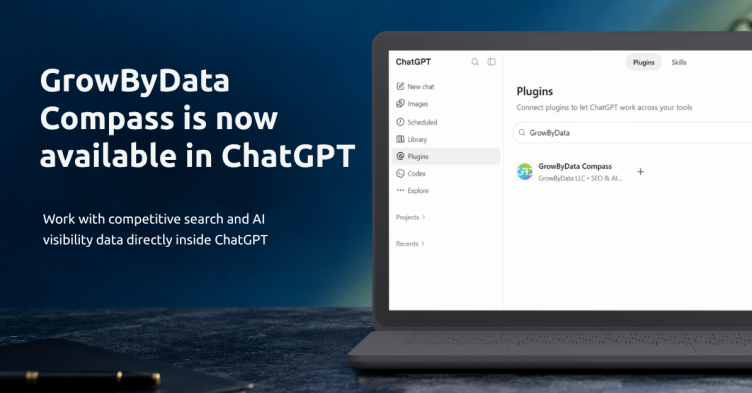
GrowByData’s ChatGPT brand monitoring tracks your mention rate, citation rate, and competitive share of voice, on your keywords, updated daily, alongside your Google Search and Shopping data.
What “tracking brand mentions in ChatGPT” actually means
ChatGPT has no public API that exposes what it says about your brand. No native analytics dashboard. No brand mention log. No citation report you can pull. Every method for monitoring ChatGPT brand visibility is a workaround, some dramatically better than others.
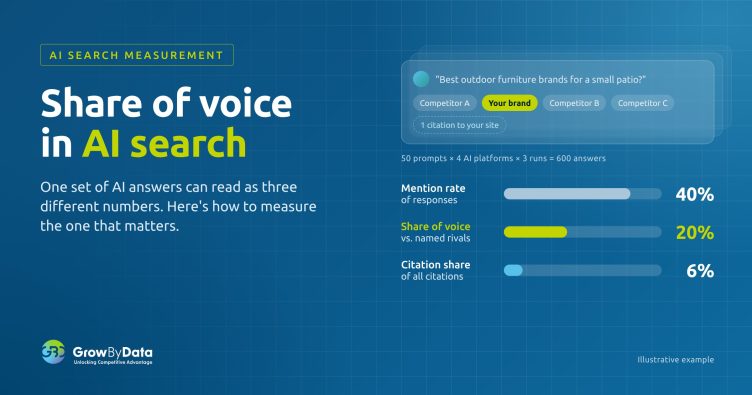
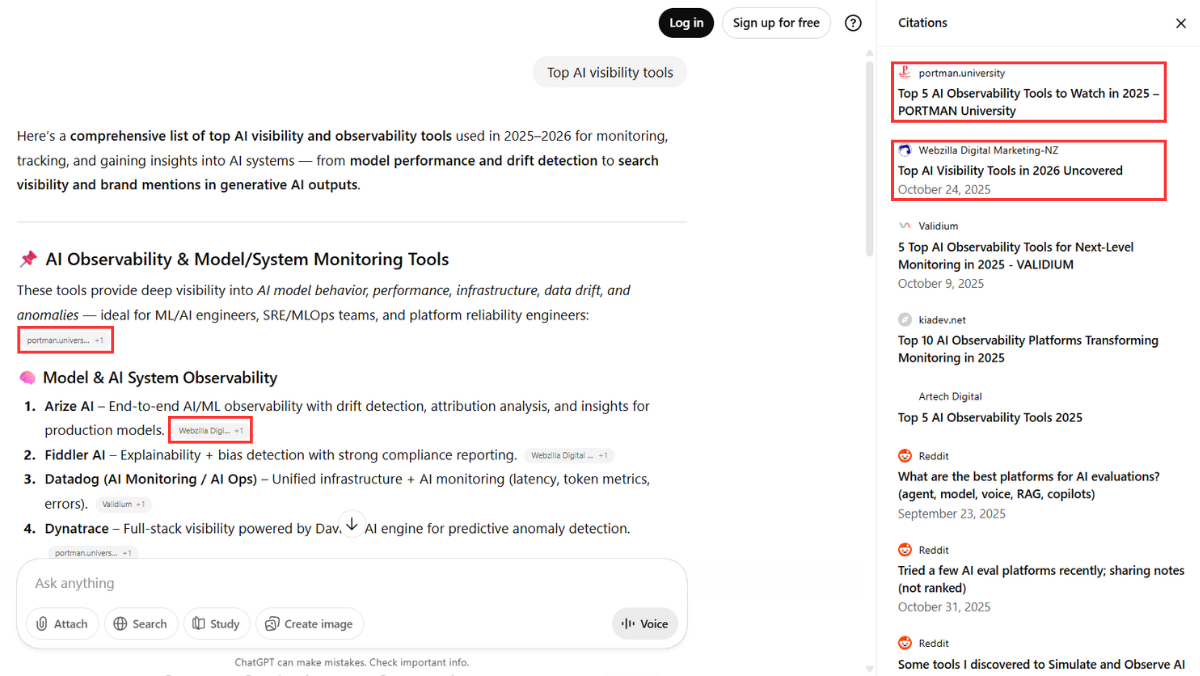
What you’re actually measuring across three distinct signal types. A brand mention means your name appears in an AI response. A citation means your specific URL was surfaced as a source, often as a numbered reference or inline link. A recommendation means ChatGPT positioned your brand as the answer to a specific problem. These map to different buyer moments and require different tracking approaches. Conflating them is the first mistake most teams make.
For a broader grounding in how these signals fit into the full picture of AI search visibility including how Google AIO, Perplexity, and ChatGPT differ in what they surface and why that context is worth having before you commit to a tracking approach.
Why manual prompt testing is not a tracking strategy
The most common “monitoring” approach: someone on the marketing team types queries into ChatGPT a few times a week and screenshots what comes back. Better than nothing, but structurally broken in four ways.
Responses vary. The same prompt typed twice produces different outputs. What you saw this morning isn’t necessarily what a buyer in a different location, using a different model version, sees this afternoon. One manual check captures a single data point from a probabilistic distribution.
Scale is impossible. A serious B2B brand might have 50 to 300 category queries worth monitoring, “best [category] software for enterprise,” “[problem] tools for [industry],” “[use case] solutions 2026” and dozens of natural variations. Testing those weekly by hand isn’t a workflow anyone sustains.
You have no trend data. You know what ChatGPT said today. You don’t know if your mention rate rose after your last press release, dropped when a competitor published original research, or tanks on certain prompt phrasings. Without longitudinal tracking, cause and effect are invisible.
You can’t benchmark competitors. Your brand appeared in three out of ten manual checks. So what? That number means nothing without knowing your top competitor appeared in eight of the same ten.
What tools actually work for tracking ChatGPT brand mentions
Purpose-built AI visibility platforms solve all four problems by automating prompt execution at scale, storing responses over time, and surfacing competitive share of voice across platforms. Here is an honest breakdown.
GrowByData LLM Intelligence
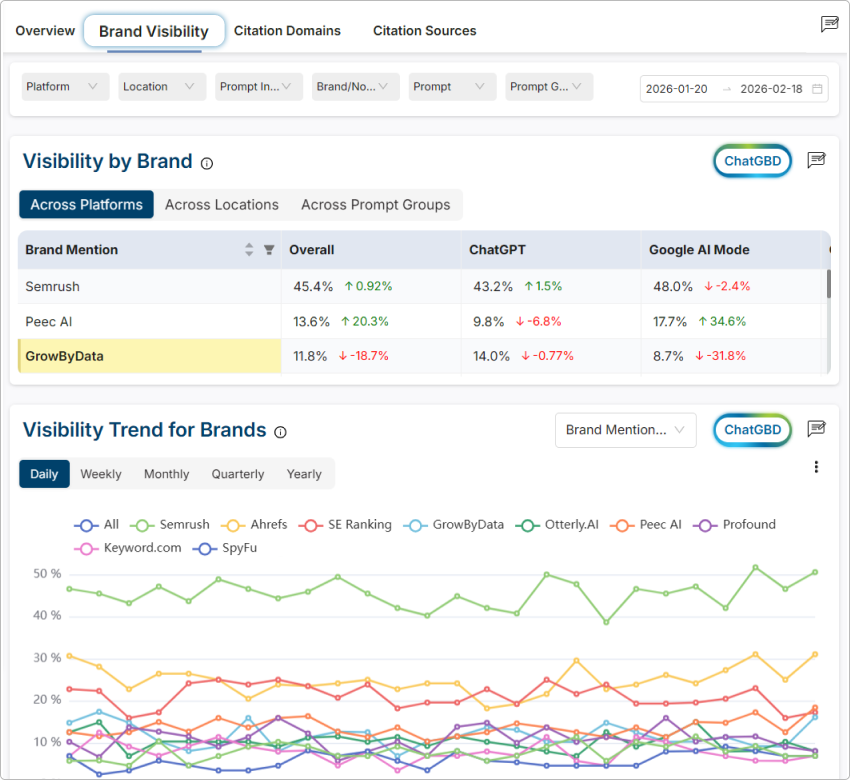
GrowByData’s LLM Intelligence tracks brand visibility across ChatGPT, Perplexity, Google AI Overviews, and Google AI Mode monitoring on the same keyword set used for your Google Search and Shopping competitive data. That unified view is the differentiator. A Director of Search running a weekly competitive review doesn’t just see that their brand appeared in 34% of ChatGPT responses for category keywords. They see it in the same dashboard where organic CTR dropped and a competitor’s Shopping Ads spend increased. Those intersections don’t surface when AI monitoring lives in a separate tool.
Citation URLs are tracked separately from brand mentions so you know whether ChatGPT is pulling from your site specifically or simply recalling your brand name from training data. That’s a meaningful distinction for content strategy.
Profound
The category leader in standalone AI visibility. Strong on automated prompt testing at scale, sentiment tracking, and share-of-voice reporting. Worth evaluating if your use case is AI-only and you don’t need the Google Search and Shopping layer. The limitation is exactly that: it doesn’t connect AI visibility to your broader search competitive picture, which means you’re managing two separate reports.
Otterly, Peec AI, and Scrunch
All three focus on AI mention monitoring at varying price points and platform depth. Otterly is the most affordable entry point for brands that need basic presence checking. Peec AI and Scrunch offer structured monitoring with different approaches to competitive benchmarking. None are purpose-built for the enterprise ecommerce use case where Shopping Ads and organic SERP data need to sit alongside AI visibility. If Perplexity citation tracking is the priority, GrowByData’s Perplexity brand monitoring tracks it on the same keyword set as your other platforms rather than as a standalone data point.
What about Quattr, Surfer, Cognizo, and Promptwatch?
Quattr and Surfer are SEO platforms with AI visibility features added on, not purpose-built for brand mention tracking across AI platforms. Cognizo and Promptwatch are lighter-weight monitoring tools. If you need longitudinal data at enterprise scale, purpose-built platforms will outperform bolt-on features every time.
What metrics actually matter
Brand mention. What percentage of your category-level prompts result in your brand being named? This is the baseline. Track it weekly on a fixed prompt set so movement is meaningful.
Citation. Of responses where your brand is mentioned, how often does a specific URL from your domain appear as a source? High mention rate plus low citation rate means ChatGPT knows your brand from training data but isn’t actively retrieving your current content. That’s a content structure problem, not a visibility problem.
Competitive share of voice in AI answers. For the same prompt set, who else is being mentioned, how often, and how? Your 40% mention rate means nothing in isolation. If a competitor holds 80% on the same queries, the gap is the story.
Prompt-type variation. Category prompts (“best tools for X”) behave differently than problem prompts (“how do I solve Y”) and comparison prompts (“X vs Y”). Being absent from comparison prompts almost always maps to missing comparison content on your site.
Trend over time. Monthly changes in mention rate correlate with things you can control: publishing new content, earning press coverage, earning a new backlink cluster from authoritative sources. Without longitudinal data you can’t connect action to outcome.
For how enterprise teams translate these numbers into business cases, see how enterprises measure ROI from AI search visibility.
What influences whether ChatGPT mentions your brand
The honest answer: it’s not primarily your search rankings. Brands with mediocre organic positions routinely show up in AI answers. Brands with strong organic visibility get ignored by ChatGPT. The factors that actually correlate:
Third-party source breadth. One strong article on your own blog does not build the same signal as being named in ten independent reviews, comparison pages, and industry publications. LLMs surface brands that appear consistently across multiple unaffiliated sources. First-party content alone isn’t enough.
Content specificity and structure. Vague positioning “a leading platform for digital marketing needs” gives a model nothing to retrieve when a user asks “what’s the best tool for tracking competitive Shopping Ads data?” Definitions, numbered processes, comparison tables, and specific data points are more citable than narrative prose. Every time.
Recency of authoritative coverage. Models update and some retrieve current content directly. Brands whose strongest third-party coverage is several years old tend to underperform brands with recent, specific, widely-cited content, one of the core themes in how AI search is changing enterprise strategy.
Citation rate on your own domain. If ChatGPT is citing specific URLs from your site, it’s actively retrieving content rather than recalling your brand from training. High-structure content the kind that answers one specific question, cleanly, in under five paragraphs earns this. Long narrative pages generally don’t.
How to build a basic tracking system without a platform
Not ready for a platform? Here’s the structured manual approach that’s meaningfully better than ad hoc prompt checking.
Start with a fixed prompt set of 20 to 30 queries a real buyer in your category would type into ChatGPT category questions, comparison questions, problem-solution questions, a handful of branded queries. Make them specific: “best competitive Shopping Ads monitoring tools for enterprise ecommerce,” not “marketing tools.” Document them in a spreadsheet and never change them mid-experiment.
Run the same set on the same day each week. Log whether your brand is mentioned, whether a URL was cited, what competitors appeared, and how your brand was characterized. Positive framing, neutral mention, and absent are three meaningfully different states.
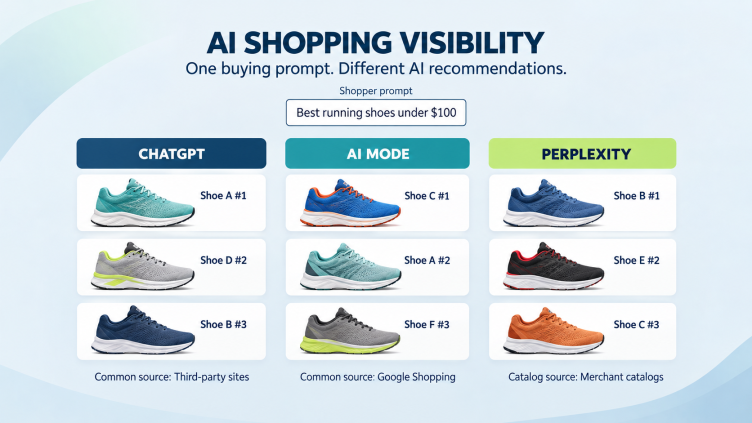
Cover at least three platforms. ChatGPT, Perplexity, and Google AI Overviews have substantially different citation graphs roughly 11% domain overlap between ChatGPT and Perplexity alone. Visibility in one does not translate to the others. The methodology for tracking brand mentions in Perplexity AI overlaps with this approach but the platform mechanics differ enough to warrant reading separately.
Record what changed when your scores shift. Mention rate drops after a competitor publishes original research? Rises after a major trade publication placement? That’s your working model of what actually moves the number.
When to move from manual tracking to a platform
Manual tracking breaks down at scale faster than most teams expect. The signal: you’re seeing competitors mentioned on queries you should own; you’re spending more than two hours a week on prompt checking; you need to report AI visibility alongside search and paid data; or you’re managing multiple brands, markets, or product lines simultaneously.
The value of a platform isn’t just automation. It’s consistency. The same prompts, the same methodology, every day, so trends are observable rather than noise. The best LLM visibility tracking tools for enterprise analysis covers how the main options differ on competitive reporting, platform coverage, and integration with traditional search data.
Track ChatGPT, Perplexity, Google AIO, and AI Mode in one dashboard
GrowByData monitors AI brand visibility on the same keyword set as your Google Search and Shopping data. No separate tools. No siloed reports. One competitive picture.
Frequently asked questions
How often does ChatGPT update which brands it mentions?
ChatGPT’s training data has a knowledge cutoff that updates with each major model version. But models increasingly retrieve current content through web access features, meaning recent authoritative coverage can influence responses faster than the historical training cycle. This is why a one-time audit is not a substitute for ongoing monitoring.
Does blocking GPTBot reduce my ChatGPT brand mentions?
Yes, over time. Blocking GPTBot. OpenAI’s training crawler removes your content from future training data updates. It doesn’t affect what the current model already knows. For most brands, blocking GPTBot is a mistake: it reduces future brand visibility in exchange for no meaningful benefit. Allowing AI training crawlers is the correct default for any brand that wants citation spread.
What is the difference between a brand mention and a citation in AI answers?
A brand mention means your brand name appeared in the response. A citation means your specific URL was surfaced as a source typically as a numbered reference or linked URL. Citations indicate active content retrieval. Mentions may simply reflect training data recall. Both matter, but they signal different things about your content’s authority.
How do I track brand mentions across ChatGPT and Perplexity at the same time?
You need to track them independently research shows only around 11% domain overlap in what ChatGPT and Perplexity cite. GrowByData’s LLM Intelligence monitors both simultaneously on the same query set, so you see cross-platform share of voice in a single view rather than reconciling two separate reports.
Why isn’t my brand showing up in ChatGPT?
The most common causes: limited independent third-party coverage naming your brand across unaffiliated sources; content that isn’t specific or structured enough for AI retrieval; a category where established competitors have significantly more authoritative content indexed; or positioning that’s too generic for a model to extract a clear answer from. A competitive AI visibility audit on your specific query set will usually identify the primary factor quickly.