
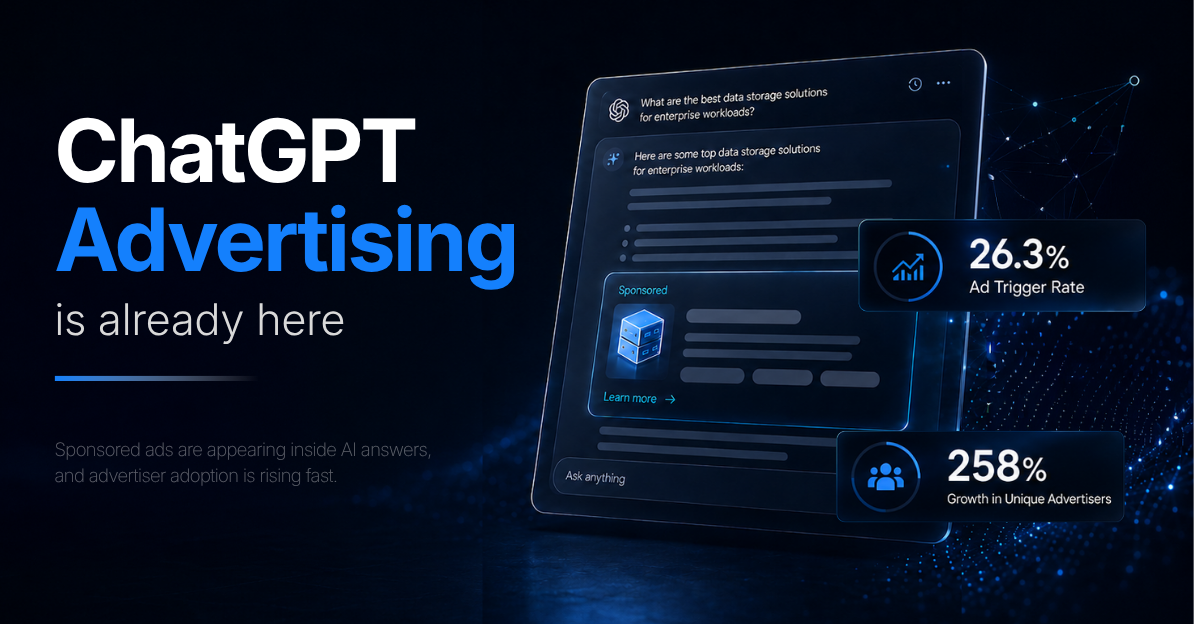
Roughly one in eleven ChatGPT prompts GrowByData tracked across a full month came back with a sponsored ad sitting inside the answer, the leading edge of ChatGPT advertising showing up at real, measurable scale. Not a link. Not a citation. An ad, labeled “Sponsored” or “Ads,” rendered right where the AI’s response used to be the whole story.
If you run paid search, ad intelligence, or brand protection for an enterprise retailer, that sentence should bother you a little. Most of the tools your team relies on today, your rank tracker, your Google Ads dashboard, even a dedicated competitive ad intelligence platform, can’t see any of it. A placement that lives inside a chat response is invisible to systems built to watch a search engine results page.
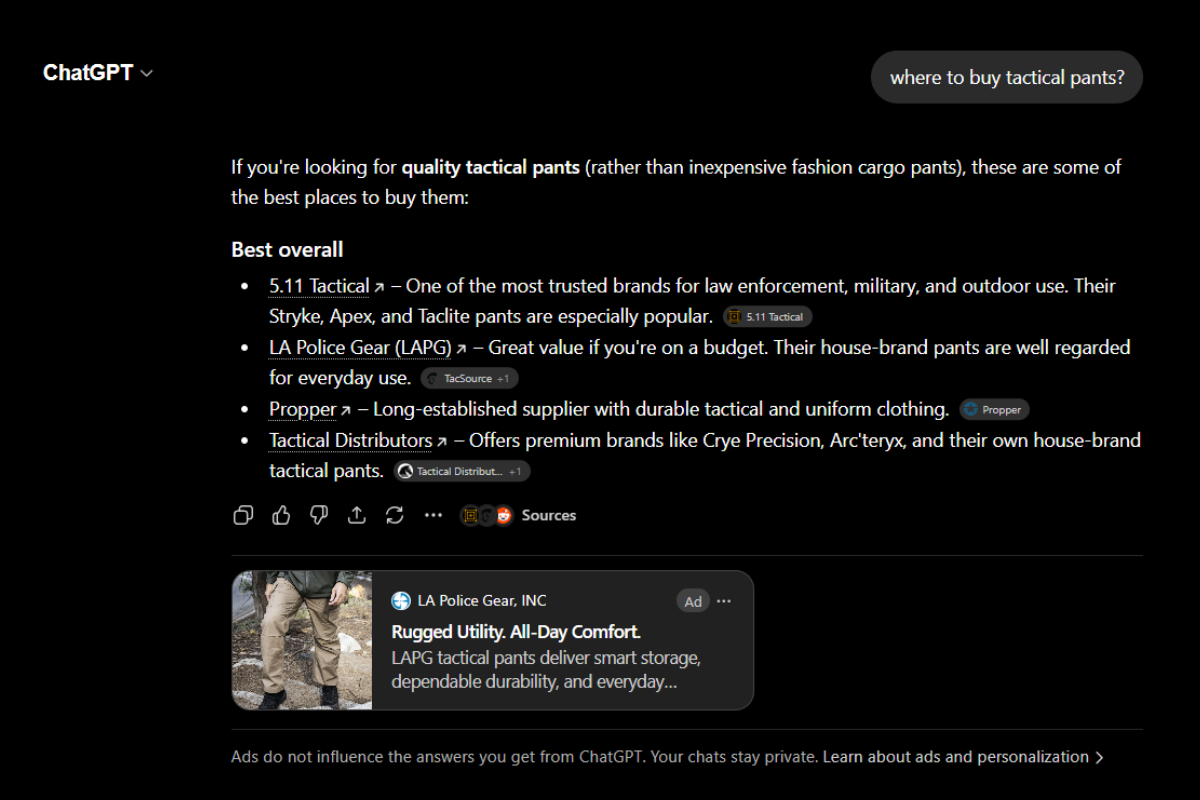
This is chatgpt advertising data pulled from GrowByData’s own tracking panel, and it’s worth sitting with before you decide whether this is a 2027 problem or a right-now one.
How This Rolled Out
OpenAI started serving sponsored placements as labeled “Sponsored” cards below select ChatGPT answers in late May. It’s not a separate ad unit bolted onto the interface, and it’s not a banner. It sits inside the response itself, in the same visual space where the model’s actual answer lives. For a buyer scanning a research prompt, the line between “what ChatGPT recommends” and “what a brand paid to show up” is thinner than it’s ever been on a traditional search results page.
That distinction matters for how you read everything below. This isn’t organic visibility slipping. Plenty of teams already know how to track brand mentions in ChatGPT on the organic side. This is the paid-media counterpart to that work, a new channel opening up inside a surface most performance marketing teams still treat as out of scope.
What the Panel Data Actually Shows
GrowByData tracks ChatGPT sponsored placements across a full month of prompt activity, spanning every client account in the panel. One verified number from June matters most:
|
9.2%
of tracked ChatGPT prompts returned a sponsored ad, June 2026
|
That’s the number worth sitting with. It’s not a majority of prompts, and it’s not rare, either. It’s a real, minority share of commercial conversations that most performance marketing teams currently have zero visibility into, drawn from a full month of tracking across every client account in the panel, not a one-off sample.
What We Don’t Know Yet
Being straight about the gaps matters more than padding the story. GrowByData doesn’t yet have a verified month-over-month advertiser growth figure for this panel, so that trend isn’t part of this piece. Category-level concentration data, whether placements skew toward specific product categories, isn’t solid enough yet to publish as a finding either.
What the data does support at the intent level: Transactional prompts showed the highest ChatGPT ad presence of any intent category tracked, well above Informational, Local, or Commercial Investigation. That’s worth flagging. It’s also based on a small number of ads, so treat it as an early signal to watch, not a settled pattern to build strategy around yet.
Where This Still Needs Sharper Data
The honest version of this story is narrower than the flashy one. GrowByData can confirm placements exist, confirm how often they trigger, and confirm which intent shows the strongest early signal. What it can’t yet confirm, with the rigor this piece holds itself to, is which product categories carry the most exposure. That’s the next thing worth tracking, not a claim worth making today.
The Budget Conversation This Forces
Every performance marketing team has some version of the same annual argument: how much of next year’s budget moves toward whatever channel is newest, and how much stays where the attribution is already proven. A 9.2% trigger rate isn’t loud enough to force that argument on its own. It is loud enough to earn a line item on the agenda.
Here’s the honest framing. Auction dynamics on any paid channel tend to follow the same arc: cheap and under-competed while advertisers are still figuring out whether it converts, then expensive and crowded once it’s proven.
Whether ChatGPT ads are currently in the cheap, early part of that curve isn’t a claim this piece can make yet, GrowByData doesn’t have a verified advertiser trend to point to. What the trigger rate does confirm is that the auction exists and is live today, which is more than most teams currently know.
The case against moving budget early is real, and worth saying out loud instead of glossing over. A 9.2% trigger rate means the large majority of prompts still show no ad at all, so the addressable volume today is a fraction of what it might eventually become. Attribution inside a chat interface is nowhere near as mature as it is on a search results page, either.
If your team is stretched thin, moving budget may not be this quarter’s fight. What it can’t be is a channel nobody on your team is even watching. Confirming exposure costs a conversation. Missing it costs a competitor’s head start.
How Do You Know If a Competitor Is Bidding on Your ChatGPT Prompts?
Right now, mostly you don’t, unless you’re checking manually. And manual checking doesn’t scale past a handful of prompts, doesn’t give you a dated record if you need to prove a trademark violation, and misses the placements that only show up for certain phrasings or certain sessions.
The practical answer is the same discipline paid search teams already apply to Google auction insights, just pointed at a surface those tools were never built to see: identify the buyer prompts in your category, track who’s showing up against them over time, and keep evidence, not just a memory of having seen something once.
Here’s where most SEO and paid search teams get this wrong: they treat ChatGPT ad visibility as an extension of their existing brand monitoring work. It isn’t. Brand monitoring, the organic side of LLM Intelligence, tracks how ChatGPT talks about you. This is paid media. Different budget line, different competitive risk, and right now, almost nobody’s watching it with any rigor.
Talk to an expert about what a ChatGPT ads audit would actually surface for your category before you assume it’s nothing.
Why This Matters More Than It Looks Like It Does
Here’s the tension worth sitting with. 9.2% isn’t a majority. Most tracked prompts still don’t show an ad. It would be easy to read that number and file this under “watch later.”
But two things push against that read. First, this is a channel that didn’t carry paid placements at all until recently, going from zero to a real, measurable trigger rate in a short window is a different kind of signal than a mature channel drifting a few points. Second, plenty of high-intent prompts still have no advertiser at all. That’s the window.
Once a competitor claims a prompt and starts showing up on it consistently, displacing them gets harder and more expensive. It’s the same dynamic that’s played out on every other paid channel that’s ever existed.
Watching this now is cheap precisely because the surface is still forming. That won’t hold for long once more advertisers figure out what the early movers already know.
What This Won’t Do
It’s worth being straight about the limits here, because a vendor blog that only sells upside isn’t worth trusting. Tracking ChatGPT ad placements tells you who’s buying visibility and where. It doesn’t tell you your own ad’s click-through rate inside a chat interface, because OpenAI doesn’t expose that the way Google Ads exposes auction insights.
It won’t replace a Google Ads strategy, and anyone telling you to shift meaningful budget out of proven search channels into an unproven one this early is selling something. What it gives you is the thing you don’t currently have at all: visibility into a channel your competitors may already be testing while you’re flying blind.
What to Actually Do With This
Three moves, in order of effort:
- Check where your commercial prompts land by intent. Transactional prompts are showing the strongest early ad presence in the panel, higher than informational or local queries. If your buyers are typing bottom-of-funnel, ready-to-act questions into ChatGPT, that’s where exposure is most likely to show up first.
- Identify which of your commercial prompts are unclaimed. The prompts nobody’s advertising against yet are the cheapest ones to hold. That won’t be true once the market catches up. This is the same land-grab logic that made early Google Ads accounts so much cheaper to run than the ones built five years later.
- Separate this from your existing brand monitoring. If your team is tracking ChatGPT brand monitoring already, that’s good instinct, wrong layer. Organic citations and paid placements need to be watched as two distinct competitive risks, not folded into one dashboard and called done. A competitor can be losing ground on organic mentions and still be buying their way past you on the exact same prompt.
This isn’t isolated to ChatGPT, either, and it’s worth seeing as one piece of the broader AI search visibility picture rather than a one-off. Google’s rolled sponsored placements into AI Overviews on a similar trajectory. If you’re tracking one AI ad surface, you should be tracking ads in Google AI Overviews too, because a brand that’s exposed on one is often exposed on the other.
GrowByData’s ChatGPT Ads monitoring tracks exactly this: which prompts trigger a placement, which brands are buying them, and dated screenshot evidence for every one, sitting alongside your existing Google and Shopping visibility instead of living in a separate tool nobody checks.
The prompts in your category that don’t have an advertiser yet won’t stay that way. Book a strategy session and find out which ones are still open before somebody else claims them.