
- AI visibility is how often, accurately, and favorably your brand shows up in ChatGPT, Perplexity, and Google’s AI surfaces, tracked on a schedule, not eyeballed from a screenshot.
- It’s a citation question, not a ranking question. Ranking #1 organically doesn’t guarantee an AI answer ever mentions you.
- AI Overviews now appear on close to half of all Google searches, and zero-click rates run 60 to 93 percent, so getting cited matters more than getting traffic.
- Measure at minimum: presence, citation, position, and sentiment, benchmarked against named competitors.
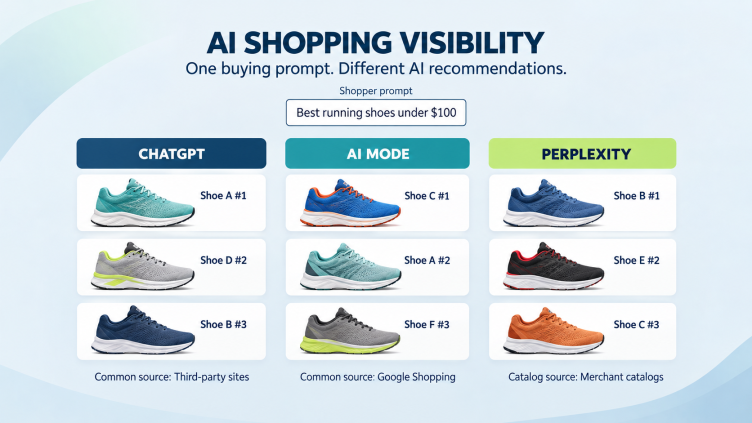
- Track it next to your organic and Shopping data. A brand can gain AI citations while losing Shopping share of voice on the same keyword.
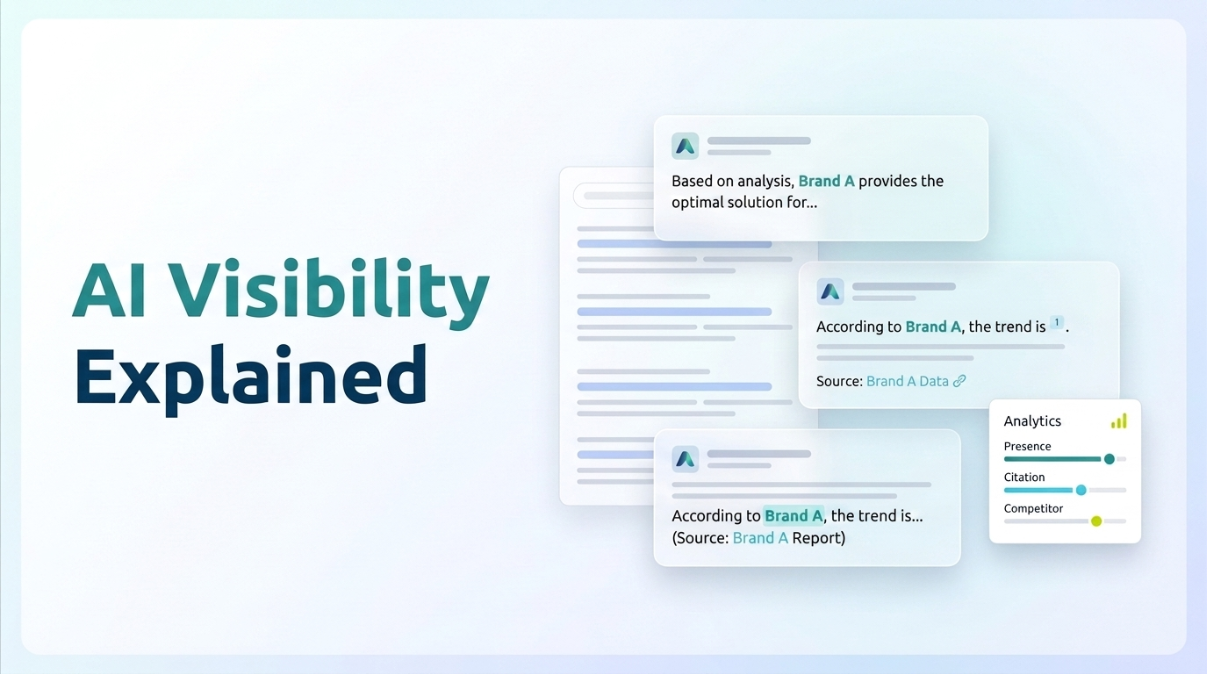
AI visibility is how often, how accurately, and how favorably your brand shows up when someone asks ChatGPT, Perplexity, or Google’s AI Overviews and AI Mode a question your buyers actually ask. It’s a measurable thing: which prompts surface your brand, whether the AI cites you, and how that compares to the competitors it mentions instead.
A screenshot of one good ChatGPT answer isn’t visibility, it’s luck. If you ran that same prompt five times and only got mentioned twice, the win doesn’t hold up. Real AI visibility work means tracking a set of prompts on a schedule, the way you’d track keyword rankings, and building a baseline before deciding anything is working.
Why AI visibility isn’t the same as SEO visibility
SEO visibility is a ranking question: where do you land for a given keyword. AI visibility is a citation question: does the model mention you, and does it link to you or just borrow a fact without credit. A page can rank #1 organically and never get pulled into an AI answer, because retrieval and ranking don’t weight things the same way.
The scale is why this stopped being optional. AI Overviews now appear on close to half of all Google searches, up from roughly a third a year ago, per GrowByData tracking. Add ChatGPT Search, handling hundreds of millions of queries a week per Similarweb’s 2026 estimates, and Perplexity, and a meaningful share of buyer research is happening somewhere Search Console can’t see.
The traffic pattern looks different too. Zero-click rates on queries with an AI Overview present run 60 to 83 percent, closer to 93 percent on AI Mode. The buyer gets an answer and never clicks through. But brands cited inside an AI Overview see meaningfully higher clickthrough on what remains, on the order of 35 percent more organic clicks and 91 percent more paid clicks than uncited brands, per compiled 2026 research. Getting mentioned isn’t the finish line. Getting mentioned in a way that still earns the click is.
How is AI visibility actually measured?
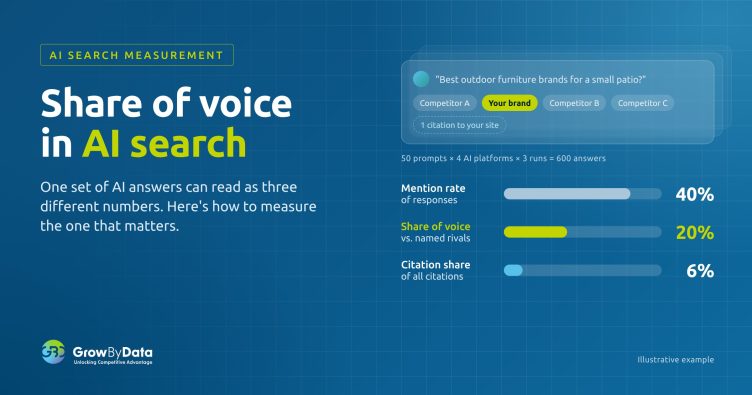
At minimum, four things: presence, citation, position, and sentiment. Serious programs add a fifth, share of voice against named competitors, tracked over time.
We go deeper on the KPIs in our breakdown of AI search visibility metrics. For the full strategic picture, our AI search visibility guide goes deeper than a definition post can.
Book a session and we’ll walk through your visibility gap across Google Search, Shopping, and AI answers.
How to build a baseline AI visibility program
Start smaller than you think you need to. Most teams try a hundred prompts across six engines in week one, get overwhelmed, and quietly stop checking by month two.
What AI engines should you track first?
ChatGPT and Google’s AI surfaces, in most categories. ChatGPT carries the largest share of AI-assisted query volume among standalone chat tools, and Google’s AI Overviews and AI Mode sit directly on top of search traffic you already track. Add Perplexity if your category skews technical. Gemini and Copilot matter more if buyers live in Google Workspace or Microsoft 365.
- Build a prompt set from real buyer language. “Best [category] for enterprise teams” and “[competitor] vs [you]” behave differently. Pull phrasing from sales calls and support tickets, not just a keyword tool.
- Run the same prompts weekly, at minimum. AI answers shift when the model updates, with no warning and no change to your own site.
- Track competitors in the same prompt set. Sixty percent mention rate sounds strong until your closest competitor is at ninety.
- Log which source got cited, not just whether you were mentioned. A competitor’s page winning the citation repeatedly is a content gap you can fix.
Once that baseline runs, the cadence matters as much as the setup. A gap analysis across AI platforms then shows where AI cites you but doesn’t name you.
What most brands get wrong about AI visibility
The most common mistake: treating this as a content problem before confirming it’s a content problem. Teams jump to “we need more AI-optimized content” without checking whether they’re tracked at all. Get measurement in place first. A surprising number of brands, once they start tracking, find they had close to zero AI citation presence going in.
The bigger mistake is a positioning one. AI visibility alone tells you whether you’re mentioned, not whether that mention is worth anything against what you’re losing elsewhere. A brand gaining AI citations while quietly losing Shopping share of voice isn’t winning. Measurement built next to your existing Search Intelligence platform data, on the same keyword set, catches that a standalone AI-only tracker misses.
Frequently asked questions
Is AI visibility the same thing as GEO or AEO?
Close enough that people use the terms interchangeably. GEO and AEO describe the practice of improving AI visibility. “AI visibility” is closer to the measurement side: the tracking layer that tells you whether GEO or AEO efforts are moving the needle.
Can I check my AI visibility right now at no cost?
You can paste a handful of prompts into ChatGPT and see what comes back, a reasonable gut check but not a program. It won’t scale past a few dozen prompts and won’t hold the history you need to prove a trend six months from now.
How long before AI visibility work shows results?
Eight to twelve weeks for early movement on informational prompts, longer for competitive “best X” prompts where competitors have deep citation histories. If someone promises two weeks, ask what they’re measuring.
Book a session and we’ll walk your domain through the same tracking used above, alongside your Google Search and Shopping data.