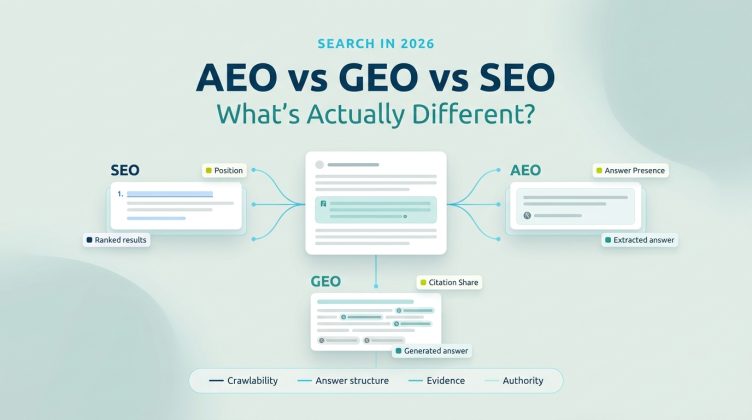
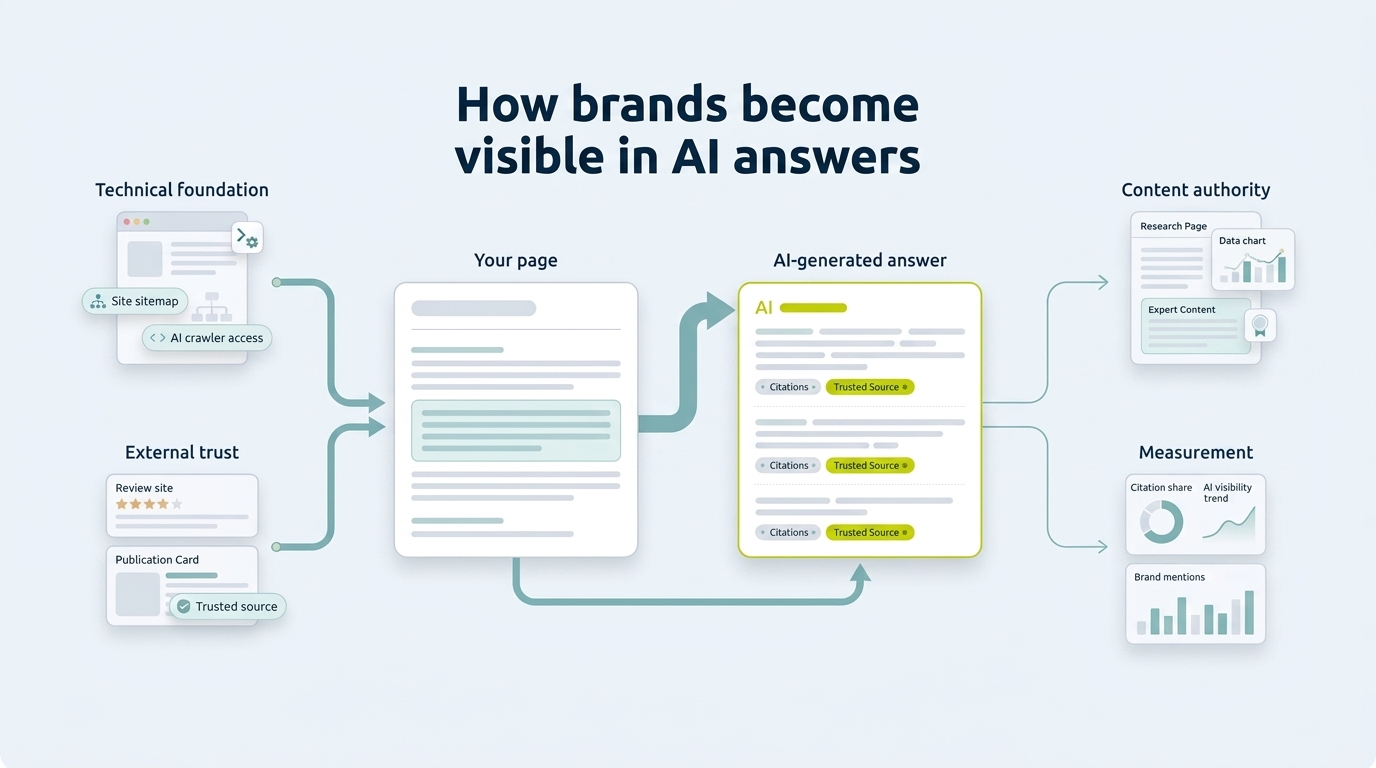
Generative engine optimization best practices are the habits that make your pages easy for AI search tools to find, trust, and cite. On Google, that work is ordinary SEO done well. On ChatGPT and Perplexity, the same foundations apply, but you also need crawler access, outside proof, and repeated measurement.
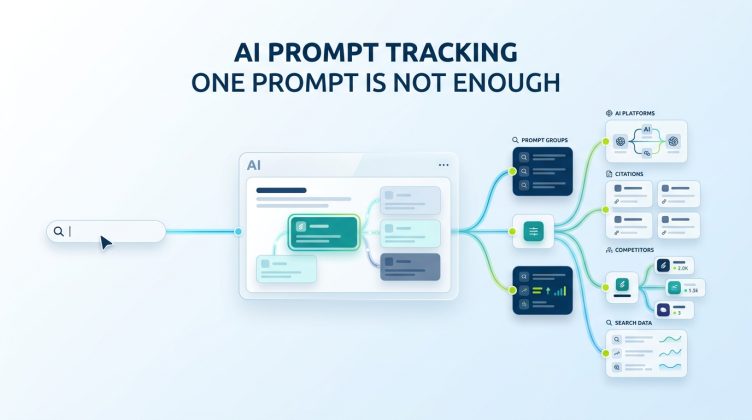
Our view: most GEO programs go wrong in measurement, not tactics. A team checks one AI answer, sees its brand missing, and rewrites pages. One check tells you very little.
12 generative engine optimization best practices at a glance
The list runs roughly in the order we’d fix things. Each practice notes where the evidence applies, because advice that holds for Google may not hold for ChatGPT or Perplexity.
| # | Practice | Where it applies | Basis |
|---|---|---|---|
| 1 | Fix indexing and snippet eligibility | Google AI Overviews and AI Mode | Google requirement (Google guide, May 2026) |
| 2 | Allow AI search crawlers | ChatGPT and Perplexity | OpenAI and Perplexity crawler documentation |
| 3 | Map real buyer prompts | All four platforms | Practitioner view |
| 4 | Publish first-party data and a point of view | All four platforms | Google guide, May 2026 |
| 5 | Answer early in passages that stand alone | Mainly ChatGPT and Perplexity | Practitioner view; Google says chunking isn’t required |
| 6 | Keep entity details consistent | All four platforms | Practitioner view |
| 7 | Earn authentic third-party coverage | All four platforms | Google warns against inauthentic mentions |
| 8 | Keep Merchant Center feeds complete | Google AI features, for ecommerce | Google guide, May 2026 |
| 9 | Add images and video where they help | Google AI features | Google guide, May 2026 |
| 10 | Refresh on a schedule | All four platforms | Practitioner view |
| 11 | Treat schema as SEO hygiene | Google rich results | Google guide says schema isn’t required for AI features |
| 12 | Measure with repeated runs | ChatGPT, Perplexity, and Google AI Mode | University of St. Gallen preprint, April 2026 |
Overlap note: practices 5 and 11 can help on some platforms but are optional for Google’s AI features, so the table lists them with that limit.
What are generative engine optimization best practices?
Generative engine optimization best practices are the content, technical, and measurement habits that raise the odds an AI answer cites your brand. The practices cover indexing, crawler access, original content, clear writing, outside validation, product feeds, and tracking. Which ones matter depends on the platform: Google AI Overviews, Google AI Mode, ChatGPT, or Perplexity.
GEO stands for generative engine optimization. The term comes from a 2023 paper by researchers at Princeton University and IIT Delhi. On their own benchmark of test queries, GEO methods raised visibility in generative engine responses by up to 40%, and the effect varied by subject area.
That last detail matters. When a vendor promises a fixed lift, remember that the original research didn’t find one.
Is SEO dead now with AI?
SEO isn’t dead with AI. Google says AI Overviews and AI Mode rely on its core Search ranking and quality systems, so optimizing for those features is still SEO. According to Google’s May 2026 guide, a page must be indexed and eligible for a snippet to appear as a link in Google’s generative AI features.
The same guide lists tactics you can ignore for Google Search. They include llms.txt files and other special markup, breaking content into tiny chunks, rewriting pages just for AI, chasing inauthentic mentions, and adding special schema.
That guidance covers Google only. OpenAI and Perplexity publish their own crawler rules, and their answer engines pick sources in their own ways. SEO still carries Google, and it carries most of the work elsewhere, but not all of it.
Google’s own AI answers don’t always follow the guide. When we searched “generative engine optimization best practices” in the US in September 2026, the AI Overview told readers to put a 40 to 80 word summary at the top of the page. AI Mode recommended heavy use of schema.
AI engines are already influencing buying decisions. Find out how your brand is represented.
Schedule a Strategy Session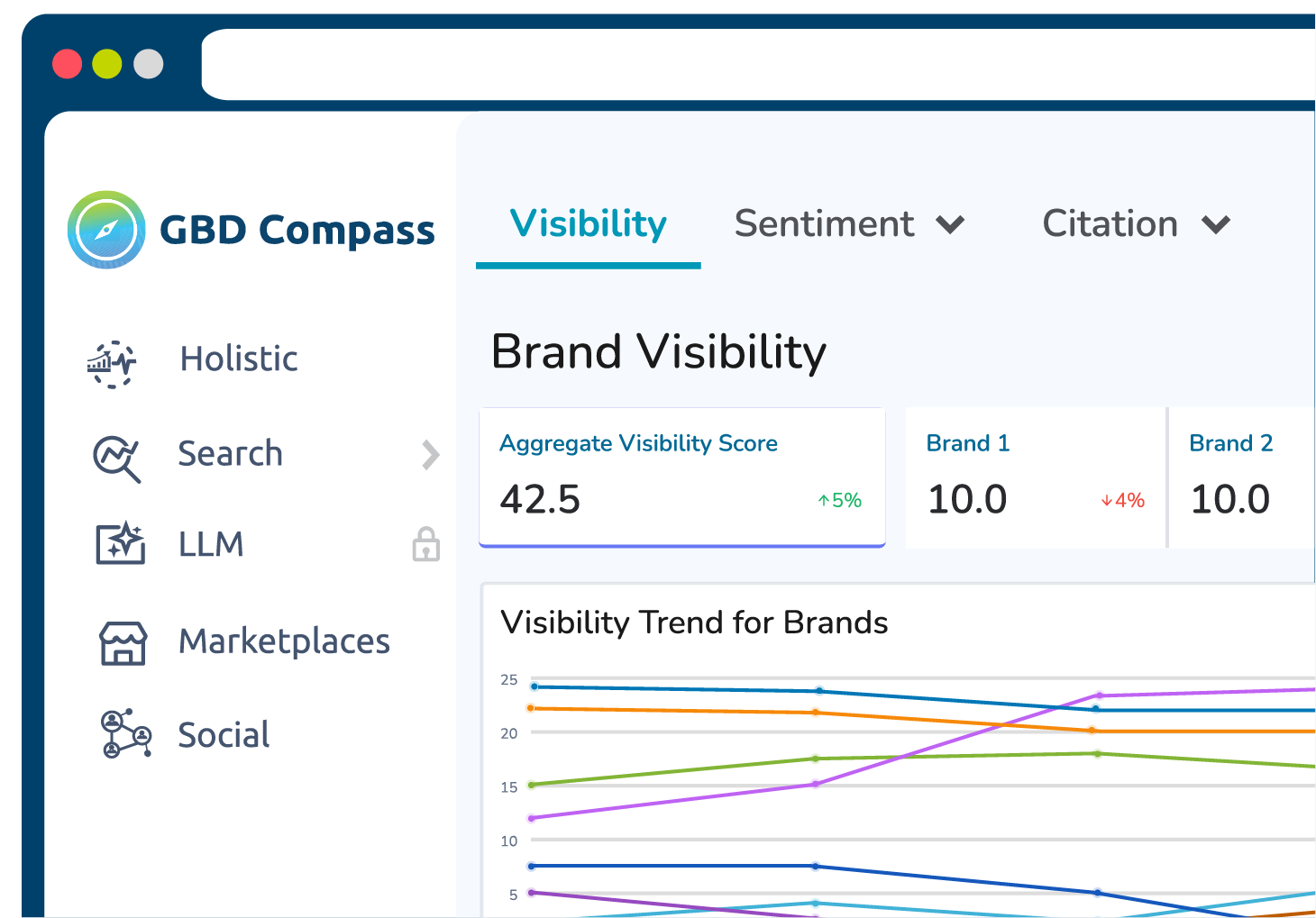
That was one check on one day, so treat it as an anecdote. It still shows why a single AI answer is a poor guide to what works.
How to apply each practice
1. Fix indexing and snippet eligibility first
Google shows a page as a link in AI Overviews or AI Mode only if the page is indexed and eligible for a snippet. Google also says the site must be included in generative AI features in Search Console.
Check Search Console for pages dropped from the index or blocked by a nosnippet rule before touching content. In our experience, teams skip this step because it doesn’t feel new.
2. Check AI crawler access per platform
ChatGPT and Perplexity use their own crawlers. OpenAI says sites that block OAI-SearchBot won’t appear in ChatGPT search answers, though they can still show as navigational links. Perplexity recommends allowing PerplexityBot so your site can appear in its results.
Watch for blanket AI blocks. OpenAI treats GPTBot, its training crawler, as a separate setting from OAI-SearchBot. A firewall rule that blocks every AI bot can remove you from ChatGPT search when you only meant to opt out of training.
Ask your web team for the current robots.txt file and firewall rules, and check both.
3. Map real buyer prompts, not keyword permutations
Build your prompt set from questions buyers actually ask. Good sources are sales calls, support tickets, Search Console queries, and the grounding queries in Bing Webmaster Tools.
A paid search director asking which tool tracks Google Shopping ads daily is a prompt worth tracking. A dozen rewordings of the same question aren’t.
Don’t turn those prompts into near-identical pages. Google says creating pages for every query variation mainly to manipulate AI responses violates its scaled content abuse policy.
4. Publish first-party data and a point of view
Google says unique, non-commodity content will likely shape your presence in AI search more than anything else in its guide. Its example of commodity content is a generic “7 tips” article. Yes, this article is a numbered list too, which is why every item here carries a scope and a source.
For an enterprise brand, first-party material usually means your own search data, pricing observations, anonymized customer patterns, and a clear stance. A summary of other people’s summaries gives an AI answer no reason to pick you.
5. Answer early in passages that stand alone
Most generative engine optimization content writing best practices come down to one habit. Answer the question in the first two or three sentences, name the subject in full, and keep limits like dates and markets in the same paragraph.
When an answer engine lifts a passage, the surrounding context is gone. “It grew last quarter” means nothing on its own. “Organic clicks to the pricing page grew in Q2 2026, US only” still makes sense when quoted.
Google says you don’t need to chunk content for its AI features, and there’s no ideal page length. Write this way for readers and for other answer engines, not because Google requires it.
6. Keep entity details consistent
Use the same company name, product names, and one-line description across your site, About page, author bios, review profiles, and press materials.
When a VP asks ChatGPT what your company does, the answer draws on whatever sources the engine finds. Conflicting descriptions give it room to guess.
7. Earn authentic third-party coverage
AI answers pull from pages you don’t own, such as review platforms, trade publications, forums, and roundups. Earn your place there with real reviews, contributed research, and useful answers.
Skip paid or fake mentions. Google says seeking inauthentic mentions isn’t as helpful as it might seem, and its AI features depend on the same spam systems as the rest of Search.
8. Keep Merchant Center feeds complete
Google says Merchant Center feeds and Google Business Profiles can help products and services appear in AI responses and other Search results. For retailers and brands, feed quality is a GEO task: accurate titles, prices, availability, and product attributes.
If you already run Google Shopping ads, your feed team owns a GEO lever and may not know it. Pair feed fixes with Google Shopping monitoring so you can see what shoppers actually get.
9. Add images and video where they help
Google says its AI features can show relevant images and video, which gives your site more ways to appear than a text link alone. Following Google’s existing image and video SEO guidance covers most of the work.
Add visuals when they explain something. A stock photo added to hit a quota helps nobody.
10. Refresh on a schedule
Set a review cycle for pages that answer fast-moving questions, and show a visible “last updated” date. We recheck our own AI search content every three months, because platform behavior and product scope change quickly.
Refreshing means changing facts, not just the date. A new timestamp on unchanged content misleads readers.
11. Treat schema as SEO hygiene, not a GEO lever
Google says structured data isn’t required for its generative AI features and that no special schema exists for them. Keep using Article, FAQPage, Product, and Organization markup where they fit, because they support rich results.
Just don’t budget schema work as your AI visibility plan.
12. Measure with repeated runs, not one-off checks
AI answers change from run to run. A 2026 University of St. Gallen study of four Swiss-German market categories found that only 34% to 42% of cited sources overlapped from one day to the next. Brand mentions were steadier but still shifted.
The authors recommend at least 7 runs per prompt per day for brand visibility, plus rolling windows of two to four weeks. The study is a preprint based on Swiss servers, and its lead author is affiliated with Aurora Intelligence, the source of its daily data. Read it as directional.
The study also found that citations concentrate on a few domains and that concentration differs by engine, with Google AI Mode the most concentrated and Perplexity the least. Set a separate baseline for each platform instead of one blended score.
What are the best strategies for generative engine optimization?
The best generative engine optimization strategies start with eligibility and measurement, then protect pages that already earn AI citations, then close gaps against named competitors. Run GEO as one search program with a separate scorecard for Google, ChatGPT, and Perplexity. The SEO lead should own it, with PR, product marketing, and the feed team contributing.
There’s no single best generative engine optimization strategy for AI, because each engine picks sources differently. A workable order looks like this:
- Baseline first. Build a prompt set that covers each stage of the funnel, and run it on each platform before changing anything.
- Protect what’s working. Find the pages AI answers already cite and keep them accurate and current.
- Close named gaps. Compare your inclusion against the competitors your sales team actually loses to, prompt by prompt.
- Connect citations to pipeline. Link cited informational pages to the solution pages that convert.
Most teams we see spin up a separate GEO workstream with its own content calendar. That usually duplicates SEO work. Keep one content plan and add the AI measurement layer on top.
The tradeoff is reporting load. Three scorecards take more time to build, and the platforms will sometimes disagree with each other from week to week.
Worked example: where GrowByData’s AI citations come from
Bing Webmaster Tools includes AI performance reports that show grounding queries and citation counts for a site. In GrowByData’s export dated June 22, 2026, 382 of 426 grounding queries carried Bing’s Informational, Learn and Solve, or Research labels. Those queries accounted for 13,727 of 14,727 citations.
Queries Bing labeled Commercial made up 5 queries and 42 citations. A page-level export from the same date showed one guide on AI search visibility with 7,699 of 23,152 page citations.
This is one site with an education-heavy content mix, so treat it as a pattern check, not a benchmark. The pattern is still useful: informational pages earned the citations, while commercial pages exist to earn leads. Measure them separately, and link the first to the second.
See where your brand appears in AI answers. Book an AI visibility audit and we’ll walk through your Google AI Overviews, AI Mode, ChatGPT, and Perplexity results.
When should you start optimizing for AI visibility?
Start optimizing for AI visibility once your core pages are indexed, open to AI search crawlers, and ranking for the questions buyers ask. For most enterprise brands, that point has already passed, because the foundation work overlaps with SEO. Start measuring before you change pages, or you won’t know what moved.
A common trigger is a sales call where a prospect says ChatGPT recommended a competitor. By then the gap already exists. A baseline taken a quarter earlier would have shown when it opened.
How do you measure visibility in generative search results?
To measure visibility in generative search results, run a fixed set of prompts on each platform many times. Track how often your brand is mentioned, which of your pages are cited, and which competitors appear. Add first-party reports from Google Search Console and Bing Webmaster Tools for the Google and Bing side.
Start with what you already have. Google points site owners to a Generative AI performance report in Search Console, and Bing Webmaster Tools reports AI citations and cited pages. Neither report covers ChatGPT or Perplexity, and neither shows competitors.
For those gaps, track a few metrics consistently:
- Inclusion rate: the share of runs where your brand appears in the answer.
- Cited URLs: which of your pages the answer links to, and how often.
- Competitor inclusion: the same numbers for the brands you compete with.
- Accuracy: whether the answer describes your products correctly.
For platform-specific setups, see how to track brand mentions in ChatGPT and how to track brand mentions in Perplexity AI. To compare vendors, see our roundup of the best LLM visibility tracking tools for enterprise.
How do you accurately measure share of voice in GEO?
To measure share of voice in GEO accurately, count how often each brand appears across repeated runs of the same prompt set, per platform, over a rolling window of a few weeks. Report each brand’s share of all mentions or citations, and put the number of prompts and runs beside every figure.
Call the metric inclusion rather than ranking, since most AI answers cite several sources at once. Keep it separate from Google Share of Voice on the classic results page. The two answer different questions, and blending them hides which one moved.
When you report upward, tie the numbers to revenue. Our guide on how enterprises measure ROI from AI search visibility covers that step.
How GrowByData helps
GrowByData is a search and AI visibility intelligence company for enterprise brands, retailers, and agencies. GrowByData Compass tracks Google results, SERP features, Google Shopping, Google AI Overviews, Google AI Mode, ChatGPT, and Perplexity. As of September 2026, it doesn’t track Gemini or Copilot.
Your team can see AI answers and classic results side by side for your chosen markets and devices, and compare your brand with the competitors you name. For details, see LLM Intelligence, Google AI Mode monitoring, and Google AI Overviews monitoring.
Most enterprise teams learn they’re missing from AI answers secondhand, usually on a sales call. If you’d rather see it first, book a demo with our team.
Frequently asked questions
Is there research behind generative engine optimization?
Yes. The term comes from a 2023 paper by Aggarwal and colleagues, accepted at the KDD 2024 conference, which tested optimization methods on a benchmark of queries. Newer work, such as the 2026 St. Gallen preprint, focuses on how much AI answers change between runs.
Do prompt variations change brand visibility in AI answers?
Yes, sometimes a lot. The St. Gallen study found that consistency between runs varied widely by prompt, and specific product questions produced steadier answers than broad ones. Track a portfolio of prompts rather than one or two.
Does llms.txt help generative engine optimization?
Not on Google. Google says its Search features, including its AI features, ignore llms.txt, so the file neither helps nor hurts there. Other services may read the file, which makes it a low-cost option rather than a priority.
Can GEO work hurt your SEO?
Not if the work follows Google’s guidance. The risk comes from tactics like mass-producing near-duplicate pages for query variations, which Google treats as scaled content abuse. Most practices on this list help both.