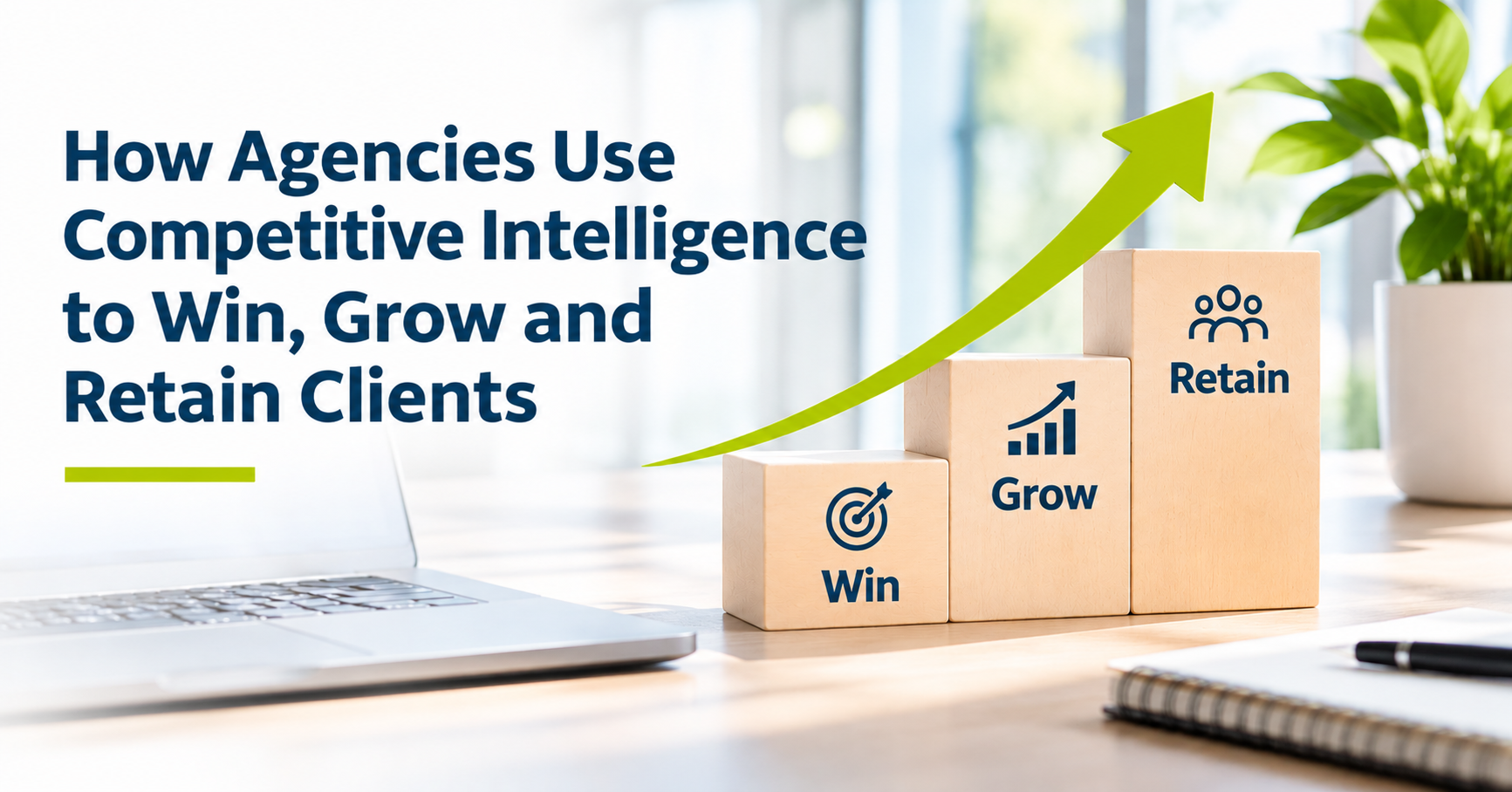
Competitive intelligence for agencies is the outside view of a client’s market: who shows up in Google and AI answers, where, and with what message. Agencies use it to show prospects something new, prove a need before proposing more work, and explain change in every business review.
Our view: the agencies that win with it lead with one sharp finding, not a dashboard.
- What is it? The outside view of a client’s market: who shows up in Google and AI answers, where, and with what message.
- How does it win pitches? One verified finding about the prospect’s market, such as a local rival missing from their brief.
- How does it drive upsells? A validated gap comes first, then a bounded pilot instead of a generic package.
- How does it help retention? Reviews about what’s changing in the market get shared with senior leadership.
- What does GrowByData Compass track? Google organic, paid, Shopping and local results, plus brand mentions and citations in ChatGPT, Google AI Mode and Google AI Overviews.
The strongest moment in a pitch is rarely the credentials slide. It’s the moment someone on the client’s side leans in and says, “We haven’t seen that before.”
Maybe it’s a regional advertiser missing from the competitive brief. Maybe the brand’s biggest national rival turns out to be a minor player in the cities that matter most. Or maybe it’s the list of publishers, videos and comparison pages that keep showing up in AI answers next to a competitor.
Findings like these change the conversation. The agency stops describing how strategic it is and starts showing it, before the contract is signed.
We went back through a year of agency calls and emails to see how teams use GrowByData Compass this way. The patterns below come from that work, with client and agency names removed.
Why Isn’t Client Analytics Enough for an Agency?
Client analytics explain what happened inside the client’s own measurable environment: traffic, ad performance, conversions and revenue. They can’t show what changed around the brand, such as a new competitor, a different results page layout or a shift in AI answers. Agencies need an external competitive view to explain performance changes and recommend the next move.
Search Console, GA4 and the ad platforms are the right place to start. They’re also blind to most of the questions a VP of marketing asks when numbers move:
- Which competitors became more visible, and where?
- Did Google change what appears on the results page for our core terms?
- Are local providers pushing national brands down in specific cities?
- Which third-party sources show up when AI tools recommend brands in our category?
- What message does a shopper see from competitors before they reach our site?
Without that outside view, an agency can report a change without explaining it. With it, the agency can give a better read and a better recommendation. That difference has commercial value at every stage:
- In a pitch, competitive intelligence shows you understand the prospect’s market.
- In an expansion proposal, it turns a vague opportunity into a specific need.
- In an ongoing engagement, it explains change and sets up the next recommendation.
The point isn’t more charts. It’s helping clients make better decisions.
What Competitive Data Can Agencies Pull From GrowByData Compass?
GrowByData Compass gives agencies competitive visibility data across Google search results and supported AI search experiences. Depending on how monitoring is configured, teams can review paid and organic share of voice, SERP features, Shopping and local results, Google AI Overviews, AI brand mentions and citations, and competitor ad messaging by market and device.
Here’s what that covers in practice, depending on the monitoring setup and reporting scope:
| What Compass tracks | What agencies use it for |
|---|---|
| Paid and organic Google Share of Voice, including above-the-fold visibility | Showing who takes visibility on priority terms, and where on the page |
| Text ads, Shopping Ads and Google Merchant Listings | Spotting product, listing and offer gaps in retail and ecommerce accounts |
| Local Map Pack visibility | Finding location-level wins and losses for multi-market brands |
| Google AI Overviews monitoring, plus brand mentions and citations in ChatGPT and Google AI Mode | Seeing whether AI answers name the client or a rival, and which sources they cite |
| Competitor ad copy, offers and promotions | Grounding creative briefs and offer tests in what competitors say |
| YouTube and Reddit results that appear inside Google search | Finding video and community gaps in the results |
| Differences across your chosen markets and devices, categories and keyword groups | Comparing performance where national averages hide differences |
Compass also connects to Claude, ChatGPT and Microsoft Copilot Studio through its MCP connector, so analysts can question the data in plain language.
To see these reports in the product, watch the full GrowByData Compass walkthrough.
None of that matters until it’s tied to a business question. “Show our competitive share of voice” produces a report. “Show where our priority markets face different competitors, and what that means for the growth plan” produces the start of a strategy.
How Do Agencies Use Competitive Intelligence to Win Pitches?
Agencies use competitive intelligence to win pitches by arriving at the pitch with a specific, verified finding about the prospect’s market, such as an overlooked local competitor or a gap in AI answers. A finding like that proves market understanding in a way that credentials slides and promises of “deeper strategy” can’t.
Prospects hear the same promises from every agency: better strategy, tighter integration, a custom approach. Original competitive findings make those promises concrete. A strong pitch observation might be:
- A competitor dominates one of the prospect’s most important local markets.
- The prospect’s visibility is concentrated in branded searches, with little presence in discovery searches.
- The category’s results are crowded with third-party publishers rather than competing brands.
- Competitors appear prominently in tracked AI answers where the prospect doesn’t.
- One service line faces a completely different set of competitors from the rest of the portfolio.
When a local competitor becomes the credibility moment
In one multi-market home services pitch, an agency used Compass to review competitive conditions across several cities. The research surfaced a local advertiser that wasn’t in the prospect’s competitive set. When the agency raised it, the prospect’s local stakeholders recognized that advertiser right away as a major rival.
The agency never presented the software. It built the finding into its pitch narrative. The prospect experienced the agency’s expertise, not its platform access, and that’s the version of competitive intelligence that wins rooms.
Run a focused pitch scan, not a data dump
A pitch doesn’t need a full monitoring program. A focused brief usually works better:
- Pick the prospect’s priority categories.
- Select a handful of representative markets.
- Separate branded from non-branded search intent.
- Include known competitors, and stay open to finding new ones.
- Collect enough observations to support the analysis you plan to show.
- Build the presentation around two or three consequential findings.
The best findings connect straight to your proposed approach. An unexpected local competitor should shape the market plan, a content gap should shape the content strategy, and a messaging difference should become a creative test.
That’s the line between research that strengthens a pitch and research that decorates it.
See what a focused competitive scan could surface for a prospect in your pipeline. Book a demo or ask for an audit of the markets and categories that matter to them.
Talk to an expert
How Do National Averages Hide Local Market Gaps?
National averages hide local market gaps because a brand can look competitive overall while losing in the specific cities where it most wants to grow. Each market often has its own set of regional specialists. Agencies find those gaps by comparing visibility market by market, category by category, instead of relying on a single national score.
This matters most for healthcare, home services, retail, financial services and any business where the customer journey depends on location. Local and international SERP monitoring is how agencies see what a shopper in each city sees.
Compare the customer journey, not just the city
Eye care shows why market intelligence has to reflect service intent. Someone searching for an eye exam, glasses or contact lenses is on a different journey from someone researching LASIK or cataract surgery.
In one multi-market eye care presentation, an agency built separate keyword and prompt groups for those journeys. It compared local visibility, competitor positioning, AI mentions, citations and sentiment for each, rather than running one generic search set everywhere. The structure that made it useful was simple:
Market × service category × customer intent × search surface
That’s far more actionable than one national number. It’s the same thinking behind competitor analysis by geography.
Turn local findings into a differentiated plan
Market-level analysis helps agencies pinpoint:
- Locations that warrant a local SEO review
- Service categories that need stronger supporting content
- Regional advertisers that need closer attention
- Differences between acquired brands and the parent brand
- Markets suited to a bounded paid search test
- Locations where competitive conditions justify different creative
For a prospect, it shows the agency can adapt. For an existing client, it makes a much stronger expansion case than recommending the same extra spend across the whole footprint.
How Does Category Research Turn Into Work a Client Approves?
Category research turns into approved work when an agency shows who already wins a category in search and AI before proposing a program. Knowing which publishers, brands, directories, videos or product listings dominate tells the client what to create. A grounded plan is easier to approve than a big, speculative one.
Clients often want to enter a new category before they understand how it behaves in search. They need to know who already shows up, which pages earn the visibility, and what they’d have to publish to compete.
From category research to ranking content
In one financial services engagement, an agency used GrowByData research to build strategies for adjacent categories, including expense management and corporate cards. The client received the strategy well, then produced and published the content. The agency later reported that the content was ranking.
The sequence is the part worth copying: research, strategy, client buy-in, execution, then observable search presence. The intelligence wasn’t a dashboard purchase sitting on its own. It informed work the client acted on.
Different categories need different playbooks
Each type of category behaves differently in search and AI:
| Category type | What the results usually look like | Where to start |
|---|---|---|
| Consumer products | Plenty of editorial and affiliate openings | Product information, comparison content and editorial outreach |
| Specialized medical services | A short list of relevant sources | Strong service pages, local presence and the few sources that matter |
| Financial education | A mix of established publishers, comparison sites, brand content and independent creators | A tight topic plan, plus video and comparison content |
One recommendation won’t fit all three. Most teams we see treat every SEO or AI visibility problem as a request for more content. Sometimes the real fix is better product information, stronger local presence, outreach, video or a tighter topic plan.
How Can Agencies Turn AI Visibility Data Into Client Actions?
Agencies turn AI visibility data into client actions by moving past the mention score to the sources behind it. That means finding tracked prompts where competitors appear without the client, reviewing the domains and pages those answers cite, and picking a short list of fixes the client can realistically influence, from content to outreach.
Clients want to know whether AI tools mention or recommend them. A visibility metric answers that, but not the next question: what should we do about it? With LLM Intelligence data, agencies can check:
- Which tracked prompts mention the client
- Where competitors appear and the client doesn’t
- Which domains and pages get cited
- How answers differ between ChatGPT, Google AI Mode and Google AI Overviews
- Which topics deserve a closer look
Build a citation research roadmap
Citation reporting surfaces publishers, comparison pages, directories and other sources worth reviewing. In one financial services engagement, an agency shared citation placement data with the client’s corporate communications and PR team, who used it to identify sources tied to competitor visibility. Search data started informing communications strategy.
A workflow that holds up:
- Find tracked AI responses that mention competitors.
- Review the cited domains and URLs.
- Open and read the underlying pages.
- Decide what the client could realistically influence.
- Prioritize a manageable set of actions.
One caution. A citation is a research lead, not proof of cause. A page cited in a competitor-heavy answer might mention your client too, so verify the page before recommending outreach.
Offer more than one route to improvement
Not every client can chase editorial placements right away.
Other options include improving service and product explanations, publishing useful comparison content, correcting inaccurate brand information, creating video, tightening local listing consistency, refining the tracked prompts, and measuring the effect of one specific content push. The best recommendation is the one the client has the resources to execute.
Our AI search visibility guide covers the measurement side in more depth.
How Do You Explain Paid and Organic Performance Together?
Agencies explain paid and organic performance together by reviewing both channels on the same results pages over the same period. Channel-specific reports can make one change look like two unrelated stories. A combined view of Google paid and organic tracking shows how a shift in paid activity moves organic traffic.
An organic traffic jump that needed explaining
For a footwear retailer, an agency used Compass data and AI-assisted analysis to look into an unexpected rise in branded organic traffic. The analysis lined up with the agency’s Search Console review and supported its explanation: reduced paid activity had shifted clicks toward organic results.
That’s very different from calling every organic lift an SEO win. The agency’s value was the interpretation, helping the client see how channel activity connected to the result.
Look past the traditional ranking
Agencies can also dig into situations like these:
- Shopping visibility improves while total share of voice falls
- Strong ad rank doesn’t translate into above-the-fold presence
- Local Map Pack visibility differs from website visibility
- Competitors appear during a brand search holdout test
- Merchant listings become more prominent in a category
- A visibility shift coincides with a change in competitor activity
None of these prove cause on their own. They give paid search, SEO, local and merchandising teams a sharper starting point for analysis and testing. Competitive SERP analysis is where most of these conversations begin.
How Can Competitor Ad Messaging Improve Creative Briefs?
Competitor ad messaging improves creative briefs by showing which promises, offers and calls to action rivals put in front of the same customers. Agencies can compare positioning, discount language and promotional timing by category and market, then turn the differences into testable value propositions, landing page ideas and seasonal media plans.
In healthcare work, agency teams compared expertise-led positioning with competitor messages about convenience and shorter wait times. In retail work, teams looked at promotional timing, discount language, product emphasis and holiday visibility. Competitive ad intelligence feeds directly into:
- Creative briefs and value proposition tests
- Landing page development
- Promotional calendars and seasonal media plans
- Local versus national messaging decisions
This applies even when an agency’s remit is creative, awareness, TV or connected TV. Search and AI results are another source of evidence about the messages customers see. They can strengthen a brief, though they aren’t a measure of offline ad effectiveness.
How Do Agencies Upsell Without Pitching a Generic Package?
Agencies upsell more credibly when the finding comes before the service. A validated gap, such as weak local visibility or competitors dominating tracked AI answers, gives the client a concrete reason to consider more work. A generic package asks for trust, while a specific finding gives the client evidence to act on.
| Competitive finding | Possible additional engagement |
|---|---|
| Weak visibility in selected local markets | Local SEO, location content or market-specific media tests |
| Competitors appear more often in tracked AI responses | AI visibility research, content strategy and ongoing monitoring |
| Relevant publishers tied to competitor citations | Editorial research and coordinated PR outreach |
| Gaps in product listing visibility | Product title, merchant feed and merchandising work |
| Little presence in an adjacent category | Category research, content development and campaign planning |
| Clear differences in competitor messaging | Creative testing and landing page improvements |
The finding still has to be validated, tied to a business outcome and scoped to a sensible size. A model that keeps the decision manageable for the client:
Focused diagnostic, then a prioritized recommendation, then a bounded pilot, then a review, then a broader engagement where the results justify it.
Clients get a small decision instead of a big leap, and the agency gets a credible path to more work. The commercial conversation stays on client value rather than software features. For Shopping-heavy retail accounts, how agencies win retail clients with Shopping intelligence walks through that version, and Google Shopping Ads monitoring covers the data behind it.
How Does Competitive Intelligence Help Agencies Retain Clients?
Competitive intelligence helps agencies retain clients by making each business review about what’s changing in the market and what to do next, rather than a recap of completed tasks. When an agency regularly brings new, relevant findings to monthly and quarterly reviews, its value becomes visible to senior leadership, not just the day-to-day team.
Agency teams have used GrowByData insights in monthly reports, quarterly presentations, competitive battlecards and executive discussions. For one self-storage client, the agency reported that LLM and share of voice reporting helped the client understand its competitors, and that the reporting was being shared up to senior leadership.
That matters more than it sounds. Single-threaded agency relationships are fragile. When your work travels past your day-to-day contact, more people inside the client can vouch for it.
Make the insight easy to repeat internally
An executive-ready update answers six questions:
| Question | What to bring |
|---|---|
| What changed? | The metric that moved, and over what date range |
| Where did it change? | The markets, devices or categories involved |
| Which competitors, categories or search surfaces were involved? | Named competitors and a supporting screenshot |
| What does it mean, and what’s still uncertain? | Your read, plus what the data can’t prove yet |
| What do we recommend? | Up to three prioritized actions |
| How will we measure progress? | The metric to watch and the next review date |
It doesn’t need to be a 40-slide deck. One market comparison, a category scorecard and a screenshot usually cover it. Saved views make it repeatable each month, and this short video on Compass filters shows how to save a custom view and share it.
Keep a forward-looking agenda
An agency that consistently brings relevant observations keeps the relationship pointed at future decisions:
- Which category should we look at next?
- Where is a competitor gaining ground?
- Which upcoming launch needs a visibility baseline?
- What should we test in content or messaging?
- Which market deserves more attention?
No platform guarantees retention. Regular, actionable intelligence does show that the agency’s contribution goes beyond running campaigns and reporting on the past.
Can AI Assistants Speed Up Agency Competitive Analysis?
AI assistants can speed up agency competitive analysis by handling exploration, summaries and first drafts against live competitive data. Through the GrowByData Compass MCP connection, analysts can query search and AI visibility data from Claude, ChatGPT or Microsoft Copilot Studio in plain language. Analysts still need to check configurations, evidence and account context before anything reaches a client.
Agency teams have to produce insights over and over, usually on tight deadlines. Prompts like these work well as starting points:
- “Compare our non-brand visibility with selected competitors across the tracked markets. Identify the largest differences and show supporting evidence.”
- “Review competitor text ad messaging by category. Separate observed claims from hypotheses and suggest three tests.”
- “Identify citation sources worth reviewing where competitors appear in tracked AI responses without our brand.”
The tradeoff is real: AI makes it faster to reach a conclusion, including a wrong one.
Some analyses also need underlying data or custom reporting beyond the standard views, so confirm access and scope before you promise a deliverable. GrowByData Compass in ChatGPT shows the setup and example questions, and the Compass MCP setup videos walk through connecting Claude, ChatGPT and Copilot Studio.
A Repeatable Workflow From Insight to Commercial Value
Agencies can make all of this repeatable with a simple process:

- Start with a decision. Pick a business question worth answering: entering a market, expanding a category, preparing a pitch, explaining a performance shift or evaluating a new channel.
- Configure monitoring around that question. Choose competitors, keywords, prompts, locations, devices, frequency and duration. Local research may need geographic breadth, an intraday paid search question needs more frequent observations, and an SEO review needs wider topic coverage.
- Find the difference that matters. Look for the unexpected competitor, the overlooked category, the missing search surface, the influential source or the market-specific gap.
- Validate before presenting. Check screenshots, URLs, sample sizes, date ranges and any changes to the tracked keyword or prompt set. Compare with client-owned data where it makes sense.
- Package the insight for action. Use a short structure: observation, evidence, implication, recommendation, next measurement.
- Track commercial results separately. Record which insights shaped pitches, which recommendations clients adopted, and which engagements grew or renewed.
That last step is the one most agencies skip, and it’s how you build your own proof of what works. For a deeper look at the measurement layer, see SEO intelligence and SERP monitoring vs rank tracking.
Frequently Asked Questions
Does better search visibility prove better revenue performance?
No. Visibility is an input to analysis, not a substitute for measuring business outcomes, so agencies should connect competitive findings with the client’s own performance data and appropriate testing. Our piece on how enterprises measure ROI from AI search visibility covers that link.
Is observed share of voice the same as Google Ads impression share?
No. Observed share of voice measures how often a brand appears on the results pages a tool collects. Google Ads impression share, traffic, conversions and revenue are separate metrics, and different collection methods can also capture different samples of ads, so state the method whenever you present the number.
Should agencies demo the software during a pitch?
Usually not. The pitches that land best present the competitive finding as the agency’s own insight and tie it to the proposed work. Save the platform walkthrough for later, if the prospect asks how the analysis was done.
Does every client account need the same monitoring setup?
No. Monitoring should reflect each client’s markets, categories, customer journey, business questions and budget. A focused setup is usually more actionable than a large dataset that isn’t tied to a decision.
Which AI platforms does GrowByData Compass track?
As of November 2026, GrowByData Compass tracks brand mentions and citations in ChatGPT, Google AI Mode and Google AI Overviews, alongside Google organic, paid and Shopping results. It doesn’t track Gemini or Microsoft Copilot answers. Copilot Studio is supported only as an AI tool that can query Compass data.
Be the Agency That Brings the Next Important Insight
Clients don’t need another dashboard to interpret on their own. They need a partner who spots a meaningful change, explains what it means and recommends a practical response.
It might be the regional competitor missing from the brief, the category where a client can build real presence, or the search feature changing who gets seen. It might be a citation source worth investigating, or the paid and organic interaction behind a surprising traffic trend. Those are the findings that make agency expertise tangible.
GrowByData is an enterprise search and AI visibility intelligence platform for brands, retailers and agencies, with 12 years of expertise and more than 4 million search results captured every month across 10+ industries.
Agencies use it for competitive market intelligence that supports stronger pitches, better-scoped expansion proposals and business reviews clients forward to their leadership. If you’re preparing pitches, see how GrowByData supports agency new business teams, and agency account management covers the growth and retention side.
Pick a prospect or a client you’re trying to grow, and we’ll walk through what Compass finds in their markets, categories and AI answers. Book a demo or request an audit.
Talk to an expert