
A Practical Framework for SEO, Paid Search, and AI-Driven Discovery
Search is no longer limited to traditional Google results. Today, visibility spans across organic listings, paid ads, shopping results, and AI-generated answers.
As platforms evolve, marketing leaders are required to measure performance across both Google Search and emerging AI-driven discovery platforms.
This shift introduces new challenges in data collection, competitive analysis, and reporting.
This article outlines how search measurement is changing and what organizations need to track visibility across modern search environments.
What Is Holistic Search Measurement?
Holistic search measurement refers to tracking visibility across all major search surfaces, including:
- Google organic search (SEO)
- Paid search (text ads)
- Google Shopping and merchant listings
- Local and map results
- AI-generated responses from large language models
- Rather than evaluating each channel independently, this approach consolidates performance into a single view.
This is increasingly important for marketing leaders who need to understand overall market visibility, not just channel-specific metrics.
GrowByData’s Approach to Search and AI Visibility
At GrowByData, search measurement is approached as a unified problem across Google and AI platforms.
This includes:
- Consolidating reporting across SEO, paid search, shopping ads, and local results
- Monitoring AI-generated outputs by evaluating prompts and responses
- Providing executive-level visibility across categories, competitors, and markets
- Customizing queries and analysis based on brand, industry, and geography
This reflects the broader need for integrated reporting rather than relying on separate tools for each channel.
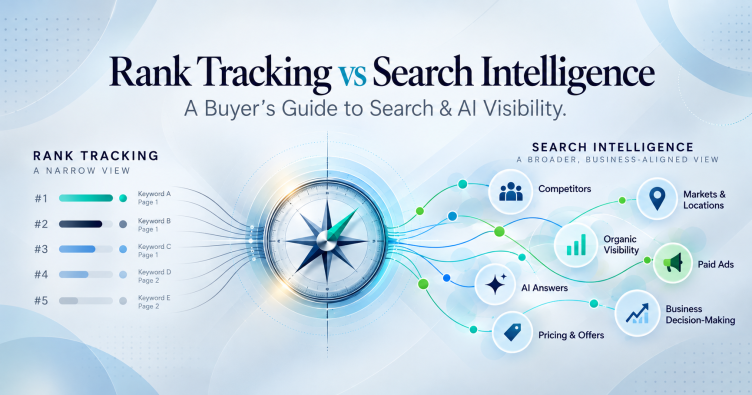
Why Traditional SEO Tools Are Not Enough
Platforms such as SEMrush, Ahrefs, and BrightEdge provide strong capabilities for SEO practitioners.
However, they are typically designed for:
- Keyword tracking
- Backlink analysis
- Page-level optimization
They do not provide a complete view across:
- Paid and organic search together
- Shopping and product visibility
- AI-generated answers
- Market-level competitive landscapes
As a result, organizations often lack a unified understanding of visibility.
Changes in Google Data and Paid Search Visibility
Recent changes in Google have affected how performance is measured:
- Reduced visibility into competitive ad data
- Limited insights from Auction Insights
- Declines in observable ad yield
These changes make it more difficult for brands to understand how they perform relative to competitors across markets.
Why Local Market Visibility Matters
Search competition varies by location.
For example:
- The same category can have different competitors in Boston versus Los Angeles
- Local providers can dominate visibility in specific regions
This makes it necessary to analyze search performance at a market level, rather than relying only on national averages.
How SERP Features Are Changing SEO
Search engine results pages (SERPs) are no longer limited to ten blue links.
They now include:
- “Things to know” sections
- Videos and visual elements
- Discussions and forums
- AI-generated summaries
These features affect:
- Where brands appear
- How often they are seen
- Whether users click
Tracking visibility across these features is becoming a core part of SEO.
The Role of AI Platforms in Search
AI platforms such as ChatGPT, Google AI Mode, Google AIO, and Perplexity AI are introducing a new way to access information.
Unlike traditional search engines, these platforms:
- Generate direct answers
- Summarize information from multiple sources
- Present results in conversational or structured formats
This changes how visibility is defined.
Instead of rankings, visibility may depend on whether a brand is mentioned within the generated response.
Panel-Based Data vs. Direct Measurement
Many AI visibility tools rely on panel-based data models.
These models:
- Use third-party datasets
- Estimate prompts and behavior
- Provide generalized visibility metrics
However, this approach has limitations:
- Prompts may not match actual customer intent
- Data is often similar across providers
- Insights may not be actionable at a brand level
An alternative is direct measurement.
What Is Customized Prompt Monitoring?
Customized prompt monitoring involves:
- Defining queries specific to a brand and its customers
- Using inputs from search data and ads
- Monitoring outputs directly from AI platforms
This allows organizations to:
- Track relevant visibility
- Align measurement with real user intent
- Generate more actionable insights
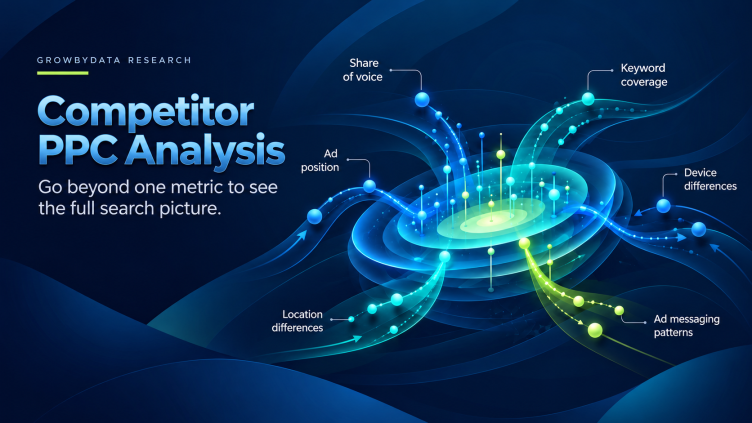
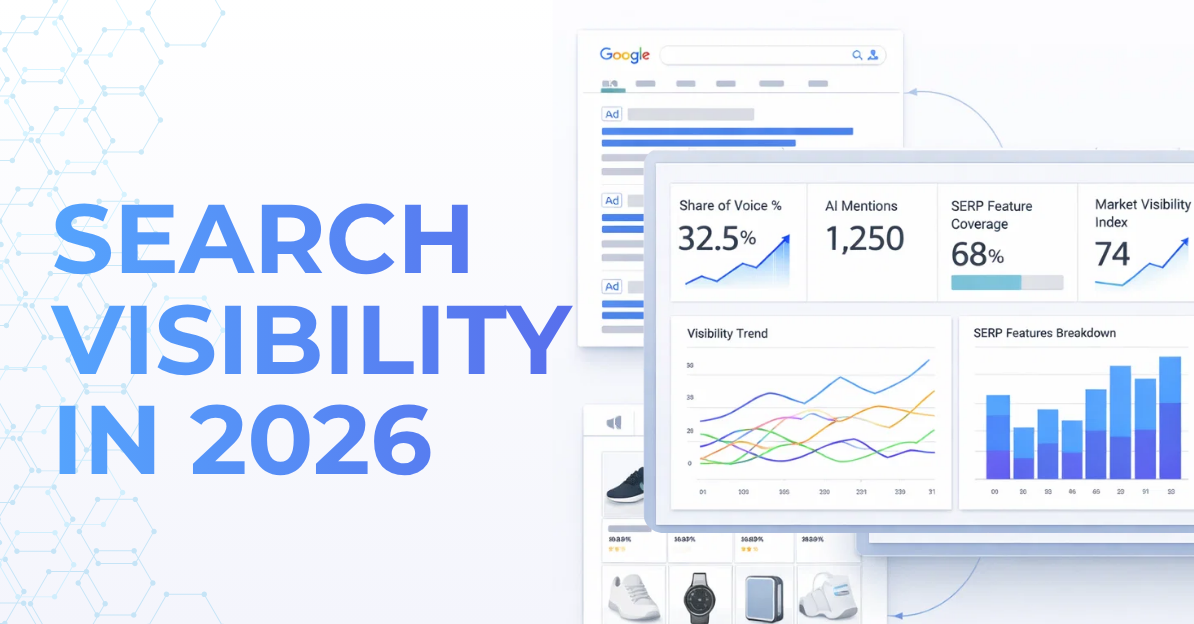
How to Measure Share of Voice in Modern Search
Share of voice in search is no longer limited to rankings.
It can be calculated by:
- Scanning a set of search terms
- Measuring presence across SERP features
- Evaluating visibility above the fold
- Counting frequency of appearance
This includes tracking across:
- Organic listings
- Paid ads
- Shopping results
- Images, videos, and other features
- This provides a broader view of competitive visibility.
Measuring Visibility in AI-Generated Answers
For AI platforms, visibility can be measured by:
- Monitoring selected prompts
- Capturing generated responses
- Identifying which brands are mentioned
This approach evaluates actual outputs rather than relying on estimated data.
Cost and Complexity of Search Measurement
Advanced search measurement requires:
- Continuous data collection
- Monitoring across multiple platforms
- Computational resources for analysis
This creates a trade-off:
- Lower-cost solutions provide generalized insights
- More advanced approaches provide precision and customization
Organizations must choose based on their strategic needs.
Market Trends in AI Search Tools
The market for AI search measurement tools is evolving.
Key observations include:
- Increased number of low-cost or free tools
- Reliance on similar underlying data sources
- Limited differentiation between providers
This raises questions about long-term value and sustainability.
The Relationship Between Google and AI Platforms
Google remains central to search strategy.
At the same time:
- AI platforms are expanding rapidly
- Advertising models are still evolving
- Data access challenges remain, especially without login
Most organizations are likely to prioritize a limited number of platforms rather than attempting to track all available options.
Conclusion
Search measurement is becoming more complex due to:
- Expansion across Google and AI platforms
- Changes in data availability
- Increasing importance of SERP features
- Need for customized measurement approaches
To adapt, organizations are focusing on:
- Holistic search reporting
- Market-level visibility analysis
- Direct monitoring of AI outputs
- More precise and relevant data collection
These changes reflect a broader shift in how visibility is defined and measured in modern search.
Know Exactly Where You Stand in Search & AI
Benchmark your brand across holistic Share of Voice, Merchant Listings dominance, and SERP feature composition.