
Patient reliance on AI tools to choose a provider doubled this year
- Patient reliance on AI tools to choose a healthcare provider more than doubled over the past year, from 17% to 36%, according to rater8’s 2026 Patient Choice Report. AI Overviews have overtaken organic listings as the most trusted section of a Google results page, at 37% trust versus 20% for organic listings, 13% for the local map pack, and 7% for sponsored results.
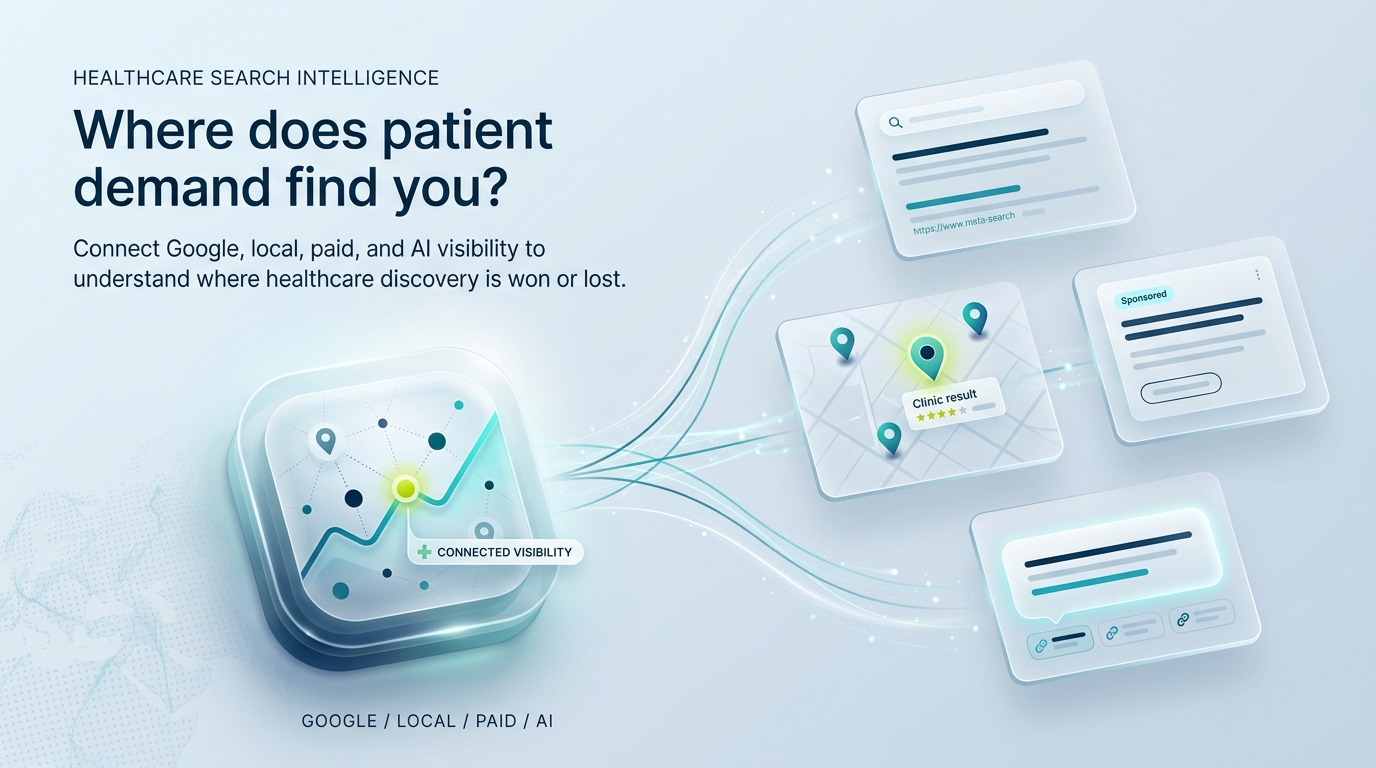
- A patient’s path to care now crosses several surfaces in one search session: a Google search, a map result, an AI Overview, a follow-up question to ChatGPT, a physician profile, and finally a call or a booking form.
- The hardest unsolved problem isn’t data collection. It’s connecting search and AI visibility to booked appointments without touching protected health information.
Over the past year, we looked at the needs raised across health systems, dental networks, behavioral health providers, cosmetic healthcare brands, and eyecare organizations. Their core questions were consistent: where are we visible, what are Google and AI platforms saying about us, which competitors are gaining ground, and did improved visibility produce more patients?
The market doesn’t need another dashboard full of rankings. Healthcare marketers need a system that connects search intelligence, local market conditions, AI answers, competitive activity, reputation, and conversion outcomes. This article covers three things: what healthcare marketers are asking for, what’s already solvable today, and what’s still unsolved.
The numbers behind the healthcare search measurement challenge
The observations below come from individual healthcare engagements. They aren’t universal industry benchmarks, but they show the size of the measurement problem.
| What was observed | The data | Why it matters |
|---|---|---|
| Google Ads impression share vs. independent tracking | For one dental exact-match term, Google Ads reported 50% to 60% impression share, while independent search observations measured 12% to 19% for the same term | The two figures answer different questions. Auction Insights reflects Google’s internal sampling; independent tracking reflects what real devices and locations actually see |
| Local map ad growth | Roughly 700% growth in local map ad activity for one “near me” query | Local ad formats can shift fast, and quietly, without a matching change in organic rank |
| AI Overview and ad co-occurrence | Over a 28-day sample of healthcare-services queries, an AI Overview appeared 97% of the time for one target query and ads appeared about 89% of the time, but ads appeared above the AI Overview only 2.3% of the time | AI Overviews are becoming the default first answer. Ad placement above them is the exception, not the rule |
| Local listing hygiene | 25 of 1,290 listings (about 1.9%) in one health system’s maps analysis lacked a URL | A hygiene rate that looks strong in aggregate can still represent dozens of specific, repairable, broken patient journeys |
| Small share shifts, real cost impact | In a national dental account monitoring 32 markets, a one- to two-point shift in competitive share correlated with a change in brand CPC | Where baseline competition is low, small share changes can carry outsized cost impact |
| Conversion tracking gap | One behavioral health provider had zero configured GA4 conversion events, despite managing thousands of lead and patient records across multiple systems | Visibility gains can’t be tied to patient acquisition if the conversion side isn’t instrumented at all |
None of this means more observations automatically produce better decisions. It means healthcare search has to be measured with the correct geography, patient intent, service availability, device, timing, and conversion context, or the numbers above stay disconnected from what a marketing team can actually act on.
1. What healthcare marketers need
They need local detail, not just national averages
Healthcare is inherently local. A hospital might draw patients nationally for a rare transplant procedure but only regionally for routine cardiology. A dental network with more than 1,000 locations might target implant campaigns only within a small radius of selected offices. Healthcare marketers need to know where a patient must be located to use a service, which clinics have appointment capacity, and which competitors are physically relevant in that market. Rank tracking built around a handful of national keywords was never designed to answer those questions. Local and international SERP monitoring, down to the media market (DMA), metro, or ZIP code, was.
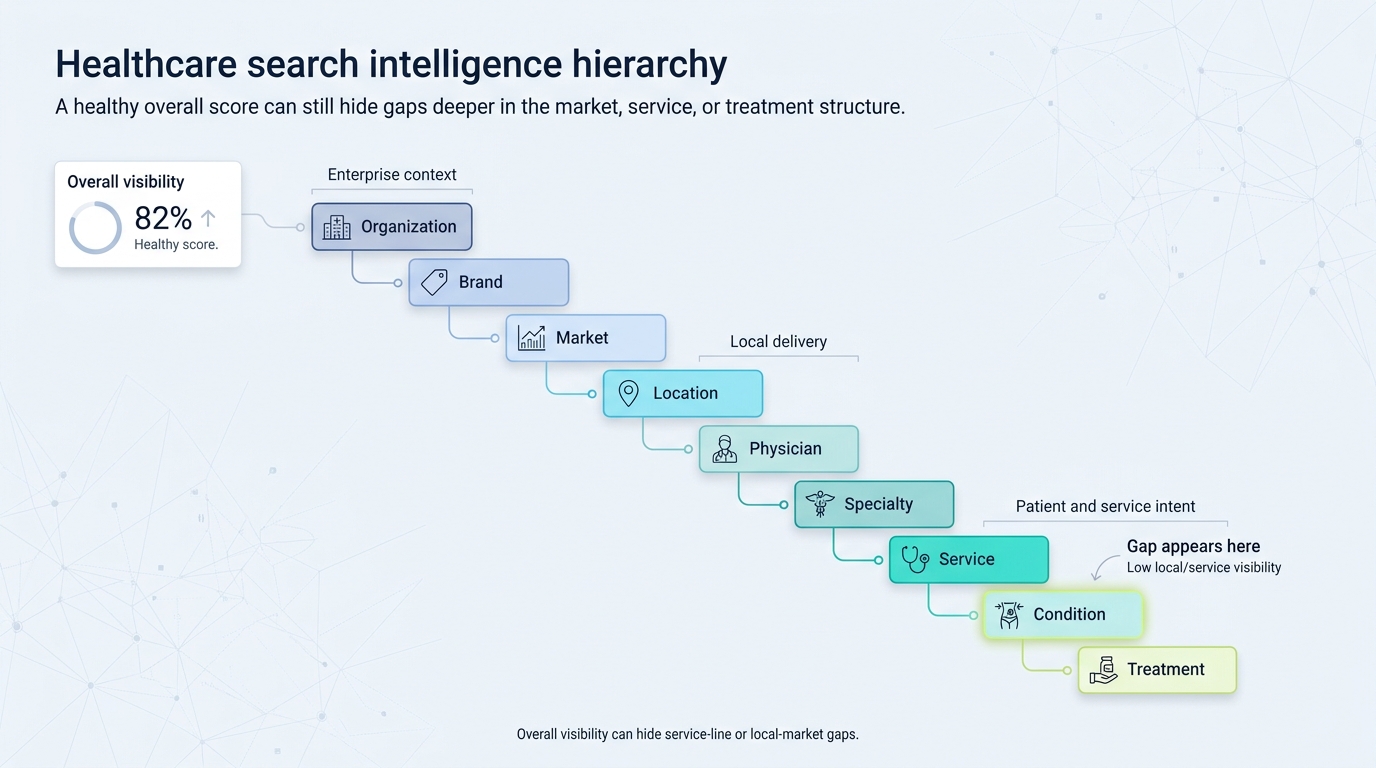
A healthy overall score can still hide gaps deeper in the market, service, or treatment structure.
They need AI answers that explain themselves, not just whether they showed up
Healthcare marketers increasingly want to know how they appear in AI Overviews, AI Mode, ChatGPT, Perplexity, and other answer engines through LLM Intelligence. Brand-mention tracking alone isn’t enough. A useful system needs to answer: was the provider recommended, for which patient question, and was the answer positive or negative? A brand can appear absent under its regional name while still being mentioned under the parent organization, so healthcare organizations need tools that understand these distinctions, not a flat list of mentions.
There’s a second risk beyond visibility. An AI answer can simply be wrong: outdated hours, a discontinued service, the wrong accepted insurance, or a closed location. That’s not a ranking problem. It’s an accuracy problem, and it can send a patient to voicemail or a locked door.
They need competitor tracking that explains what changed
Healthcare marketers often notice the business signal before they can explain it: brand CPC increases, impression share falls, a competitor starts appearing more often. The competitor set has also gotten wider. A hospital system’s real competition now includes national telehealth platforms and retail health clinics inside pharmacies such as CVS and Walgreens. One dental organization found that a small increase in a competitor’s brand-term share lined up with a change in its own CPC, which mattered because baseline competition was low. That’s why competitive market intelligence needs to be connected to media and business outcomes, not reported on its own.
They need patient-acquisition attribution
This is the most important need, and the least solved one. Healthcare marketers ultimately want to know which search generated the inquiry, whether the person passed clinical and insurance screening, and whether an appointment was scheduled and attended. In one behavioral health discovery process, the data was scattered across a CRM, an intake platform, an electronic medical record workflow, and referral processes, with no formal conversion events configured at all. That problem is common: visibility data exists, patient data exists, and operational data exists, but they aren’t connected.
If your team is measuring Google, AI Overviews, and paid search as three separate reports, that’s the gap worth closing first.
2. What’s already working
Despite these challenges, healthcare marketers are already getting real, measurable value from tracking this today.
Multi-location Google monitoring
It’s possible to monitor priority keywords across chosen locations, devices, and schedules, then report on paid and organic share of voice, local map presence, competitor activity, and enterprise SERP tracking data. This moves healthcare marketers past a national ranking average and shows where market conditions actually diverge.
Tracking what AI platforms say about you, and why
Healthcare marketers can now track selected patient questions across major AI platforms: whether the brand appears, whether competitors appear, which sources get cited, and what the answer actually says. A provider might rank well organically and still be absent from AI recommendations, with a competitor winning instead because of citations from a publisher or a third-party medical resource.
Trademark and brand protection monitoring
With enterprise brand protection monitoring, healthcare brands can detect advertisers using protected brand language, preserve screenshots, and build evidence packages for escalation. Enforcement teams need the actual ad, the timestamp, the market, and whether a reported violation comes back after escalation.
3. What’s still unsolved
Measuring the area patients would actually travel from
Cities and states are crude stand-ins for a real healthcare market. The market needs finer-grained targeting: media markets and metro areas, custom drive-time or catchment areas (the real zone patients would travel from for a given service), and geography that changes by service line. A routine dental visit, a local eye exam, and a rare heart procedure shouldn’t be measured with the same map.
Keeping brand and location names straight
Healthcare brands routinely have overlapping names, domains, regional brands, physician groups, and affiliated institutions. AI visibility measurement is only as reliable as the list of names and locations it’s built on, and the market is still working on matching regional brands to their parent systems and connecting physicians to the right clinic.
Recommendation-level reasoning, not presence or absence alone
Knowing that a brand was or wasn’t mentioned is a start. The harder, more useful question is why. Which content or citation source actually drove the recommendation, which competitor is gaining recommendation share on a given question, and which part of a patient’s research shaped the answer? Most tools stop at presence and absence, but healthcare marketers increasingly want to know the mechanism behind the result.
Measuring what a real, logged-in patient actually sees
A once-a-day, logged-out scan can’t fully reproduce what a real, signed-in patient sees at different times of day. This matters most for paid search, where healthcare advertisers target by audience, location, and time of day, and where Google personalizes what each person sees. The market needs privacy-safe measurement that compares what an anonymous scan sees against what a real, signed-in person sees, and measures that gap directly.
AI-driven research through connected data
Search data is starting to become queryable through AI assistants, not just dashboards. A healthcare marketer should eventually be able to ask, directly, which competitors increased cardiology ad activity in a market last month, or where the brand is absent from AI answers for a given procedure. This is the direction GrowByData’s MCP integration points toward: connecting Compass data straight into the AI tools a team already uses, instead of building another dashboard. The connections are emerging; reliability, permissions, and access across multiple accounts still need work.
Connecting results to patients without exposing who they are
This has to connect to outcomes while respecting privacy and compliance requirements. The right approach uses grouped data that never names a specific patient: whether an inquiry came in, whether screening was passed, whether an appointment was booked and attended. That lets marketers compare visibility against real results without exposing who any specific patient is. This is the gap GrowByData sees as the least solved in the market today, and the one most worth solving carefully rather than quickly.
Turning findings into action, not just more findings
Many healthcare audits correctly identify missing local pages, weak physician visibility, and incomplete schema. Identifying a problem isn’t the same as fixing it. Healthcare organizations need a simple system that assigns every finding an owner, a priority, a due date, and a way to check whether it worked, along with executive reporting built around real healthcare decisions instead of raw rankings.
A practical framework for healthcare search and AI
Healthcare organizations can start with five steps.
| Step | Focus | What to define or connect |
|---|---|---|
| 1. Define the patient and service opportunity | Scope | Priority services, locations and travel areas, patient eligibility, clinic capacity, high-value procedures |
| 2. Measure every surface where patients search | Coverage | Organic listings, paid ads, maps, AI Overviews, AI Mode, ChatGPT and other answer engines, reviews, directories |
| 3. Keep brand and location names consistent | Consistency | Parent brands, regional brands, hospitals, clinics, physicians, service lines |
| 4. Connect visibility to patient outcomes | Follow-through | Calls, forms, qualified leads, appointments, attendance, all combined without exposing any one patient’s information |
| 5. Turn findings into follow-up | Accountability | Every finding gets an action, an owner, a deadline, and a way to measure it |
The future of healthcare search is understanding what patients want
The next generation of healthcare marketing technology won’t be defined by how many keywords it tracks. It will be defined by whether it can answer the questions that actually matter: what does a patient need, which provider can serve that need, and did the marketer’s action produce a measurable patient outcome?
Google search, local results, AI Overviews, and conversational AI are converging into one discovery journey. Healthcare organizations need measurement and strategy that converge with it.
Turn Google and AI visibility into more patients
GrowByData is a search and AI visibility intelligence company for enterprise brands, retailers, and agencies. In healthcare, dental, behavioral health, and eyecare, we help teams understand how they and their competitors appear across Google and AI search. Our approach can help teams analyze local and regional competitive visibility, AI Overview and conversational AI presence, competitive ad intelligence on competitor advertising, and brand protection against trademark misuse.
We already work with health systems, national dental service organizations, medical aesthetics providers, and multi-location eyecare and behavioral health networks on exactly this problem.
Want to see what prospective patients encounter when they search for your services?