
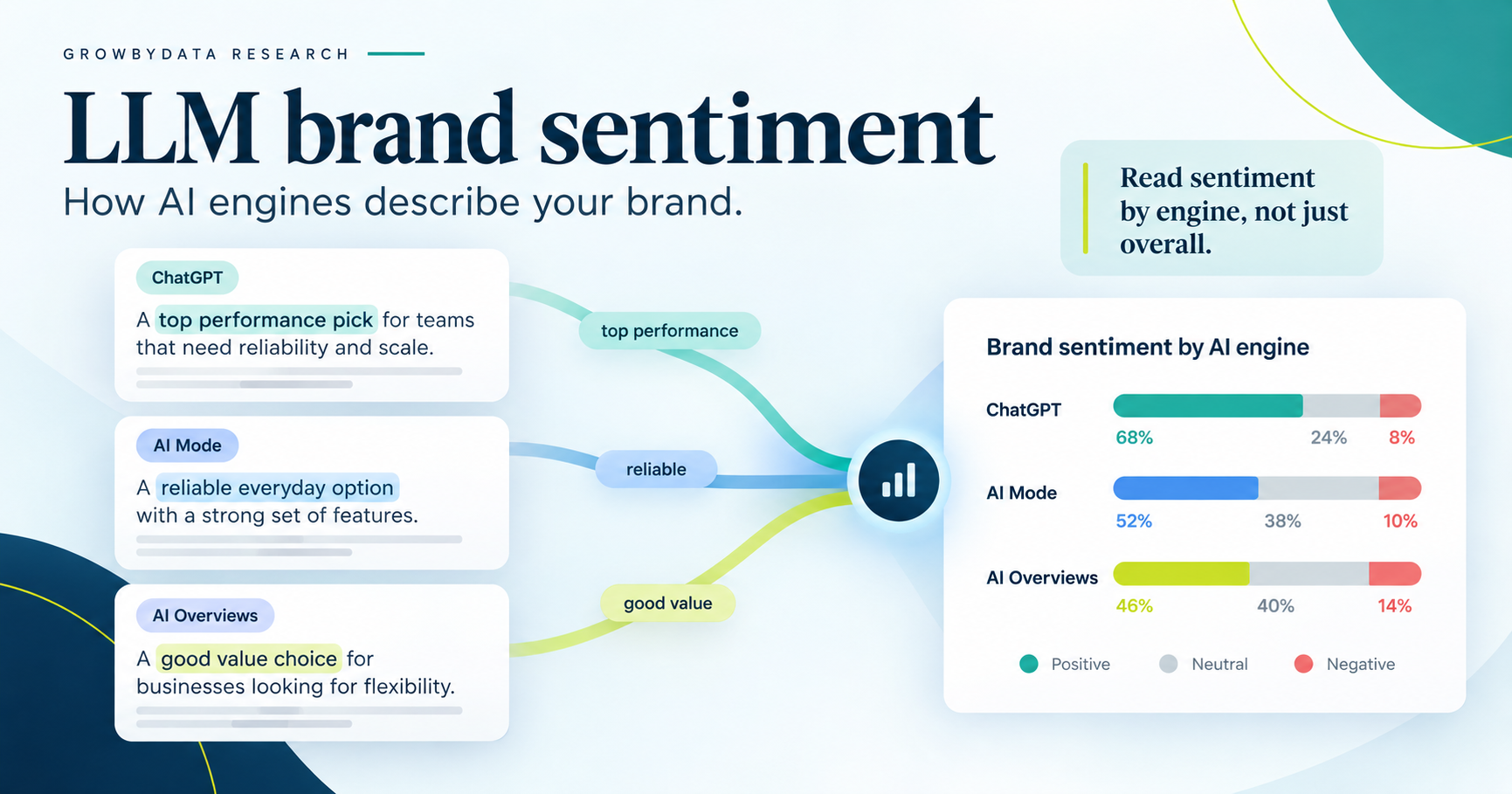
LLM brand sentiment is the tone an AI engine takes when it mentions your brand in an answer: positive, neutral, or negative. Some teams call it AI brand perception. It’s a separate question from whether you’re mentioned at all, and a brand can appear in ChatGPT or Google AI Mode every day while being described in neutral, matter-of-fact terms.
Our view: a brand doesn’t have one LLM sentiment score. It has a different profile in each engine, prompt type, and time period, and a blended score can hide the problem. The useful signal is often the gap between engines and the statements behind the score.
How is LLM brand sentiment different from social listening?
LLM brand sentiment measures what an AI engine says about your brand when someone asks it a question. Social listening measures what people post about you on social networks, forums, and review sites. The two overlap, because AI engines often cite those same sources, but only one shows the answer a buyer reads.
| Social listening | LLM brand sentiment | LLM visibility | |
|---|---|---|---|
| What it measures | The tone of what people post about you | The tone of what an AI engine says about you | Whether an AI engine mentions you at all |
| Where the data comes from | Social posts, forums, reviews | AI answers, such as ChatGPT, Google AI Mode, and Google AI Overviews | The same AI answers |
| The question it answers | What do people say about us? | How does AI describe us? | Does AI bring us up? |
Sentiment and visibility answer different questions, so track both. A brand that’s rarely mentioned has a visibility problem, not a sentiment problem. Our guide to AI search visibility covers the visibility side.
Why does LLM brand sentiment matter?
LLM brand sentiment matters because an AI answer can frame your brand before a buyer reaches your site. If the answer calls you the budget option while praising a competitor, that framing lands first. You can’t correct a first impression you never saw, which is why the answer itself needs measuring.
There’s direct evidence of this on Google. In Pew Research Center’s March 2025 study of 900 US adults’ Google searches, users clicked a traditional result in 8% of visits with an AI summary and 15% without one. They clicked a link inside the summary in just 1% of visits.
That study covered Google AI summaries, not ChatGPT or every AI engine. And GA4 and Search Console can’t show what any AI answer said about you.
How do LLMs see your brand?
In the answers we tracked, LLMs described most brands positively or in plain, neutral product terms. Across 34 apparel and footwear prompts tracked in GrowByData Compass from September 1 to 30, 2026, no brand mention was labeled negative. The top 10 brands in the report were 93.4% to 97.1% positive, and the rest of their mentions were neutral.
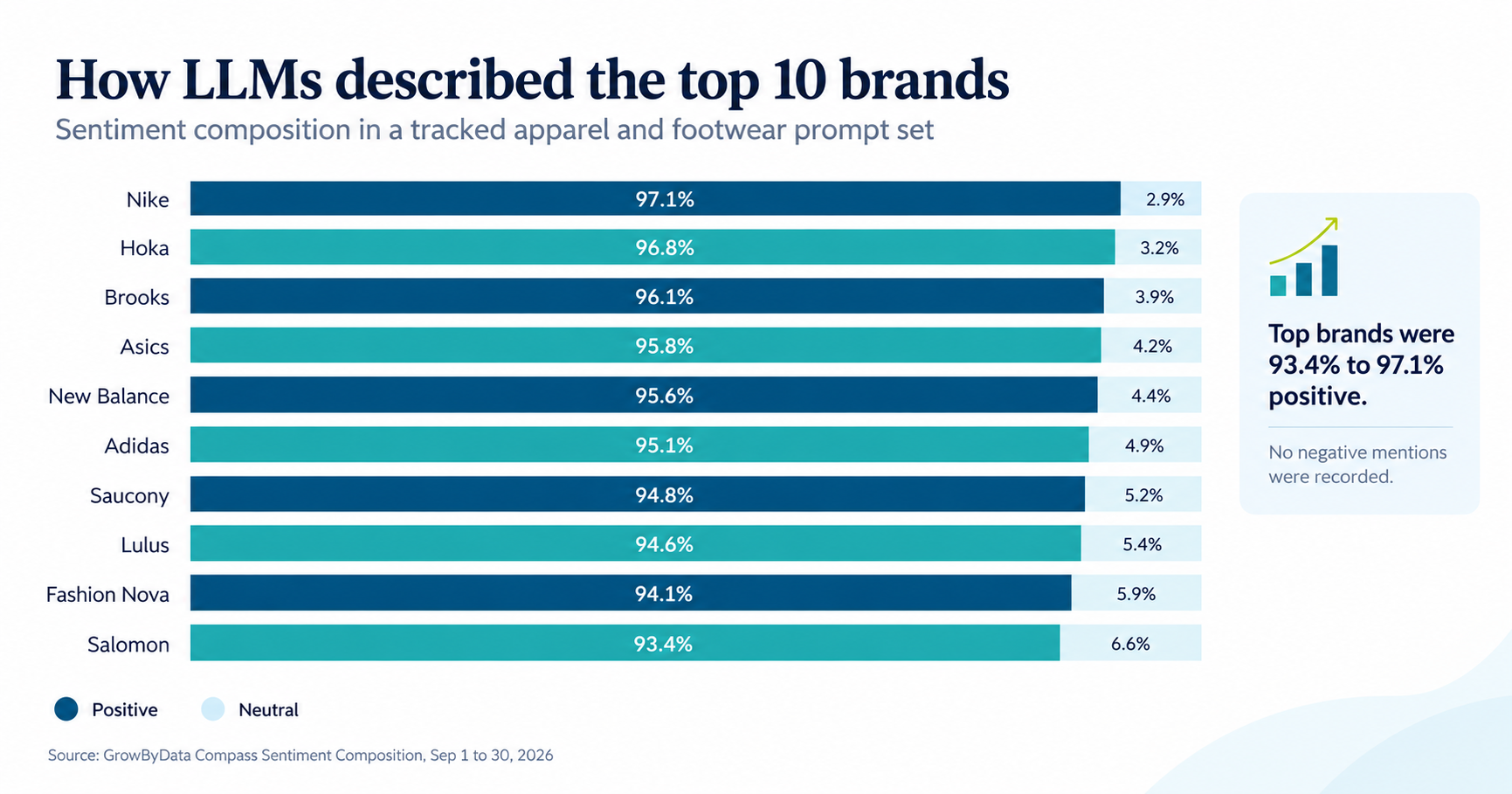
Sentiment Composition in GrowByData Compass, top 10 brands in the tracked prompt set, September 1 to 30, 2026. There’s no negative segment because none was recorded.
Neutral mentions here were descriptive, not evaluative
In this dataset, neutral mentions were often product facts with no judgment either way. The neutral statements about Nike included the Run Defy being suited to road running and gym training.
Neutral sentiment isn’t the same as not being recommended. A neutral statement can sit inside a recommendation, and a positive one doesn’t guarantee you’re the pick.
So don’t treat a neutral share as a problem by default. Read the statements: a neutral line with the wrong use case is worth fixing, while an accurate one may be fine.
Retailers drew far more neutral mentions than brands: up to 63.6%
In September, 63.6% of Foot Locker’s mentions and 56.3% of DICK’S Sporting Goods’ mentions were neutral. Nike, Hoka, Brooks, Asics, and Adidas sat between 3.0% and 4.2%.
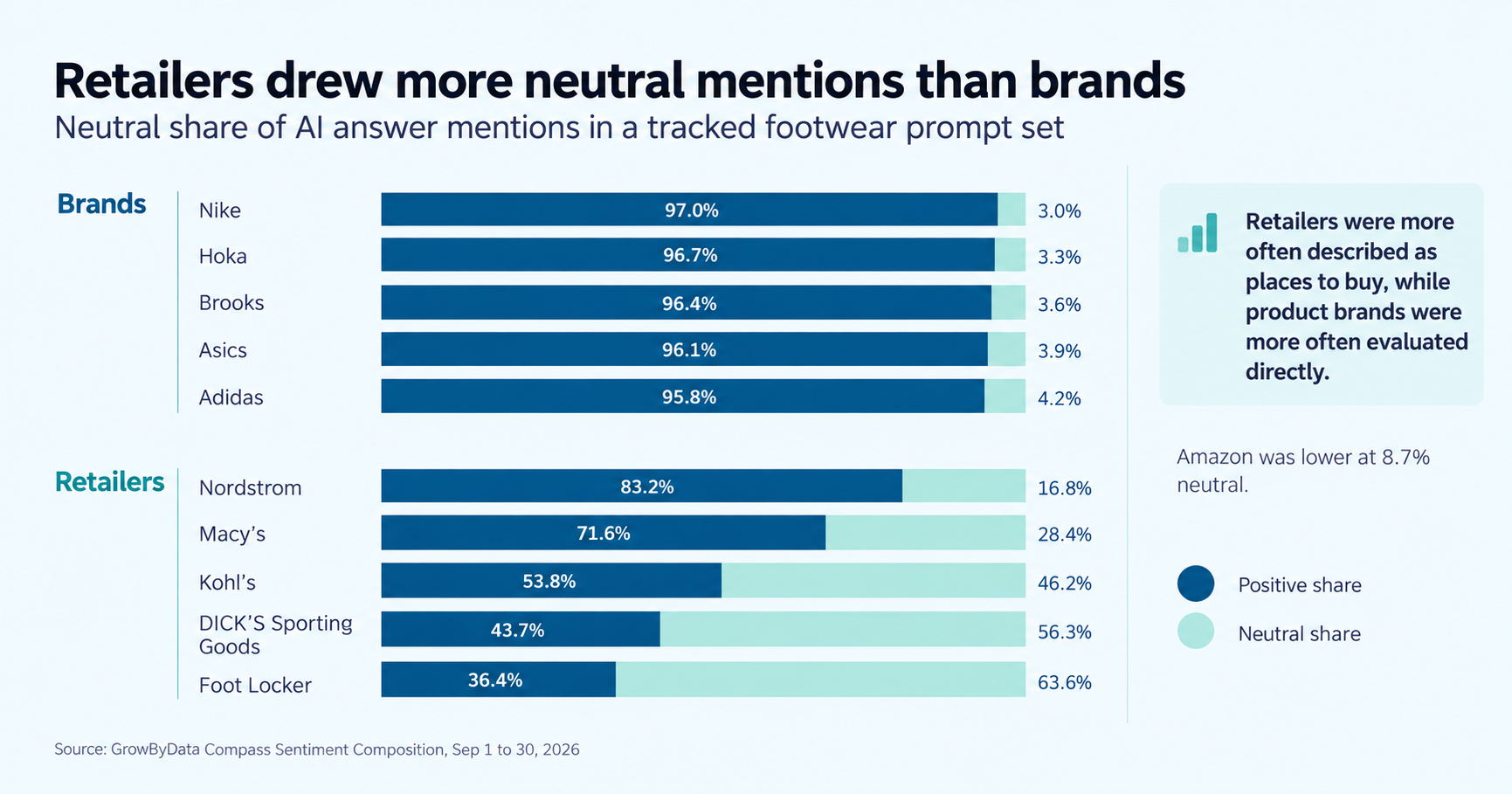
Neutral share of AI answer mentions for footwear brands and retailers. Source: GrowByData Compass Sentiment Composition, September 1 to 30, 2026.
Our read, which we haven’t tested, is that entity role plays a part: an engine may evaluate a brand’s shoes but mention a retailer as a place to buy them. Amazon’s lower neutral share, 8.7%, shows the pattern isn’t universal.
Why does the same brand score differently in ChatGPT and Google?
Each AI engine writes its own answer and can draw on different sources, so the same brand can be framed differently. In GrowByData Compass, the dress brand Azazie had a Favorability Score of 73.7 in ChatGPT and 96.7 in Google AI Mode for the same 34 tracked prompts, a 23-point gap (August 24 to September 22, 2026).
Favorability Score is GrowByData Compass’s single number for the positive, neutral, and negative mix, where 100 means every mention was positive. Read it alongside the composition, because the same score can come from different mixes.
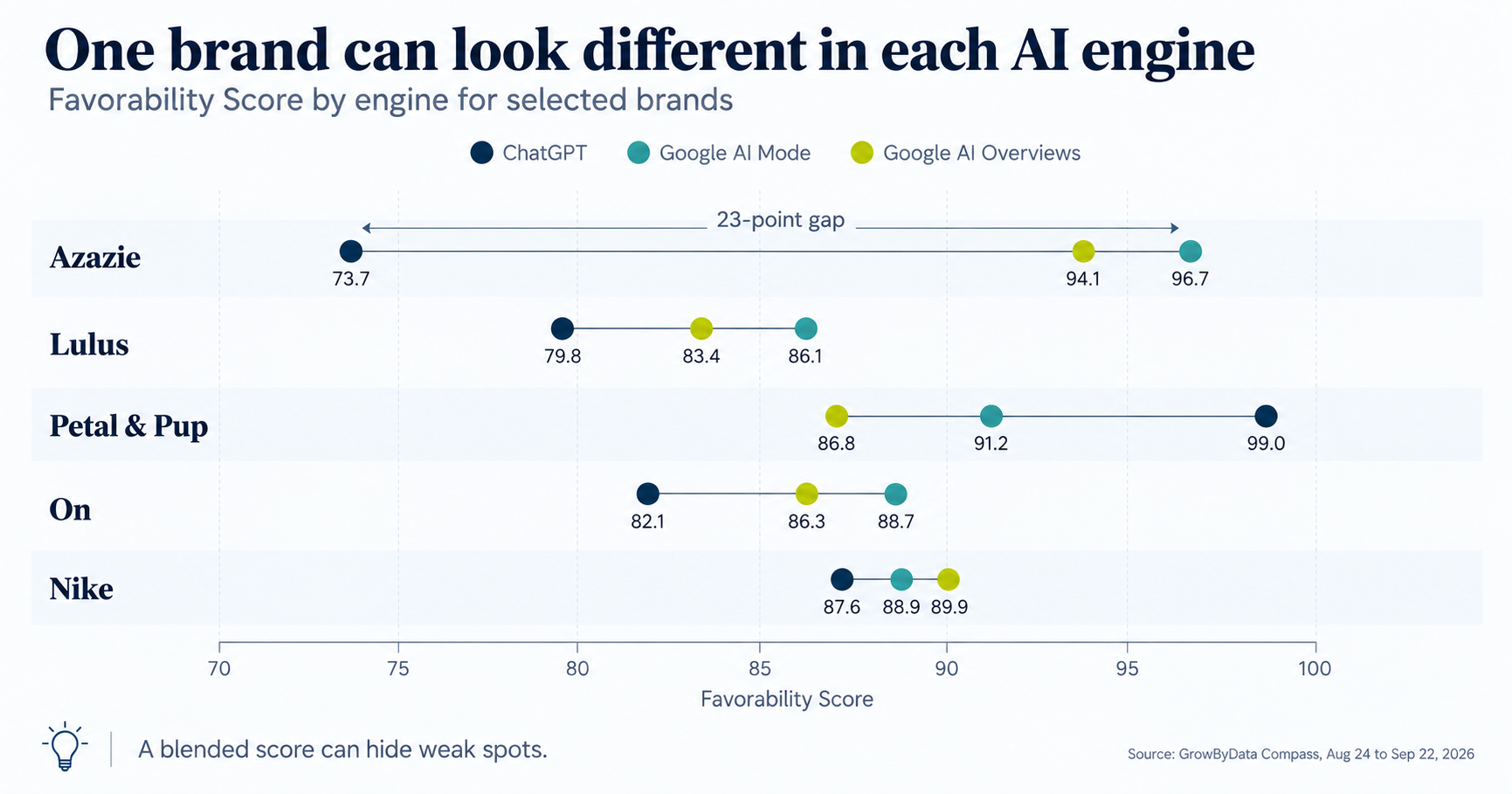
Favorability Score by engine for five brands in the tracked prompt set. Source: GrowByData Compass, August 24 to September 22, 2026.
No engine was consistently the harshest. Of the 100 brands listed in the report, 47 were scored in all three engines. The lowest score came from ChatGPT for 15 of them, Google AI Mode for 16, and Google AI Overviews for 12, with 4 ties.
That’s the case against one blended score. Petal & Pup scored 99.0 in ChatGPT and 86.8 in Google AI Overviews, so its overall 97.5 hides the weak spot. Nike’s three scores sat within 2.3 points.
How we got these numbers
- Source: GrowByData Compass, LLM > Sentiment (Sentiment Overview and Sentiment Composition).
- Scope: 34 tracked apparel and footwear prompts in ChatGPT, Google AI Mode, and Google AI Overviews. Favorability scores cover August 24 to September 22, 2026. Sentiment composition covers September 1 to 30, 2026.
- Labels: Compass sentiment classification of each brand mention.
- Limits: one prompt set in two categories, not an industry benchmark. The composition export reports shares, not mention counts, so treat figures for less-mentioned brands and retailers as directional.
How do you measure brand sentiment?
You measure brand sentiment in AI answers by asking each AI engine the same buyer questions on a schedule. Save every answer, label each mention of your brand positive, neutral, or negative, and compare the results by engine and over time. Keep the questions fixed, or your trend won’t mean anything.
You can start by hand.
- Write the questions buyers ask. Mix category questions (“best running shoes for flat feet”), comparisons, and questions that name your brand.
- Run each one in the engines your buyers use. Save the full answer, not just whether you were named.
- Label each mention. Mark it positive, neutral, or negative, and copy the exact phrase.
- Repeat with the same questions. Compare each round against the last, engine by engine.
Two decisions make the numbers trustworthy. Decide what you’re scoring, the whole answer or each mention of your brand inside it, because they produce different totals. Then hold the conditions steady: prompt mix, location, device, language, and signed-in status.
How labels become a score
Tools roll those labels up differently, and the biggest difference is how they count a neutral mention.
| Scoring approach | How a neutral mention counts | Score for 70% positive, 30% neutral, 0% negative |
|---|---|---|
| Net sentiment (positive share minus negative share) | 0 | 70 |
| Weighted score (neutral counts as half a positive) | Half a positive | 85 |
| Positive, neutral, and negative shares only | Reported on its own | No single score |
Both scores come from the same 100 mentions. Neither is wrong, but they aren’t comparable, so don’t benchmark one tool’s score against another’s. For how Compass calculates its Favorability Score, see our guide to AI sentiment tracking.
Where manual checks run out
A spreadsheet works for a handful of questions but gets hard to trust at scale, because the same prompt can return a different answer from day to day or by location.
As of October 2026, GrowByData Compass tracks brand sentiment in ChatGPT, Google AI Mode, and Google AI Overviews. It keeps the captured answer for each tracked prompt and filters sentiment by platform, location, device, and prompt intent.
Captured answers also show which sources an engine cited, here review sites beside ChatGPT’s recommendations. For setup by platform, see ChatGPT brand monitoring and Google AI Mode monitoring.
Rather not build this by hand? We’ll run an AI sentiment audit on your top buyer questions across ChatGPT, Google AI Mode, and Google AI Overviews. Talk to an expert
How can you improve your brand’s sentiment in AI answers?
You improve your brand’s sentiment in AI answers by starting with the statements, not the score. Sort what the engines say about you into inaccurate claims, missing differentiation, accurate neutral descriptions, and genuine criticism. Each one calls for a different response, and some don’t need one at all.
| What the engine says | What to do |
|---|---|
| An inaccurate claim, such as a wrong price or a discontinued product | Correct your own pages, and ask third-party sites to fix errors where you have a legitimate way to |
| Accurate but generic, with nothing that sets you apart | Make the differentiator explicit on your product and comparison pages |
| An accurate, neutral product fact | Often fine as it is |
| Genuine criticism | Treat it as a product or service signal before a content one |
Then look at the sources cited alongside those statements. A citation is a lead worth checking, not proof that the source caused the tone. If a cited page gets you wrong, it’s worth fixing either way.
For Google’s AI features, there’s no shortcut. Google’s Search Central guidance, updated December 10, 2025, says AI Overviews and AI Mode need no additional requirements or special optimizations. Standard SEO best practices still apply.
Re-measure by engine after any change, since a fix that shows up in one engine may not move another. A single month of data shows where you stand, not whether a fix worked. LLM Intelligence ties sentiment to the mentions and citations behind it.
Frequently asked questions
Can ChatGPT do sentiment analysis?
Yes, ChatGPT can label the sentiment of text you paste into it, such as reviews or survey answers. That’s a different job from LLM brand sentiment, which measures how ChatGPT itself describes your brand when buyers ask it questions. You’d use the first to analyze feedback and the second to see how AI presents you.
Does a high sentiment score mean AI engines recommend your brand?
Not necessarily, because a sentiment score only covers the answers where your brand appears. A brand can score 97 and still be missing from most of the buying prompts you track. Read sentiment alongside visibility, meaning how often AI engines mention you at all.
How often should you check LLM brand sentiment?
In our view, a monthly review of LLM brand sentiment works for most teams, with a closer look after product launches, pricing changes, or PR events. AI answers shift as engines and their sources change, so a quarterly check can miss a drop for weeks.
Can GrowByData track brand sentiment in AI platforms?
Yes. As of October 2026, GrowByData Compass tracks brand sentiment in ChatGPT, Google AI Mode, and Google AI Overviews. It reports a Favorability Score, the positive, neutral, and negative split, and the statements behind each segment, by engine, location, and prompt group.
Check your LLM brand sentiment before a prospect does
It’s better to find a sentiment problem in a report than to hear it from a prospect quoting ChatGPT. Our team can run an AI sentiment audit on your top buyer prompts across ChatGPT, Google AI Mode, and Google AI Overviews, with the statements behind each score.
GrowByData is a search and AI visibility intelligence company for enterprise brands, retailers, and agencies.