Google AI Overviews are AI-generated answer panels at the top of Google search results, citing 4-7 source URLs per response. As of May 2026, AI Overviews appear on roughly 47% of US searches and on most informational and commercial queries. AI Overviews compress the organic results below the fold driving down click-through rates by 15-30% for traditional position-1 listings making citation share inside AI Overviews the new ranking metric.
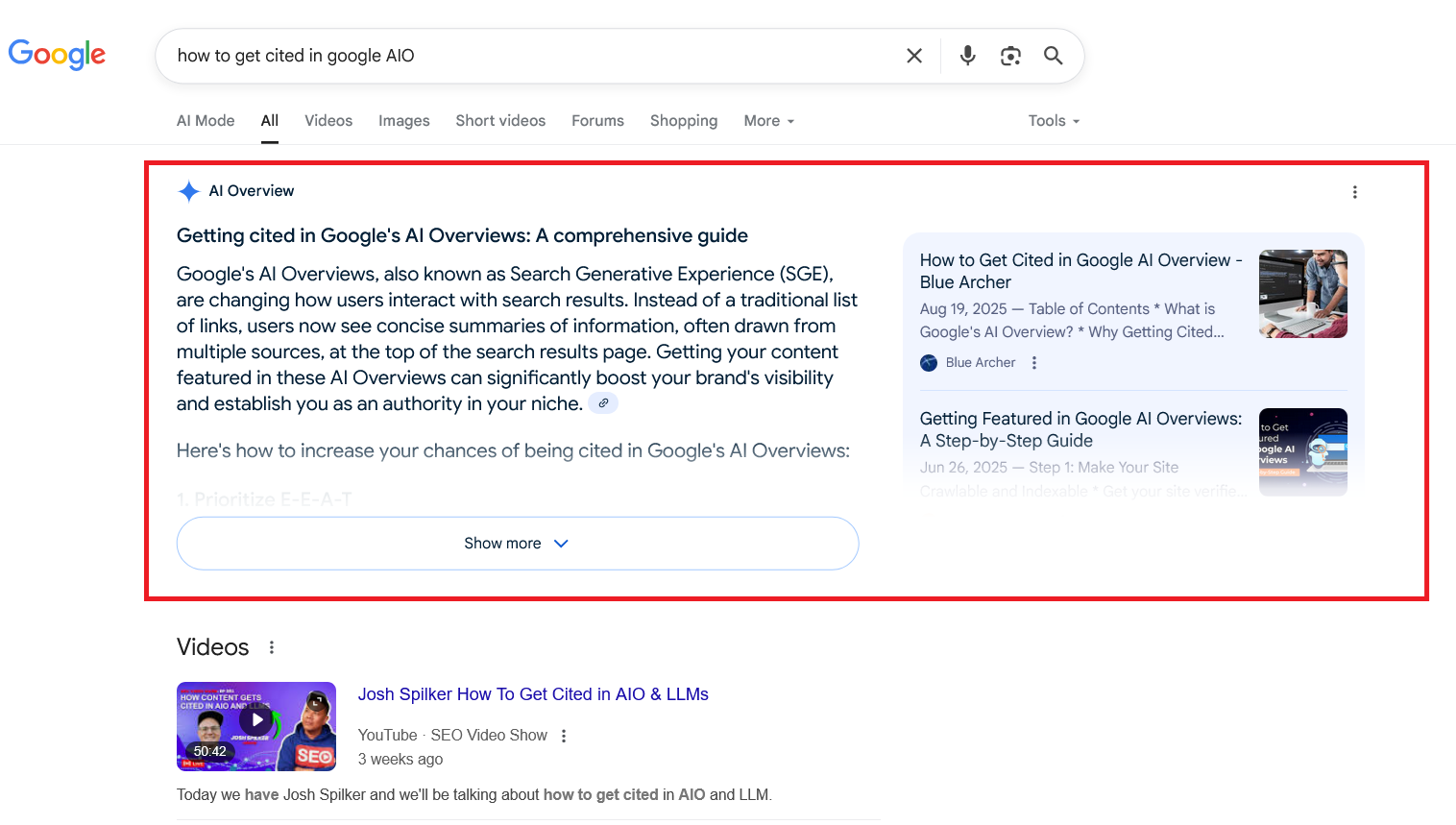
Google AI Overviews are AI-generated answer panels at the top of Google search results.
Each one cites roughly 4 to 7 source URLs. As of May 2026 they appear on about 47% of US searches, and on most informational and commercial queries. Because they push the organic results below the fold, position-1 listings lose 15 to 30% of their click-through rate. What you get cited for now matters as much as where you rank.
The Shift You Can’t Ignore
Google AI Overview, previously called Search Generative Experience (SGE), started as a test and is now a standing feature of Google search. By mid-2025 it appeared in close to half of all Google results.
For the searcher, it’s convenient. One AI-written summary pulls together facts, opinions, and product suggestions, and it often answers the question without a click. For brands and agencies, it’s a problem. Visibility used to mean the ten blue links, or a SERP feature like People Also Ask or Google Merchant Listings. Now it also means being quoted inside Google’s own answer.
If your brand isn’t cited in an AI Overview, you’re absent at the moment your customer decides.
How Does a Google AI Overview Work?
An AI Overview is assembled from modules rather than written as one block of prose. A single result can carry a written summary, an image, a video, a product card, and a comparison table, each drawing on different sources. Ordinary results are ordered by rank. These modules are assembled by the model, so a brand can win the summary and be missing from the product cards sitting directly beneath it.
We track the modules separately for that reason. Presence in one tells you very little about presence in another. These are the components we categorize:
| AIO feature | What it means |
|---|---|
| AI Summary | The core AI-written answer, and the most visible slot |
| AI Summary Image | Embedded visuals that pull attention away from text results |
| AI Summary Videos | Video that holds the user inside the SERP |
| Citations | The clickable sources credited in the answer |
| Feature Lists | Bulleted or numbered summaries |
| Structured List | Comparative bullets used for decisions |
| Follow-up Prompts | Suggested queries that extend the session |
| AIO Ads | Sponsored placements inside the overview |
| Places | Local business listings |
| Product Lists | Shopping modules that sit against your organic listing |
| Reviews | Aggregated ratings |
| Table – AI | Side-by-side data comparisons |
How to Create Content That Ranks in AI Overviews
Getting cited has less to do with keyword density than with whether a model can lift a clean answer off your page. Four things matter most.
1. Answer the Question Immediately
Put the answer directly under the question, in one or two sentences. AIO is an answer engine, so it rewards pages that resolve a query fast instead of building toward it. If your H2 asks what a Google AI Overview is, the next line should say what it is, not set up context first.
2. Give the Model Something to Extract
Models pull from structure. A clear H2 and H3 hierarchy, numbered steps, and comparison tables all give the model something it can lift without paraphrasing. Long undifferentiated prose gets skipped, however good the writing is.
3. Keep the Page Credible and Current
Experience, expertise, authoritativeness, and trustworthiness still apply. Cite sources you’d be willing to defend in a client meeting, put a real author with real credentials on the page, and refresh the data. Stale numbers are the fastest way to lose a citation you already had.
4. Target the Phrasing People Actually Use
AI Overviews trigger most often on long, spoken-sounding queries. Chase the exact wording buyers type rather than the head term you wish you owned. People Also Ask is the cheapest place to find that wording.
None of this guarantees anything. We’ve watched pages do all four correctly and still lose the citation to a five-year-old forum thread. What it does is make you eligible, which is more than most competing pages manage.
Why It Matters for Brands and Agencies
AI Overview reorders the page rather than restyling it. Rank high and collect clicks stops working as a strategy once the answer sits above everything you rank for.
1. Citations Now Carry the Attention
Your brand can be the one a searcher remembers without holding the top organic position. In health, citation presence reached 87% by June 2025. Being absent from the answer means the conversation happens without you, even on queries where you dominate the organic listings. Citations also move query by query, which is why a one-off audit tells you almost nothing.
2. Visual Modules Take the Click
Images, video, product cards, and tables compete for the attention a blue link used to collect. A product card inside the overview can absorb the click your listing was going to get. Knowing which module types dominate your category tells you what to build next.
3. Paid Ads Sit Inside the Answer
Google now places ads within the overview, either above or below the AI summary. Position matters more than usual here. An ad above the summary gets seen. One below it often doesn’t, and Google reports neither placement, so you need third-party tracking to confirm you appeared at all.
4. Competitive Visibility Is Hidden
Google Search Console shows no AI Overview data. It won’t tell you which queries triggered one, whether you were cited, or which competitor took the slot instead. Share of voice in AI search has to be measured outside Google’s own tools.
For brands, the overview is the first thing a customer reads. For agencies, it’s a reporting gap you can fill with Google AI Overviews monitoring, tracked alongside brand mentions in ChatGPT, Google AI Mode, and Perplexity.
Who You’re Actually Competing With Now
The competitors you watch in traditional SERPs are only part of the set. Inside the AI answer, the rules for who gets included are different.
1. Rank and Citation Are Separate Games
Traditional SEO measures rankings, traffic, and clicks. AI SEO measures whether you’re cited inside the answer, and the two decouple more often than most teams expect. A brand sitting fifth organically can appear in the AI summary while the number-one result is left out entirely.
2. Share of Voice Moves Weekly
Share of voice has always been a core marketing metric. Inside AI Overview it means the percentage of citations your brand holds, and it shifts fast. A brand can own a query one week and vanish the next as the model updates. Tracking it over time is the only way to know which direction you’re moving.
3. Unexpected Sources Get Cited
AI Overview frequently cites pages that don’t rank on page one. Niche publishers, forums, and aggregators end up competing directly with established brands, and occasionally a site from an adjacent industry gets pulled in on content relevance alone.
4. Paid Sits Alongside Organic in the Same Block
The overview is not purely organic real estate anymore. Google embeds sponsored results directly inside the AI block, and they blend closely with the generated content. Learn more about ads in AI Overview. Three things follow from this: placement drives performance, with ads above the summary dominating attention and those below often overlooked; your ad can now sit against brands cited organically in the same answer; and Google Ads reports no placement-level data for In-AIO Ads, so performance is invisible without external tracking.
Industry Trends and Variations in 2026
Two years ago the question every SEO lead asked about AI Overviews was whether the feature had reached their queries yet. That question is settled. AI Overviews now appear on roughly 47% of US searches, and in most categories a searcher sees some form of AI answer more often than not.
The useful question has moved to where the answer appears, because that determines whether you can be seen at all.
The AI-generated answer surfaces in three different places on the results page: the standalone Overview panel most people picture, folded inside a People Also Ask result, and inside the Google Things to Know panel. Across the first half of 2026, only about 27% of AI answer placements were the classic Overview panel. Roughly 59% surfaced inside People Also Ask, and another 14% inside Things to Know.
A dashboard that only watches the Overview panel is reporting on a quarter of the available placements.

How AI Answer Placement Splits by Industry
The mix varies enough between categories to change where a content team should spend its time.
| Industry | Overview panel | Inside People Also Ask | Inside Things to Know |
|---|---|---|---|
| Retail | 18% | 60% | 22% |
| Health | 26% | 54% | 21% |
| Financial Services | 33% | 60% | 8% |
| Automotive | 28% | 61% | 11% |
| High Tech | 41% | 49% | 10% |
| Travel | 25% | 74% | 2% |
Retail: the Answer Is Mostly Below the Fold
Retail has the lowest Overview panel share we measured, at 18%. The other 82% is split between People Also Ask at 60% and Things to Know at 22%, which is the highest Things to Know share of any industry in the panel. A retail team optimizing only for the top panel is competing for the smallest slice of its own category.
Health: an Even Three-Way Split
Health was the early leader in raw AIO presence and still is, but presence stopped being a differentiator once almost every query started triggering an answer. Placement is what separates brands now. The split runs 26% Overview, 54% People Also Ask, 21% Things to Know, which is about as even as it gets. Health brands have to earn citations on all three surfaces rather than picking one.
Financial Services: the Panel Still Pays
Among regulated categories, Financial Services is where the classic Overview panel carries the most weight, at 33% of placements, with only 8% landing in Things to Know. For fintech and banking content teams that concentrates the opportunity. Winning the main citation moves more here than it does in Retail, where the answer is scattered across expandable modules.
Automotive: People Also Ask Decides It
Automotive leans harder into People Also Ask than any category except Travel, at 61%, with 28% in the Overview panel and 11% in Things to Know. That points a dealer group or automotive brand toward the questions buyers actually type, model comparisons, financing terms, reliability, because that’s the surface carrying the category’s answers.
The Device Split Most Dashboards Flatten
There’s a device layer underneath all of this. The Overview panel leans mobile, accounting for 55% of Overview placements. Things to Know leans the other way, with 72% of its placements on desktop. A national desktop-only view will undercount the exact surface your buyers see most on their phones, which is why placement has to be read across the markets and devices that matter to you rather than as one blended number.
Want to see how your AI answer placement splits across Overview, People Also Ask, and Things to Know in your category? Request your AI Overview Intelligence Brief.
Why AI Overviews Are So Hard to Measure
AI Overview became one of the most consequential surfaces in Google search without ever getting a reporting interface. Marketing and agency teams are measuring it blind.
1. Google Reports None of It
Search Console shows no metric for AI Overview appearances or citations. Google Ads gives no breakdown for In-AIO Ads or their position. GA4 can’t isolate traffic that originated inside an overview.
2. Competitor Activity Is Invisible
Without independent tracking you can’t see which competitors are winning citations on your target queries, who controls the product cards and video slots, or where paid competitors are showing up inside the block.
3. The Feature Keeps Changing
Google tests, reconfigures, and rolls out AIO changes with little notice. Citations turn over week to week, module types shift with query intent and season, and ads appear or disappear leaving no reporting trail behind them.
How GrowByData Closes the Gap
GrowByData is a search and AI visibility platform built for enterprise brands, retailers, and agencies. We track when and where AI Overviews appear for your keywords, identify which module types are active in each result, measure share of voice across organic citations and paid placements together, and benchmark competitive visibility at the category, region, and keyword level.
What Enterprise Teams Should Do About It
Five moves separate the teams treating AI search as a blind spot from the ones treating it as a measurable channel.
1. Defend the Citations You Have
Citations turn over frequently, and losing one can drop you off the top of the page without any ranking change to explain it. Track citation presence daily so you can see the loss and identify which competitor took the slot.
2. Optimize for the Modules Your Category Favors
Every industry has a module fingerprint. Some categories run on product cards, others on video, others on tables. Monitor which types dominate your queries and build toward those rather than assuming the written summary is the whole prize.
3. Bring Paid Into the Same View
In-AIO Ads are absent from Google’s native reporting, which makes bids and ad space difficult to defend. Track when your ads and your competitors’ ads appear in the overview, including whether they land above or below the AI content.
4. Benchmark Rather Than Guess
Without independent tracking there’s no way to know how your AI Overview share of voice compares to anyone else’s. Competitive share-of-voice metrics by keyword, category, and geography give budget conversations something to stand on.
5. Read the Regional and Seasonal Variation
AIO presence and module mix shift by location and time of year. Local and seasonal intelligence lets you time launches and bidding against what the SERP actually looks like in the markets and devices that matter to you.
Where This Leaves Enterprise Search Teams
AI Overview is now the first thing most searchers read, and it shapes which brands they consider before they click anything. For marketers that cuts both directions. Losing a citation costs you visibility you can’t see disappearing in Search Console, and winning one puts you in front of a buyer who never scrolls.
The teams handling this well know when AI Overviews appear on their queries, which modules dominate their category, and who is being cited instead of them. That’s what GrowByData measures: AIO presence and module types, share of voice across organic and paid, and In-AIO Ads that Google won’t report on.
See exactly where you stand in AI Overviews today.