
Search “best AI Mode tracking tool” right now and you’ll get a page of listicles written by AI Mode tracking tools, each one putting itself first. That’s not a knock on any single vendor. It’s just how this category works at the moment: it’s young enough that most of the buying guides are marketing, and the specific numbers in them go stale fast.
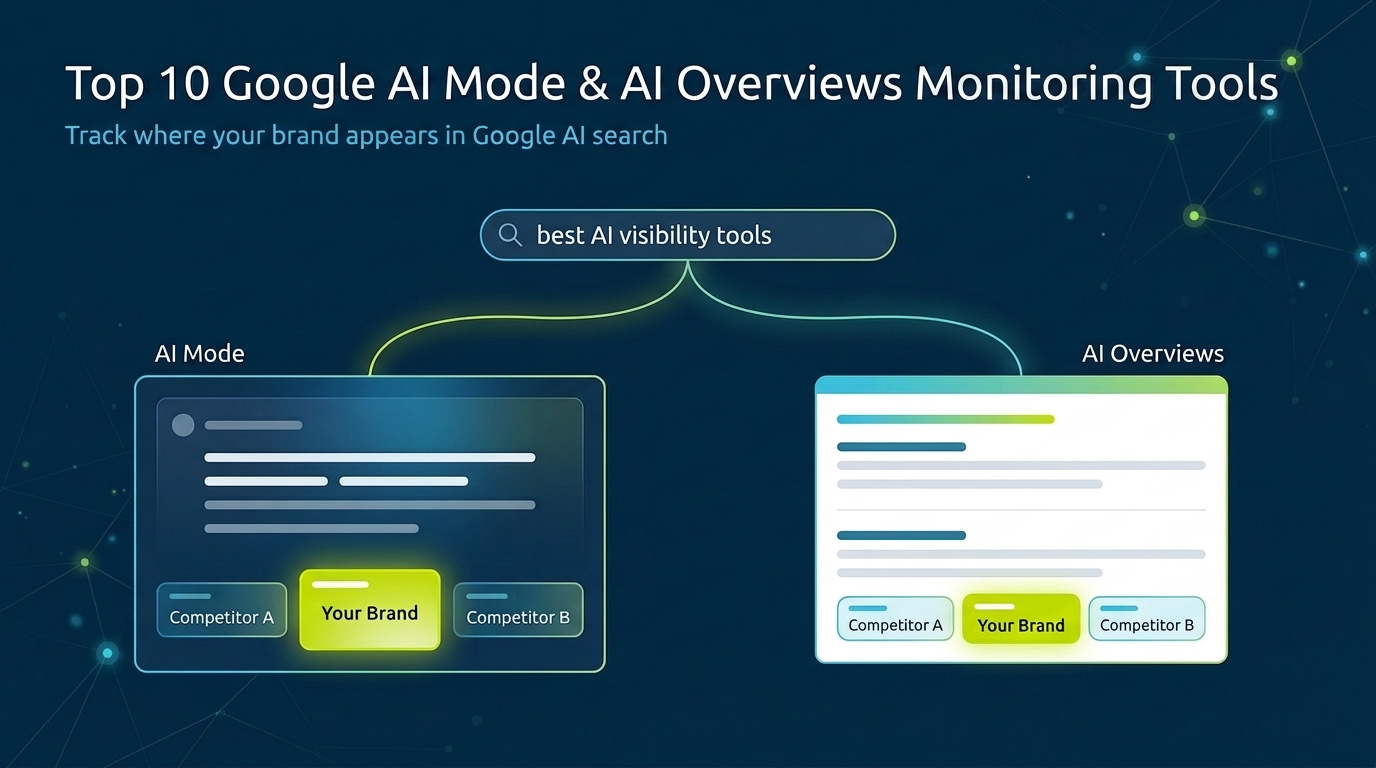
Google AI Mode and Google AI Overviews (AIO) are two different surfaces inside Google Search. AIO is the summary box that appears above traditional results for a subset of queries. AI Mode is a separate, full-page conversational experience where the user chats with Google’s AI instead of scanning a results list. A tool that tracks one doesn’t automatically track the other well, and the two require different capture methods, so it’s worth checking both separately before you commit budget. This list covers ten tools that monitor one or both, checked against public product documentation, help centers, and pricing pages as of August 18, 2026, rather than any single vendor’s own comparison page.
The 10 tools at a glance
| Tool | AI Mode | AI Overviews | ChatGPT/Perplexity | Best for |
|---|---|---|---|---|
| Profound | Yes | Yes | Yes | Enterprise AI-search intelligence, separate toolset from Google data |
| BrightEdge | Yes | Yes | Yes | Teams already on BrightEdge for organic SEO |
| Semrush | Yes | Yes | Yes | Teams already paying for Semrush |
| AthenaHQ | Yes, Starter+ | Yes | Yes | GEO-first teams with budget for premium tiers |
| GrowByData | Yes | Yes | Yes | Teams that want AI Mode and AIO tied to existing Google search data, not siloed |
| Otterly.ai | Paid add-on | Yes | Yes | Small teams, entry-level budget |
| Peec AI | Yes | Yes | Yes | Multi-seat teams wanting daily multi-engine dashboards |
| Rankscale.ai | Yes | Yes | Yes | Budget-conscious teams, SEO-adjacent |
| Scrunch AI | Yes | Yes | Yes | Content teams optimizing for AI answers and agents |
| Nozzle | Not documented | Yes | Not documented | Teams tracking AIO as one line item in broader rank data |
Support levels checked against public documentation as of August 18, 2026. “Not documented” means we couldn’t confirm it publicly, not that the tool definitely lacks it.
What’s the difference between tracking Google AI Mode and AI Overviews?
AIO tracking is closer to traditional rank tracking. You’re checking whether a summary box appears for a given query and whether your domain is cited inside it, which is a snapshot you can capture the same way you’d capture a SERP feature. AI Mode tracking is harder. Because it’s conversational, the “result” changes based on how a query is phrased and what came before it in the exchange, so tools have to simulate realistic prompts rather than just checking a fixed keyword list.
That distinction matters when you’re evaluating vendors. A tool built for AIO snapshots can bolt on AI Mode support without doing it well. Ask any vendor on this list, GrowByData included, exactly how they capture AI Mode data before you buy. If you’re mapping this against an existing LLM Intelligence stack, the same question applies to whatever you’re already running. If you work in a regulated category, see our guide to AI search tracking for healthcare before you choose a tool.
How we evaluated these tools
We looked at four things: whether the tool captures AI Mode specifically or just AIO, whether it tracks citations (not just brand mentions), whether competitors are visible in the same view, and what a team actually pays once they’re past the entry tier. Pricing shifts fast in this category, so treat every number here as a starting point to verify, not a locked quote. For the broader shift driving this whole category, our AI search visibility guide covers how enterprise teams are adapting their measurement stack.
The 10 tools, ranked
1. Profound
Profound is one of the more established names in AI visibility, built around citation tracking across ChatGPT, Gemini, Perplexity, Microsoft Copilot, and Google’s AI surfaces. It separately announced Google AI Mode support in June 2025, on top of its existing AI Overviews coverage. It’s a strong pick if AI visibility is the only thing on your list. The tradeoff: it’s a separate toolset from your existing Google search data, so you’re running two dashboards side by side instead of one. Pricing is enterprise and custom quoted, so get a current number before you budget around it.
2. BrightEdge
BrightEdge built AI Catalyst on top of an already-mature enterprise SEO platform, tracking brand presence and sentiment across Google AI Overviews, AI Mode, ChatGPT, and Perplexity, sitting next to the organic content performance data you’re probably already using. It’s weaker on the competitive Shopping Ads side, so if paid and organic both matter to your team, you’re likely supplementing it elsewhere.
3. Semrush
Semrush folded AI visibility into its existing suite as a $99-a-month per-domain add-on, billed annually, covering 25 tracked prompts across ChatGPT, Gemini, Perplexity, and both Google AI Overviews and AI Mode. That’s convenient if your team already lives in Semrush for keyword research, and the add-on structure means you’re paying for AI visibility separately even if you’re already a customer. Extra prompts and domains each cost more on top of the base $99.
4. AthenaHQ
AthenaHQ positions itself as a GEO command center, with prompt tracking and a citation engine covering eight or more AI platforms, including AI Mode, Gemini, Claude, Copilot, and Grok alongside ChatGPT and Perplexity. That breadth sits on the paid Starter tier and above; the no-cost Essential tier doesn’t include AI Mode, according to its own plan comparison. The catch on Starter is cost: it runs around $295 a month on a credit-based system, with 3,600 credits included, and that climbs fast if you’re tracking a lot of prompts across a lot of platforms.
5. GrowByData
Where GBD fits in this list: it’s the only tool here that puts Google AI Mode monitoring and Google AI Overviews monitoring next to your organic rankings, SERP features, and Google Shopping Ads competitive data, on the same keyword set, updated daily. If a Director of SEO and a Director of Paid Search are both asking “are we visible,” this is the one dashboard that answers both questions instead of sending them to separate tools. It’s not the cheapest entry point on this list, and it’s not built as an AI-visibility-only specialist the way Profound or Peec AI are. If your need really is narrow AI citation tracking and nothing else, one of the specialists below might be a simpler fit.
6. Otterly.ai
Otterly is one of the more accessible tools on this list to get started with. Its Lite plan starts at $29 a month for 15 prompts, unlimited team members, and daily tracking, low enough that a single marketer can justify it without a procurement conversation. It tracks citations and sentiment across ChatGPT, Perplexity, and AIO out of the box, covering similar ground to a dedicated ChatGPT brand monitoring tool. Google AI Mode is currently a paid add-on rather than part of the core plan, per Otterly’s own pricing page, and it doesn’t touch Google Shopping or paid search at all.
7. Peec AI
Peec runs daily cross-engine dashboards with unlimited seats on every tier, which matters if several people on your team need logins. Starter, Pro, and Advanced plans let you pick from a supported model list that includes Google AI Mode, Google AI Overviews, ChatGPT, Perplexity, Copilot, and Gemini, including Perplexity brand monitoring. The focus is narrow by design: citation tracking across LLMs, full stop. There’s no broader search intelligence layer, so if you need Google organic or Shopping data too, you’re pairing it with something else.
8. Rankscale.ai
Rankscale is the budget option here, with an Essentials tier starting around $20 a month and a Pro plan around $99 a month with 1,200 credits included. Because the amount of monitoring depends on credits and how many engines you select, compare expected monthly response volume rather than just the headline price. Team collaboration and white-label features are newer additions to the platform, so if you’re an agency managing this for multiple clients, test that workflow specifically before rolling it out.
9. Scrunch AI
Scrunch approaches the problem from the content side: it monitors brand visibility across nine AI surfaces, including Google AI Mode, AI Overviews, ChatGPT, Perplexity, Gemini, Claude, Copilot, Grok, and Meta AI, then helps you rewrite content to be more “AI-ready.” Plans start around $250 a month. That’s a genuinely different angle from a pure monitoring tool, closer to a content-optimization platform that happens to include monitoring than a dedicated search-and-AI visibility platform.
10. Nozzle
Nozzle tracks AI Overviews as one SERP feature inside a broader rank-tracking product, which makes sense if AIO visibility is just one line item in a much bigger SEO reporting setup. We couldn’t find public documentation confirming dedicated AI Mode or cross-LLM tracking (ChatGPT, Perplexity) for Nozzle, which doesn’t mean it definitely lacks it, but it does mean you should ask directly before assuming it’s covered.
Talk to an expert and see your visibility gap across Google Search, Shopping, and AI Mode on your own keywords.
Which one should you actually pick?
If AI visibility is the entire job, a specialist like Profound, Peec AI, or Otterly will get you there faster and cheaper than a platform built for more than that. If you’re a Director of SEO or Paid Search who’s already answering to a VP about Google Shopping performance and organic rankings in the same weekly meeting, adding a fourth disconnected dashboard for AI Mode is its own kind of problem. That’s the gap GrowByData was built to close: one keyword set, tracked daily, visible across Google Search, Shopping, and AI Mode at once. If ChatGPT and Perplexity visibility matter just as much as Google’s AI surfaces, our roundup of best LLM visibility tracking tools for enterprise teams covers that wider comparison.
Whichever you choose, don’t take a vendor’s own ranking of itself at face value, including ours. Ask for a live look at your actual domain before you sign anything. For the questions to ask before you sign a contract, our brand guide to AI and LLM search visibility walks through evaluation criteria in more depth.
Frequently asked questions
Does Google AI Mode show up in Search Console?
Yes, as of June 2026. Google launched a dedicated Generative AI performance report inside Search Console (Performance > Generative AI) that separates impressions from AI Overviews and AI Mode out of the standard organic report for the first time. It’s rolling out gradually, UK properties first, and covers impressions by page, country, and device. It doesn’t show clicks, CTR, or which prompts actually drove those impressions. That gap, visibility without the prompt-level or competitive context, is exactly what dedicated tools like the ones on this list exist to fill.
Can one tool track both AI Mode and AI Overviews?
Some can, but check the fine print. Several tools on this list added AI Mode support after launching with AIO tracking only, and the depth of that support varies a lot. Ask the vendor to show you a live capture, not just a feature checklist.
How often should AI Mode visibility be checked?
Daily, if the keywords are revenue-relevant. AI-generated answers shift faster than traditional rankings because the underlying model can change its response without any change to the SERP itself, so a weekly or monthly snapshot will miss most of what’s actually happening. If you’re building the case for that cadence internally, see how enterprises measure ROI from AI search visibility.
Book a session and we’ll walk your domain through the same tracking used above.