Key takeaways
- “Did we get mentioned” is not a metric. It’s the equivalent of judging SEO on whether your domain shows up anywhere in Google, with no regard for position or clicks.
- Start with presence rate and citation share. The other seven KPIs are refinements once those two have a baseline.
- AI-assisted search now accounts for over half of global search activity when every engine is combined, which is why a rank-tracking metrics framework doesn’t transfer cleanly.
- Track engine-level variance separately. ChatGPT, Perplexity, and Google AI Mode retrieve differently, and a blended average hides the gap you need to see.
- Report weekly internally, monthly to stakeholders, so trend velocity is visible before a budget conversation.
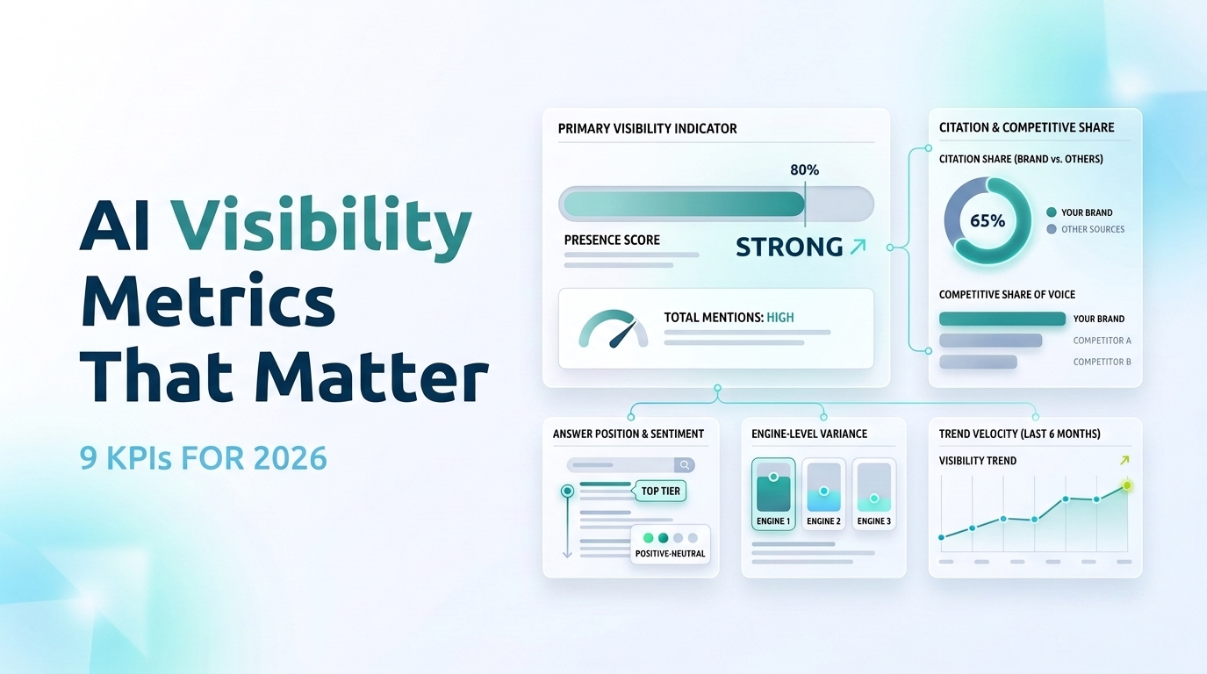
AI search visibility metrics are the numbers that tell you whether your brand is actually winning inside ChatGPT, Perplexity, and Google’s AI surfaces, as opposed to occasionally getting lucky. Most teams stop at one metric: did we get mentioned. That tells you almost nothing useful on its own.
Below are the nine KPIs worth building a dashboard around, roughly in adoption order. You need presence and citation share first, everything else layered in as the program matures. Why bother: AI-assisted search now accounts for a majority of global search activity when every engine is combined, by some 2026 estimates north of 55 percent, and Google’s own AI Overviews alone reach roughly half of all searches. A metrics framework built for ten-blue-links SEO wasn’t designed for a channel that size.
What metrics measure success in AI search engines?
Nine, in three groups: whether you show up, how you show up, and what it’s worth to the business.
1. Brand Visibility
The percentage of tracked prompts where your brand appears at all. This is your floor metric. If it’s low, nothing else here matters yet.
2. Citation share
Of the prompts where you’re present, how often your domain is actually linked or named, versus just referenced in passing. A model can describe your product accurately and never cite you, which means zero traffic back to your site.
3. Share of voice against named competitors
Run the same prompt set for your top three to five competitors. Sixty percent presence sounds fine alone. It looks different next to a competitor at ninety.
4. Answer position
Named first, or buried third. Position correlates with perceived credibility the same way it does in organic search, even without a literal ranking algorithm.
5. Sentiment accuracy
Whether the AI’s description is current and accurate, or repeating outdated pricing or a stale, unflattering comparison. This is the metric that catches reputational risk before it becomes a sales objection.
6. Prompt coverage breadth
How many distinct buyer-intent prompts you’re actually tracked against, not just how many favorable ones you already watch. Fifteen cherry-picked prompts is a highlight reel, not a category.
7. Engine-level variance
Presence and sentiment on ChatGPT versus Perplexity versus AI Mode can differ sharply, since each engine retrieves differently. A blended average hides the gap you need to see.
AI engines are already influencing buying decisions. Find out how your brand is represented.
Schedule a Straegy Session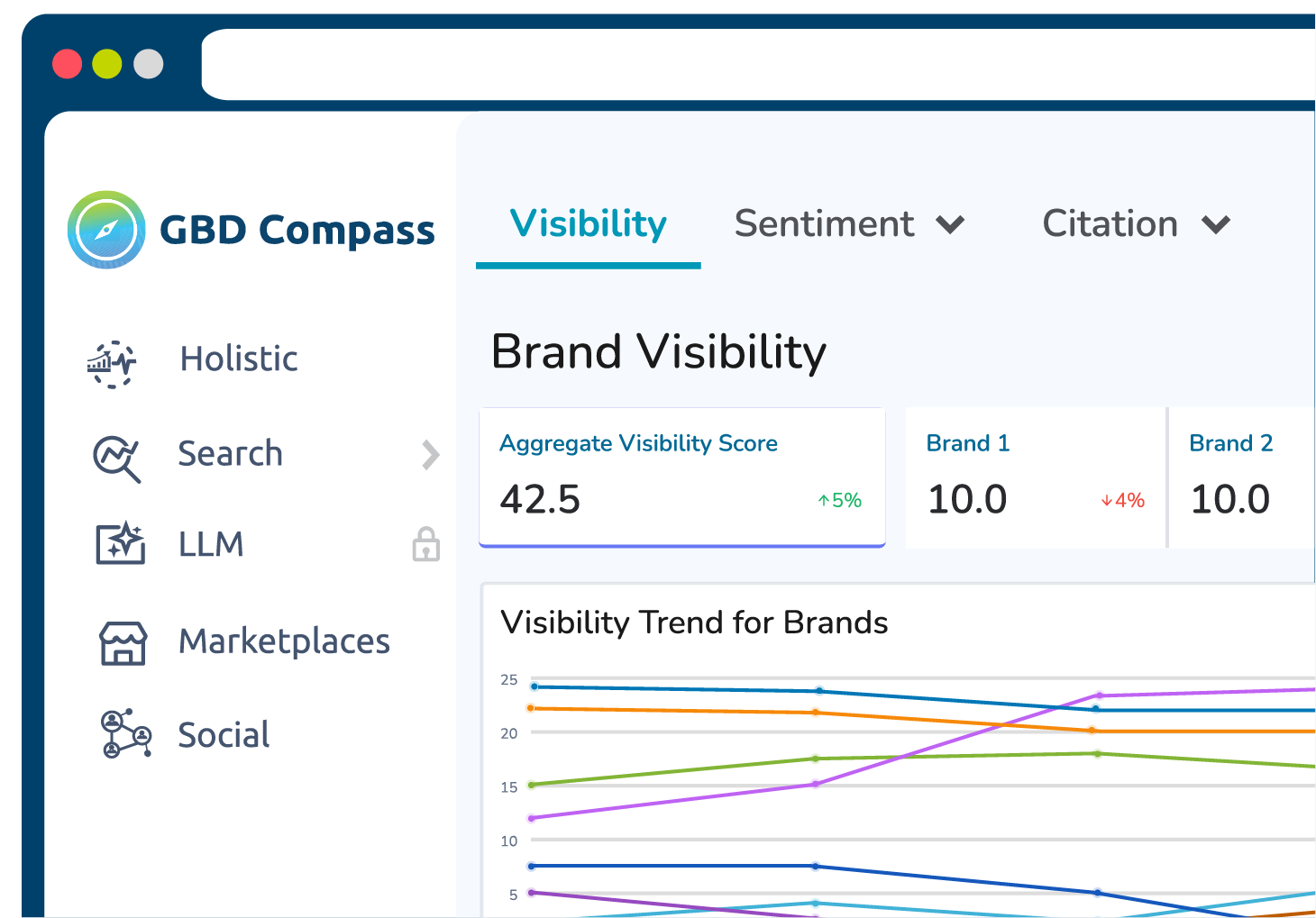
8. Citation-to-click correlation
Where analytics allow it, tie AI referral traffic to the prompts and pages that actually drove a visit. This turns AI visibility from a vanity report into an attributed channel, and it’s the metric most dashboards skip because it’s hardest to build.
Want to see where these nine numbers stand for your brand today?
Book a session and we’ll walk through your AI visibility gap alongside your Google Search and Shopping data.
Which of these KPIs should you prioritize first?
Presence rate and share of voice, full stop. Everything else here is a refinement of a program that already knows whether it’s visible at all. Optimizing sentiment accuracy before you’ve established a baseline presence rate is building the second floor before the first.
Where teams get this wrong: they inherit a rank-tracking-shaped metric from their SEO stack and force it onto AI search because it’s familiar. There’s no fixed position ten results long, no guaranteed placement for a given prompt on a given day. A KPI framework built for AI search has to account for that variability, not average it away.
For the broader approach these KPIs plug into, our AI search visibility guide covers the full framework, and our plain-language definition of AI visibility is a good starting point if you’re building the case from scratch. For proving value to a budget owner, see how enterprises measure ROI from AI search visibility. For the operational side, see how to monitor AI search visibility.
Frequently asked questions
What’s a good presence rate benchmark to aim for?
It depends on category maturity and competitive density, so treat any flat percentage online with suspicion. A more useful benchmark is relative: close the gap against your top two or three named competitors within a defined prompt set.
Do these KPIs apply the same way to Google AI Overviews as they do to ChatGPT?
Mostly, with one adjustment. AI Overviews sit inside a search results page, so citation and position data often ties directly to keyword-level Search Console data, harder to replicate for ChatGPT or Perplexity, which have no equivalent first-party reporting.
How often should these metrics be reported internally?
Weekly for the team running the program, monthly for stakeholders. Weekly catches sudden swings from model updates. Monthly shows trend velocity clearly enough to justify continued investment.
Get these nine metrics tracked automatically, not pieced together by hand.
See how GBD Compass builds this dashboard on your actual prompt set and keyword list.