
Ecommerce coverage favors growth stories: revenue, ROAS, marketplace expansion. The operational layer underneath those numbers gets almost no attention.
Amazon marketplace operations is the unglamorous work that decides whether that growth holds: catalog management, product data governance, pricing oversight, buyer messaging, feed operations, listing maintenance, and Buy Box monitoring. None of it shows up in a quarterly deck. All of it determines whether an Amazon business scales or just gets busier.
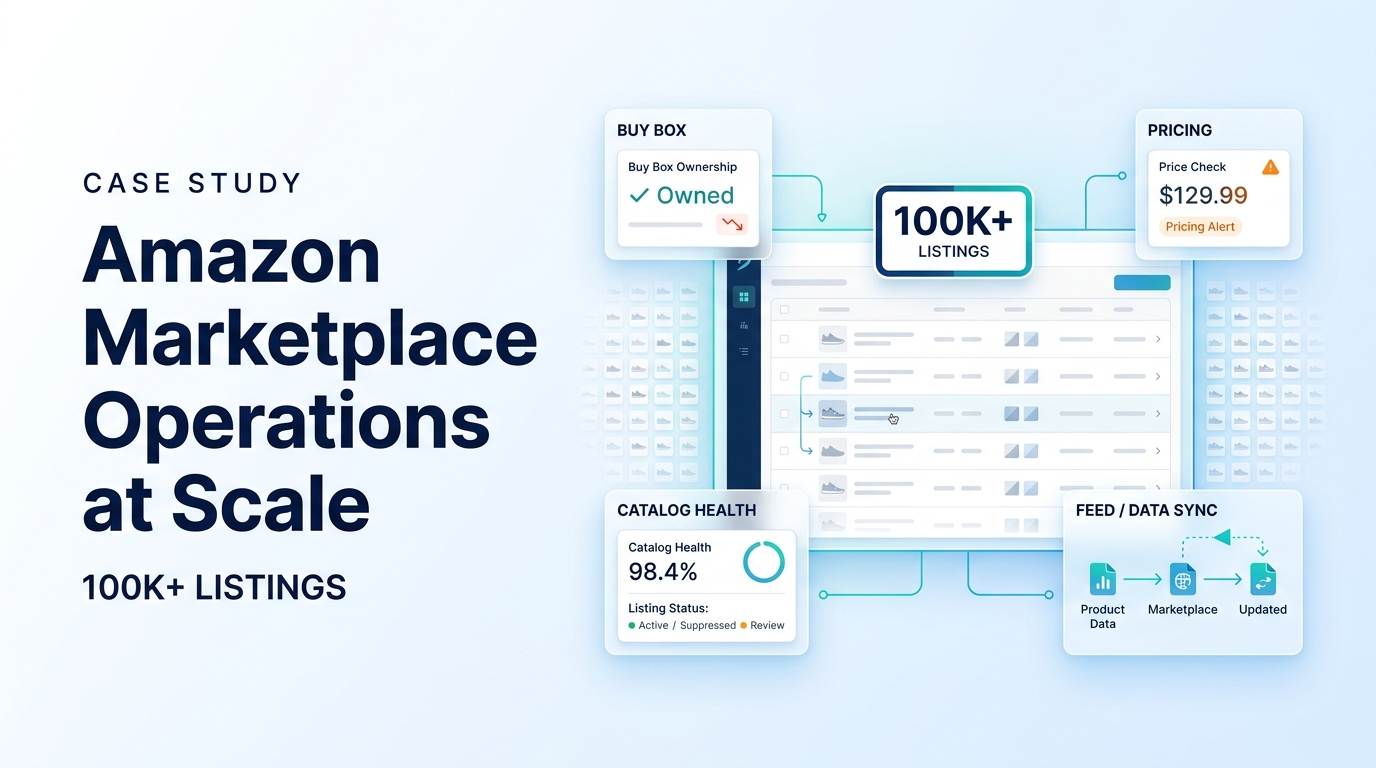
Over several years, GrowByData ran Amazon marketplace operations for a footwear retailer managing a large, fast-moving Amazon catalog. The engagement started as catalog support and grew into a full operations partnership covering most of the day-to-day execution. The lasting output was a working model: a way of running eCommerce product catalog management at a scale where manual effort stops being an option.
Advertising Alone Does Not Fix Amazon
Most retailers start with traffic: Sponsored Products, DSP, promotions, Amazon SEO. Those investments matter, and they cannot fix an operational problem underneath them.
Take an ordinary sequence. A shopper searches for a running shoe, finds the listing, clicks through. On arrival: bullets are stale, an attribute is missing, the price is wrong, inventory hasn’t synced, the Buy Box belongs to a third-party seller, and two customer questions have gone unanswered for a week. The ad spend that delivered that shopper is already gone.
Amazon’s ranking behavior increasingly favors sellers who keep catalogs healthy and offers accurate. Digital shelf analytics makes that visible, but the fixes themselves are operational. This retailer understood the distinction early. They weren’t chasing more sales on Amazon. They wanted an Amazon operation that could absorb more sales without breaking.
What Does Amazon Marketplace Operations Actually Cover?
Ask ten people in ecommerce what “marketplace operations” means and you’ll get ten different answers. On this engagement, it broke down into seven connected workstreams:
- Catalog governance: keeping attributes, content, and structure consistent across thousands of ASINs
- Buy Box reporting: tracking ownership, competitive movement, and sales indicators weekly
- Pricing governance: catching pricing errors and competitive shifts before they cost margin
- Buyer messaging: covering response times against Amazon’s seller performance metrics
- Systems integration: keeping product data accurate between internal systems and the channel management platform
- Catalog cleanup: removing accumulated operational debt at scale
- Compliance: tracking verification requirements and account health obligations
None of these are exciting individually. Run together, over years, they’re the difference between an Amazon business that scales and one that just adds headcount.
The Challenge: Thousands of Products, Tens of Thousands of Child ASINs
Athletic footwear is among the more demanding categories on Amazon. A single shoe model generates dozens of child ASINs under one parent listing, each carrying its own size, width, and colorway, each with attribute requirements of its own. Add seasonal releases and marketplace-specific fields and the count climbs quickly.
Multiply that across thousands of styles and the daily workload becomes constant rather than periodic. Product content needs updating, suppressed listings and stranded inventory need clearing before they quietly pull ASINs out of search results, and pricing discrepancies keep surfacing between systems. Feeds fail. Buyer messages arrive at all hours, and compliance requirements shift without anyone sending a memo about it.
At that volume, manual management stops working. Scaling requires both tooling and people who know Seller Central well enough to diagnose what broke.
Building the Foundation: Catalog Governance
The first work was catalog governance, which is easy to undervalue because nobody notices it when it functions.
Almost every marketplace KPI depends on catalog quality. Accurate attributes affect search visibility, conversion, return rates, and compliance standing. Bad attributes affect all four in the other direction.
- Listing maintenance. Specifications change, attributes get added, Amazon’s category requirements move. Keeping listings current became a standing workstream rather than a project with an end date.
- Product data governance. Consistent attribute definitions across systems are what keep the catalog from drifting. This covered attribute standards, content consistency, and catalog integrity, and it sits directly on top of product data enrichment. We ran a similar enrichment program in footwear with Schuler Shoes, where the constraint was attribute completeness rather than catalog scale.
- Catalog synchronization. Product data has to stay aligned between the retailer’s internal systems and every marketplace destination. Reliable product feed management is what prevents a pricing update in one system from silently failing to reach another.
- Troubleshooting. Catalog problems rarely have single causes. Most involve some combination of feed logic, attribute validation, and Amazon-side processing, and isolating which one broke is its own skill.
Over time this stopped being maintenance work and started being an asset. The catalog became something the business could act on.
Product Content: Where Traffic Converts or Does Not
Once a shopper reaches a product detail page, content does the selling. Titles, bullets, backend keywords, and A+ Content decide whether the click becomes an order.
Content work across the engagement covered three areas. Bullet point optimization, where the job was accuracy and Amazon compliance as much as persuasion, executed as bulk updates across large ASIN groups rather than one listing at a time. Listing update management, which at this catalog size depends on repeatable flat-file processes instead of manual edits. And ongoing content maintenance as descriptions, specifications, and attributes aged out.
For a catalog in the thousands of styles, content governance is a full workstream. Pairing it with product intelligence is what turns it from upkeep into something measurable, since you can see which content changes moved position and which did nothing.
Buy Box Reporting
Buy Box ownership decides who captures demand on a shared listing. Losing it does not reduce sales gradually. It removes them.
GrowByData set up recurring Buy Box reporting covering ownership trends, product-level performance, week-over-week changes, competitive movement, and sales indicators. The mechanics of what drives ownership are covered in more depth in our guide to winning the Amazon Buy Box.
The reporting cadence mattered more than the reports. Weekly visibility meant the team saw ownership slipping on a set of ASINs while it was still a small number, instead of finding out in a monthly sales review after the damage had already compounded. That shift, from explaining declines to catching them, is what digital shelf analytics is for.
Pricing Governance
Pricing errors are among the least discussed risks in marketplace operations and among the most expensive. A wrong price can cut margin, trigger complaints, affect Buy Box eligibility, and damage how the brand is perceived by shoppers comparing sellers.
At thousands of SKUs with prices moving from multiple upstream systems, errors are not exceptional events. They are a steady background rate. GrowByData ran daily pricing error monitoring against the catalog, with the goal of catching anomalies early enough that the fix cost nothing beyond the fix itself.
The same monitoring surfaces competitive movement, which is where competitive price intelligence and minimum advertised price policy connect to the operational side. Detecting your own error and detecting a reseller undercutting an advertised price use the same underlying data.
If pricing errors or Buy Box losses are already eating into margin and you want a clear read on where the exposure sits in your own catalog, that’s a 30-minute conversation, not a project.
Buyer Messaging as an Operations Function
Plenty of organizations treat customer support and marketplace operations as separate departments. Amazon does not make that distinction. Response time feeds seller performance metrics, and seller performance metrics feed Buy Box eligibility.
GrowByData covered buyer messaging during US off hours, which closed the gap between a message arriving overnight and someone seeing it the next morning. The effect was faster response times, more consistent answers, and less after-hours load on the internal team.
Treating messaging as part of operations rather than as a support silo is a small reframe with a direct line to seller metrics.
The Systems Layer
Behind any marketplace program of this size sits a channel management platform, and the quality of that integration sets the ceiling on everything else. For this retailer, that platform was Rithum.
Work here covered product feed management, catalog synchronization, data quality monitoring, listing publication, content troubleshooting, and the workflows connecting them. It is unglamorous and it is decisive. Frontend performance gets the attention, but whether the backend can move product data accurately between systems is what determines if the operation scales or just gets busier. Product intelligence tells you what to change. The systems layer determines how fast you can change it.
A 100,000-Product Catalog Cleanup
Operational debt accumulates the way technical debt does. Discontinued products stay active. Legacy listings persist under old attribute schemes. Duplicate ASINs multiply. Eventually the catalog carries more history than product.
The largest single project in this engagement was an Amazon cleanup covering well over 100,000 products. Work at that scale needs sequencing, clear rules for what gets removed versus merged versus corrected, and coordination across teams who each own part of the data.
Projects like this never get written up, because the outcome is an absence rather than a result. What it bought was speed: room to launch the next initiative without dragging years of catalog debt behind it.
Compliance and Seller Verification
Amazon’s compliance requirements keep moving. Practices that passed review two years ago now fail it.
Sellers have to track verification requirements, policy updates, product information standards, data quality thresholds, and account health obligations. Falling behind on any of them can suspend listings or the account.
GrowByData supported ongoing compliance operations across the engagement, which kept requirement changes from turning into listing interruptions. Handling compliance continuously rather than in response to a problem is cheaper by a wide margin, though that is hard to prove until the first time it works.
From Vendor to Operations Partner
The most durable outcome here has little to do with the cleanup or the reporting cadence. The relationship stopped looking like a vendor arrangement and started looking like an extension of the team.
The engagement today covers most of what a marketplace operations team would own directly: catalog and content governance, Buy Box reporting, pricing intelligence, buyer messaging, feed operations, troubleshooting, and compliance. Individually, each of those is a service line. Together, they function as an extension of the retailer’s own operations team, which is a different thing to buy and a different thing to deliver.
Five Things This Engagement Confirmed
- Catalogs are assets, not overhead. Poor product data creates failures in every downstream system. Good product data compounds quietly.
- Operations decide whether advertising pays. Ads bring shoppers to the page. What is on the page decides the rest.
- Monitoring beats troubleshooting. Weekly Buy Box reporting and daily price checks cost less than the revenue lost between a problem starting and someone noticing.
- Buyer messaging is an operations metric. Response time feeds seller performance, and seller performance feeds Buy Box eligibility.
- Small fixes compound. The accumulated effect of routine operational work usually exceeds any single project in the same period.
Where This Leaves Retailers
For this retailer, Amazon performance did not come from one initiative. It came from years of catalog governance, content management, Buy Box reporting, pricing oversight, buyer messaging coverage, compliance work, and one very large cleanup.
None of that is proprietary. It is available to any retailer willing to treat marketplace operations as a discipline rather than a cost center. The reason more do not is that the work is unglamorous and the payoff is mostly invisible, which makes it easy to defer and expensive to have deferred.
If you are managing a large Amazon catalog and want to know what your operational exposure actually looks like, talk to a marketplace operations expert.