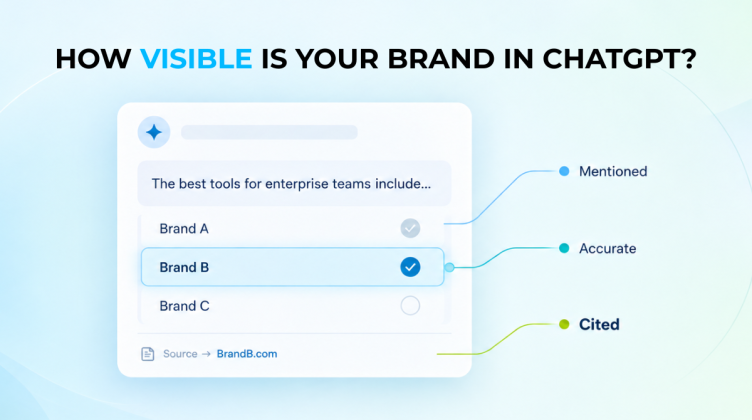
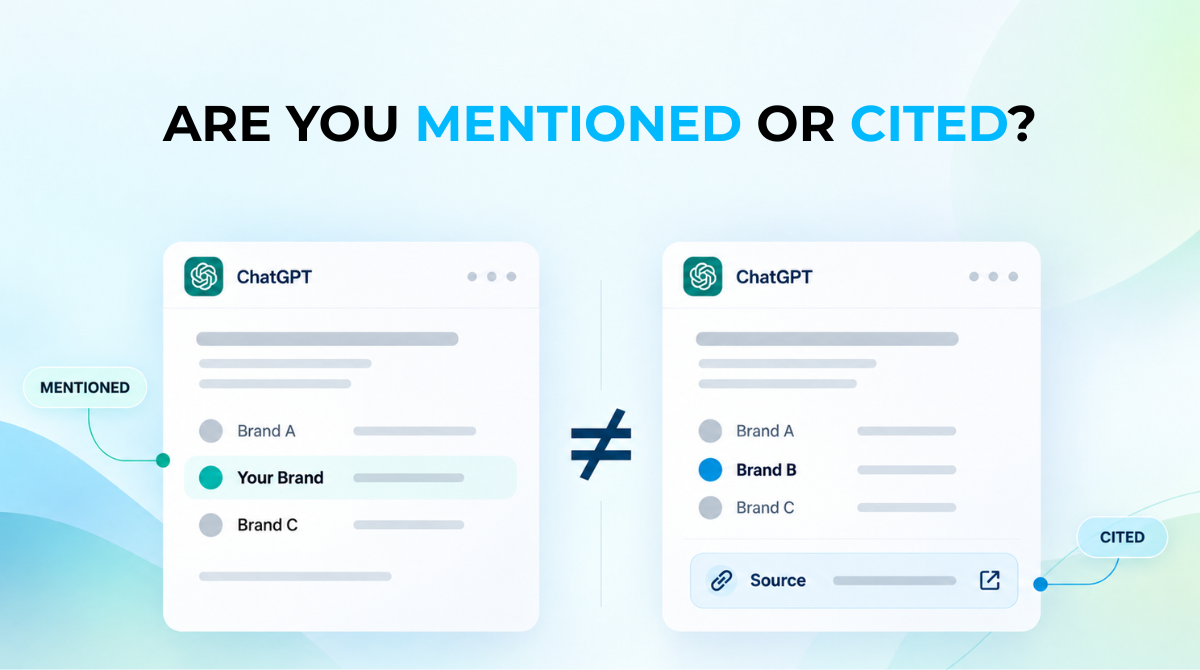
Most teams running a ChatGPT citation analysis are actually doing something else: counting how often their brand name shows up in a response. That’s mention tracking, and it has its place. It answers a different question than the one that matters here.
Citation analysis asks who ChatGPT is pulling from to answer questions in your category. Not whether it happens to say your name.
What is ChatGPT citation analysis?
ChatGPT citation analysis is the process of identifying which sources ChatGPT cites or draws from when it answers questions in your category, as distinct from tracking whether it mentions your brand by name. It’s a narrower, ChatGPT-specific version of citation tracking in AI more broadly, and a genuinely different exercise from tracking brand mentions in ChatGPT, which counts whether your name comes up rather than who gets cited.
If you’ve searched for chatgpt brand citation tracking tools before, most of what turns up is a mention counter with a citation label stapled on. That mismatch is exactly why this gets confusing.
ChatGPT citation analysis vs. the related terms
These get used interchangeably, and that causes real confusion in planning meetings. They’re not competing frameworks, they’re pieces that add up to the same picture.
| Term | What it means |
|---|---|
| ChatGPT mentions | Your brand named in the answer text, whether or not there’s a link |
| ChatGPT citations | ChatGPT linking directly to a page as a source |
| Citation analysis | The full source list for a topic, not just the citations that happen to be you |
| Citation share | Your citations as a percentage of all citations for a given prompt set |
Track only citations of your own brand and you’ll miss the point. The useful data is in who else is getting cited, and how often, not just whether you show up on the list.
What sources does ChatGPT actually cite for your category?
Start with prompts a buyer would actually type, not your brand name. A few to build from:
- Best tools for tracking brand visibility in ChatGPT
- How do I monitor my competitors’ AI search presence
- What’s the difference between AI Overviews and AI Mode tracking
- How often should I check chatgpt search citations for my brand
Fifteen to twenty-five prompts like these is enough for a real read without eating your whole week. Write them the way a Director of Paid Search or a VP of Ecommerce Marketing would ask, not the way a marketer would ask about their own brand.
| Step | Do this | Look for |
|---|---|---|
| 1 | Write 15-25 buyer-voice prompts for your category | Category questions, not brand-name searches |
| 2 | Run each prompt 3-4 times, not once | Which sources repeat vs. which show up once and vanish |
| 3 | Log every citation as it appears | Domain, URL, and source type, covered next |
| 4 | Repeat monthly | Whether the same sources hold position or a new one breaks in |
ChatGPT’s citations shift response to response. A source that shows up on the first run can vanish on the second, and one that never appeared shows up on the third. A single pass gives you a snapshot. A handful of passes gives you a pattern, and the pattern is the part worth having.
What to log for each citation
Keep this in a spreadsheet you can sort, not a running list in a doc.
| Field | What it captures |
|---|---|
| Domain | The site being cited, not the individual page |
| Page URL | The exact URL ChatGPT pulled from |
| Source type | Editorial, owned, competitor, marketplace, or community |
| Prompt | Which prompt variant surfaced it |
| Times cited | How many of your runs included it |
The source-type column is where the actual thinking happens. A citation from a competitor’s blog tells you one thing. A citation from a third-party roundup that doesn’t mention anyone in your category yet tells you something more useful: an outlet that’s already shaping the conversation and hasn’t picked a side.
AI engines are already influencing buying decisions. Find out how your brand is represented.
Schedule a Straegy Session
What affects whether a source gets cited
- Existing citation history. Pages ChatGPT has cited before for similar prompts tend to keep showing up.
- Clear, specific claims. Pages with concrete numbers and named comparisons get pulled more than vague marketing copy.
- Third-party roundups and comparisons. ChatGPT leans on aggregator consensus the same way it does for brand mentions.
- Recency. Pages updated in the last few months outcite stale ones covering the same ground.
- Structured content. Definitions, tables, and numbered steps are easier for the model to lift than long paragraphs of prose.
Common mistakes in ChatGPT citation analysis
- Only checking once. Citations shift with every model update and every new page the crawlers pick up. A single afternoon of prompting is a snapshot, not a trend line.
- Testing only branded prompts. Buyers ask category questions, not your company name.
- Skipping the source-type column. A citation count without knowing editorial vs. competitor vs. owned tells you almost nothing.
- Stopping at the list. The data means nothing until someone pitches an editor or fixes a page because of it.
If you’re already three of these in, that’s usually the sign it’s time for something tracking this on a schedule instead of by hand. ChatGPT brand monitoring is built for exactly that gap. Walk through your own domain’s citation list with us and you’ll have it before the meeting ends.
Turning the citation list into a plan
Once you have the list, the obvious move is to file it and move on. Don’t.
The publishers already citing your competitors but not you are a short, specific list worth a real pitch. They’ve established that they’ll cite a company like yours; they just haven’t cited yours yet. The pages citing nobody in your category are worth flagging too, since that’s where the next citation cycle gets decided.
This is the part mention tracking can’t give you. It tells you what ChatGPT says about your brand. Citation analysis tells you who’s deciding what gets said in the first place, and that’s a list you can actually act on.
What we found running this on ourselves
We ran this exact process on our own category, search intelligence and AI visibility platforms, against ChatGPT over a 90-day window. The list came back long: more than 200 distinct pages cited across our tracked prompt set.
| Domain | Citation frequency in our 90-day pool |
|---|---|
| Ahrefs.com | Highest, appeared across dozens of distinct pages |
| Semrush.com | High, appeared across dozens of distinct pages |
| Profound (tryprofound.com) | High, appeared across multiple pages |
| GrowByData.com | Not present in this citation pool |
Source: GBD Compass Intel, growbydata.com account, ChatGPT platform, trailing 90 days. Capped at 200 returned rows, so the true total may run higher.
That’s the pattern this kind of analysis is built to expose: a handful of publishers doing most of the work of educating the model, and everyone else watching from outside it. Our own share of that citation pool is thinner than we’d like right now, and closing it is a live project, not a finished one.
FAQ
Is ChatGPT citation analysis the same as backlink analysis?
No. Backlinks measure who links to your site for search rankings. Citation analysis measures who ChatGPT pulls from when it builds an answer, a different signal even though some of the same pages show up in both.
How often should you re-run a citation analysis?
Monthly at minimum for a competitive category. The citation pool shifts with every model update and every new piece of content the crawlers pick up, so a quarterly check misses most of the movement.
Can you influence which sources ChatGPT cites?
Not directly, and not immediately. You can improve your odds by getting cited more often on the third-party sources ChatGPT already leans on, and by publishing pages structured clearly enough for the model to pull from directly.
Do citations from ChatGPT drive any actual traffic?
Some, through the citation link, but the bigger value is influence: showing up as the source that shaped an answer a buyer read before they ever visited your site.
If a citation list like that would change how you prioritize next quarter, see what it looks like for your own category before you plan around guesses instead.