An AI search visibility gap analysis shows where AI answers name your competitors and leave you out. We ran one on GrowByData. Across 3,028 tracked AI answers, growbydata.com was used as a source in 509, but GrowByData was named in only 348.
So at least 161 answers used our pages and never said our name. A single visibility score would hide that, because it blends mentions and citations into one number.
Our view: being left out isn’t the worst gap. Being used as a source without being named is worse, because the AI trusts your content and still leaves you off the buyer’s list.
What is an AI search visibility gap?
An AI search visibility gap is a buyer question where AI answers include your competitors but not you, describe you less favorably, or get facts about you wrong. It can show up on one prompt, one platform, or one source the AI relies on. If an AI answer leaves your brand out, you get no visibility in that answer.
A ranking drop still leaves you somewhere on the page. An AI answer often names a few options and stops there. If you’re not in it, a buyer can build a shortlist without you and never scroll down to the links.
Fewer people click through, too. Pew Research Center found that Google users clicked a regular search result in 8% of visits when an AI summary appeared, and in 15% of visits when it didn’t (900 US adults, browsing data from March 2025).
If you’re new to measuring this, our guide to AI search visibility covers the basic metrics.
What’s the difference between being cited and being named in an AI answer?
Being named means the AI answer mentions your brand in its text. Being cited means the answer links to your page as a source. The two often don’t match: an answer can cite your page for a fact and recommend someone else, or name you without linking to anything you published.
That gives you four possible outcomes for any answer:
| Named in the answer | Not named | |
|---|---|---|
| Cited as a source | Best case. The AI uses your page and recommends you. | Recommendation gap. The AI uses your page but doesn’t name you. |
| Not cited | Earned mention. Other sites talk about you, and the AI repeats it. | Absent. You’re not in the answer at all. |
Most gap reports focus on the bottom-right box. The top-right box is harder to spot, and in our data it was big enough to matter.
What are the types of AI visibility gaps?
There are six AI visibility gaps worth tracking: prompt, recommendation, source, platform, search-to-AI, and accuracy gaps. Each one points you to a different place to look. The same missing mention can come from a weak page, a missing source, or a platform difference, so sort the gap before you try to fix it.
AI engines are already influencing buying decisions. Find out how your brand is represented.
Schedule a Strategy Session
| Gap | What you see | Where to look first |
|---|---|---|
| Prompt gap | Competitors are named in the answer and you aren’t | Whether you have a page that answers that exact question, and which pages the AI cites instead |
| Recommendation gap | The AI cites your page but names other brands | Whether your cited page is about your brand, or only uses you as the source of a fact |
| Source gap | Pages the AI cites mention competitors, not you | The publishers, review sites, and forums behind the answer |
| Platform gap | You’re named on one AI platform and missing on another | What each platform cites for the same prompt |
| Search-to-AI gap | You rank on Google for a topic, but AI answers on it don’t name you (or the reverse) | How your ranking page is written, and which pages the AI picks over it |
| Accuracy gap | You’re named, but with wrong facts or weaker wording than competitors | The source pages the answer draws from |
One prompt can show more than one gap. If you’re missing and the cited sources favor competitors, that’s a prompt gap and a source gap. Log it under the one you’ll work on first.
Our data: cited in 509 AI answers, named in only 348
We ran this analysis on our own brand before writing about it. This is how we measured it.
| What we measured | Detail |
|---|---|
| Tool | GrowByData Compass, GrowByData’s own account |
| Dates | August 26 to September 24, 2026 |
| Answers | 3,028 AI answers to the prompts we track about our own product areas |
| Platforms | ChatGPT (1,317 answers), Google AI Mode (1,317), and Google AI Overviews (333) in the US, plus Perplexity (61) in Boston, MA |
| Named | The brand appears in the answer text |
| Cited | The domain appears as a source |
| Competitors | Three vendors tracked in our account, kept anonymous here |
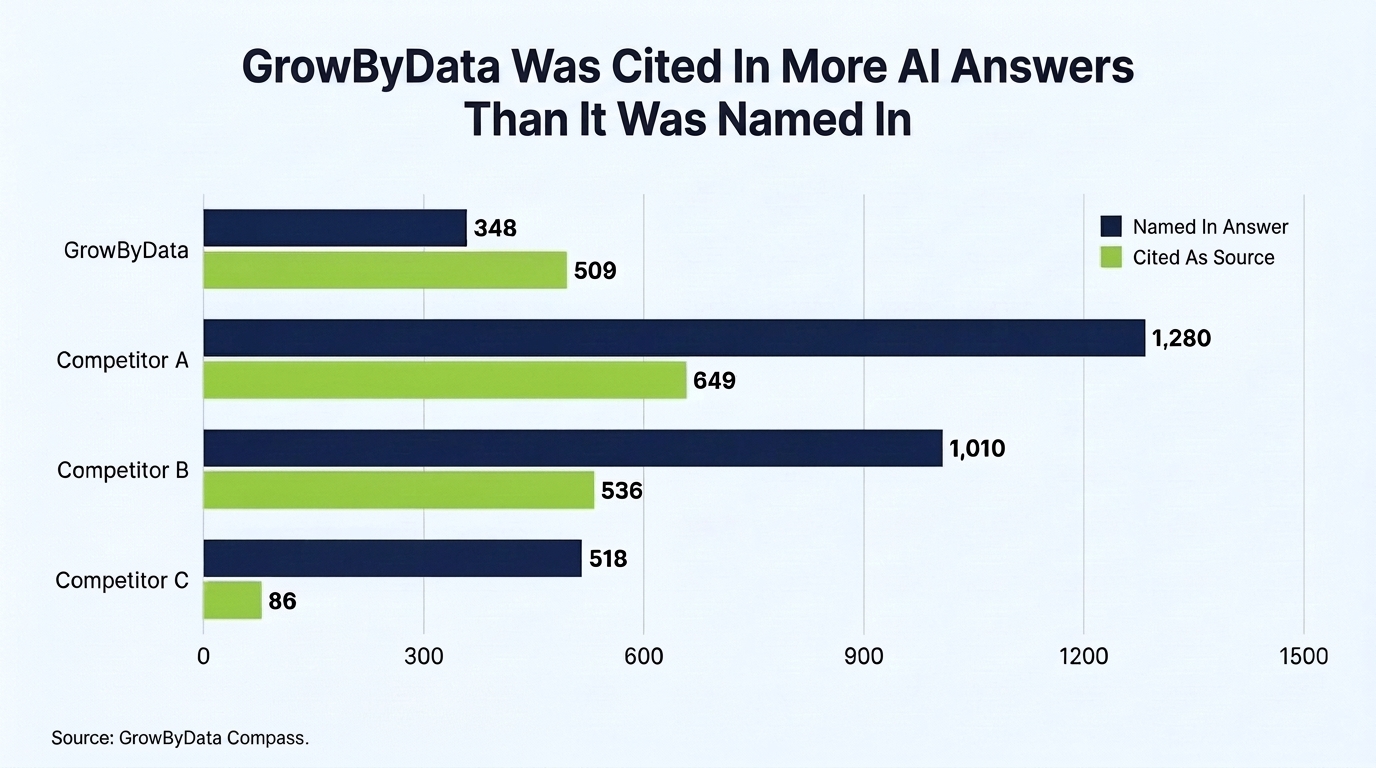
| Brand | Answers naming the brand | Answers citing its website |
|---|---|---|
| GrowByData | 348 | 509 |
| Competitor A (SEO suite) | 1,280 | 649 |
| Competitor B (SEO suite) | 1,010 | 536 |
| Competitor C (AI visibility platform) | 518 | 86 |
All counts come from the same 3,028 answers, prompts, and dates.
At least 161 answers used our pages without naming us
growbydata.com was cited in 509 answers, and GrowByData was named in 348. Even if every answer that named us also cited us, at least 161 answers (509 minus 348) cited our pages and left our name out.
The real number could be higher, since some answers name us without citing us.
Our competitors showed the opposite pattern
All three competitors were named in more answers than they were cited in. Competitor C, an AI visibility platform, was named in 518 answers while its own website was cited in 86. That suggests other sites, like reviews, roundups, and forums, are doing much of its recommending.
For us, the pattern was a warning. AI used our pages for information more often than it put us forward as an option.
The platform made a big difference
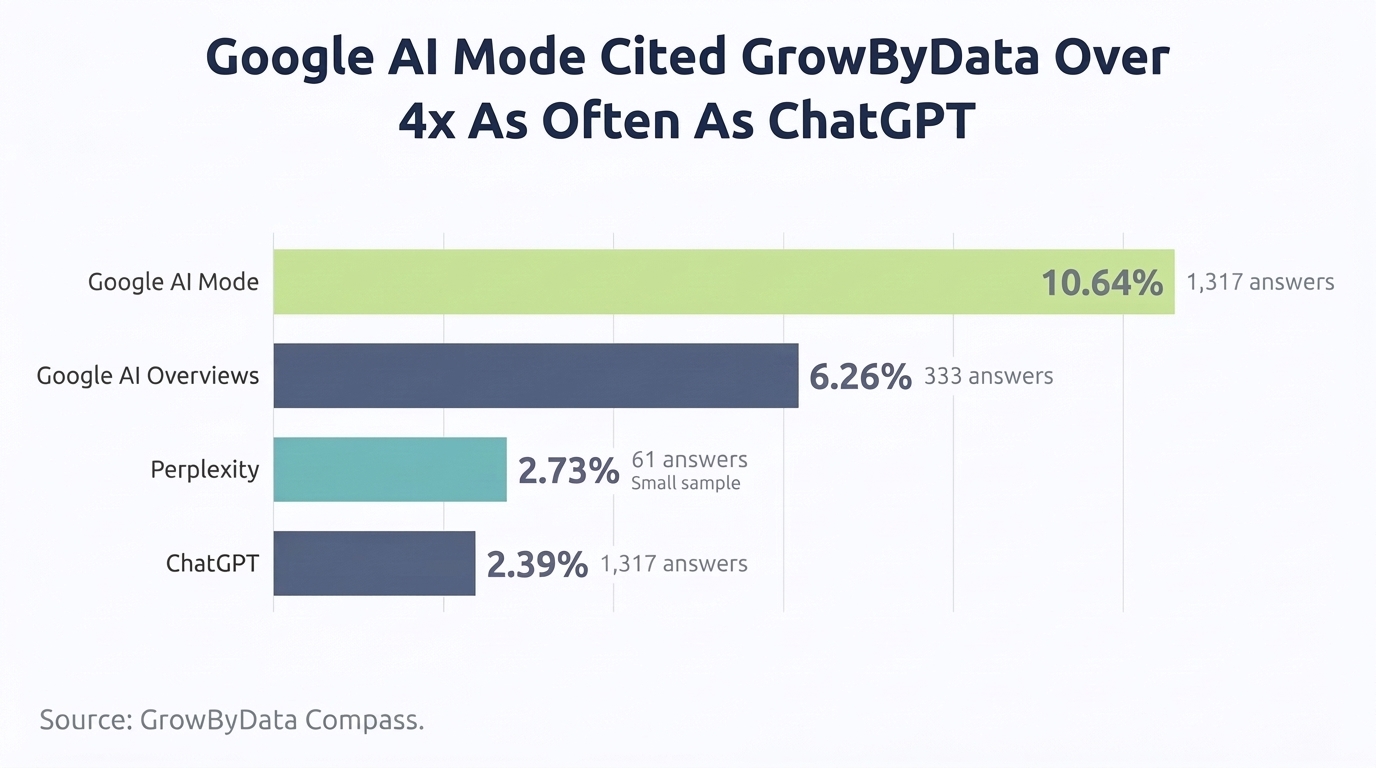
In Google AI Mode, 10.64% of all citations in these answers went to growbydata.com. In ChatGPT, it was 2.39%. That’s over four times the difference for the same prompts in the same month.
A blended score across platforms would have hidden that.
We’re named for Shopping Ads and MAP, not for AI visibility
This was the most useful finding for us.
| Prompt | Platform | Answers naming GrowByData | Answers naming a tracked competitor |
|---|---|---|---|
| What data do Google Shopping Ads tools miss? | Google AI Mode | 12 | 0 |
| What are the most common MAP policy violations, and how do brands enforce compliance across marketplaces? | Google AI Mode | 27 | 0 |
| how do we track competitor in google ai overviews? | ChatGPT | 0 | 30 |
| best tools for tracking llm brand visibility | ChatGPT | 0 | 30 |
| How do I know if competitors are being mentioned more often in AI Overviews, and how do I measure the gap? | Google AI Mode | 0 | 27 |
Counts are answers over the 30 days. “A tracked competitor” means at least one of four SEO and AI visibility vendors in our Compass account.
AI links GrowByData with Google Shopping Ads and MAP monitoring. It doesn’t yet link us with AI visibility tracking, even though we sell it.
Some guides call this a topic or entity gap: the AI has a fixed idea of what you do. The last row is the question this article answers.
Google and AI answers disagree about us
In Search Console, our AI search visibility guide averaged position 1.5 for “which ai search visibility tool identifies visibility gaps for brands” (3,411 impressions, September 7 to 13, 2026). Google ranks us for the topic.
The AI answers we tracked on closely related prompts didn’t name us. That’s a search-to-AI gap.
What this data can’t tell you
- It’s one company’s prompts, not a benchmark, and they lean toward our own product areas.
- We haven’t yet checked how many of the 161 or more answers named a competitor instead of us.
- AI answers change from run to run, and Perplexity’s 61 answers are too few to compare.
- Compass doesn’t track Gemini or Microsoft Copilot (as of September 2026).
The fix we’re testing is simple to describe and slow to do: make GrowByData the subject of the pages AI already cites, not only the source of the numbers on them. This page is the first one.
Find your AI visibility gaps
See where AI names your competitors instead of you
We’ll analyze the questions your buyers ask across ChatGPT, Perplexity, Google AI Overviews, and Google AI Mode to uncover where you’re missing, cited but not named, or losing visibility to competitors.
Why do some brands appear more often in AI responses than competitors?
Some brands appear more often in AI responses because the pages AI draws on name them more often and answer the question directly. Ranking on Google helps, but it isn’t enough. For Google’s AI features, a page has to be indexed and eligible to show a snippet before it can appear as a supporting link.
Google also says you don’t need special markup or AI text files to appear in AI Overviews or AI Mode. There’s no technical shortcut here. The work is writing pages that answer the question and getting other sites to name you.
For a recommendation gap, these are the changes we’d try first. They’re our view, not a proven formula:
- Put your brand name next to what you do in the headline and first lines, not only in the footer.
- Put your name on your data. “The GrowByData Retail Industry Panel found” gives an AI a brand to repeat. “A study found” doesn’t.
- Make sure every page AI cites also says, in plain words, what you sell and who it’s for.
How do you run an AI search visibility gap analysis?
You run an AI search visibility gap analysis in seven steps: build a prompt list, pick competitors, run each prompt many times, count mentions and citations separately, sort gaps by type, compare them with Google rankings, and fix the most valuable ones first. The first round takes the most work. After that, you rerun the same list.
- Start with questions buyers ask. Pull them from Search Console, Bing Webmaster Tools, and sales calls. Group them into finding vendors, comparing vendors, and solving a problem. Ten to fifteen prompts is enough to start, as long as you run them more than once.
- Pick competitors, then add the sites behind the answers. Start with the vendors you lose deals to. Then add the review sites, publishers, and forums the AI cites.
- Run each prompt many times. Track the same prompts on each platform, in your chosen markets and devices, for a few weeks. Google says AI Overviews and AI Mode may run several related searches to build one answer, so one check on one day tells you very little.
- Count mentions and citations separately. If you add them together, the recommendation gap disappears. Our guides on how to track brand mentions in ChatGPT and track brand mentions in Perplexity AI cover the platform details.
- Label each gap with one of the six types in the table above.
- Check Google for the same topic. Match each prompt to its closest keyword. If you rank and still aren’t named, look at the page and at the sources the AI picked over it.
- Fix the most valuable gaps first, then rerun. The next section covers how to rank them.
Start with the reporting you already have. According to Google, AI Overviews and AI Mode traffic is counted inside the normal Web results in the Search Console Performance report.
Bing Webmaster Tools goes further for Microsoft’s AI features. Since June 2026, it shows citation share: your percentage of all citations for the same query. Neither tool tells you which competitors were named instead of you.
How do I find out where my biggest AI search gaps are?
Your biggest AI search gaps are the ones on prompts closest to a purchase, not the ones you have the most of. Sort gaps by how close the prompt is to a buying decision and what a win is worth. Then check whether the gap repeats across platforms before you spend time fixing it.
| Prompt type | Example from our tracking | Priority |
|---|---|---|
| Shortlist | “best tools for tracking llm brand visibility” | High |
| Question about your brand | “How does GrowByData track citations in ChatGPT and Perplexity answers?” | High. Check the answer for wrong facts |
| How-to with a tool in mind | “how do we track competitor in google ai overviews?” | Medium to high |
| Definition | “what is generative engine optimization” | Low |
The definition row is an example of the prompt type, not a prompt from our data.
Larger teams can go one step further and weight each prompt by the deal size of the product line it belongs to. Losing one shortlist prompt for your biggest product line can cost more than losing ten definition prompts.
Which AI search visibility tool identifies visibility gaps for brands?
A good gap tool tracks you and your competitors on the same prompts, and keeps mentions and citations as separate numbers. It shows results by platform, lists the exact pages the AI cited, and lines them up with your Google rankings. A tool that gives you one score can tell you you’re behind, but not why.
| Ask the vendor | Why it matters |
|---|---|
| Can I see the same prompts for my brand and my competitors? | Without it, you can’t compare |
| Are mentions and citations reported separately? | Blended, they hide the recommendation gap |
| Is every result split by platform? | Our citation share ranged from 2.39% to 10.64% by platform |
| Does it show the cited URLs? | You need the pages to find source gaps |
| Does it rerun prompts over time? | One answer on one day is an anecdote |
| Can it match prompts to Google rankings? | That’s how you find search-to-AI gaps |
Here’s the catch with prompt-level tracking. It costs more than spot checks, and any prompt list is only a sample of what buyers ask. Build it from real questions, or you’ll end up measuring gaps nobody has.
Also check which AI tools your buyers use before you pick a vendor. Guides often list Gemini, Copilot, and Claude alongside ChatGPT and Perplexity, so confirm coverage for the ones that matter to you. Compass covers ChatGPT, Perplexity, Google AI Overviews, and Google AI Mode, and doesn’t track Gemini or Microsoft Copilot (as of September 2026).
For a vendor-by-vendor view, see our roundup of the best LLM visibility tracking tools for enterprise.
How GrowByData helps
Every number in this article came out of GrowByData Compass. That’s also why Compass keeps mentions and citations apart. Add them together, and our 161-answer gap disappears into a single number.
GrowByData is a search and AI visibility intelligence company for enterprise brands, retailers, and agencies. Compass tracks Google results and SERP features alongside ChatGPT, Perplexity, Google AI Overviews, and Google AI Mode.
That lets you trace a gap to the platform, prompt, and cited page behind it. Our LLM Intelligence page shows how it works.
Frequently asked questions
Is an AI visibility gap the same as a content gap?
No. A content gap means you haven’t published on a topic. An AI visibility gap can happen even when you have strong pages, because the answer names competitors or relies on other sites that leave you out.
If GrowByData has visibility gaps, why trust its method?
Because finding gaps is what the method is for. We published our own because it was the clearest example we had. A tool that shows you no gaps at all is more likely missing prompts than showing a perfect result.
Why does my brand show up on one AI platform but not another?
Each platform pulls from different sources and builds answers in its own way, so the same prompt can name different brands. Check each gap one platform at a time before you fix it.
How often should you rerun an AI visibility gap analysis?
Our view: rerun the full prompt list every month and after any big content change, and track your top prompts all the time. AI answers shift as models and sources change, so a quarterly check misses too much.
Start with the questions your sales team hears
Most teams find out they’re missing from AI answers when a prospect mentions a competitor that ChatGPT suggested. You don’t have to wait for that. Take the questions your sales team hears most, run them on the four platforms for a few weeks, and look first for answers that cite you without naming you.
Once you know where your gaps are, our generative engine optimization best practices cover what to change.
GrowByData Compass
See your search and AI visibility in one place
Track where your brand and competitors are mentioned, which sources AI cites, and how visibility changes across ChatGPT, Perplexity, Google AI Overviews, Google AI Mode, and Google Search.