
Share of voice in AI search is your brand’s share of the brand mentions in AI answers, counted across a fixed set of prompts for you and a named group of competitors. You calculate it per platform, such as ChatGPT, Google AI Mode, AI Overviews and Perplexity, and track it over time. Citations to your website are a separate number.
Our view: most AI share of voice reports mix up three different metrics, and the one they pick changes the answer more than anything your team did that month.
What is share of voice in AI search?
Share of voice in AI search measures how much of the AI answer space your brand holds compared with competitors. It counts your brand’s mentions in AI answers across a defined prompt set, divides that by all mentions of your brand plus a named competitor set, and reports the result per platform and time period.
Traditional share of voice compared ad spend or Google results. In AI search there’s no ranked list of ten links to count. There’s an answer, usually naming a handful of brands, and the list changes from run to run.
That’s why the denominator matters so much. “Share of voice” only means something when the reader knows what you divided by.
How do analysts define share of voice for AI search?
Most AI share of voice reports use one of three definitions: mention rate, mention share or citation share. Mention rate divides by AI responses, mention share divides by brand mentions in a named competitor set, and citation share divides by citations. Only mention share compares you against a fixed, named competitor set, so we call it share of voice.
| Metric | Formula | What it tells you | Where it misleads |
|---|---|---|---|
| Mention rate (also called presence rate) | Responses that mention your brand ÷ all responses in your prompt set | How often you show up at all | It ignores competitors. You can rise to 40% while a rival rises to 70%. |
| Share of voice (mention share) | Your brand’s mentions ÷ mentions of your brand plus your named competitors | Your slice of the conversation against the competitors you chose | It changes when you change the competitor list, so the list has to stay fixed. |
| Citation share | Citations to your domains ÷ all citations in the same responses | Whether AI answers send readers to your pages | A brand can be named without a link, or linked without being named. |
Overlap note: some tools label mention rate as “share of voice.” If a report doesn’t show its denominator, assume it’s mention rate.
Some tools add a fourth, position-weighted score. We’d leave it out of executive reporting, because answer order is mostly noise.
According to SparkToro, two answers to the same prompt in ChatGPT or Google’s AI had less than a 1 in 100 chance of naming the same brand list. The odds of the same list in the same order were about 1 in 1,000 (January 2026; 600 volunteers, 12 prompts, 2,961 runs across ChatGPT, Claude and Google’s AI). How often you appear across many runs holds up better than where you appear.
Illustrative example: one dataset reads as 40%, 20% or 6%
The numbers below are an illustrative example, not GrowByData data. They show how far apart the three metrics can land on the same responses.
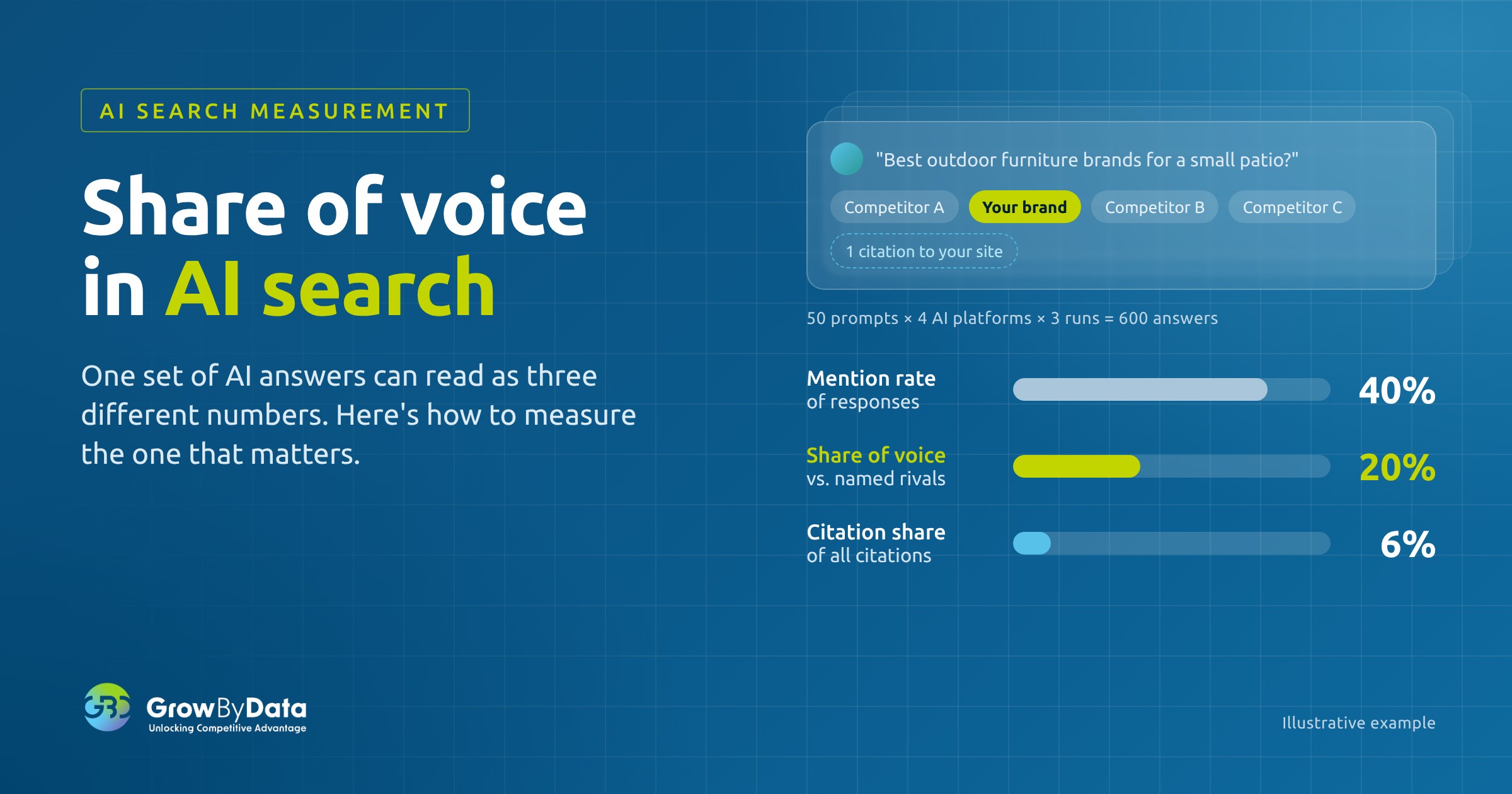
A home furnishings retailer tracks 50 buyer prompts on four AI platforms, three runs each, for one week. That’s 600 AI responses. The team also tracks four named competitors.
| Measure | Calculation | Result |
|---|---|---|
| Mention rate | The brand is named in 240 of 600 responses | 40% |
| Share of voice (mention share) | 240 brand mentions out of 1,200 total mentions across the brand and four competitors | 20% |
| Citation share | 90 citations to the brand’s domain out of 1,500 citations in those responses | 6% |
In this example, each brand counts at most once per response, so 240 responses naming the brand equal 240 mentions.
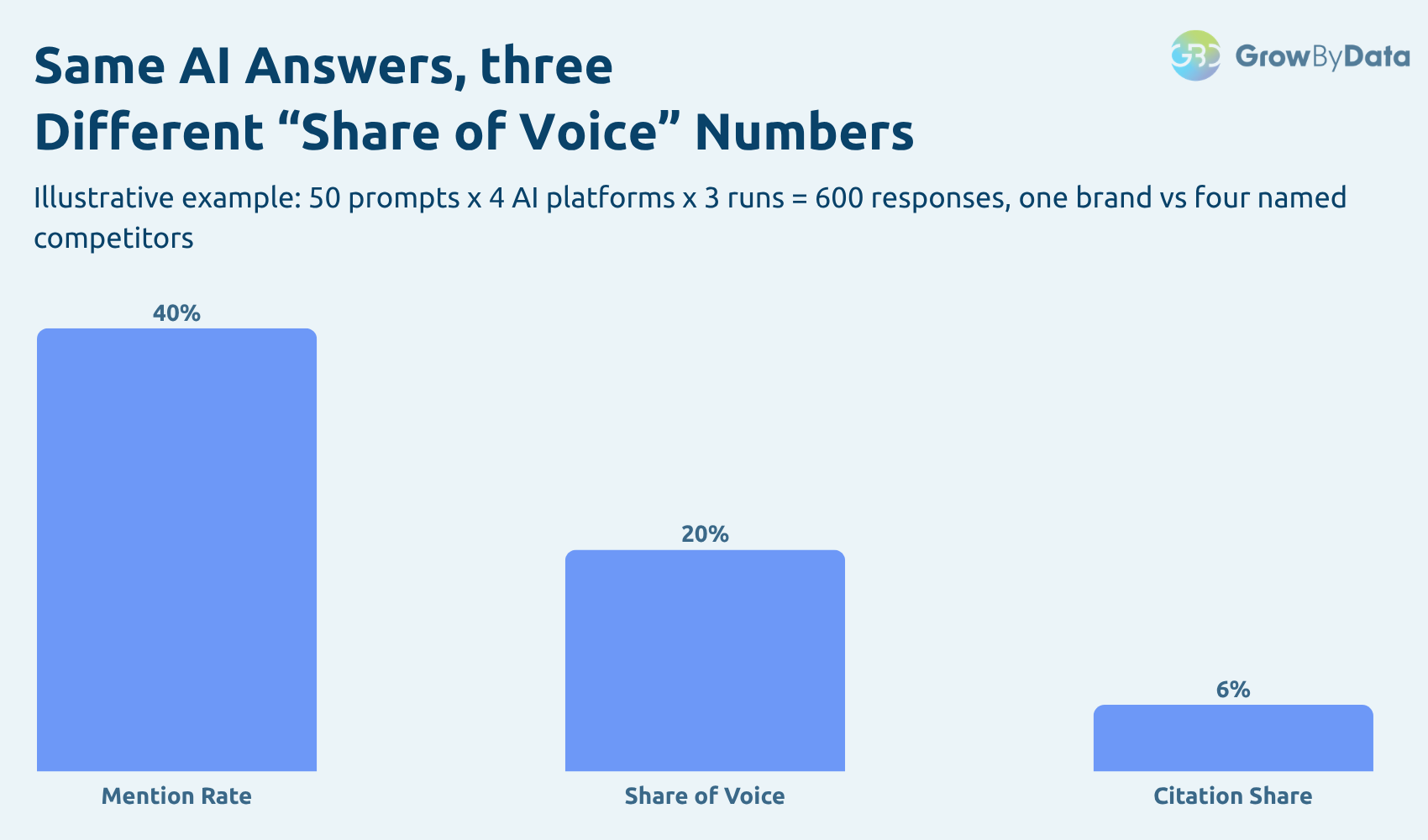
All three come from the same week of answers, yet one slide would say 40%, another 20% and the citation report 6%.
None of these numbers is wrong. They answer different questions. The mistake is putting one of them on a dashboard as “AI share of voice” without saying which one it is, then comparing it with an agency report that used another.
How do I measure my brand’s share of voice in AI search?
To measure your brand’s share of voice in AI search, fix a prompt set that mirrors real buyer questions, name three to five competitors, and run every prompt repeatedly on each AI platform you care about. Count brand mentions and citations separately, then divide your mentions by the total mentions for your brand and those competitors.
- Build the prompt set from real demand. Use the questions buyers already ask: Search Console queries, People Also Ask wording, sales call notes. For one product line, 50 to 150 prompts is a workable start in our experience. Keep prompts that name your brand out of the set, since they inflate your share.
- Freeze the competitor set. Pick three to five brands you lose deals to and keep the list fixed for the quarter. Changing it resets your trend line.
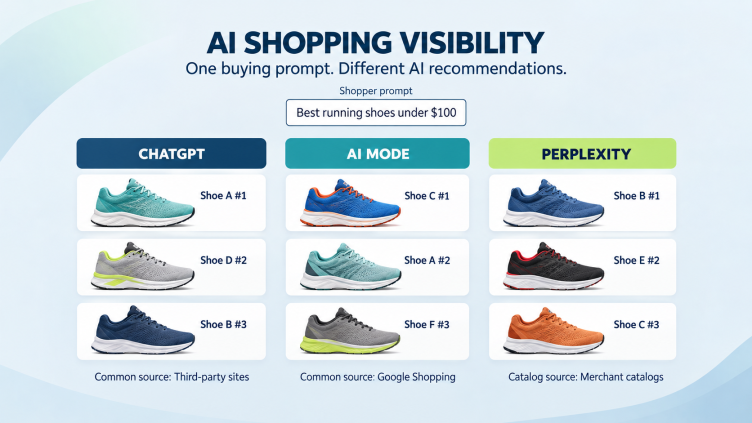
- Pick platforms and report them separately. In our experience, ChatGPT, Google AI Mode, Google AI Overviews and Perplexity often name different brands for the same prompt, so a blended score hides where you’re losing.
- Run each prompt more than once. Because answers vary from run to run, one manual check per prompt is an anecdote. In our experience, three runs per prompt per week is a reasonable floor, and more is better for big categories.
- Normalize brand names. A brand name, its domain and a common abbreviation are one brand. Unmerged variants quietly cut your share.
- Count mentions and citations separately. Count each brand at most once per response, and report mention share and citation share side by side. They move for different reasons.
- Trend it weekly, review it monthly. Week-to-week swings are normal. In our experience, a shift that holds for three to four weeks is worth acting on.
How do you accurately measure share of voice in GEO?
Accurate share of voice in generative engine optimization (GEO) comes from volume and consistency, not precision on any single answer. Run a stable prompt set repeatedly on each AI platform, keep the competitor list fixed, and report the trend per platform. Single answers vary too much from run to run to support conclusions on their own.
GEO is the practice of improving how often AI answers mention or cite your brand. Three things make GEO measurement shaky, and most teams we see get at least one of them wrong:
- Too few runs. SparkToro found that the overall percentage of responses naming a brand was a reasonable metric when measured across many prompts and runs, while single rankings weren’t. In its separate headphones test, Bose, Sony, Sennheiser and Apple appeared in 55% to 77% of responses (142 human-written prompts, 994 responses).
- A moving prompt set. Adding 30 new prompts in October and comparing with September isn’t a trend. It’s a different sample.
- Blended platforms. Averaging ChatGPT and Google AI Overviews into one number can hide a loss on one platform behind a gain on another.
The tradeoff is cost, since more prompts and more runs take longer to collect and review. In our experience, a smaller prompt set measured consistently beats a large one sampled once.
How do I measure my brand’s share of voice in ChatGPT and Google AI Overviews?
Measuring share of voice in ChatGPT and Google AI Overviews means running the same prompts on both and reporting each separately. ChatGPT gives a standalone answer, while Google AI Overviews appear on a results page next to ads and organic listings. Track mentions and citations for your brand and competitors on each platform.
The two platforms behave differently in ways that change the read:
| ChatGPT | Google AI Overviews | |
|---|---|---|
| Where the answer appears | A chat answer, sometimes with product cards or sponsored placements | On a Google results page, often near the top, alongside ads, Shopping and organic results |
| What a “mention” competes with | Other brands in the same answer | Other brands in the answer and everything else on the results page |
According to Google’s documentation on AI features (updated December 10, 2025), sites that appear in AI Overviews and AI Mode are counted in Search Console’s Performance report under the Web search type (Google Search Central).
Google added Search Generative AI performance reports to Search Console in June 2026 (Google Search Central Blog). Bing launched an AI Performance report in Bing Webmaster Tools as a public preview on February 10, 2026, showing citations, cited pages and grounding queries across Microsoft Copilot, Bing’s AI summaries and select partner integrations (Bing Webmaster Blog).
Use those reports for your own site’s AI visibility. What they can’t give you is share of voice, because they report only your site, not which competitors the same answers named.
What’s the difference between AI share of voice and Google share of voice?
Google share of voice measures your share of visibility on Google results pages, usually weighted by rank, across organic listings, ads and SERP features. AI share of voice measures your share of brand mentions inside AI answers. The two often disagree, so enterprise teams should report them side by side rather than merging them.
We cover the Google side, including the weighted formula, in our guide to Google Share of Voice.
Our view: the useful insight is where the two disagree. A brand can lead Google share of voice for “best patio furniture” and barely appear when someone asks ChatGPT the same question.
That gap tells your SEO and content teams where to look first. It’s also why we measure Google results and AI answers in the same platform, for matching keywords and prompts.
How to increase AI share of voice
Increasing AI share of voice usually means being described by more of the sources AI answers rely on, not publishing more pages about yourself. Start with the prompts where competitors get named and you don’t, check which sources those answers cite, and close the gaps on your own pages and on third-party sites.
Three moves tend to matter most:
- Fix the losing prompts first. Sort prompts by the gap between your mention share and your top competitor’s. Work from the biggest gap down.
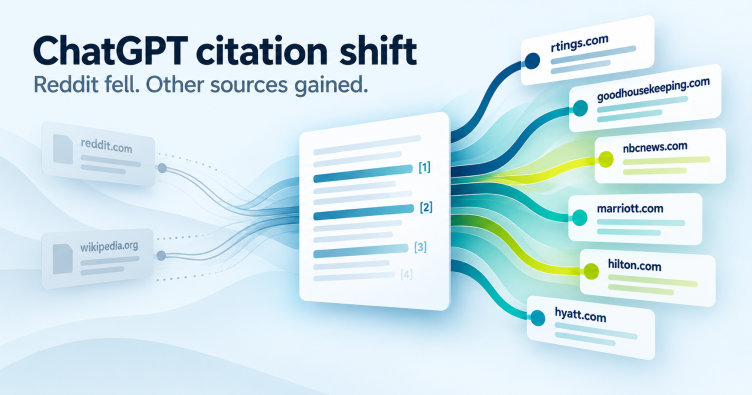
- Check citations as well as mentions. If AI answers cite review sites, retailer pages or forums when they name a competitor, those sources are where your brand story needs to be accurate and present.
- Keep product facts consistent. AI answers repeat what they find. Conflicting specs or names across your site and retailer listings make it harder for AI tools to describe you correctly.
None of this moves quickly. Expect changes to take several weeks to show up, and judge progress on the trend line rather than a single run.
How GrowByData measures share of voice in AI search
GrowByData is a search and AI visibility intelligence company for enterprise brands, retailers and agencies. GrowByData Compass tracks brand mentions, citations and sentiment for your prompts across ChatGPT, Google AI Mode, Google AI Overviews and Perplexity, next to your Google organic, paid and Shopping visibility for the same topics (as of October 2026; Compass doesn’t track Gemini or Copilot).
With both in one place, you see your mention share and citation share against your chosen competitors per platform, and you see how the same competitors perform on Google for the matching keywords. Our LLM Intelligence solution covers the AI side, with dedicated views for ChatGPT brand monitoring, Perplexity brand monitoring, Google AI Mode monitoring and Google AI Overviews monitoring.
See your AI share of voice against your competitors. We’ll run your buyer prompts across ChatGPT, Google AI Mode, AI Overviews and Perplexity and show you where competitors get named and you don’t. Book a demo
Frequently asked questions
Is AI share of voice the same as AI visibility?
No. AI visibility usually means how often your brand appears in AI answers at all, which is closer to mention rate. Share of voice compares your mentions with a named competitor set, and our guide to AI search visibility covers the wider set of metrics.
What is a good share of voice in AI search?
There’s no universal benchmark, because the number depends on your prompt set, platforms and competitor list. A better test is direction and gap: are you gaining on the top competitor in your set, platform by platform? Treat any published “good score” as context, not a target.
Can I measure AI share of voice manually?
You can start manually with a handful of prompts, which is a good way to learn what answers look like. It breaks down at scale, because answers change between runs and need repeating on several platforms every week. Our guides on how to track brand mentions in ChatGPT and track brand mentions in Perplexity AI cover the manual approach.
Should citations count toward share of voice?
Report citations as their own number. Citations show whether AI answers send readers to your pages, while mentions show whether answers recommend you. Merging them hides which one is moving.
Which AI platforms should be in an AI share of voice report?
Include the platforms your buyers use for research. For most US enterprise brands, that’s at least ChatGPT and Google’s AI features, AI Overviews and AI Mode. Report each one separately so a loss on one isn’t hidden by a gain on another.
Your next step
Most teams find out they’re losing AI share of voice when a prospect mentions a competitor that ChatGPT recommended. Measuring it on a fixed prompt set, per platform, against the competitors you lose to shows you that gap before your sales team hears about it.
Get an AI share of voice audit. We’ll show your mention share and citation share against your chosen competitors across ChatGPT, Google AI Mode, AI Overviews and Perplexity, next to your Google share of voice. Talk to an expert