
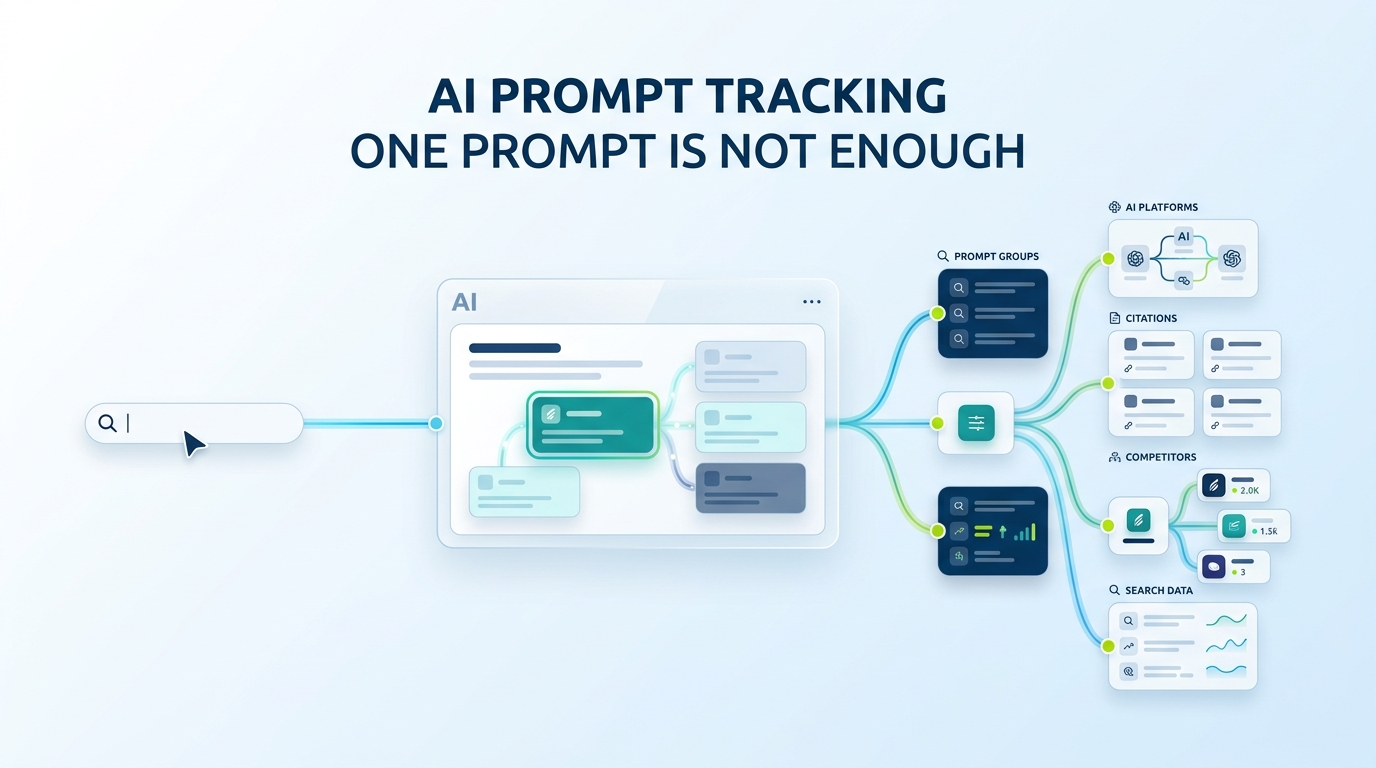
AI prompt tracking helps marketing and SEO teams understand how their brand appears across AI-generated answers. But one prompt, one platform, or one visibility score is not enough to show the full picture.
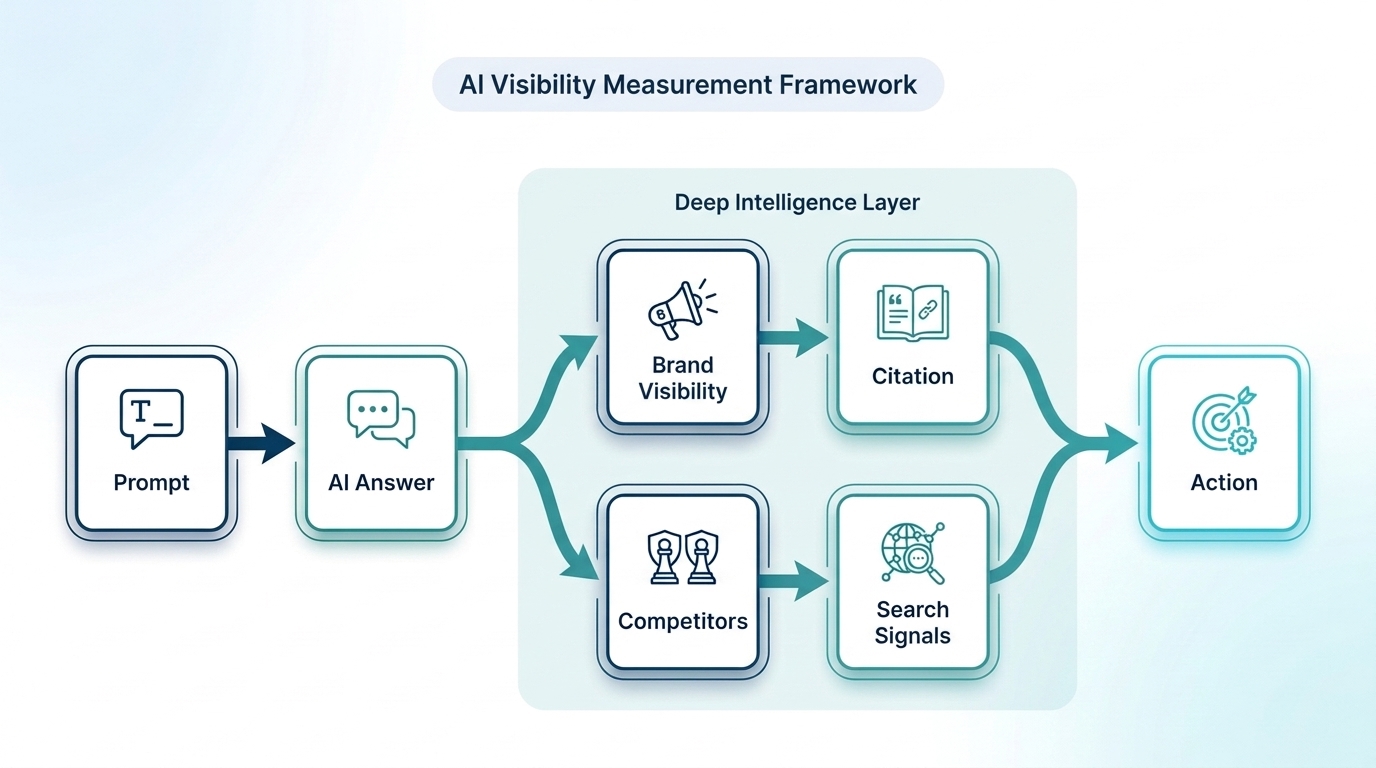
A useful AI visibility program shows which topics your brand appears for, which competitors show up instead, which sources are cited, and how results differ by platform.
Our view: prompt tracking is an important measurement layer, but the prompt itself should be the starting point of the analysis, not the final metric.
What is AI prompt tracking?
For marketing and SEO teams, AI prompt tracking is the practice of repeatedly testing relevant questions across platforms such as ChatGPT, Google AI experiences, and Perplexity, then measuring which brands, competitors, citations, and sources appear in the answers.
An enterprise search platform, for example, might monitor questions such as:
- What are the best enterprise SERP monitoring tools?
- Which software tracks citations in AI-generated answers?
Each prompt gives you one observation. Repeated across a meaningful set, those observations reveal patterns in where your brand appears, which competitors get recommended, and which sources influence the answer. This is the core measurement layer inside an LLM Intelligence platform.
That is different from traditional rank tracking, which might tell you a page ranks #4 for a keyword. AI prompt tracking tells you your brand appeared in the answer, which competitors also showed up, and which third-party source the AI used to support it.
Why is one prompt not enough to measure AI visibility?
One prompt is not enough because changing the wording, intent, platform, or context of a question can change which brands and sources appear in the response.
Imagine a company tracks only “what are the best enterprise SERP tracking tools?” Its brand appears, so the team concludes AI visibility is strong.
But buyers ask the same underlying question differently:
- Which tools track paid and organic search together?
- What monitors Google Shopping competitors?
- What are the best alternatives to a named competitor?
A brand can perform well on one version and disappear on the others.
The first result was not wrong. It was too narrow to represent the whole topic. Instead of asking “do we appear for this prompt?”, the more useful question is “how consistently do we appear when buyers discuss this problem?” That is why AI visibility should be measured across groups of related prompts, not isolated ones.
How should you choose AI prompts to track?
Choose prompts that represent real buyer problems, comparisons, and decision stages, rather than generating hundreds of small wording variations. A simple way to organize them is by intent.
| Prompt Type | What It Measures | Example |
|---|---|---|
| Discovery | Whether your brand enters the conversation early | What are the best enterprise search intelligence platforms? |
| Problem | Whether you appear around the problem you solve | How can I track whether ChatGPT recommends my company? |
| Capability | Whether AI understands what your product does | Which tools track organic, paid, Shopping, and AI search? |
| Comparison | How you perform when buyers narrow their options | What are the best alternatives to [competitor]? |
| Branded | How AI systems understand your company directly | What is [brand] known for? |
The goal is not the largest possible prompt database. It is a representative measurement set that reflects the topics and buying situations that matter to your business. For a closer look at one platform, see how to track brand mentions in ChatGPT or track brand mentions in Perplexity AI.
What should you measure besides brand mentions?
Brand mentions tell you whether your company appeared. They do not explain why, whether your own content supported the answer, or which competitors and sources are winning when you are absent. A stronger framework looks at several signals together.
| Signal | What It Tells You |
|---|---|
| Brand presence | Whether your brand appears in the answer |
| Citations | Which pages and domains support the answer |
| Competitor visibility | Which brands appear when you do not |
| Topic visibility | Which groups of buyer questions you consistently win or miss |
| Platform visibility | Whether performance differs across ChatGPT, Perplexity, and Google AI experiences |
| Brand positioning | How the AI system describes your company |
A brand can appear in an AI answer without its own website being cited, if the response leans on a publisher, review site, or competitor as its source instead.
If you rarely appear at all, that is a brand visibility gap. If you appear but are rarely cited, that is a content or authority gap, and it needs a different fix. Combining both into one number hides which one you actually have.
Why does AI visibility differ across platforms?
The same prompt can produce different brands, citations, and sources across AI platforms, because each system uses its own retrieval, ranking, and answer-generation process.
A report that says “AI visibility: 62%” does not tell you whether that comes from one platform, one strong topic, or broad performance across many buyer questions. A team should be able to break that down:
- Are we stronger in ChatGPT or Perplexity?
- Are the same competitors and domains showing up repeatedly across platforms?
Google itself notes that its AI experiences can use different models and techniques, which is one reason supporting links and generated answers can vary (Google Search Central). For a closer look at how these two Google surfaces differ, see Google AI Overviews and Google AI Mode. The practical takeaway: preserve the platform layer instead of collapsing everything into one score.
How should AI prompt tracking connect with SEO data?
Prompt tracking tells you what happened in an AI answer. Traditional search data helps you investigate why.
If a competitor consistently appears for a topic where you do not, check before writing another “AI-optimized” article:
- Which of their pages rank organically?
- Which domains is AI citing?
- Do you already have a relevant page, and how visible is it in traditional search?
The answer may point to very different actions: strong organic rankings but weak citation visibility, weak visibility everywhere, a brand described around the wrong use case, or third-party sources doing more work than your own site. This is why prompt data becomes more useful connected to broader Search Intelligence. For the fuller picture, see our AI search visibility guide.
What does a useful enterprise AI visibility framework look like?
Define the topics that matter, build representative prompt groups around them, and track the full context of each response rather than brand presence alone.
Then connect any gap back to search data before deciding what to do about it, that last step is the one teams skip. A gap might mean refreshing a page, building a comparison page, correcting brand positioning, or deciding the signal is not yet strong enough to act on. The measurement only matters if it changes a decision.
What can AI prompt tracking not tell you?
Prompt tracking is a measurement sample. It cannot represent every question every customer asks, prove that an AI mention caused a conversion, or guarantee future answers will stay the same.
If Brand A appears more often than Brand B across 200 tracked prompts, you can say Brand A appeared more often across that set. Be careful about turning that into a claim that Brand A owns a fixed share of all AI conversations in the market.
The same caution applies to revenue attribution. A buyer might discover a company through Google, see it mentioned in ChatGPT, and convert weeks later. Prompt tracking explains one part of that journey, not the whole path.
How GrowByData approaches AI prompt tracking
GrowByData treats prompt-level visibility as one layer of a broader search intelligence problem. GrowByData LLM Intelligence examines AI visibility across prompts and platforms, including brand visibility, competitors, citations, and positioning. If you are comparing options, our breakdown of the best LLM visibility tracking tools for enterprise teams covers how different platforms handle this.
When a competitor starts appearing consistently for an important topic, the useful question is which prompts and platforms are driving the gap, which sources are being cited, and whether the competitor also has strong organic visibility behind it.
GrowByData also provides dedicated monitoring for ChatGPT, Perplexity, Google AI Mode, and Google AI Overviews. The goal is not to report that a score changed, but to explain what changed underneath it.
Frequently asked questions
What is LLM prompt tracking?
For marketing and SEO teams, it usually means the same thing as AI prompt tracking: repeatedly testing questions across AI platforms and monitoring how brands, competitors, and sources appear in the responses. The term can also refer to technical prompt monitoring inside LLM applications, so context matters.
How many AI prompts should a brand track?
There is no universal number. Start with enough to represent your most important topics and buyer intents, and add more only when they introduce a genuinely different question, not just another wording variation.
Should companies track the same prompts across every AI platform?
A consistent core set makes platform comparisons easier. Add platform-specific prompts only where audience behavior or platform capabilities genuinely justify them.
What is the difference between a brand mention and an AI citation?
A mention means the AI response refers to your brand. A citation means a page or domain is presented as a supporting source. Your brand can be mentioned even when your own website is never cited.
Prompt tracking is the starting point, not the final metric
AI prompt tracking gives enterprise teams a useful new measurement layer, but the value does not come from running the largest number of prompts. It comes from understanding where your brand appears, where it is missing, which competitors appear instead, and how the pattern changes across platforms. That is what turns prompt tracking from another dashboard into useful search intelligence.