
Most guides to SERP features hand you the same list: Featured Snippets, Knowledge Panels, Local Packs. Reasonable starting point, if you’re optimizing in a vacuum. The problem is that SERP composition varies significantly by industry, and the features worth your attention depend entirely on the queries your audience is actually running.
GrowByData tracked SERP feature presence across seven industries:
- Automotive
- Retail
- Health
- Financial Services
- High Tech
- Travel
- Software
What emerged doesn’t match the standard playbook. AI Overviews dominate non-retail SERPs. Merchant Listings are almost exclusively a retail battleground. People Also Ask is the one feature that shows up reliably across every industry. And Featured Snippets barely register anywhere.
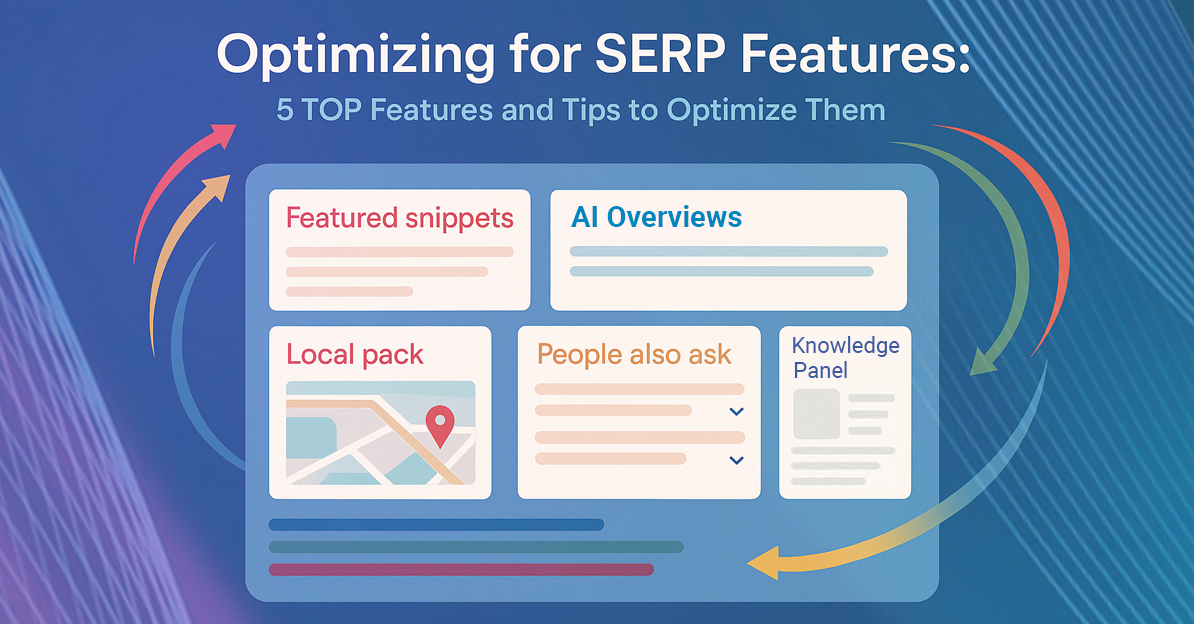
These are the 5 features that actually show up in competitive SERPs, and what it takes to compete in each one. For a full breakdown of every feature type, see our complete list of Google SERP features.
1. AI Overviews: The Feature That Now Owns Most SERPs
AI Overviews aren’t a niche feature to monitor anymore. Outside of retail, they’re the dominant feature on the page, accounting for more than 80% of SERP feature presence in most industries, and topping 90% in Health.
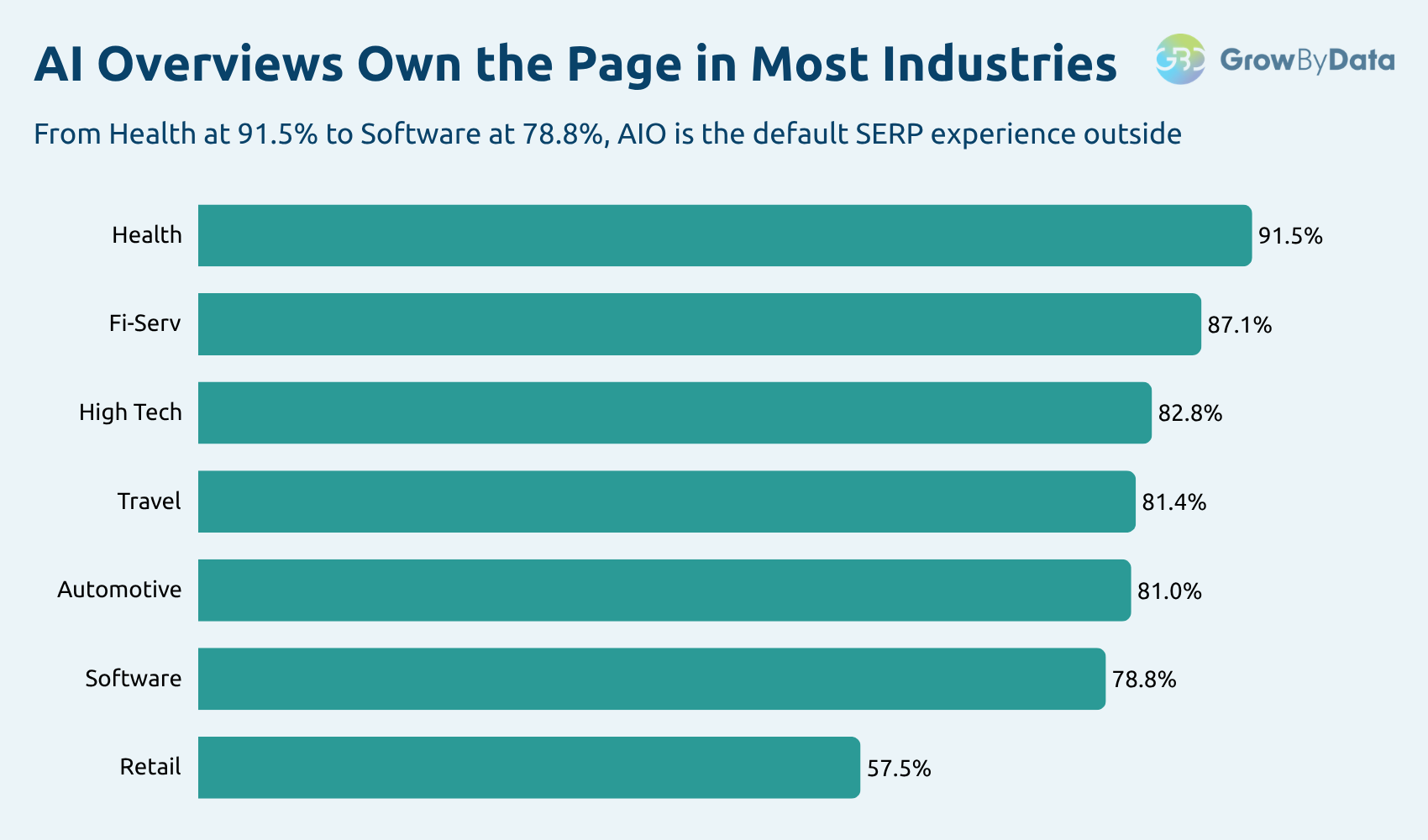
Retail is the clear outlier, where Merchant Listings take the real estate that AIO doesn’t. But even there, AIO still fires on trend and advisory queries, “best running shoes for flat feet,” “what to look for in a standing desk,” while Merchant Listings handle direct product queries. Knowing which query types in your keyword set trigger AIO, even Google AI Mode and which don’t, is the starting point for any content strategy.
When an AI Overview fires, it doesn’t just add another result. It restructures the page. Organic listings, paid ads, and everything below get pushed down. The brand cited sits above all of it. The brand that isn’t cited is below everything.
Three signals that improve AIO citation:
- Topical authority over individual articles. Pages cited in AI Overviews tend to come from sites with comprehensive topic coverage. A single well-written guide isn’t enough. The cluster around it is what signals genuine expertise.
- Entity clarity through schema. Markup that explicitly defines your brand, products, and their relationships removes ambiguity about what you are, which is a prerequisite for being cited rather than displaced.
- Citable paragraph structure. AI Overviews lift short, self-contained answers. A paragraph that can’t stand alone as a complete response to a question won’t get cited. Write for extraction, not just narrative flow.
→ For a full breakdown of AI Overview mechanics and optimization: Google AI Overviews: 2026 Guide with Examples
2. Merchant Listings and Shopping Ads: The Product Listing Layer
Merchant Listings are almost entirely a retail story. Across every other industry in GrowByData’s dataset, they barely register. If you’re running search for a retail brand, this is the main battleground. For everyone else, it shouldn’t drive meaningful resource allocation.
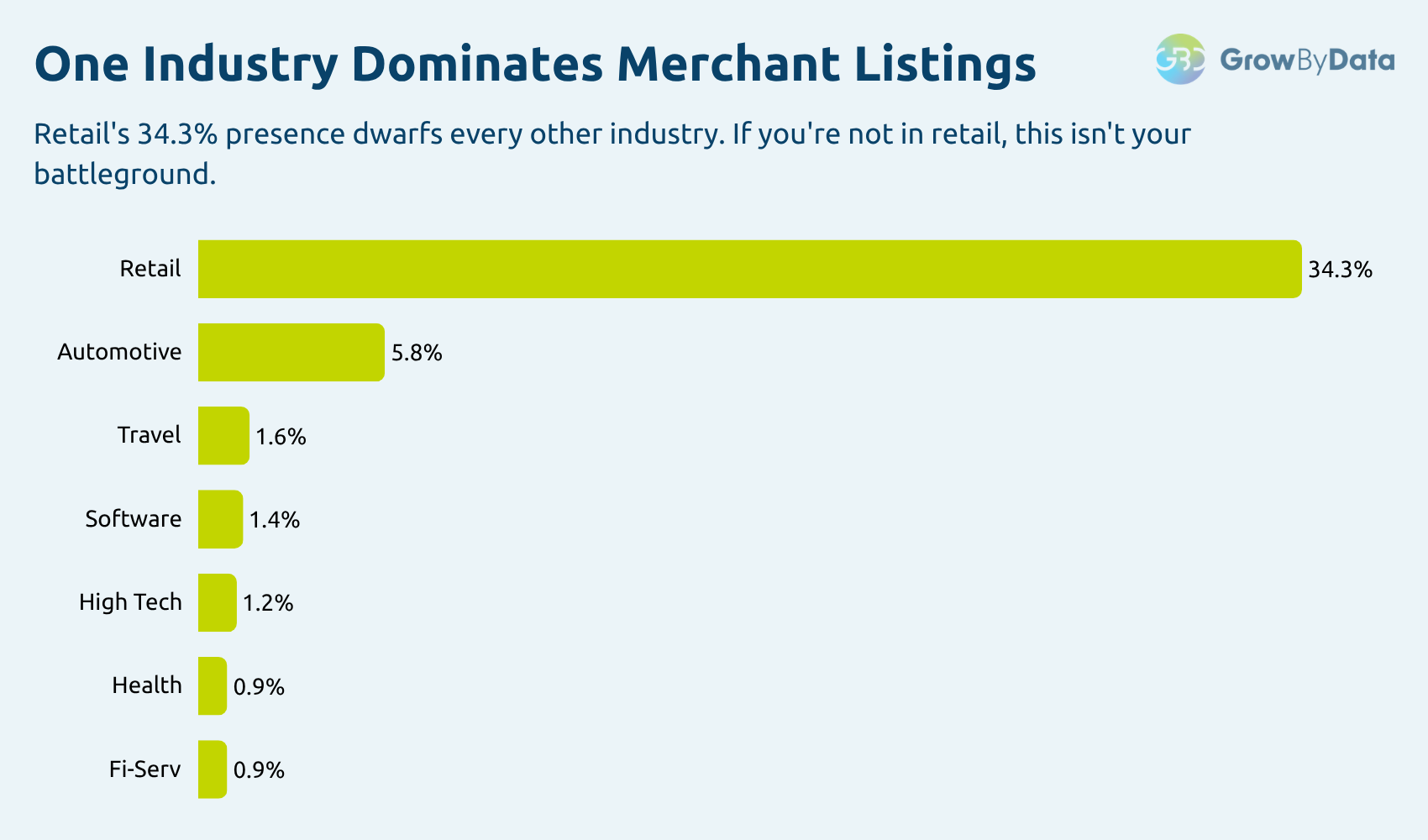
Within retail, the distinction most brands miss: Merchant Listings are organic product listings surfaced through Google Merchant Center. Shopping Ads are the paid carousel. Different levers, different budget lines, different teams. The organic layer dominates. Most brands competing for product listing visibility are doing it through feed quality and Merchant Center hygiene, not paid bids.
Three levers for Merchant Listings:
- Product title specificity. Attribute stacking (material, fit, gender, occasion) is what gets products matched to mid-funnel queries. “Women’s slim-fit cotton chino trousers” outperforms “women’s trousers” every time.
- Feed freshness. Google favors listings with current pricing and in-stock signals. Stale feeds drop in visibility fast, especially during peak shopping windows.
- Price competitiveness. Merchant Listings surface price prominently. If your price sits significantly above the category average on a given query, your listing loses real estate regardless of title quality or feed hygiene.
On Shopping Ads: their relatively low presence makes competitive serp monitoring more important, not less. When a competitor starts scaling paid Shopping spend on your core terms, that shift can happen fast. You want to catch it in week one, not month three. → See how GrowByData monitors Shopping Ads visibility
→ For a step-by-step guide to Merchant Listings optimization: How to Rank in Google Merchant Listings in 9 Steps
How does your SERP feature visibility compare to competitors?
See which features your competitors are winning, across your actual keyword set and industry.
3. People Also Ask: The One Feature That Shows Up Everywhere
People Also Ask is the most consistent feature in GrowByData’s dataset. It appears at meaningful levels across every industry. It’s the only feature in this analysis that does. Featured Snippets don’t appear in the tracked data at all. Local Packs and Knowledge Panels are highly query-specific. PAA fires reliably regardless of industry or intent level.
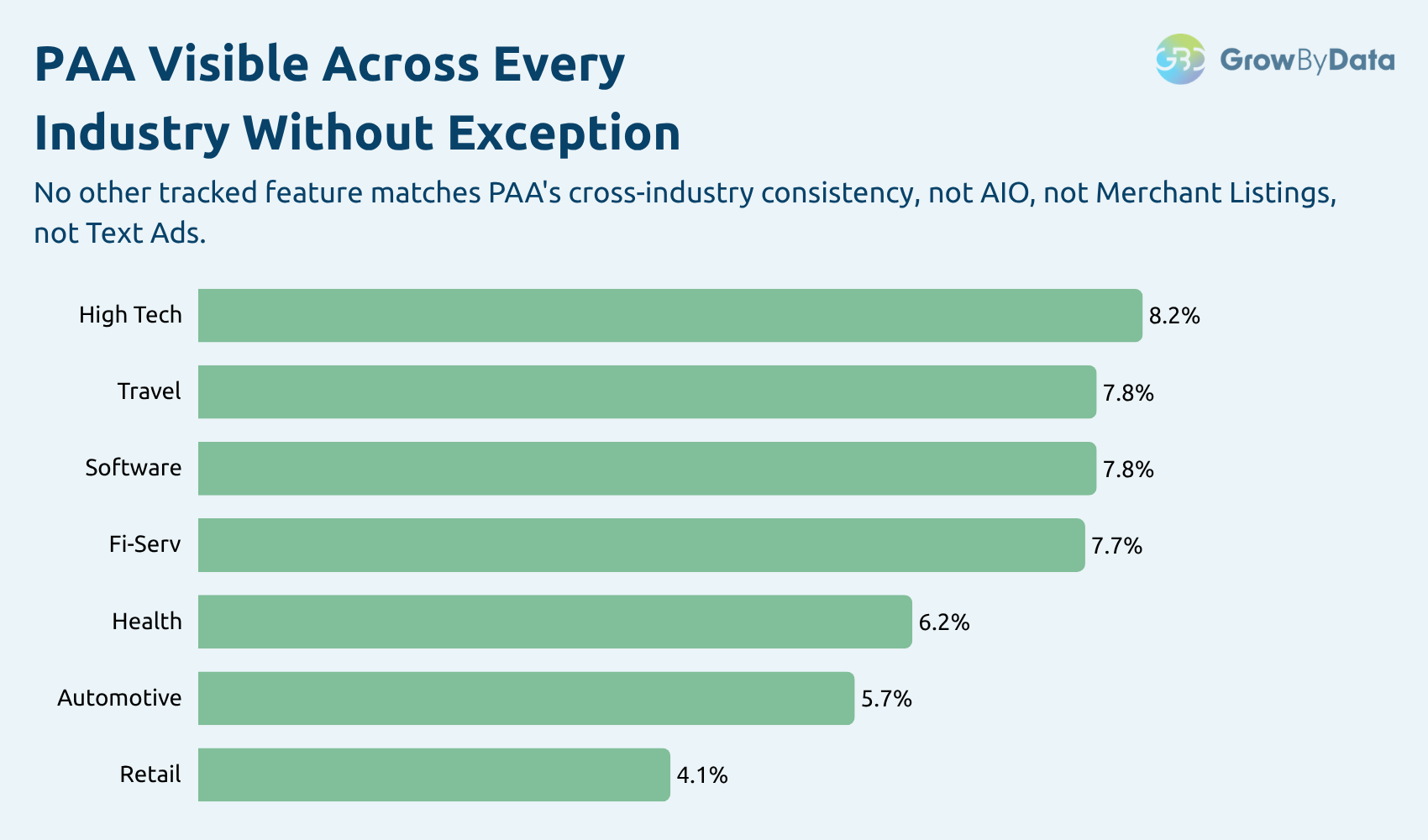
That consistency is exactly why it’s underinvested. It doesn’t look dramatic in any single industry. But it’s always there, and the compounding mechanism is what makes it worth building for explicitly.
Winning one PAA box doesn’t earn you one answer slot. Google expands the PAA cluster dynamically: answering one question surfaces related questions, and a page that answers those well can appear across multiple boxes for a single query. That’s cluster visibility from a single piece of content.
What Does It Take to Appear in People Also Ask Boxes?
Three things that consistently trigger PAA inclusion:
- Direct-question headings. H2 or H3 tags phrased as actual questions signal to Google that your page answers that query directly. “What’s the difference between X and Y?” outperforms “Types of X” for PAA inclusion every time.
- Concise, self-contained answers. The sweet spot is 40-60 words immediately following the question heading. Long explanations get skipped. Answers that open with a direct response get pulled into PAA boxes.
- FAQ schema markup. Structured data explicitly labels your question-and-answer pairs for Google. It doesn’t guarantee PAA inclusion, but it removes ambiguity about what your content is doing and where the answer starts.
→ For the full 7-step PAA optimization guide: How to Rank in People Also Ask Boxes in Google Search
4. What People Are Saying: The Feature Most Brands Are Missing
“What People Are Saying” is Google’s UGC-aggregation feature pulling from Reddit, forums, and review platforms. The distribution across industries is uneven, and the pattern is telling.
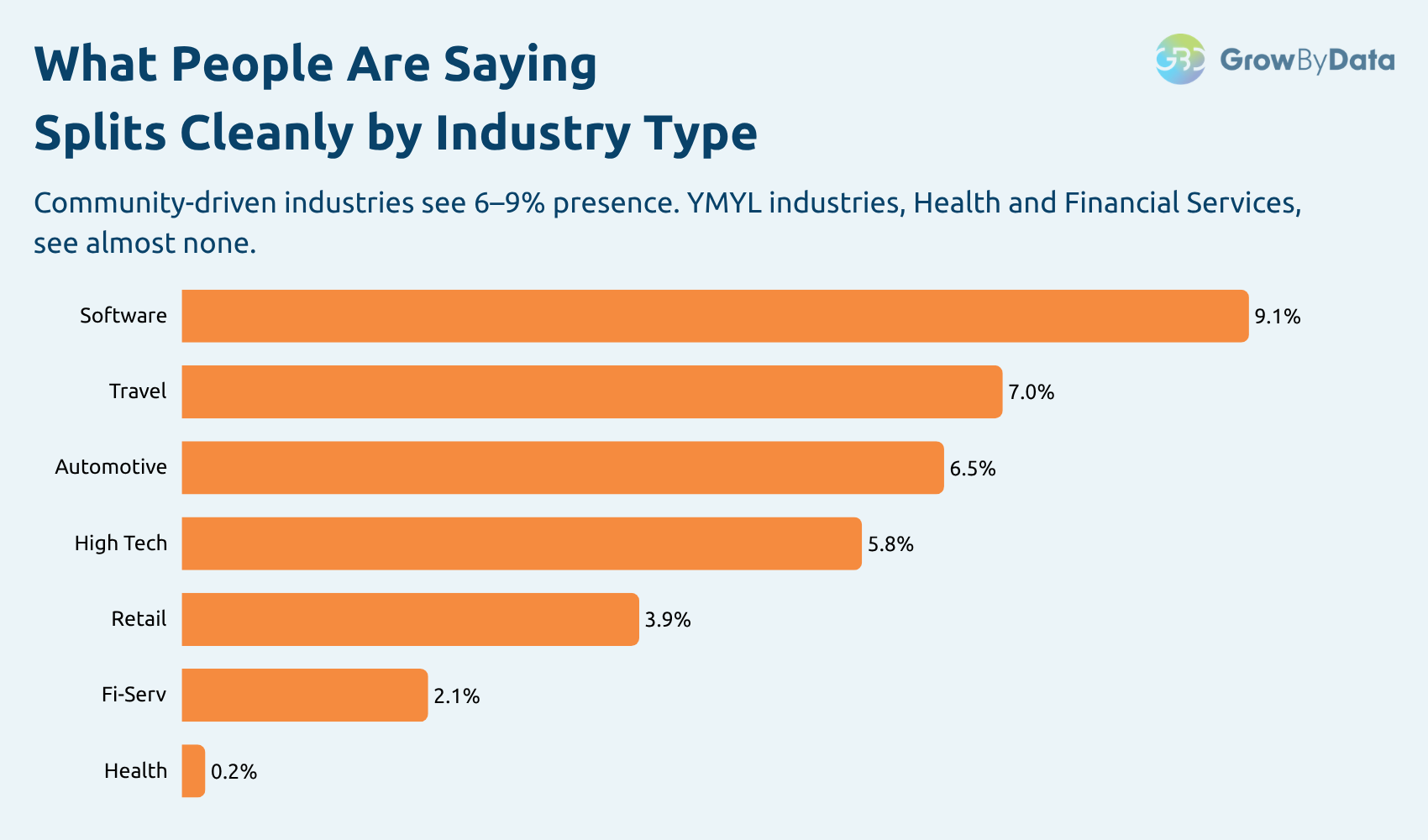
It fires most strongly on subjective, experience-based queries: product comparisons, software reviews, service recommendations, community discussions. Software and Travel show the highest presence. Health and Financial Services, where YMYL signals push Google toward authoritative sources over community opinion, show the lowest.
The brand implication is direct. If you’re in Software, High Tech, Automotive, or Travel, there is a SERP feature actively surfacing what people say about your category, and potentially your brand, that your content team has no direct control over. The optimization lever here isn’t on-page SEO. It’s brand presence on the platforms Google is already pulling from.
Three ways to influence What People Are Saying presence:
- Build a presence on the platforms Google pulls from. Reddit, G2, Trustpilot, and niche community forums are disproportionately cited. Brands with active, credible presences on these platforms show up in this feature. Brands that don’t cede the space to competitors and unsatisfied customers.
- Monitor what’s appearing for your key queries. Tracking which communities and threads Google is surfacing for your high-intent terms tells you where brand conversations are happening, and where problems need addressing before they compound into a visibility problem.
- Create content that answers the same questions community threads do. When your official content provides clearer, more complete answers than forum discussions, Google increasingly cites it alongside or instead of the forum thread. This is where SEO and community management intersect.
5. Text Ads: Low Share, High Strategic Value
Text Ads are the smallest feature in GrowByData’s dataset by share across all industries. The absolute numbers are low. The strategic relevance isn’t.
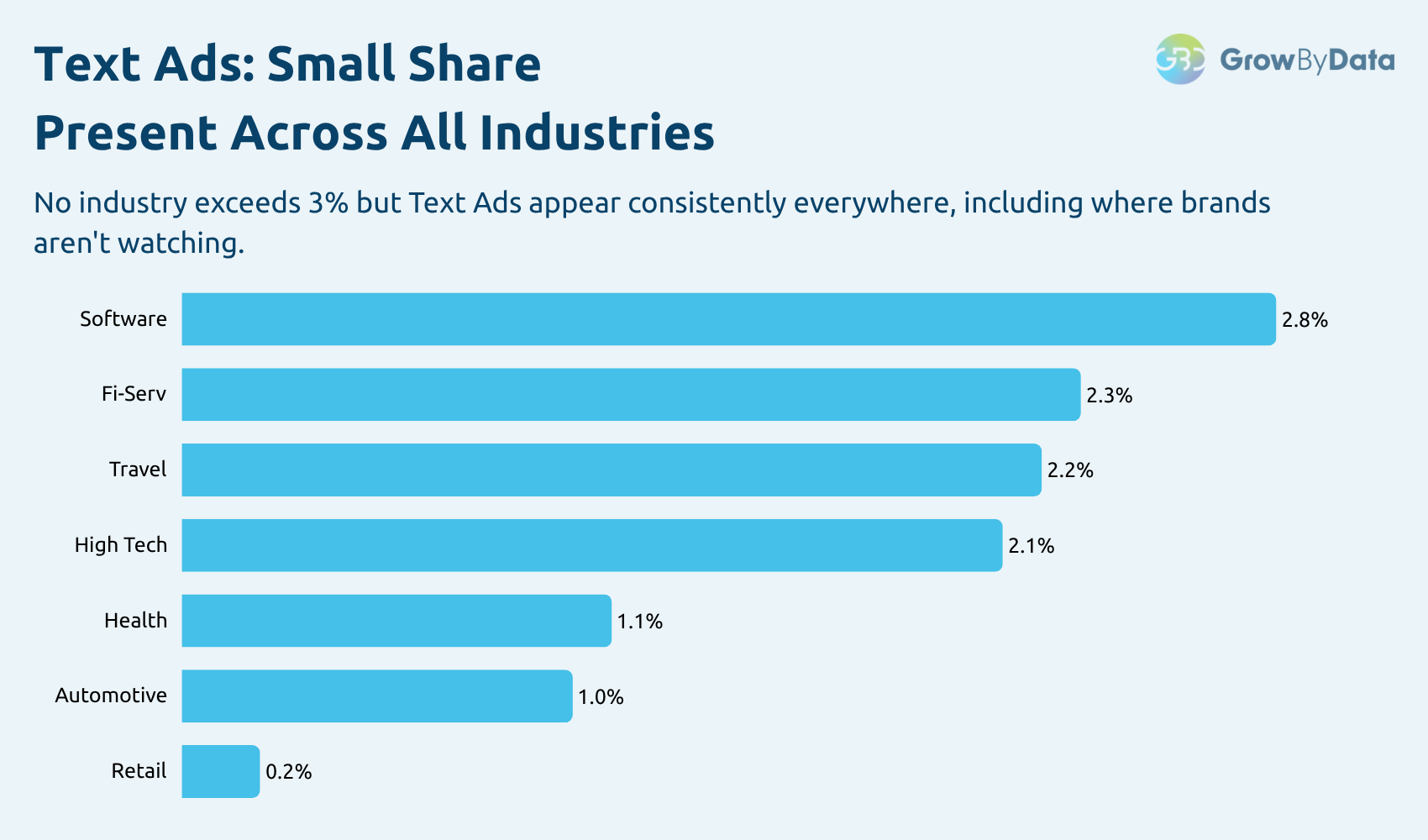
Text Ads don’t compete on the same queries as Merchant Listings or AIO. They appear on brand comparison queries, category-intent searches, and high-consideration terms like “best [product category] for [use case],” “alternatives to [competitor],” “[brand] vs [brand].” These are queries where a buyer is still deciding which brand to evaluate. Losing visibility here is expensive in a way that’s hard to attribute, because the damage shows up as a conversion problem, not a traffic problem.
The small share also reflects real opportunity. In industries where Text Ads presence is low, most brands aren’t competing there. When a competitor starts scaling Text Ads on your core high-intent terms, the shift happens fast and few brands catch it early.
Three areas to get right for Text Ads:
- Ad copy matched to the specific query intent. Text Ads on brand-comparison queries need to answer the comparison directly. “Rated #1 for [specific use case]” outperforms generic brand messaging when the user is actively evaluating alternatives.
- Sitelink extensions for category depth. Sitelinks that surface specific categories convert better than homepage-only links and increase the physical space your ad occupies on the SERP: more real estate, more entry points for the click.
- Competitive monitoring before budget commitment. The priority right now isn’t spend optimization. It’s visibility monitoring. Knowing when a competitor takes a Text Ads position on your core terms is the signal that tells you when to respond. → See GrowByData’s Text Ads visibility analysis across industries
Optimizing for SERP Features: What the Data Actually Tells You
The generic SERP features playbook doesn’t survive contact with real industry data. AI Overviews dominate non-retail SERPs. Merchant Listings are a retail-specific battleground. People Also Ask is the one feature that crosses every industry consistently. “What People Are Saying” is growing in community-driven categories while most brands ignore it. Text Ads are small in share but strategically important on high-intent queries.
The brands winning across all five aren’t optimizing each feature in isolation. They’re tracking which features are gaining or losing ground in their specific industry, catching competitor moves before they show up in traffic reports, and allocating effort based on what actually appears on their SERPs, not what appears on a generic list.
See how your brand’s SERP feature visibility compares to competitors
Track AI Overviews, Merchant Listings, PAA, Shopping Ads, and Text Ads across your actual keyword set, by industry, by query type, by competitor.