
Say you’re the VP of brand marketing at a mid-size DTC skincare company. A customer asks Perplexity “what’s the best vitamin C serum for sensitive skin,” and your product doesn’t show up in the answer. Not because Perplexity doesn’t know you exist. Because the page it pulled its answer from was a competitor’s ingredient breakdown, and yours was never in the mix of sources it read.
That’s the problem Perplexity visibility monitoring exists to solve, and it’s one piece of the wider shift in AI search visibility. Perplexity passed 100 million monthly active users as of April 2026, with enterprise customers in the tens of thousands, according to financial reporting on the company. This isn’t a channel to get to eventually. For a lot of marketing teams, the board is already asking, and they still can’t fully answer.
We looked at seven tools that touch this problem, including our own. None of them wins on every dimension, and we’re skeptical of any list that pretends one does. Here’s how we evaluated them, then the case for and against each.
How we evaluated these tools
Nine criteria, roughly in order of how often they came up: Perplexity citation and mention tracking, prompt-level visibility, competitor benchmarking, citation and source analysis, coverage across multiple AI platforms, whether traditional search context is included, enterprise scalability, reporting and workflow depth, and pricing where a vendor makes it public. No tool on this list scores well on all nine. Which ones matter most depends on what your team is actually trying to answer, which is why the table below is a starting point, not a ranking.
At a glance
| Tool | Best for | Watch out for |
|---|---|---|
| GrowByData | Enterprise teams that want Perplexity and broader AI visibility connected to Google organic, paid, and Shopping intelligence | Broader platform than necessary if the only requirement is basic Perplexity mention tracking |
| Profound | Enterprise teams focused heavily on AI-search visibility, citation intelligence, and AEO workflows | Primarily AI-search focused rather than a full traditional rank-tracking, paid-search, and Shopping suite |
| Otterly | Teams wanting an accessible entry into multi-engine AI visibility monitoring, citations, and content insights | Costs rise substantially as prompt volume, tracking frequency, and AI-engine coverage expand |
| Peec AI | Focused AI-search analytics covering visibility, citations, sentiment, competitors, and optimization opportunities | Doesn’t provide the traditional Google organic, paid, and Shopping breadth a search-intelligence platform does |
| Scrunch | Brands wanting AI visibility combined with citation, AI-agent, and AI referral-traffic intelligence | More focused on AI search and AI customer experience than traditional search intelligence |
| BrightEdge AI Catalyst | Existing BrightEdge enterprise SEO customers who want AI visibility folded into an established SEO workflow | The broader enterprise SEO platform may be more than a company needs for Perplexity monitoring alone |
| Semrush AI Visibility Toolkit | SEO teams wanting AI visibility alongside traditional SEO inside the Semrush ecosystem | Coverage and refresh frequency vary by feature; ecommerce and Shopping intelligence isn’t the focus |
What does “Perplexity visibility monitoring” actually measure?
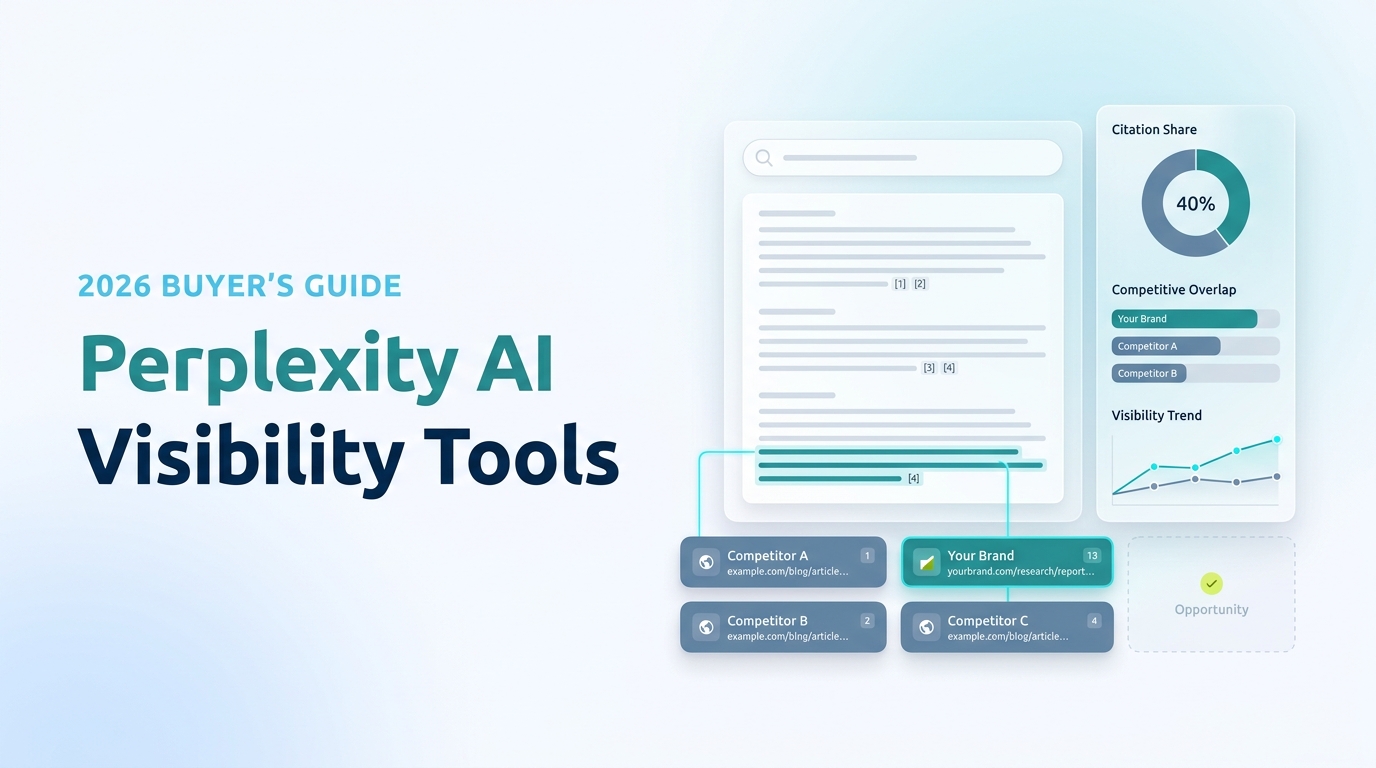
Checking whether you earned a citation is the narrow version of this question. The fuller version covers a few more angles teams actually care about:
- whether your brand shows up at all for prompts that matter to your category
- how often it shows up relative to named competitors
- which domains and specific URLs Perplexity is citing
- your citation share against that competitive set
- brand mentions that show up without a citation attached
- where you land in the answer, mentioned first or an afterthought
- the tone or context around any mention
- how any of this shifts week to week
For an SEO team, the harder question sits underneath all of that: what actually caused the change. A citation can disappear because Perplexity swapped its sources, a competitor shipped stronger content, the underlying search results moved, or the model’s answer changed for reasons that have nothing to do with your site.
This is where the tools genuinely diverge. Some specialize almost entirely in AI visibility. Others fold AI-search performance into a broader view that includes traditional organic search, paid search, ecommerce, or competitive intelligence.
1. GrowByData
GrowByData tracks Perplexity brand monitoring alongside ChatGPT brand monitoring, Google AI Mode monitoring, and Google AI Overviews, in the markets and devices you choose. The real value shows up when a citation changes in Perplexity: instead of that being a data point on its own, you can check it against what’s happening in Google organic, paid, and Shopping for the same brand at the same time.
A few enterprise SEO suites connect AI visibility to search data too, BrightEdge and Semrush both do to varying degrees. Where GrowByData differs is the ecommerce depth underneath that Google side: paid Shopping listings and SKU-level tracking that a general-purpose SEO suite isn’t built around.
Best for: teams who want AI visibility and Google performance in the same view instead of stitched together from two logins.
Not for: a team that only wants basic Perplexity citation checks. That’s more platform than the job requires.
2. Profound
Profound is a name most people in this space already recognize. It raised a $96 million Series C at a $1 billion valuation in February 2026, and says it works with more than 700 enterprise customers, including 10% of the Fortune 500, among them Target, Walmart, Ramp, MongoDB, U.S. Bank, and Figma.
Its focus runs substantially deeper on AI visibility, citations, and AEO workflows than on traditional rank tracking, paid search, or Shopping intelligence. It has added some Google SERP capability to parts of its platform, so it’s no longer accurate to say it has no traditional search data at all, but that’s not where most of the product lives.
Best for: enterprise teams whose primary need is AI-search intelligence and AEO workflows.
Not for: a team expecting the same depth on traditional rank tracking, paid search, or Shopping that a dedicated search-intelligence platform provides.
3. Otterly
Otterly’s pricing scales with how much monitoring you need: publicly listed plans run from around $29 a month for a small number of tracked prompts up to roughly $989 a month at higher volume, with enterprise options above that. Where you land depends on how many prompts, markets, and AI engines you’re tracking, so a flat “affordable tool” label undersells the range.
The product has expanded well beyond a bare-bones mention counter, too. Multi-engine monitoring, daily tracking, agent analytics, API access, and multiple workspaces are part of what’s on offer now.
Best for: teams that want to get started quickly and scale up monitoring as needs grow.
Not for: assuming the price stays low. Teams tracking large prompt volumes, multiple markets, or several AI engines should model out where their actual usage lands on that scale before committing.
4. Peec AI
Peec AI’s feature list has filled out considerably since it launched. The platform now tracks brand visibility, share of voice, citations and cited sources, competitor benchmarking, sentiment, and ranking position, with prompt-level analysis and optimization recommendations layered on top.
It’s a dedicated AI-search analytics platform built to show how a brand appears across answer engines and how that stacks up against named competitors. That’s not thin analytics, to be clear. The difference from GrowByData is scope: Peec stays specialized in AI-search visibility, while GrowByData connects that visibility to a broader set of traditional Google organic, paid, and Shopping data.
Best for: teams that want deep, dedicated AI-search analytics without needing it tied to traditional search data.
Not for: a team whose real question is how AI visibility relates to what’s happening on the Google side. Peec doesn’t cover that ground.
5. Scrunch
Scrunch describes itself as an AI customer experience platform, and the feature list holds up that claim. Beyond visibility and citation tracking, cited domains and specific URLs, it covers AI-agent and bot activity hitting your site and AI referral traffic to individual pages, a broader picture of how AI systems interact with a brand, not just whether they mention it.
Reviewers on G2 consistently point to fast setup and responsive support, which matters if your team doesn’t have weeks to spend on implementation.
Best for: brands that want AI visibility paired with insight into AI-agent traffic and how AI platforms are actually reading their content.
Not for: a team whose center of gravity is traditional Google search intelligence. Scrunch’s focus stays on AI search and AI customer experience.
6. BrightEdge AI Catalyst
BrightEdge AI Catalyst integrates AI-search monitoring into BrightEdge’s existing enterprise SEO platform, so AI citation data sits alongside the organic performance data teams already use it for. By BrightEdge’s own account, it covers ChatGPT, Perplexity, and Google AI Overviews, with coverage of additional AI platforms expanding; exactly which environments a given report tracks can vary by feature.
Best for: enterprise organizations already running BrightEdge for organic SEO who want AI-search intelligence folded into that existing workflow.
Not for: a team looking only for lightweight Perplexity monitoring. The wider BrightEdge platform is likely more than that team needs.
7. Semrush AI Visibility Toolkit
Semrush’s AI visibility coverage spans ChatGPT, Perplexity, Gemini, and Google’s AI surfaces, though which platforms a given report covers, and how often that data refreshes, varies by feature. The AI Visibility Toolkit can be purchased on its own, while Semrush One bundles it with the company’s traditional SEO tracking.
Best for: SEO teams already working inside the Semrush ecosystem who want AI-search monitoring added without a separate workflow.
Not for: teams needing SKU-level, Shopping-specific, or other specialized retail search intelligence. Semrush’s strength is breadth across keywords and platforms, not that kind of depth.
Do you need a Perplexity-only tool, or a broader view?
A dedicated AI-search tool is cheaper and faster to stand up, and if AI visibility is a contained question for your team this quarter, that’s a legitimate reason to pick one over a bigger platform. Nobody needs a full platform to answer a narrow question.
It gets harder when the real question turns out to be broader than Perplexity alone. If ChatGPT and Google AI Mode are in scope too, our broader best LLM visibility tracking tools for enterprise roundup covers those, and the full LLM Intelligence view ties them together. If AI visibility needs to connect back to what’s happening in Google organic, paid, or Shopping, that’s the specific gap GrowByData, and to a lesser extent BrightEdge and Semrush, are built to close.
The right tool depends on the question you’re asking
If you mainly want to know whether your brand shows up across AI engines, Peec AI, Otterly, Profound, or Scrunch each answer that in their own way, some narrower, some broader, depending on what else you need alongside it. If AI visibility needs to live inside a broader enterprise SEO workflow you’re already running, BrightEdge or Semrush make more sense than adding another standalone tool. GrowByData becomes the relevant option when the goal is connecting AI citations and visibility with what’s actually happening across Google organic, paid, and Shopping results for the same brand.
Monitoring tells you visibility changed. The harder, more valuable work is figuring out why it changed and what else moved alongside it. That’s true no matter which tool ends up on your login list.
If you want a first look at where your own brand stands across Perplexity and Google before picking a tool, talk to an expert and walk through your own keyword and prompt data.
Related reading: track brand mentions in Perplexity AI for the step-by-step manual process, track brand mentions in ChatGPT if that platform matters more to you, or see the full breakdown in why GrowByData outperforms Profound and Otterly.