

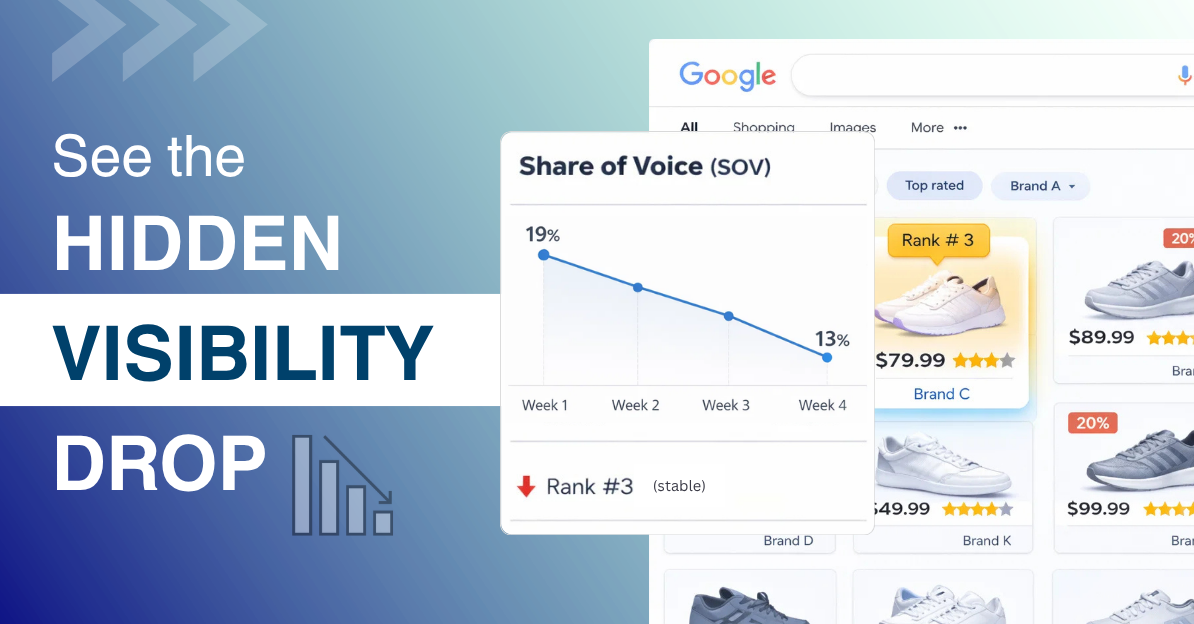
Stable rankings can mask a slow erosion of SERP real estate and most ecommerce teams aren’t measuring it.
Ecommerce teams have been trained to watch rankings. But rankings are no longer the whole story.
Google’s results page has changed structurally. Merchant Listings, shopping grids, local inventory feeds, and product annotations now occupy far more of the visible page than they did 18 months ago. As those surfaces expand, a brand can hold its ranking position and still lose ground to competitors, not because it slipped, but because the page around it got more crowded.
This is the visibility gap: the difference between where you rank and how often shoppers actually encounter your products.
GrowByData platform data
Across tracked ecommerce categories in Q1 2026, GrowByData observed Merchant Listing share of voice declining from approximately 19.5% to 13% over a 90-day window even among brands whose average listing rank held steady. The driver was competitor entry into shopping grids, not ranking loss.
That gap is widening. And most teams aren’t measuring it.
“Ranking reports give you a position. Visibility reports give you a share. Those two numbers are diverging.”
Why merchant listings are reshaping the competitive baseline
Product grids on Google’s results page now appear more frequently and with more products per grid than a year ago. GrowByData’s Google Shopping Monitoring is tracking across page-one results shows increases in three interconnected metrics: the number of Merchant Listing grids appearing per query, the number of products shown within each grid, and the total pixel area dedicated to shopping surfaces.
The practical effect is that the number of competing products a shopper sees before clicking anything is growing. For brands, this changes what “winning” on search looks like. It is no longer sufficient to rank. You need to appear, repeatedly, across an expanding set of product surfaces.
Large retailers with physical store networks are accelerating this shift. By activating local inventory feeds, they can surface store-level availability directly in search results adding a fulfillment signal that purely digital brands cannot match without comparable infrastructure.
When rankings stay stable but share of voice drops
One of the most important insights from GrowByData’s analysis is that visibility can erode even when rankings appear unchanged. In one marketplace analyzed, Merchant Listing share of voice declined from roughly 19.5% to around 13% over a short period while average listing rank remained relatively stable.
What changed was not ranking performance. What changed was the competitive landscape. As Google introduced more product listings into the results, additional competitors entered those grids. Even though existing products maintained similar positions, their relative exposure to shoppers declined.
Visibility is increasingly shared across a larger set of products. For ecommerce leaders, this means traditional ranking reports no longer tell the full story.
What ecommerce teams should watch
As Merchant Listings continue to expand, several factors will increasingly shape product visibility:
- Participation rate across Merchant Listings and shopping grids
- Competitive pricing within specific product categories
- Fulfillment and shipping signals free shipping annotations appeared in roughly 40% of tracked listings
- Product feed completeness and structured data quality
- Local inventory feed activation, particularly for brands competing with large-format retailers
Frequently asked
What is SERP visibility, and how is it different from ranking?
Ranking measures where a single listing appears in search results. SERP visibility measures how frequently and prominently a brand’s products appear across all shopping surfaces including Merchant Listings, shopping grids, and local inventory placements relative to competitors. A brand can maintain its ranking while losing visibility if more competitors enter the shopping grid.
What is Merchant Listing share of voice?
Merchant Listing share of voice is the percentage of total Merchant Listing impressions a brand captures within a given category or keyword set. It reflects how often your products appear in Google’s shopping surfaces compared to the total available exposure in that market.
Learn More on Google’s Merchant Listings & How to Optimize to Improve Organic Visibility
What should ecommerce teams track beyond traditional rankings?
Marketing teams from brands and retailers should monitor SERP Visibility, participation rate across shopping grids, product annotation coverage (free shipping, local pickup), and local inventory feed activation particularly as large-format retailers expand their grid presence.
Why is Google’s search results page becoming more shoppable?
Google Shopping has steadily expanded the proportion of page-one real estate dedicated to product discovery surfaces Merchant Listings, shopping grids, paid placements, and AI-generated search features. This reflects Google’s commercial interest in facilitating product discovery directly within search, reducing the steps between query and purchase. Monitoring Google shopping products and paid shopping placement is very important in order to be up-to-dated with the competition and the market.