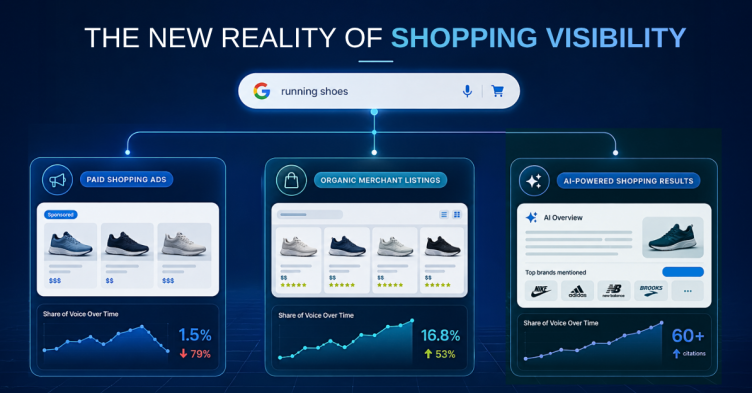

Shopping ads intelligence is competitive data showing which brands appear in Google’s Shopping carousel, on which keywords, in which locations, how often, and with what ad copy. It’s built from direct SERP observation rather than keyword-tool estimates.
For agencies pitching and retaining retail clients, it’s the sharpest differentiator available. Most agencies don’t use it. The ones that do win more pitches and hold accounts longer.
This article is for agency strategists, directors of performance, and paid search leads who manage or pitch retail ecommerce accounts at enterprise brands with $50M+ in revenue.
Why Most Retail Pitches Lose Before the Second Slide
The typical agency pitch brings the same things every time:
- Category trends from a keyword tool
- A rough share of voice estimate
- A few competitor screenshots
The client has seen it. They nod, ask a few polite questions, and move on to whoever felt sharpest in the room.
The agencies that consistently win retail business show up differently. They walk in already knowing what’s happening in the prospect’s Shopping category. Which competitors are winning placements. On which product lines. In which markets. What their ad creative looks like this week.
That’s not a strategy deck. That’s intelligence. And it changes the dynamic before a single slide is presented.
Standard competitive research answers the wrong questions for a retail pitch. A Director of Paid Search at a $200M apparel retailer doesn’t need to know which keywords a competitor ranks for. They need to know:
- Which competitor is appearing above them in the Shopping carousel on their top SKUs
- Whether a challenger brand surged on their core category during a recent promotion
- Whether their own Shopping Ads coverage reflects the markets they’re actually investing in
Those are different questions. They require different data.
Understanding how Google Shopping competitor analysis actually works and what data it requires is the foundation of a retail pitch that lands.
What Is Shopping Ads Intelligence and How Is It Measured?
Shopping ads intelligence is competitive visibility data drawn from direct observation of Google Shopping search results. Not modeled from keyword databases. Not estimated from panel traffic.
The distinction matters. Retail clients with mature paid search teams will push on methodology.
Here’s how observed Shopping intelligence works:
- An automated system captures live Google Shopping results on a defined keyword set
- Captures run across specified markets and devices on a daily cadence
- Each capture records which advertisers appeared, carousel position, product title, price, and promotional overlay
- Aggregated over time, this produces share of voice, position trends, competitive entry and exit signals, and creative patterns
None of that is available from the ad platform itself.
The data source is the SERP. The actual Shopping carousel your client’s customers see when they search. That’s what makes it useful for an agency pitch: you can run this analysis on a prospect’s category without touching their ad account, and show up with their competitive picture already built.
For a broader view of how competitive data applies across search surfaces, competitive SERP analysis covers organic, text ads, and SERP features alongside Shopping.
How to Use Shopping Intelligence in a Retail Pitch
The most effective approach: run a category-level visibility gap analysis on the prospect before the meeting. Not a keyword gap. A Shopping visibility gap.
A Director of Performance at an apparel retailer doesn’t need 30 slides. They need to see that Brand A is appearing on 64% of category queries in their core markets while their brand is showing up on 31%, and that two of those gaps concentrate in their highest-margin product line.
That’s three minutes of context that justifies an entire engagement.
The pitch doesn’t require the prospect’s ad account. You define the keyword set and markets. The data captures the full competitive field on those terms. You run the analysis on the category, not the account. Then you show up having already done the work the client hasn’t done themselves.
This approach works across retail categories. The beauty industry Google Shopping Ads analysis is one example of what category-level Shopping intelligence reveals. The same structure applies to apparel, footwear, home goods, sporting goods, and electronics.
Want to see what competitive Shopping intelligence looks like on a live retail category before your next pitch?
Book a strategy session and we’ll run a category analysis on the accounts you’re targeting.
What GBD Compass Shows Agencies That Platforms Don’t
GrowByData’s GBD Compass tracks Shopping Ads visibility through direct SERP observation. It captures what actually appears in the Google Shopping carousel on the keywords you define, in the markets and devices you choose, updated daily.
For agencies, that means competitive data across a client’s full category without needing their ad account credentials.
Here’s what GBD Compass surfaces specifically:
- Shopping Ads share of voice by brand and category. Which advertisers are winning the most carousel placements on a given keyword set, and how that shifts week over week.
- Carousel position data. Not just presence, but where in the carousel competitors consistently appear, tracked across the full keyword set daily.
- Ad copy and creative monitoring. Competitor product titles, pricing, promotional overlays, and offer language visible in Shopping results.
- Product-level tracking. Which specific products competitors are pushing into Shopping, and how their assortment coverage changes over time.
- Geographic and device breakdowns. Shopping visibility by your chosen markets and by device. Mobile and desktop Shopping SERPs diverge significantly on competitive presence.
- Daily tracking cadence. A client running 80 priority keywords across 5 markets on 2 devices generates 800 SERP captures per day. That’s roughly 72,000 Shopping competitive observations per quarter. Every one tied to the client’s actual category. Not a sample. The complete record.
Agencies using GBD Compass with retail clients see a 44% average CTR improvement after acting on competitive Shopping Ads insights.
GBD Compass is built for the teams described on the Google Shopping Ads monitoring solution page: paid search leads, ecommerce directors, and agency strategists who need the full competitive field on their chosen keywords.
How Does Google Shopping Competitive Data Compare Across Tools?
Not all competitive Shopping data is equal. Senior retail buyers know the difference. Here’s an honest comparison:
| Capability | Google Ads Auction Insights | Semrush PLA Research | GBD Compass |
|---|---|---|---|
| Data source | Your own live auctions | Monthly database snapshots | Daily observed SERP captures |
| Update frequency | Real-time (your auctions only) | Monthly | Daily |
| Competitor discovery | Brands in your auctions only | Any domain, keyword-based | Full carousel field on defined keyword set |
| Share of voice metric | Impression share % only | Not available | SOV by brand, trended daily |
| Carousel position tracking | No | Yes, per keyword (monthly) | Yes, across full keyword set daily |
| Ad copy and creative visibility | No | Yes (PLA Copies report) | Yes |
| Keywords outside your campaigns | No | Yes | Yes |
| Geographic granularity | Campaign level | Country-level database | Location-level on chosen markets |
| Device breakdown | No | Desktop or mobile (select one) | Both tracked simultaneously |
| Historical data | Limited (Google Ads window) | Back to 2012 | Longitudinal from tracking start |
| Requires client ad account | Yes | No | No |
| Plan required for full data | Any Google Ads account | Guru plan ($449.95/mo) | Enterprise |
Semrush’s PLA Research is a legitimate tool with real keyword-level data, ad copy visibility, and historical depth back to 2012. The gap is cadence and granularity. Monthly snapshots work for strategic research. They’re not sufficient for week-over-week competitive tracking or catching a competitor surge in real time.
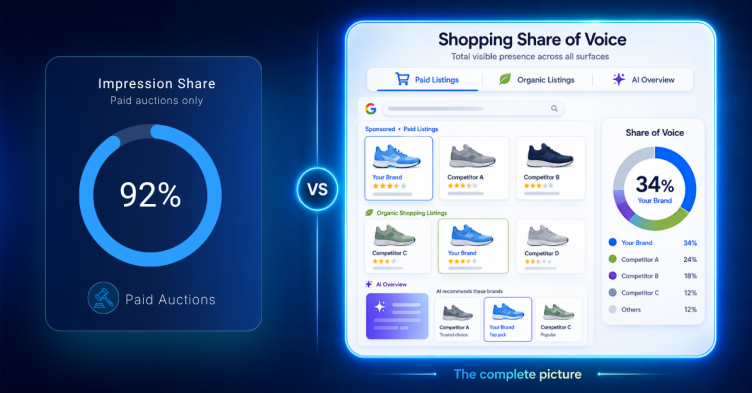
Google Ads Auction Insights is the most misunderstood tool in this space. It only shows the fight you’re already in. Understanding Google share of voice as a metric and why impression share is a more limited measure is a useful framing for this conversation with clients.
The Objection Every Agency Hears: “We Can See This in Google Ads”
At some point a retail client will say it. Usually a paid search manager who’s comfortable in the platform and skeptical of external tools.
The honest response: Google Ads shows you your own data, and only from the auctions you already entered.
Auction Insights does not show you:
- Competitors appearing on category head terms you abandoned six months ago
- A challenger brand running aggressive Shopping campaigns in the Southeast while your campaigns are concentrated in the Northeast
- What creative is dominating the carousel on your top product category this week
- The competitive field on keywords you’re not bidding on
One G2 reviewer who leads paid search at a global agency put it plainly: GBD gives clients visibility into “all competitors in the SERP, not just what the engines report.”
That’s the gap. The platform tells you about the fight you’re in. Shopping intelligence tells you about the full battlefield.
The complete guide to monitoring Google Shopping Ads covers this distinction in more depth, including why platform-native data systematically undercounts the competitive field in Shopping specifically.
How Shopping Intelligence Supports Retention, Not Just New Business
Winning the client is one problem. Keeping them is a separate one, and competitive ad intelligence solves both.
Monthly reporting is where agency relationships most often erode. The client sees traffic numbers and bid data they can pull themselves. They don’t need an agency for that.
What they can’t get from the platform:
- How their Shopping visibility shifted relative to competitors last month
- Which new entrants showed up in their category
- Whether a competitor’s surge in week three correlated with a promotion they should have matched
Agencies that embed competitive Shopping share of voice into standard monthly reporting give clients something they can’t replicate internally. Senior clients at $100M+ retailers don’t churn from agencies that consistently surface things they didn’t know. They churn from agencies that present data the client could have pulled themselves.
The difference between organic and paid Shopping visibility is also worth including in client reporting. Changes in organic Shopping presence often precede or explain shifts in paid performance that would otherwise look like campaign issues.
It shifts the agency relationship from “they manage our budget” to “they see things we can’t.” That’s a retention mechanism, not just a deliverable upgrade.
What Retail Clients Typically Find in a First Shopping Ads Audit
Across retail categories, three findings come up consistently when agencies run Shopping intelligence for the first time.
1. The competitive field is wider than expected.
Most brands assume their Shopping competition matches the top three or four brands they already know. The actual field is usually two to three times wider. Smaller regional brands, private-label retailers, and marketplace sellers often hold meaningful carousel presence on mid-funnel product queries that don’t appear in the brand’s auction data.
2. Geographic gaps cluster in specific markets.
A brand’s Shopping coverage often looks strong in aggregate but has market-level holes. A competitor holds dominant SOV in a region the brand’s campaigns technically cover but underinvest in. The regional Shopping Ads intelligence view is where these gaps surface clearly.
3. Promotional surges go undetected until too late.
Competitors running time-limited promotions create Shopping SOV spikes that often coincide with a brand’s own conversion dips. Monthly data misses these. Daily tracking catches them, and gives agencies something specific to point to when a client asks why their Shopping performance dipped in a particular week.
For apparel specifically, apparel brand Shopping Ads trends show how fast the competitive field can shift. Challengers can gain significant carousel presence in short windows that traditional reporting wouldn’t flag until the next monthly review.
Right-Sizing Shopping Intelligence for Each Client
Not every retail client needs the same depth. A $50M retailer in a single category with one core US market needs a narrower setup than a $500M multi-category brand running Shopping Ads across ten markets.
Shopping intelligence tools scale to the client. You set:
- The keyword list
- The geographies
- The competitor set
- The device configuration
Agencies that right-size the data setup to the client’s actual competitive environment earn trust faster. The client sees that you understand their business isn’t generic.
It’s also worth being direct about what Shopping intelligence doesn’t replace. It’s not a campaign management tool. It doesn’t automate bid decisions or feed directly into Google Ads. What it does is give the people making those decisions a complete picture of the competitive environment: which products to prioritise, which markets need more coverage, which competitor moves warrant a response.
Understanding how product title optimisation affects Shopping Ads visibility is one practical output of that intelligence, as product title patterns in competitor feeds become visible through Shopping capture data.
Frequently Asked Questions
What is shopping ads intelligence?
Shopping ads intelligence is competitive data showing which advertisers appear in Google’s Shopping carousel, on which keywords, in which markets, how often, and with what creative. It’s built from direct SERP observation rather than keyword-tool estimates, giving agencies and brands a complete picture of the competitive field beyond what the ad platforms report.
Do agencies need client credentials to run Shopping Ads competitive analysis?
No. Category-level and competitor-level Shopping visibility data is available through tools like GBD Compass without accessing a client’s ad account. You define the keyword set and markets and the tool observes the full competitive field on those terms. You can build a prospect’s competitive picture before the first meeting without needing account access.
How is observed Shopping data different from Google Ads Auction Insights?
Auction Insights only shows competitors already bidding in your active auctions. Observed Shopping intelligence captures the full carousel across any keyword set, including competitors on terms you’re not bidding on, with product-level, geographic, and device-level breakdowns that Auction Insights doesn’t provide.
How often is Shopping Ads competitive data updated in GBD Compass?
GBD Compass tracks Shopping visibility daily. A typical client setup generates hundreds of SERP observations per day across their chosen keywords, markets, and devices, producing a longitudinal competitive record rather than monthly snapshots.
How do agencies use Shopping intelligence for client retention?
Agencies embed competitive Shopping share of voice data into monthly reporting. This shows clients how their visibility shifted relative to competitors, which new entrants appeared in their category, and what creative patterns are gaining traction. It gives clients insight they can’t pull from the ad platform directly.
What retail categories does Shopping intelligence cover?
Shopping intelligence applies to any category where Google shows Shopping Ads results: apparel, footwear, home goods, sporting goods, beauty, electronics, auto parts, and others. Coverage depends on the keyword set you define, not a pre-built category database.
What do retail clients typically find in their first Shopping Ads audit?
Common findings include a competitive field two to three times wider than expected, geographic market gaps where competitors hold carousel dominance that aggregate data obscures, and promotional surge patterns that correlate with the client’s own conversion dips but weren’t visible in monthly reporting.
How does Shopping Ads intelligence connect to broader search visibility tracking?
Shopping is one surface in a broader competitive picture. GBD Compass connects Shopping Ads share of voice to organic SERP features, text ads, and AI visibility in a single view. The Search Intelligence platform covers all of these surfaces together, which is the context retail clients increasingly need as the search landscape spreads across more result types.