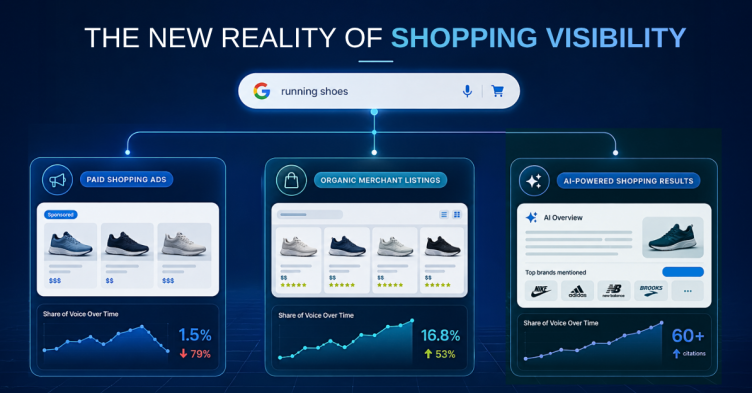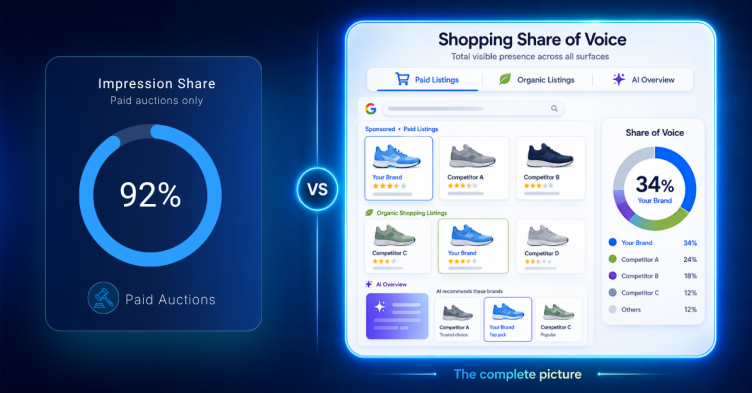

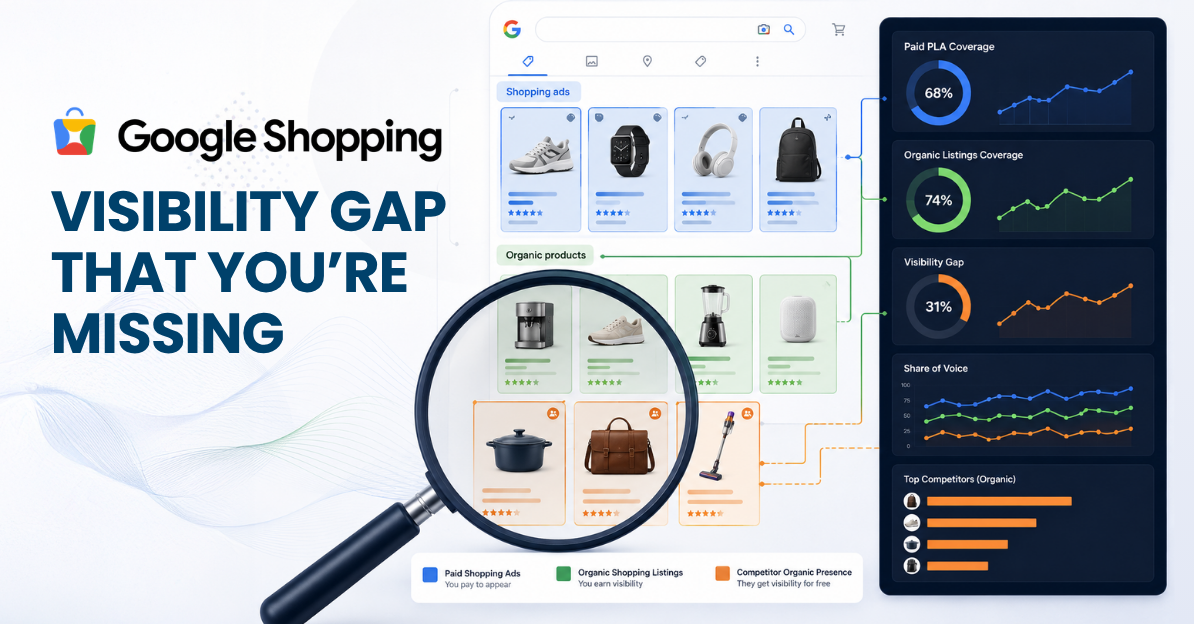
Here’s something most teams get wrong: Google Shopping isn’t one channel. It’s two. There’s the paid side – Product Listing Ads running through Standard Shopping or Performance Max campaigns and there’s the organic side, where Google pulls free product listings straight from your Merchant Center feed. Both show up in the same carousel. And most enterprise teams are only watching one of them.
That blind spot has real consequences. Paid PLAs and organic Shopping listings are scored by completely different signals, optimized through different levers, and measured by different teams. When you treat them as the same thing, you lose sight of where your visibility is actually coming from – and more importantly, where competitors are gaining ground without spending a cent.
This piece breaks down how the two surfaces work, why the gap between them is so easy to miss, and what it actually takes to monitor both at once – especially if you’re spending $500K or more on Shopping annually.
In This Article
- The Two Google Shopping Surfaces, Defined
- Why Most Enterprise Teams Only See Half the Picture
- How Google Scores Each Surface Differently
- What Does It Actually Mean to Track Both?
- Why Do Different Tools Report Different Google Shopping Visibility?
- The Queries That Expose the Gap
- Paid vs Organic Coverage: Sample Query Analysis
- How Tracking Differs: A Quick Reference
- What a Unified Search Intelligence Setup Actually Looks Like
- The Practical Takeaway for Enterprise Teams
The Two Google Shopping Surfaces, Defined
They look similar in search results. They operate nothing alike.
- Paid Google Shopping (PLAs) are cost-per-click ads served through Google Ads. They can appear across Google Shopping experiences and product-rich search results, depending on the query, format, and campaign setup. Advertisers control bids, feed optimization, campaign structure, and targeting. Visibility is directly tied to budget, bid strategy, and feed quality. Auction Insights gives some competitive data – but only for queries where you’re already bidding. Anything outside your active campaigns is a blind spot.
- Google Shopping organic listings – what Google calls Google Shopping organic listings, previously labeled Popular Products or Merchant Listings – are unpaid product results drawn from Merchant Center. They appear in the Shopping tab, in image search, and in organic SERP carousels. Google scores them on feed quality, product data completeness, price competitiveness, and reviews. No bid required. No direct spend lever.
Same tab. Completely different engines.
Why Most Enterprise Teams Only See Half the Picture
The measurement gap isn’t a strategy failure – it’s structural. Paid Shopping data lives in Google Ads: campaign reports, performance breakdowns, partial competitive signals. Organic Shopping data is scattered across Merchant Center and Search Console, neither of which was built to show you what competitors are doing on the same queries you’re bidding on.
So teams default to what’s measurable. Paid metrics are easy to pull, so paid metrics get watched. Organic gets ignored – not because no one cares, but because there’s no clear dashboard to look at. Shopping Ads monitoring shows you how your PLAs stack up against the competition. Organic monitoring shows you something different: whether a competitor is winning placements on your most valuable queries without spending anything to get there.
That second part is the one that stings. A competitor ranking organically on queries where you’re bidding heavily isn’t just a visibility problem – it’s a margin problem. Their cost of presence is zero. Yours isn’t. And it’s one of the most consistent findings in in Google Shopping competitive audits: brands with solid paid SOV, sitting next to competitors who have built quiet organic dominance on the same high-intent queries.
How Google Scores Each Surface Differently
This is where the two channels diverge completely.
- Paid PLA ranking factors: bid amount, Ad Rank (Quality Score x bid x context), feed data quality (title, description, image, GTIN), landing page experience, historical CTR, and campaign structure. Google’s auction runs in real time. Two brands with identical products can see wildly different results based on bid adjustments and feed optimization alone.
- Organic listing ranking factors: product data completeness in Merchant Center (title, category, attributes, availability), price relative to competitors on the same query, review count and star rating, image quality, and relevance to user intent. No bidding. Google decides placement based on what it thinks will be most useful to the searcher.
The practical implication: you can spend heavily on PLAs and still lose organic placements to a competitor with a leaner catalog but better-structured feed data. Both surfaces need attention – and they respond to entirely different optimization levers.
What Does It Actually Mean to Track Both?
Tracking paid Google Shopping visibility means monitoring PLA coverage across target queries, competitive share of voice at the product and category level, and pricing differentials visible in the Shopping carousel. Your own Google Ads data is a starting point for understanding your own spend, but it only covers queries where you’re bidding – and it tells you nothing about where competitors appear when you don’t.
- Tracking organic Shopping visibility is harder. Merchant Center shows your own feed performance but nothing about competitors. Search Console shows which queries triggered your organic listings – but not where you rank against a competing brand on that same query, and not what the full competitive field looks like from a buyer’s perspective.
- Real visibility tracking – the kind that gives a Paid Search Director a complete picture – requires monitoring the actual SERP: which brands appear in the organic carousel for a given query, at what position, with what price point. That’s not a report Google natively provides. It requires external monitoring against a defined keyword set.
Why Do Different Tools Report Different Google Shopping Visibility?
This comes up constantly when teams first try to build a Shopping reporting stack. The short answer: every tool samples different queries, at different times, from different locations – and Google serves different results based on personalization, localization, and auction dynamics. No two crawls of the same query are identical.
Auction Insights only reflects queries where your campaign was in the auction. A third-party tool crawling those same queries from an external IP sees the non-personalized SERP – which is useful for competitive benchmarking, but not the same thing your customers are seeing. Both views are valid. They’re just answering different questions.
The mistake is trying to reconcile them. Your campaign performance data tells you how your spend performed within your campaigns. SERP-level monitoring tells you what the broader competitive landscape looks like – including competitors who are winning on queries you never entered. Competitive Shopping analysis is most valuable precisely on those queries: the ones where someone else is winning and you have no idea it’s happening.
See Where Your Search Visibility Gaps Are Forming
GrowByData Search Intelligence tracks paid Shopping, organic listings, text ads, and SERP features together – across your brand, competitors, categories, and tracked keyword set. Audit first. No sales call required.
The Queries That Expose the Gap
The most revealing analysis isn’t aggregate campaign metrics – it’s query-level coverage mapping. On your highest-converting product queries, how does your paid PLA presence compare to your organic listing presence? And where do competitors appear on one surface but not the other?
Three patterns surface consistently:
- Paid-only presence. Brand is bidding and winning PLAs, but organic listing is absent or buried. This typically points to a Merchant Center feed issue – missing attributes, incomplete product data, or price competitiveness problems that affect organic scoring without touching paid performance at all.
- Organic-only presence. Product appears in organic listings but no paid campaign is running for those queries. Common in large catalogs where campaign coverage has gaps. The brand is getting exposure but leaving conversion acceleration on the table.
- Competitor organic gap. A competitor appears organically on queries where you’re spending on PLAs. Their cost of presence is zero. Your CPC is climbing because the organic results are training searcher behavior toward their product. This is the pattern that compounds – and the one that’s nearly impossible to spot without monitoring both surfaces on the same query set.
- The table below illustrates what this looks like across a set of monitored apparel queries. Brand A has strong paid coverage. The organic column tells a different story.
Paid vs Organic Coverage: Sample Query Analysis
| Query | Brand A PLA | Brand A Organic | Competitor PLA | Competitor Organic | Gap |
|---|---|---|---|---|---|
| women’s running shoes | ✓ P1 | ✗ Not ranked | ✓ P2 | ✓ P1 | Organic gap |
| trail running shoes men | ✓ P1 | ✓ P3 | ✗ Not bidding | ✓ P2 | Covered |
| waterproof running shoes | ✓ P2 | ✗ Not ranked | ✗ Not bidding | ✓ P1 | Organic gap |
| cushioned running shoes women | ✗ Not bidding | ✓ P2 | ✓ P1 | ✓ P1 | Paid gap |
| lightweight running sneakers | ✓ P1 | ✗ Not ranked | ✓ P3 | ✓ P2 | Organic gap |
| best road running shoes | ✓ P2 | ✓ P4 | ✓ P1 | ✓ P3 | Covered |
Brand A is paying for position on four of these six queries. On three of those four, a competitor has organic presence Brand A doesn’t – showing up for nothing on queries where Brand A’s CPC budget is running. That’s the pattern the paid-only view completely misses.
How Tracking Differs: A Quick Reference
| Factor | Paid PLAs | Organic Listings |
|---|---|---|
| Data source | Google Ads (Auction Insights, campaign reports) | Merchant Center, Search Console, SERP monitoring |
| Competitive visibility | Partial – only queries where you entered the auction | Not natively available – requires external SERP monitoring |
| Ranking lever | Bid + Ad Rank + feed quality | Feed completeness + price + reviews + relevance |
| Cost per click | CPC – every click carries a cost | No direct cost per click |
| Update frequency | Real-time, auction-dependent | Variable – Google recrawls Merchant Center feeds periodically |
| Competitor gap detection | Partially visible in your own campaign reports – competitors outside your auctions are not shown | No native tool – third-party SERP monitoring required |
| Optimization owner | Paid Search / PPC team | Ecommerce / feed management / SEO team |
That last row is worth pausing on. Paid and organic Shopping don’t just require different data – they’re owned by different teams. Which means the gap between them isn’t just a reporting problem. It’s an organizational one. No single team sees the full picture unless the data is unified somewhere.
What a Unified Search Intelligence Setup Actually Looks Like
Google Shopping is one surface inside a much larger competitive environment. The problem is that most data architecture enterprise teams have built treats it like an island. Paid data sits in Google Ads. Organic signals live in Merchant Center. SERP features are invisible to both. The result is three partial views of the same competitive picture, owned by different teams, never in the same place at the same time.
The brands that have fixed this aren’t using more tools. They’ve reduced them by moving everything onto a single keyword foundation:
- Paid Shopping coverage tracked through direct SERP monitoring, independent of your Google Ads account, so you see every competitor on a query, not just the ones who entered the same auctions as you
- Organic listing presence tracked by brand, rank, and price point on those same queries, updated daily
- Text ads and SERP features alongside both, so the full above-the-fold competitive picture is visible in one place
- One shared keyword set driving all of it, in the markets and on the devices you have chosen, so every surface is measured on an equal footing
That last point is what most platforms skip. GBD isn’t crawling a broad sampled database and surfacing whichever slice of your category it happened to catch. It tracks the specific keywords that drive your revenue, every day. When a competitor starts winning organic placements on a query where your spend is highest, you see it that day. Not in a monthly refresh. Not when someone notices a CPC trend in a quarterly review.
What that gives a Paid Search Director or Ecommerce lead isn’t a vague “competitive picture.” It’s the answer to a specific question most teams can’t currently answer:
- On the queries where we’re spending the most, which competitors are appearing organically at zero cost?
- At what position, and at what price point?
- Is the next action a bid adjustment, or a Merchant Center feed fix?
You can’t answer those questions if paid and organic data live in separate tools.
The Practical Takeaway for Enterprise Teams
Google Shopping is not a single channel with a single metric. It’s two surfaces – one that responds to budget and bids, one that responds to feed quality and price – competing on the same queries, with different rules and different data sources.
Most enterprise teams have reasonable visibility into their paid Shopping performance. Almost none have real competitive visibility into organic listings – what competitors are winning, on which queries, at what price point, without any ad spend. That gap is growing as Google expands organic product placements across the SERP, in image search, and across emerging product surfaces – including AI-powered search experiences where product results are beginning to appear.
The floor is knowing both surfaces exist. And Shopping is not the only surface expanding.
AI platforms including ChatGPT, Perplexity, and Google AI Mode are beginning to surface product results of their own. The brands building a unified monitoring setup across paid and organic Shopping today will be better positioned when those AI surfaces become a third surface worth tracking – and the GBD Search Intelligence query foundation extends directly into LLM Intelligence when that time comes.
The ceiling is tracking all of it at scale, against your specific competitor set, across the queries that actually drive revenue – and having that data in the same place so the right team sees the right signal at the right time.
See Where Your Search Visibility Gaps Are Forming
Enter your domain and GrowByData pulls your competitive visibility across paid Shopping, organic listings, text ads, and SERP features – against your actual competitor set. Audit first. No sales call required.