
Every list of the top price intelligence tools promises the same thing: catch a competitor’s price move before it costs you the sale. Here’s something worth knowing before you trust one of those lists, including this one. Most “top price intelligence tools” roundups online are written by one of the vendors in the list. That vendor is always ranked first. It’s not a knock on the category. It’s just how the content usually gets made.
Price intelligence software tracks competitor pricing across websites, marketplaces, and ad channels, then turns that raw data into alerts, dashboards, or automated repricing rules. Some tools specialize narrowly in price tracking. Others fold in MAP violations monitoring, digital shelf analytics, or full pricing optimization for enterprise catalogs. The right fit for a $60M apparel brand watching 200 SKUs on Amazon looks nothing like the right fit for a distributor enforcing MAP across 400 resellers.
This piece compares the top 8 price intelligence tools a Director of Pricing or Ecommerce would realistically shortlist in 2026, plus the questions worth asking before any of them get a signature.
| Tool | Best for | Key strength | Where it falls short |
|---|---|---|---|
| GrowByData | Enterprise brands and retailers pricing across a wide, mixed retail footprint | SKU-level pricing across 50+ retailers with hourly refresh, MAP enforcement built in | Not the leanest option for a small, stable competitor set with no MAP need |
| Prisync | Small and mid-market teams that need fast setup | Straightforward, affordable competitor and MAP tracking | Thin MAP enforcement; strains at large enterprise SKU counts |
| Competera | Teams with a dedicated pricing analyst | AI-driven price optimization, not just tracking | More sophistication than smaller teams can operationalize |
| Price2Spy | Retailers running dynamic pricing at moderate scale | Tracking, MAP monitoring, and repricing in one platform | No digital shelf or AI search visibility layer |
| Wiser | Brands managing in-store and online price parity | Strong digital shelf and assortment tracking | Retail-parity features go unused by online-only teams |
| Omnia Retail | Retailers who want pricing decisions and execution in one system | Tight loop between intelligence and automated repricing | Opinionated structure for teams that want raw data instead |
| Intelligence Node | Large enterprise retailers with complex catalogs | Price tracking plus assortment monitoring at scale | More platform and implementation lift than growing teams need |
| DataWeave | Brands and retailers with complex, multi-channel catalogs | Deep data accuracy across marketplaces and quick commerce | Enterprise sales process, not a self-serve signup |
What actually separates these tools
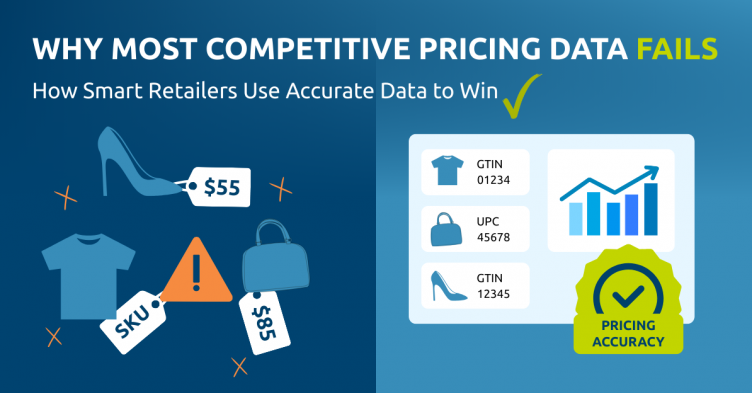
Every vendor in this space claims real-time monitoring and broad marketplace coverage. In practice, most of that claim doesn’t survive a proof-of-concept. Refresh frequency is the first thing to test, not take on faith: a tool that says “real-time” but refreshes once a day will miss a competitor’s four-hour flash promotion every time, and you won’t find out until a customer complains you’re overpriced. Product matching is the second, and it’s the one vendors talk about least. Matching a competitor’s listing to your SKU when the titles, images, and categorization all differ slightly is genuinely hard, and a tool with sloppy matching will hand your pricing team false alerts until they stop trusting the dashboard entirely.
The third is scope creep in reverse. A lot of teams buy a “price intelligence platform” expecting MAP enforcement, digital shelf scoring, and repricing automation bundled in, then discover the plan they signed covers price tracking alone and everything else is a separate line item.
What’s the difference between price intelligence and price monitoring?
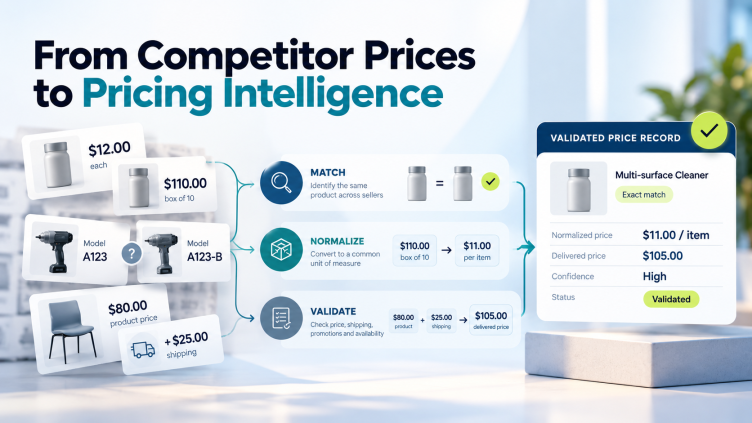
Price monitoring is the data collection layer: scraping or pulling competitor prices on a schedule. Price intelligence is what happens after that: normalizing the data, matching products across retailers, and turning raw price points into a decision, whether that’s an alert, a repricing rule, or a trend report a pricing team acts on manually. A lot of vendors use the terms interchangeably in their own marketing, which makes vendor comparisons harder than they should be. Ask directly what happens to the data between collection and the dashboard. That’s usually where the real product lives, or doesn’t.


The top 8 price intelligence tools
GrowByData
GrowByData tracks competitor pricing across Google, Amazon, Walmart, Target, and more than 50 other retailers, matched to the SKU level with hourly refresh. That’s fast enough to catch a same-day flash sale rather than finding out about it in next week’s pricing review. MAP monitoring and enforcement live inside the same product, with violations flagged SKU by SKU instead of rolled into a category-wide report someone has to dig through manually. It’s built for enterprise brands and retailers managing pricing across a wide, mixed retail footprint. A team with a small, stable competitor set and no MAP enforcement need may still find a narrower point tool faster to stand up.
Prisync
Prisync is one of the more established standalone price-tracking tools. Small and mid-market ecommerce teams use it for competitor and MAP tracking without a long setup process. It’s straightforward and reasonably priced for smaller catalogs, but enterprise teams tracking tens of thousands of SKUs across many marketplaces tend to outgrow it, and MAP enforcement workflows are thinner than purpose-built compliance tools.

Stay Ahead with Price Intelligence by GrowByData
Optimize your pricing strategy with real-time competitor insights.