
Quick Answer
Competitive price intelligence should be evaluated on the accuracy of product matching, unit-of-measure normalization, competitor and catalog coverage, data freshness, quality controls, and how easily the data can move into the systems that make pricing decisions. For ecommerce teams, matching accuracy matters more than a large SKU count. Before selecting a provider, test the data against your own products and measure correct matches, incorrect matches, price accuracy, unmatched products, and refresh latency.
Ecommerce pricing teams have access to more competitor data than ever. The difficult part is deciding whether that data is trustworthy enough to use.
A competitor may appear cheaper because it sells a different pack size. Two products may share a model family but differ in an important specification. A price may be correct but several days old. A scraper may continue running after a website change while quietly returning incomplete information.
This is why price intelligence should be evaluated as a data-quality problem, not only as a price-monitoring problem.
The most important question is not how many prices a provider can collect. It is whether the right product was matched, the price was interpreted correctly, the observation is current, and the resulting data is reliable enough to support a pricing decision.
What Is Competitive Price Intelligence?
Competitive price intelligence is the process of collecting, matching, normalizing, validating, and delivering competitor pricing data so ecommerce and pricing teams can make informed decisions.
Price monitoring is one part of that process. A useful competitive pricing program may also need to understand:
- Which competitor product corresponds to your SKU
- Whether the match is exact or only comparable
- Which variation, size, color, or model is being compared
- Whether the displayed price is per item, pack, box, case, or another selling unit
- Whether the price is promotional
- Whether the product is available
- Whether shipping or freight changes the economic comparison
- When the observation was collected and validated
- Whether an unusual result should be reviewed before it reaches a pricing model
The difference matters because a price without context can look precise while still being wrong.
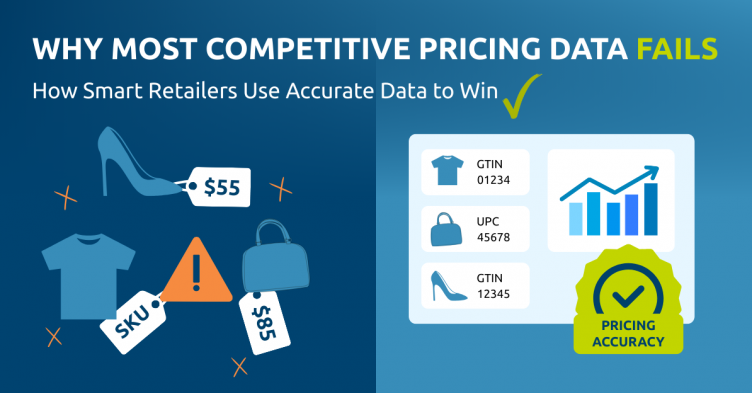
Why Competitive Pricing Data Fails
Traditional competitor monitoring often begins with known product URLs and a scheduled collection process. That can work until the underlying ecommerce environment changes.
Retailers redesign product pages. Product identifiers change. Variants are reorganized. Pack information moves into descriptions. Prices appear only after a selection is made. Some sites introduce new restrictions or page structures. Products disappear and new ones appear without a corresponding match.
These changes create a dangerous difference between a missing value and an incorrect value.
A missing value is visible. A plausible-looking number attached to the wrong product or quantity may travel through reports, dashboards, and pricing algorithms before anyone realizes something is wrong.
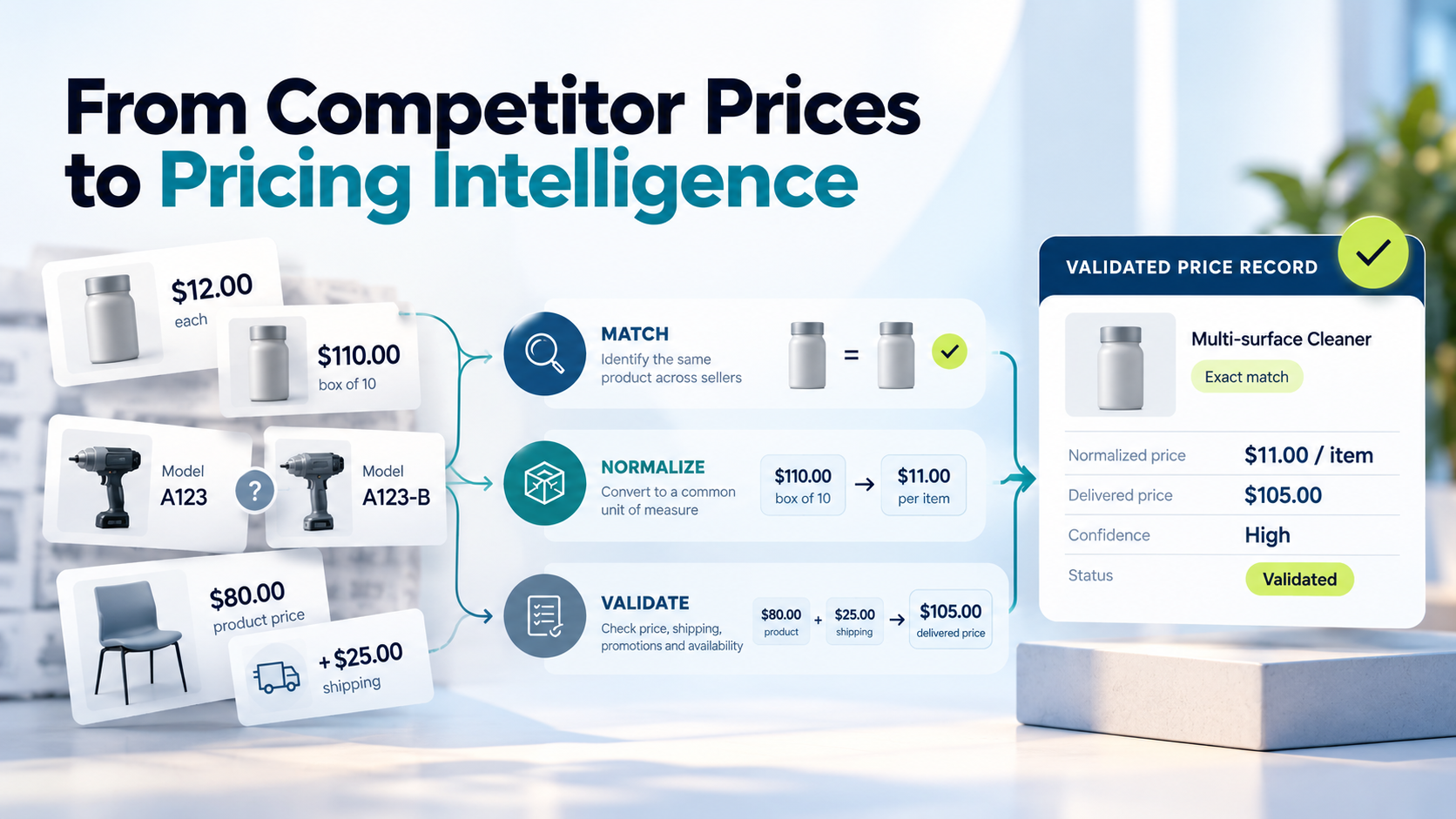
| Observation | What A Basic Monitor Sees | What Price Intelligence Must Determine |
|---|---|---|
| $12 vs. $110 | Large price gap | Is one price for a single item and the other for a box? |
| Model A123 vs. A123-B | Likely match | Does the suffix indicate a different variant or specification? |
| $80 vs. $95 | $80 is cheaper | Does freight or shipping reverse the delivered-price position? |
This is also why competitive pricing data can fail even when the collection process appears to be working.
Start With Product Matching, Not Coverage Claims
Large SKU counts sound impressive, but they do not tell you whether the underlying product relationships are correct.
Matching should be evaluated before coverage because every downstream calculation depends on it.
Exact Product Matches
An exact match identifies the same commercial product across sellers. Evidence may include UPC or GTIN, manufacturer part number, brand, model, dimensions, size, color, technical specifications, pack quantity, or other category-specific attributes.
Even exact matching requires care. Similar identifiers may refer to different variants, bundles, power configurations, sizes, or included accessories.
Comparable Product Matches
Comparable matching is different. The products are not identical, but they may be sufficiently similar for a defined pricing use case.
This can be useful for private-label products, alternative brands, or categories where exact matches are limited. The important point is that an exact match and a comparable match should not be treated as the same thing.
A useful competitive pricing dataset should preserve information such as match type, confidence, relevant matching attributes, differences between the products, validation status, and whether human review is required.
And sometimes the correct answer is simply: there is not enough evidence to make a reliable match.
An unmatched product is usually safer than a confidently wrong comparison.
Unit Of Measure Can Make A Correct Match Wrong
A product can be matched correctly while the price comparison is still invalid.
One retailer may sell an item individually. Another may sell a pack of six. A B2B distributor may show a case price with a minimum order quantity. A competitor may list a roll, box, pair, gallon, pound, or other selling unit.
If those differences are ignored, the result may look like a major pricing opportunity when it is simply a unit-of-measure problem.
A stronger data model preserves the original observation and the normalized comparison. Depending on the category, useful fields may include:
- Displayed web price
- Displayed selling unit
- Pack quantity
- Minimum order quantity
- Calculated unit price
- Promotional price
- Shipping or freight charge
- Delivered price
- Conversion rule
- Validation or exception status
This also makes quality control possible. If a product that normally sells near $10 suddenly normalizes to $100, the system should not assume the competitor increased price tenfold. It should investigate whether the pack quantity, match, website structure, or extraction changed.
Measure Usable Coverage, Not Collected Products
Coverage is another metric that becomes misleading when treated as a single number.
A provider may successfully discover thousands of competitor products, but only a portion may be matched to your catalog. Of those matches, some may be sufficiently reliable for automated analysis while others require review.
It is useful to think about coverage in four layers:
- Observed coverage: products successfully discovered or collected
- Matched coverage: products connected to something in your catalog
- Validated coverage: matches considered reliable enough for analysis
- Business coverage: the products, categories, revenue, or strategic assortment that actually matters to the pricing decision
This distinction is especially important for full-site and category-level competitor price monitoring.
One hundred thousand collected products do not automatically create one hundred thousand usable competitive comparisons.
Ask how a provider handles pagination, filters, duplicate product URLs, variants, unavailable products, changing category structures, and product-count reconciliation. A mature program should be able to explain where coverage is strong, where it is incomplete, and why.
Refresh Frequency Is Not The Same As Data Freshness
Price intelligence vendors often compete on daily, hourly, or near-real-time monitoring. Frequency matters, but the schedule alone does not tell you how quickly a usable market change reaches your team.
A more useful question is:
How long after a real competitor price change does a validated observation appear in the system your team uses?
That is refresh latency.
A high-frequency collection process does not help if product matching is stale, a site change caused fields to disappear, or the data waits in a manual transformation process before reaching analysts.
Different products may also justify different cadences. Strategic or volatile SKUs may need more frequent monitoring. Stable long-tail products may not.
The goal should be to collect each competitive signal at the frequency required by the decision it supports.
Run A Live Test Before Choosing A Provider
Do not rely only on a vendor’s stated coverage or accuracy figures.
Give shortlisted providers a representative sample from your actual catalog. Include the products that are easy to match and the products that usually cause problems.
A useful pilot can include:
- Two to five real competitors
- Products with clean manufacturer identifiers
- Variants with similar model numbers
- Multipacks and bundles
- Products with different units of measure
- Private-label or comparable products
- Products with promotions or changing availability
Then measure the output directly.
| Pilot Metric | What It Tells You |
|---|---|
| Correct match rate | How much of the matched data is usable |
| Incorrect match rate | The risk of false information entering pricing decisions |
| Unmatched rate | Where coverage or matching limitations remain |
| Price and promotion accuracy | Whether the observed commercial information matches the source |
| Unit normalization accuracy | Whether apparently different prices are truly comparable |
| Refresh latency | How quickly a real market change becomes usable data |
The incorrect-match rate deserves particular attention. A product with no match can be routed for investigation. A wrong match may quietly influence a pricing decision.
Want To Test Competitive Pricing Data Against Your Own Catalog?
GrowByData can help evaluate matching, pricing data, normalization, and competitor coverage using the products and markets your team actually works with.
Move From Monitoring To Decision-Ready Data
A dashboard can help analysts review the market, but enterprise pricing programs often need the same data to reach pricing engines, BI tools, cloud data platforms, internal models, and operational workflows.
This is where standardized schemas, provenance, and validation become important.
A useful pricing feed should make it possible to understand where an observation came from, when it was collected, which product it was matched to, how the price was normalized, and whether an exception was detected.
The distinction is simple:
| Raw Price Monitoring | Decision-Ready Price Intelligence |
|---|---|
| URL collected | Product relationship validated |
| Displayed price | Source price plus normalized comparable price |
| One match status | Exact, comparable, uncertain, or unmatched |
| Every change alerted | Changes evaluated for materiality |
| Data stays in a dashboard | Validated data can move into downstream systems |
The purpose is not to automate judgment out of pricing. It is to give pricing analysts, managers, and models better evidence to work with.
How GrowByData Approaches Competitive Pricing Data
GrowByData combines competitive data collection with product matching, normalization, quality control, analyst review, and integration-ready delivery.
The objective is to move ecommerce and pricing teams from disconnected competitor observations toward trusted SKU-level intelligence.
Depending on the program, this can include competitor product and price collection, promotions, availability, freight, exact and comparable matching, unit-of-measure normalization, catalog discovery, recurring monitoring, quality checks, and standardized data feeds.
Automation provides scale, while human review is used where product complexity, fuzzy matching, site changes, or unusual observations require additional judgment.
This becomes particularly important when competitive data is used outside a reporting dashboard. Pricing algorithms and automated workflows cannot recognize questionable data unless the uncertainty, confidence, and exception status are represented explicitly.
GrowByData can also connect competitive pricing intelligence with broader search visibility questions. A product may be competitively priced but still lose demand if shoppers do not discover it, its product data is unclear, or competitors are more visible across search and AI discovery environments.
For teams with MAP requirements as well, our guide to MAP monitoring explains the related challenge of monitoring reseller pricing and violations across digital channels.
Frequently Asked Questions
What Is The Difference Between Competitor Price Monitoring And Competitive Price Intelligence?
Competitor price monitoring records pricing observations over time. Competitive price intelligence goes further by matching products, normalizing quantities and units, validating data quality, and delivering the information in a format that can support pricing decisions.
What Is The Most Important Thing To Evaluate In A Price Intelligence Provider?
Product matching quality should be near the top of the evaluation. Coverage, freshness, analytics, and integrations are less useful if the underlying products have been matched incorrectly.
What Is Exact Product Matching?
Exact product matching identifies the same commercial product across retailers using evidence such as GTIN, UPC, manufacturer part number, model, brand, size, pack quantity, and technical specifications.
What Is Comparable Product Matching?
Comparable matching connects products that are not identical but are sufficiently similar for a defined pricing use case. It is especially useful for private labels, alternative brands, and categories where exact product matches are limited.
Why Does Unit Of Measure Matter In Competitor Price Comparisons?
A correct product match can still produce a misleading comparison if one retailer sells a single unit and another sells a pack, box, case, or other quantity. Competitive pricing data should preserve the source unit and normalize prices where appropriate.
How Should Ecommerce Companies Test A Pricing Intelligence Provider?
Run a live test using your own SKUs and competitors. Include straightforward products and difficult cases, then measure correct matches, incorrect matches, unmatched products, price accuracy, unit normalization, and refresh latency.
How Often Should Competitor Prices Be Refreshed?
There is no single best cadence. Refresh frequency should reflect product importance, competitor importance, price volatility, promotional activity, and how quickly your organization can act on a change.
Can Competitive Pricing Data Feed Pricing Algorithms?
Yes, but model-ready data requires strong validation. Ideally, observations should include source, collection time, match type, confidence, normalization status, availability, and anomaly information so automated systems can treat uncertain data differently from validated data.
Better Pricing Decisions Start With More Trustworthy Data
Competitive price intelligence is not valuable simply because it collects more prices.
It becomes valuable when your team can trust that the right product was matched, the unit and quantity were interpreted correctly, meaningful market changes were detected, and the resulting data can reach the people and systems that need to act on it.
That is the standard ecommerce teams should use when evaluating a competitive price intelligence provider.
Test Competitive Price Intelligence Against Your Own Catalog
Talk to GrowByData about your products, competitors, markets, matching requirements, and pricing-data workflow. We can help you evaluate what reliable competitive pricing intelligence should look like for your business.