By the GrowByData team | Last updated: September 25, 2026 | ChatGPT Ads product details verified: September 25, 2026
You can’t track competitor ads in ChatGPT the way you track them on Google. There’s no Auction Insights, no ad library, and no report that tells you who bid on the prompts your buyers are typing.
If a rival starts buying placements under those answers, there’s a decent chance you’ll hear about it from a prospect before you see it yourself.
So we tracked it.
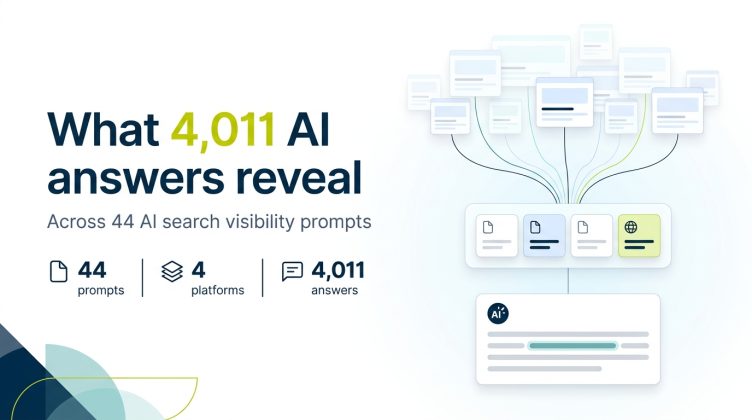
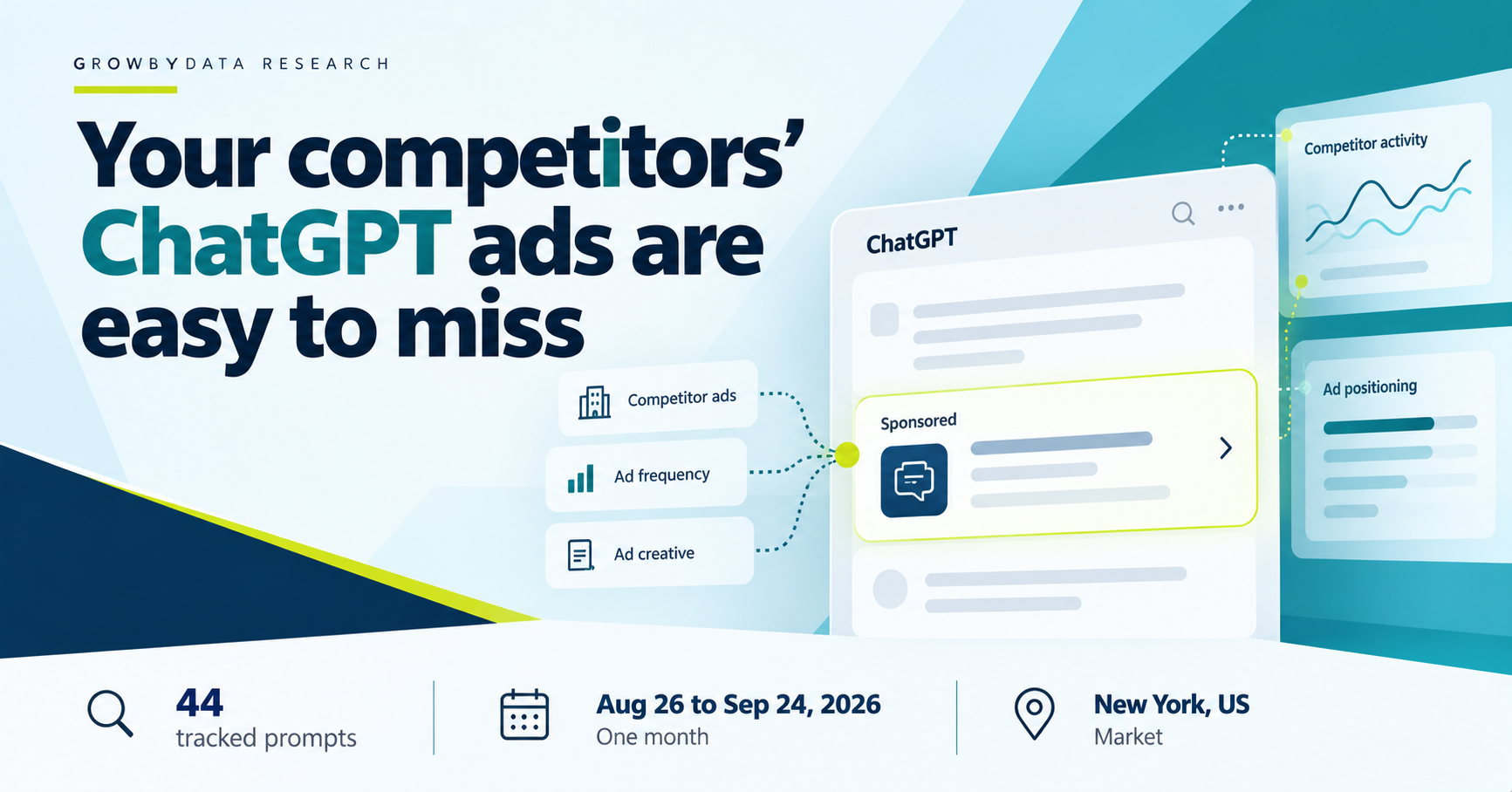
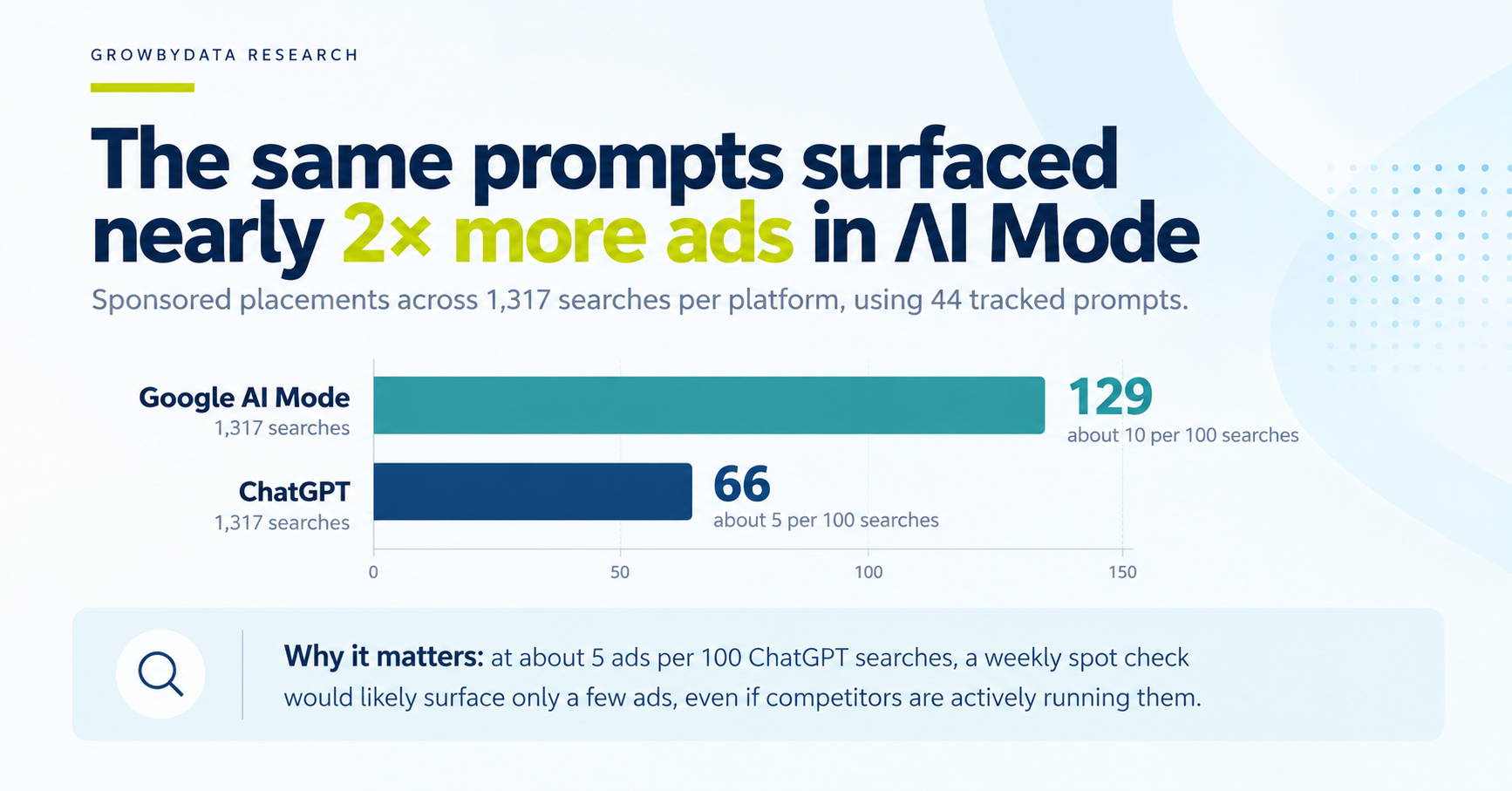
For a month we ran 44 prompts for a B2B SaaS company in marketing and pricing analytics, roughly once a day in ChatGPT and in Google AI Mode. ChatGPT served 66 sponsored placements across 1,317 searches. AI Mode, on the same prompts, served 129.
The short answer: ChatGPT has no Auction Insights-style competitor report, so you track competitor ads by monitoring a fixed set of buyer prompts over time. Keep the account type, location and prompt wording the same on every run. Record every sponsored placement and every run where no ad appeared. Then compare which advertisers show up, what their ads say, where they link and how often, over several weeks.
What 1,317 ChatGPT searches showed
| Metric | Result |
|---|---|
| Subject | B2B SaaS company, marketing and pricing analytics |
| Prompts monitored | 44 |
| Test period | August 26 to September 24, 2026 |
| Market | New York, US |
| ChatGPT searches | 1,317 |
| ChatGPT sponsored placements | 66 |
| Placements per 100 ChatGPT searches | About 5 |
| Google AI Mode searches (same prompts) | 1,317 |
| Google AI Mode sponsored placements | 129 |
There’s no Auction Insights for ChatGPT
On Google, a paid search manager can open the Ads Transparency Center and look at a rival’s creative, then check Auction Insights to see how often the two of you land in the same auctions. ChatGPT has neither. OpenAI’s ads help pages and announcements, as of September 2026, don’t describe a public ad library at all.
Running your own ChatGPT campaigns doesn’t open that window either. Ads Manager reports on your campaigns only, so nothing in it tells you who else was in the room. That leaves sampling: running the prompts your buyers would run and writing down which ads show up.
How to track competitor ads in ChatGPT
- Start from queries you already pay for. Take your best-converting non-brand Google Ads terms and rewrite each one the way a buyer would ask ChatGPT, so “enterprise rank tracker” turns into “what’s the best rank tracking tool for an agency managing 40 retail clients?” Write two or three phrasings of each.
- Add the prompts where conquesting happens: comparisons, pricing, switching, and “alternatives to” for each named competitor. Retail teams should add product prompts too, since OpenAI lists product feeds among its ad capabilities (August 2026).
- Keep the session type, country and prompt wording identical from run to run. Change any one of them and you’re measuring a different ad pool.
- Run priority prompts daily and log every run, including the ones where no ad appeared. Those empty runs are your denominator.
- Wait about four weeks before you report anyone’s share. Then report placements per 100 runs, by competitor and by prompt group, as a share of observed placements.
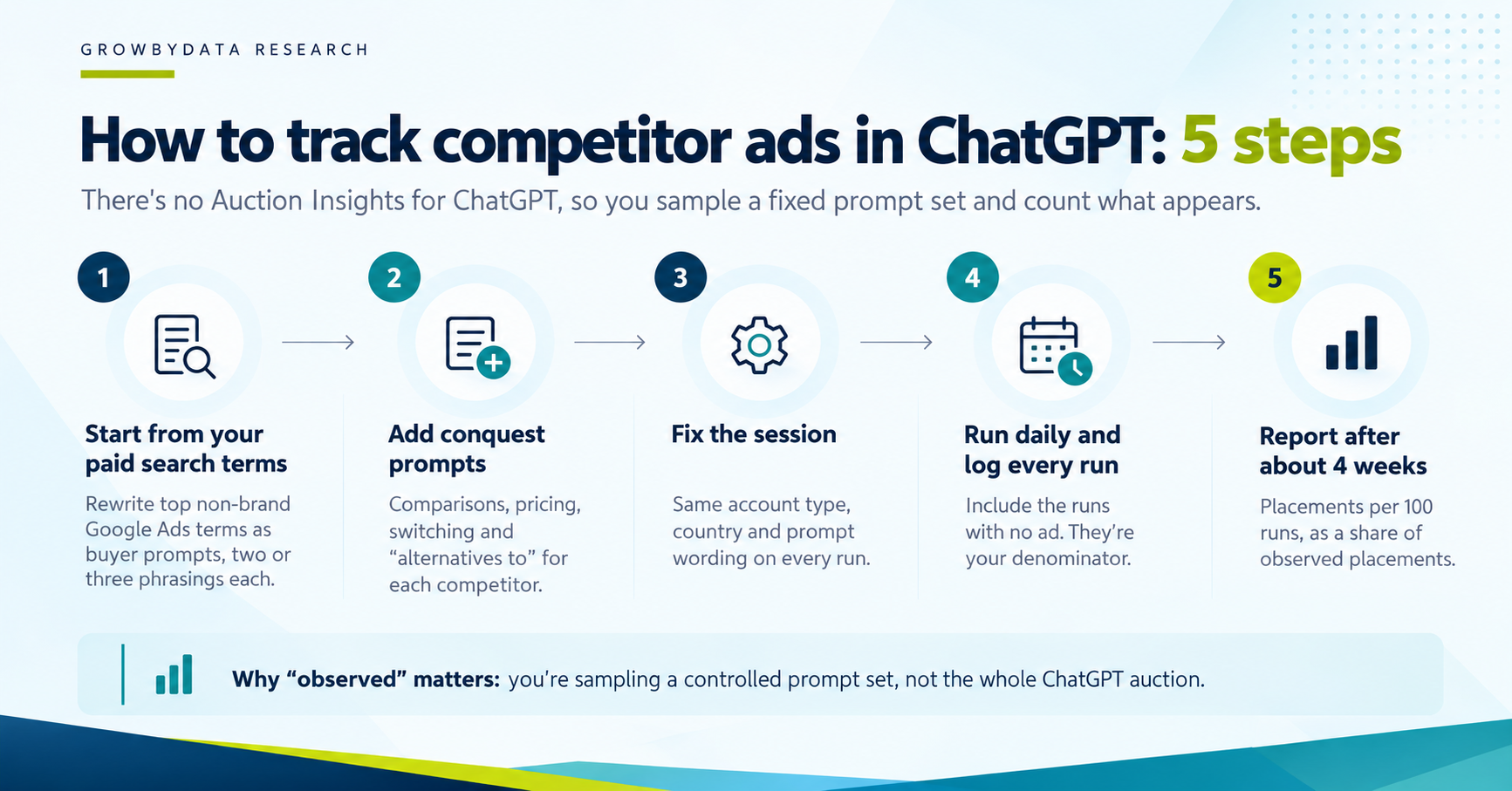
Step 4 is the easy one to skip. Without the empty runs you can say a competitor appeared, but you can’t say how often, and a single empty run proves nothing about whether they stopped buying.
“Observed” matters in step 5. You’re sampling a controlled set of prompts, not watching the whole ChatGPT auction, so any share you report is a share of what your sample saw.
See what your category’s prompts return. If you’d rather not build this by hand, we’ll show you which advertisers appear on your category’s prompts in ChatGPT and Google AI Mode.
What to capture from every ChatGPT ad
According to OpenAI’s Help Center, a standard ad is a card under the response, labeled sponsored. It carries the advertiser’s name and logo, a headline, a line of description copy, an image and a landing page.
OpenAI is also testing Sponsored Agents, where the ad opens a chat with an AI version of the business, but that’s a limited alpha with selected advertisers for now.
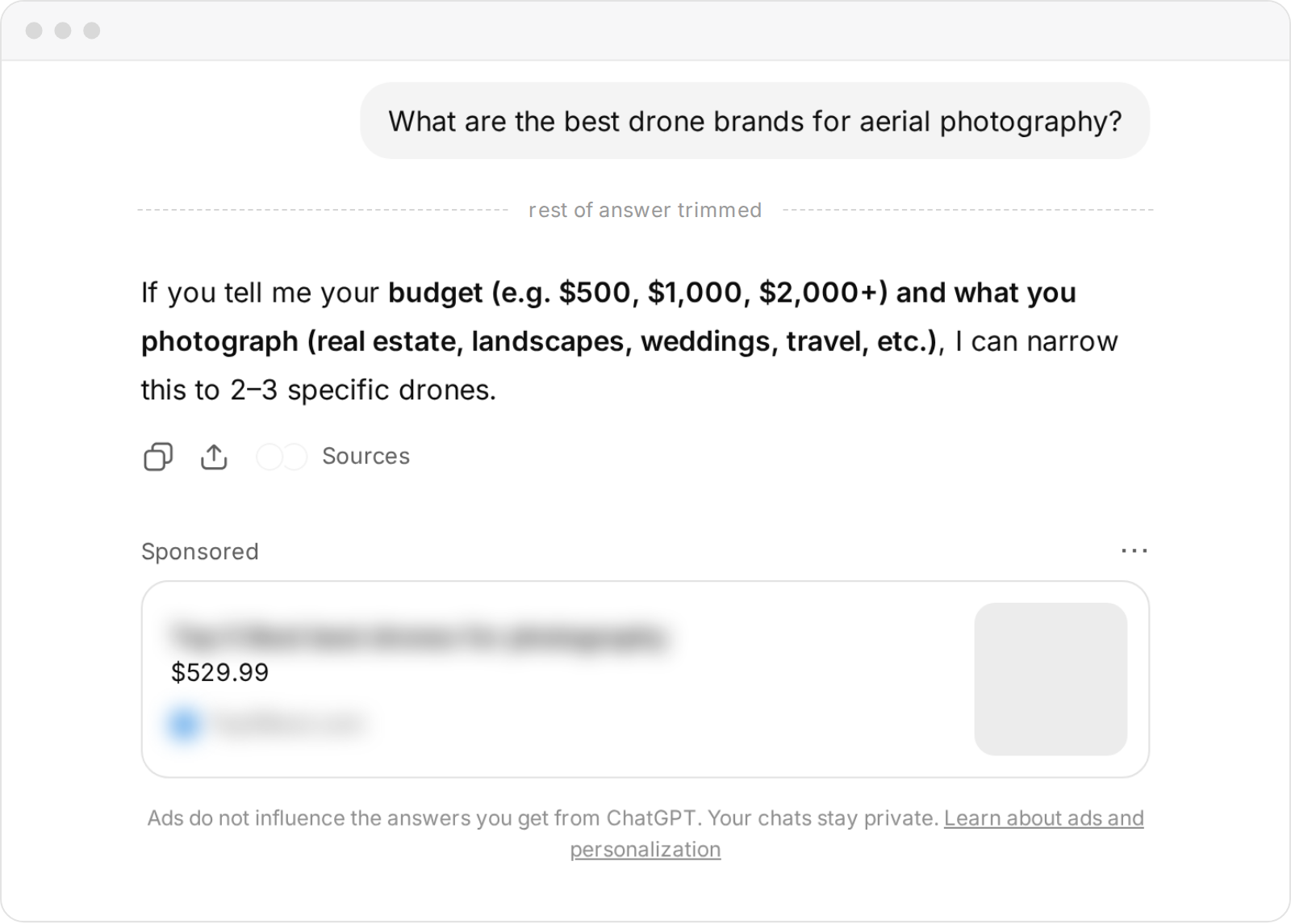
Capture every part of the card. The headline is the hook a competitor is testing, and the description (or the price, on a shopping ad like this one) carries the offer. We’d read the landing page first, since it shows which funnel stage they’re paying to send AI traffic to. It’s the same read you’d run on their Google search ads with competitive ad intelligence.
The prompt isn’t the only thing that picks the ad. OpenAI says delivery weighs the conversation’s context and intent, the ad’s landing page and copy, and “context hints” the advertiser writes, which aren’t exact-match keywords. That’s how a rival wins a phrasing you never tested, and why step 1 asks for two or three versions of every intent.
Why your ChatGPT account changes what ads you see
OpenAI started testing ads in the US on February 9, 2026, and by August 31 they were in more than 40 countries. Who sees them depends on the session, per OpenAI’s Help Center:
| ChatGPT session | Ads? |
|---|---|
| Plus, Pro, Business, Enterprise or Edu account | No ads |
| Logged-in adult on a no-cost or Go plan | Ads can appear; personalization settings can shift which ones |
| Logged out | All-audience ads only; mature-content ads go only to eligible logged-in users |
| User identified or predicted as under 18 | No ads |
| Conversations about health, mental health or politics | No ads nearby |
The easy mistake: someone on the paid team runs twenty prompts in the company’s Business workspace, sees nothing and reports that nobody’s advertising. That workspace was never going to show an ad. Pick one setup, keep it fixed, and don’t blend setups in one report.
What 1,317 ChatGPT searches revealed
Our test subject was a B2B SaaS company in marketing and pricing analytics: 44 prompts across search, AI visibility, Google Shopping Ads, MAP and pricing, run roughly daily from New York between August 26 and September 24, 2026.
ChatGPT returned 66 sponsored placements in 1,317 searches, about 5 per 100. No advertiser name appeared more than 6 times, and 31 of roughly 42 appeared once. Google AI Mode returned 129 on the same prompts and search count.
- A light routine misses almost everything. Ten prompts checked weekly is 40 runs a month, or about two ads at our rate. That’s not enough to say who’s buying.
- AI Mode was the busier surface, with nearly twice the placements. A team watching only ChatGPT is watching the quieter one, so put Google AI Mode monitoring on the same prompt set.
One caveat: this is one martech-heavy prompt set, and our platform classifies nearly all 44 prompts as informational. Commercial prompts may carry more ads, and retail or finance could look nothing like this, so run a month on your own category before you settle on a cadence.
Compare paid and organic visibility on the same prompt
A list of who advertised is interesting for about a week. What changes decisions is reading each ad against the answer above it. OpenAI says ads don’t influence ChatGPT’s answers, so paid and organic signals can point different ways.
| Organic answer names | Sponsored ad from | What it tells you |
|---|---|---|
| The competitor | The competitor | They have paid and organic visibility on this prompt |
| Neither brand | The competitor | They’re buying visibility where no one owns the organic recommendation |
| Your brand | The competitor | A possible conquesting signal |
| Your brand | Your brand | Your paid and organic visibility reinforce each other |
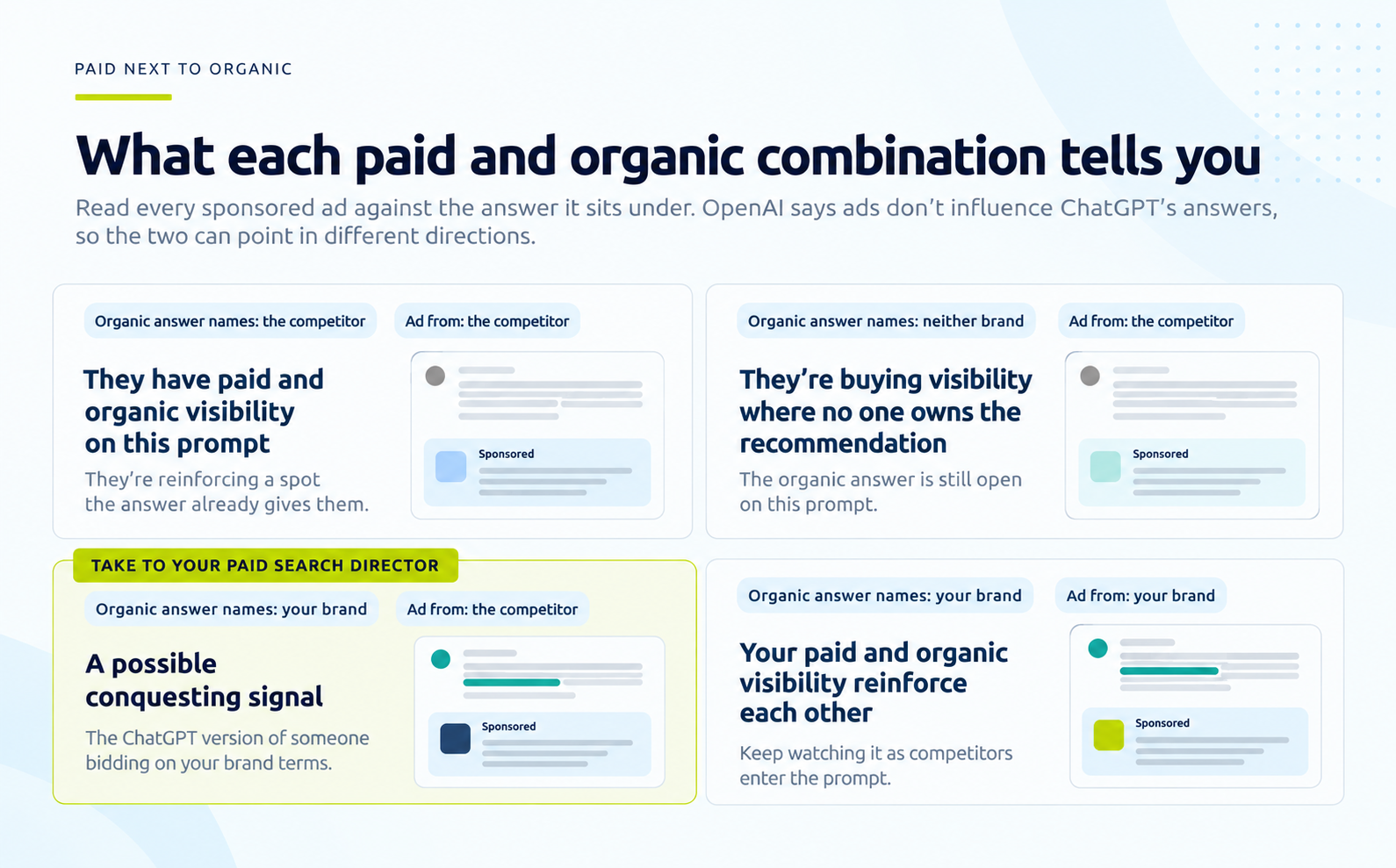
The third row is the one to take to your paid search director. That’s the ChatGPT version of someone bidding on your brand terms, and nobody is going to flag it for you.
The organic half of that read is the same work you’d do to track brand mentions in ChatGPT. Run both off one prompt set so the two halves line up.
How to automate ChatGPT competitor ad monitoring
The manual version works for a handful of prompts. Past that, the hard parts are the ones in the method above: running prompts daily, keeping sessions consistent, logging empty runs and normalizing advertiser names.
Whichever platform you look at, ask four things: which session type it tracks from, whether it counts runs with no ad, whether it covers Google AI Mode and AI Overviews as well as ChatGPT, and whether you can see the organic answer next to the ad.
GrowByData is a search and AI visibility intelligence company for enterprise brands, retailers and agencies. As of September 2026, GrowByData Compass records sponsored placements in ChatGPT, Google AI Mode and Google AI Overviews for your tracked prompts and ranks advertisers by their share of observed placements.
The organic side lives in the same platform through ChatGPT brand monitoring, and the details are on our ChatGPT Ads monitoring page.
No tool, ours included, sees the personalized ads a specific logged-in person gets, because those depend on that person’s own settings and history. What you get is a consistent read of what the tracked session sees. That’s enough to make competitive calls on.
If you already watch rivals on Google, keep the two reports side by side to see where their placements are moving. The same advertisers may be running ads in Google AI Overviews and classic search ads.
Frequently asked questions
Can you see what ads competitors are running in ChatGPT?
Not through a public library. As of September 2026, OpenAI’s ads documentation describes no competitor ad library, so you see rivals’ ads by running relevant prompts repeatedly under the same conditions and logging what appears.
Does ChatGPT have Auction Insights?
No. ChatGPT Ads Manager reports on your own campaigns: impressions, clicks, spend, CTR, average CPC, average CPM and conversions. It doesn’t show which other advertisers competed for the same conversations.
Can ChatGPT ads show up on prompts that name a competitor?
OpenAI’s documentation doesn’t rule it out. Delivery is based on the conversation’s context and intent and on context hints advertisers write, which OpenAI says aren’t exact-match keywords. Put competitor-name prompts in your set and see what your category returns.
How often should you check competitor ads in ChatGPT?
Daily for priority prompts gives you a usable sample, and occasional checks don’t. In our test, 1,317 ChatGPT searches produced 66 sponsored placements, so a routine of a few dozen runs a month would catch only a couple of ads.
It’s better to find a competitor’s ChatGPT ads in your own data than on a sales call. Book a demo, or ask us for a ChatGPT ads audit of your category prompts.