Personal AI agents are assistants that can research, compare and buy things for one person, and Meta’s Muse has put that model in front of US consumers. Meta launched Muse on September 8, 2026. It can open a browser, fill out forms and pay at checkout, while asking the person before sensitive actions such as spending money.
Our view: search visibility is becoming agent visibility. The brands that appear in AI answers today can shape the shortlist an agent evaluates tomorrow.
Most teams we talk to still treat that shortlist as a future problem. It’s already being written.
What Is Meta’s Muse?
Meta’s Muse is a personal AI agent introduced on September 8, 2026. It runs on its own secure virtual machine with a built-in browser, allowing it to research, fill out forms and complete tasks on a person’s behalf. Meta says Muse checks with the user before sensitive actions such as making a purchase.
According to Meta’s announcement, Muse runs on a dedicated virtual machine and can open a browser, fill out forms and interact with websites on the user’s behalf. Meta announced a US rollout on iOS, Android and muse.ai, along with access inside WhatsApp.
Two details matter more for marketers than the launch specs. Meta says Muse can act on something a person mentioned only once, and it can complete purchases through Link by Stripe, with Shop Pay listed as coming soon.
Early coverage from TechCrunch focused heavily on trust and privacy. That’s important. For brands, another question follows: what changes when consumers become comfortable letting an agent research and act for them?
Adoption is still early, and that’s the argument for paying attention now. The 2026 Braze Customer Engagement Review reports that 19% of consumers use AI agents for brand interactions and projects that figure could reach 46% by the end of 2026. Its consumer survey covered 4,000 people in the US and UK between November 21 and December 2, 2025.
What’s the Difference Between a Chatbot, MCP and a Personal AI Agent?
A chatbot answers questions in a conversation. MCP, the Model Context Protocol, is an open standard that lets AI applications connect with external data and software. A personal AI agent goes further by researching, evaluating options and completing tasks on a user’s behalf.
| Layer | What It Does | Examples | What Visibility Means |
|---|---|---|---|
| Answer | Responds to a question with information and sources | ChatGPT, Perplexity, Google AI Mode | Being named or cited in the answer |
| Connect | Lets AI applications reach external data and software through a standard | Model Context Protocol (MCP) | Your data can be accessed by compatible AI tools |
| Act | Researches, evaluates and completes a task | ChatGPT agent, Meta’s Muse | Making the shortlist the agent acts on |
The layers overlap rather than replace each other. An agent can use AI-generated answers, connected tools and browser automation as part of the same task.
Most coverage frames these technologies as separate eras, with one replacing another. We don’t think that model holds up.
Anthropic released MCP on November 25, 2024 as an open standard for connecting data sources with AI applications. OpenAI’s developer documentation compares the concept to a USB-C port for AI applications.
By December 2025, the Linux Foundation reported more than 10,000 published MCP servers and adoption across a growing set of AI platforms and tools.
Agents added another layer. OpenAI introduced ChatGPT agent in July 2025, describing a system that can carry out tasks using its own computer. Muse also uses browser-based interaction to work with websites.
Meta’s Muse announcement doesn’t mention MCP. Browser automation gives agents another way to interact with websites when a direct connection isn’t available, although working through a site’s interface can introduce more failure points than a structured integration.
For marketers, the answer layer is the part that can be measured most directly today across Google AI Overviews, Google AI Mode, ChatGPT and Perplexity.
Our view is that this answer layer can influence what happens next. If a brand rarely appears when an AI system researches a category, it may have fewer opportunities to enter an agent’s consideration set.
How Do You Get Your Brand Mentioned by ChatGPT?
There is no published formula that determines which brands ChatGPT mentions. What marketers can influence is the information environment from which AI systems learn about and retrieve information on a category.
Relevant category roundups, review platforms, trade publications, well-indexed first-party pages and consistent third-party profiles all give AI systems more sources from which to understand a brand and its products.
For enterprise teams, three practical areas are worth checking. First, see whether your brand appears in the category pages and comparisons buyers already use. Second, describe your products in language that matches how customers actually search and ask questions. Third, keep important pages technically accessible and indexable.
None of that replaces SEO. The additional step is measuring the answers themselves. An AI search visibility gap analysis can show where AI platforms name competitors instead of your brand.
The Stats: One Brand Appeared in 49% of Google AI Mode Answers
We checked how concentrated this answer layer already is in our own category. GrowByData Compass scanned 44 buyer prompts about search and AI visibility tools from August 21 to September 20, 2026, in the New York region. The table counts answers in which Compass detected each brand.
| Brand | ChatGPT (1,361 Answers) |
Google AI Mode (1,362 Answers) |
Google AI Overviews (297 Answers) |
Perplexity (249 Answers) |
|---|---|---|---|---|
| Semrush | 498 (36.6%) | 669 (49.1%) | 136 (45.8%) | 56 (22.5%) |
| Ahrefs | 457 (33.6%) | 473 (34.7%) | 72 (24.2%) | 25 (10.0%) |
| Profound | 235 (17.3%) | 226 (16.6%) | 60 (20.2%) | 15 (6.0%) |
| GrowByData | 74 (5.4%) | 224 (16.4%) | 39 (13.1%) | 14 (5.6%) |
Source: GrowByData Compass, GrowByData account, 44 tracked prompts, August 21 to September 20, 2026, New York region. Brand mentions only. One prompt set in one category, not a market benchmark.
Yes, that includes us, and our own numbers aren’t the strongest in the table. If an agent relied heavily on these answers while researching the category, a small number of brands would have a much better chance of entering its consideration set.
Three patterns stand out:
- The platforms disagree. Every brand in this sample appeared less often on Perplexity than on Google AI Mode. Measuring one AI platform doesn’t tell you what is happening on another.
- The gap at the top varies by platform. On ChatGPT, the leading brand appeared about seven times as often as the fourth brand. On Google AI Mode, that multiple was closer to three.
- A paid layer is forming. Across the same prompts and dates, Ahrefs recorded 51 Google AI Mode ad appearances across 15 prompts, accounting for about 31% of the AI Mode ad appearances in this dataset. It occupied the top ad position in 88% of those appearances. ChatGPT also displayed sponsored placements in the dataset.
That’s why GrowByData Compass reports AI platforms separately through views such as ChatGPT brand monitoring and Google AI Mode monitoring, rather than collapsing them into a single blended score.
On the paid side, ChatGPT Ads monitoring, our analysis of ads in Google AI Overviews and our guide on how to track competitor ads in ChatGPT cover the emerging advertising layer.
These numbers have limits. We selected the prompts, they lean toward GrowByData’s own solution areas, and the Google AI Overviews sample is much smaller than the ChatGPT and Google AI Mode samples. The data measures what the answers contained. It does not show which product or brand an autonomous agent ultimately selected.
Want to See Where Your Brand Shows Up?
Book a demo or audit to review how your brand appears across ChatGPT, Google AI Mode and Google AI Overviews, and which competitors are being named instead.
What Does a Shopping Agent Like Muse Read on Your Product Page?
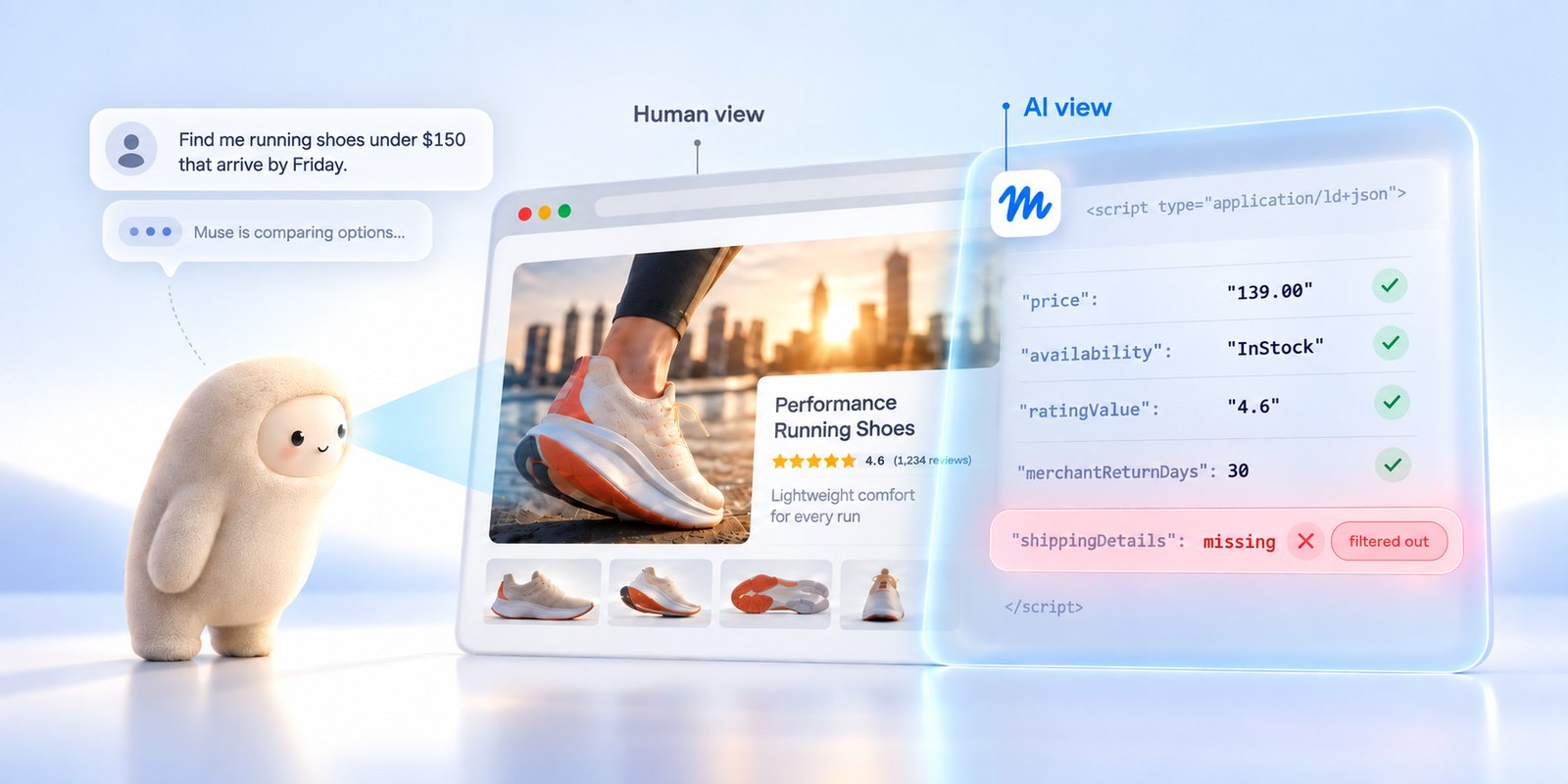
A shopping agent can use machine-readable product information such as price, stock, shipping, returns and ratings alongside the content visible on a product page. Structured product data makes those facts easier for machines to interpret consistently.
Picture a customer asking an agent to find running shoes under $150 that arrive by Friday. If your product information doesn’t provide a reliable delivery estimate, your product could fail that requirement before price or reviews become deciding factors.
The funnel still exists, but a machine may evaluate product information before the shopper sees the final shortlist.
For Shopify merchants, a direct connection to Meta already exists. Shopify added Meta as an AI channel on September 8, 2026, the day Muse launched. According to the Shopify Changelog, merchants can manage how their product catalog is shared with Meta through Shopify’s agentic commerce settings.
| What the Shopper Sees | A Machine-Readable Equivalent |
|---|---|
| Sale price | price |
| “In stock” label | availability |
| Star rating and review snippets | aggregateRating (ratingValue) |
| Return policy | hasMerchantReturnPolicy (merchantReturnDays) |
| Shipping information | shippingDetails |
Illustrative. The right-hand column uses property names from Google’s merchant listing structured data documentation. How any specific personal AI agent discovers, interprets or weighs these fields isn’t public.
The work itself is familiar to anyone who manages ecommerce search visibility. It includes Google Shopping product title optimization, complete product attributes and the feed quality behind Google Merchant Listings.
GrowByData’s Google Shopping monitoring and Google Shopping Ads monitoring show what those surfaces display for your products and your competitors. Our guide to AI shopping visibility covers how products appear inside ChatGPT and Google AI Mode answers.
Running Shopping for a Retail Brand? Book a demo to review visibility across Google Shopping ads, AI Mode and ChatGPT in your category, including where competitors appear.
How Can I Measure How Often AI Agents Pick My Brand?
You can’t measure that reliably today.
Google Search Console and Bing Webmaster Tools can report search queries, impressions and clicks from their respective search ecosystems. AI visibility platforms can measure prompts, answers, mentions, citations and competitive visibility. Neither type of data reliably confirms that an autonomous agent selected a brand, visited a site or completed a purchase on someone’s behalf.
GrowByData Compass measures the inputs around AI discovery and visibility. It does not claim to identify whether a downstream conversion was completed autonomously by an AI agent.
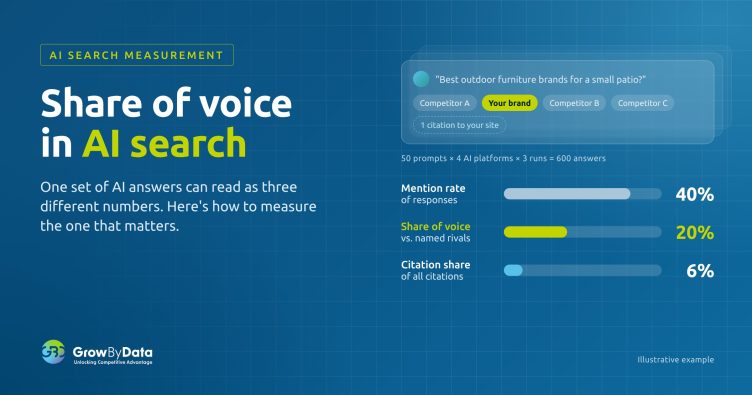
What you can measure today comes down to four useful signals. Brand mentions show whether your company appears in the answer. Citations show which sources are supporting those answers. Competitor share shows which brands dominate a category. Ad visibility shows who is paying to appear alongside emerging AI experiences.
The practical unit is a fixed set of prompts that real buyers use, scanned on a schedule and compared over time. One-off screenshots tell you very little because AI answers can change between runs.
Our view is that monthly monitoring is a reasonable baseline, while categories that change quickly may warrant more frequent tracking. The right cadence depends on the market, the prompts and how quickly the underlying results move.
This is still a proxy. It won’t tell you whether an autonomous agent converted. But it can tell you whether your brand is making it into the information environment from which those agents may build their shortlist.
Our guides to AI search visibility and tracking brand mentions in ChatGPT cover the measurement method in more detail. For the reporting side, see our analysis of how enterprises measure ROI from AI search visibility.
See Which Brands AI Answers Shortlist in Your Category
Book an audit to review your visibility across ChatGPT, Google AI Mode and Google AI Overviews against the competitors that matter in your category.
How Do You Optimize for Personal AI Agents?
You can’t optimize for every personal AI agent through one tactic. The practical work is to improve the information and connections an agent can use when researching your category.
- Build visibility in the sources AI answers use. Monitor category roundups, review platforms, trade publications and your own indexed pages. Then measure whether your brand actually appears across ChatGPT, Google AI Mode and Google AI Overviews against named competitors.
- Improve the product data machines can interpret. Keep specifications, prices, availability, shipping information and return policies accurate and accessible. For retailers, that work starts with the product feed and the structured information on the product page.
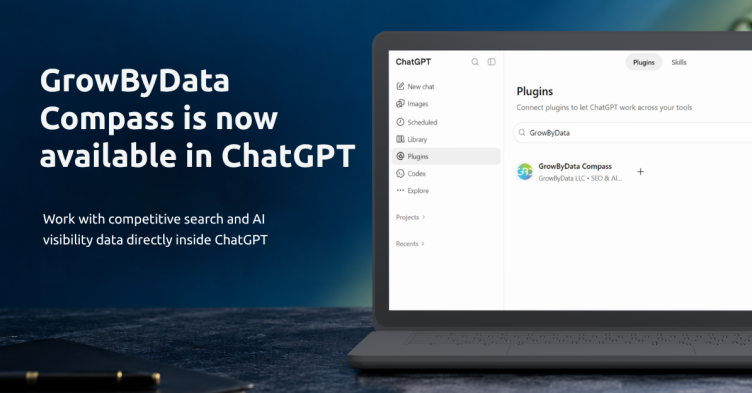
- Connect your own data to the AI tools your team uses. Your analysts are becoming agent users too. The GrowByData Compass MCP connector lets compatible AI tools query search and AI visibility data without relying on a manual CSV workflow.
The tradeoff is reporting load. AI visibility adds another set of signals alongside rankings, SERP features and paid search. Someone still needs to own the measurement and decide which changes matter.
GrowByData is a search and AI visibility intelligence company for enterprise brands, retailers and agencies. LLM Intelligence in GrowByData Compass tracks brand presence in ChatGPT and Google AI Mode, while Google AI Overviews monitoring covers AI Overviews on Google’s search results. GrowByData Compass doesn’t track Gemini or Copilot.
Agent visibility starts with the information an agent can discover and evaluate. Today, the measurable part is still the answer layer: who gets named, who gets cited, which products appear and which competitors consistently make the shortlist.
Most brands discover an AI visibility gap when a prospect says a competitor was recommended by ChatGPT. With a personal agent operating between the brand and the customer, that competitive decision may become much less visible.
Find Out Where Your Brand Stands Before Agents Build the Shortlist
Book a demo or audit to review how your brand and competitors appear across ChatGPT, Google AI Mode and Google AI Overviews.