

Key Takeaways
- At enterprise scale, MAP compliance usually fails on execution, not policy design — manual monitoring can’t keep pace with SKU and seller volume.
- Effective enterprise MAP compliance means minimal operational overhead, high trust in the data, and direct alignment with revenue and margin goals.
- Reactive enforcement, chasing violations after they’ve already happened, is the main pattern brands need to move away from as they scale.
Table of Contents:
In today’s complex e-commerce landscape, brands are under constant pressure to maintain pricing integrity and manage dealer networks efficiently. Minimum Advertised Price (MAP) policies have evolved from a simple compliance exercise to a critical lever for margin protection and long-term brand equity.
For manufacturers juggling multiple product assortments, price tiers, and reseller networks, the challenge is not the lack of pricing data. It’s about operational simplicity and scalable enforcement.
This article highlights how forward-thinking enterprises leverage modern MAP monitoring to drive profitability, build stronger dealer networks, and protect their brand value.
Why MAP Monitoring Breaks Down at Enterprise Scale
Most brands fail to maintain MAP compliance not because their policies are weak, but because the execution falls short. The complexity of multi-channel retail and the fragmentation of reseller networks often hinder effective enforcement.
Many brands struggle with MAP compliance not because of weak policies, but because of execution challenges:
- Manual monitoring that does not scale across SKUs and sellers
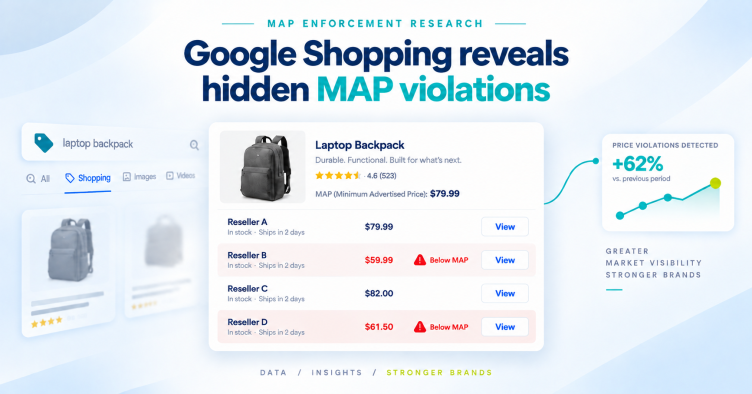
- Fragmented visibility across marketplaces and search channels
- Over-reliance on internal teams to interpret and act on map violations
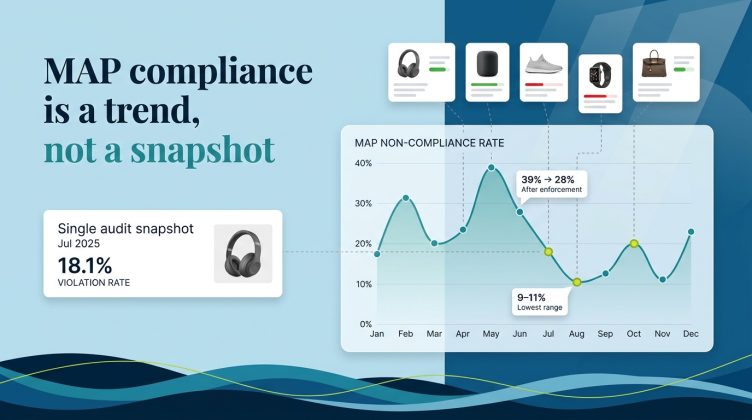
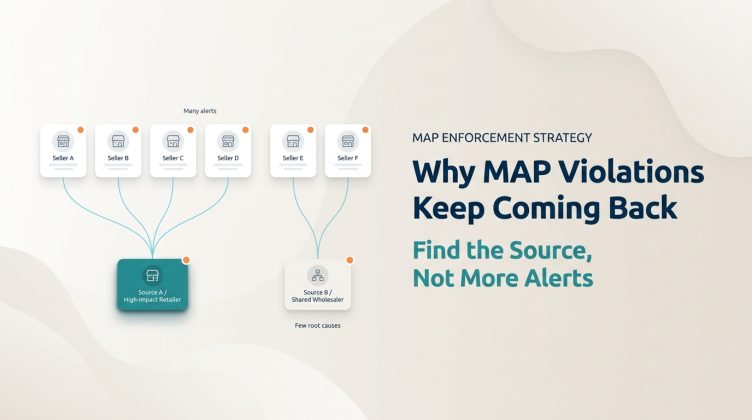
- Reactive enforcement instead of proactive control
As brands grow, the pressure increases. Teams get bogged down with escalations, follow-ups, and compliance issues, all of which detract from high-value strategic work. MAP compliance should be seamless, proactive, and scalable to ensure pricing integrity across your ecosystem without constant intervention.
What Effective MAP Compliance Looks Like in Practice
At scale, a successful MAP monitoring software shares a few defining characteristics:
1. Minimal Operational Overhead
The system operates reliably without constant oversight. Teams do not need to “babysit” enforcement workflows or chase down recurring issues.
2. High Trust in the Data
Violations are accurate, timely, and actionable. There is confidence that pricing intelligence reflects real market conditions.
3. Alignment With Revenue and Margin Goals
MAP compliance supports profitability. It protects premium positioning while allowing flexibility across different price bands and product categories.
If you’re benchmarking vendors against these four traits, our MAP monitoring software comparison scores ten of them on exactly this.
4. Seamless Integration with Broader Commerce Strategy
MAP data informs assortment planning, pricing strategy, and channel performance. It does not live in isolation.
GrowByData’s platform is built specifically around these principles, enabling enterprise teams to move from reactive enforcement to structured, scalable control.
👉Here is the complete Guide to Complete MAP Monitoring
From MAP Compliance to P&L Ownership
As e-commerce leaders’ step into roles with direct P&L responsibility, MAP compliance naturally shifts into their operational “swim lane.”
At that level, MAP monitoring supports more than policy enforcement. It enables:
- Margin protection across premium and entry-level products
- Fair competition within reseller and distributor ecosystems
- Pricing discipline as assortments expands into new categories
- Clearer coordination between sales, merchandising, and digital teams
When MAP enforcement is stable and dependable, leadership can focus on strategic questions such as:
- Where can margin be expanded without eroding demand?
- Which competitors are driving price pressure in key categories?
- How should pricing tiers evolve across the customer lifecycle?
MAP intelligence becomes a decision-making asset, not a compliance burden.
👉 Why MAP Enforcement Is Essential for Pricing Leaders
The Role of Search Intelligence in MAP and Pricing Strategy
MAP compliance does not exist in a vacuum. Pricing decisions play out across search results, marketplaces, and digital shelf visibility.
That is why leading brands pair MAP monitoring with advanced search intelligence.
GrowByData’s Search Intelligence capabilities help teams understand:
- Share of voice across paid and organic search
- Competitive positioning at critical moments of intent
- Emerging trends before they impact revenue
- How pricing and promotions influence visibility
Importantly, the emphasis is on clarity over volume. Insights are designed to reduce cognitive load for digital and e-commerce teams, not add to it.
This allows organizations to stay ahead of market shifts while maintaining pricing discipline.
Designed for Partnership, Not Just Reporting
One of the most overlooked aspects of enterprise technology adoption is ongoing partnership.
MAP and search intelligence platforms must evolve alongside the business. As assortments change, channels expand, and AI-driven search reshapes discovery, pricing intelligence cannot remain static.
GrowByData operates with a feedback-driven model, where product enhancements are guided by real-world enterprise use cases. The goal is simple: make pricing and search intelligence easier, more reliable, and more impactful over time.
Why MAP Monitoring Matters More in 2026 and Beyond
Several structural shifts are increasing the importance of MAP compliance:
- Heightened price transparency across marketplaces
- Increased pressure on margins, not just topline growth
- Greater complexity driven by AI-powered search and automation
- Expanded product assortments with tighter pricing tolerance
In this environment, MAP monitoring must be scalable, accurate, and low friction. Anything less becomes a liability.
Enterprise teams that invest in reliable MAP intelligence position themselves to protect profitability while continuing to grow.
Automatically Monitor and Enforce MAP Compliance Across Channels
GrowByData’s MAP Monitoring Platform continuously tracks pricing behavior, detects violations, and ensures your brand’s pricing integrity across Amazon, Walmart, Google Shopping, and other marketplaces.