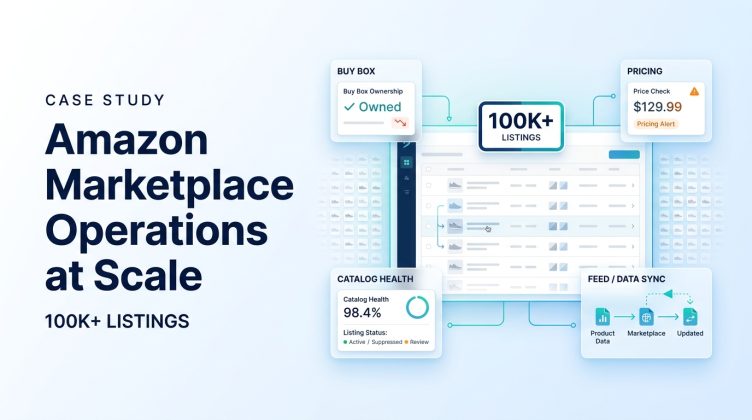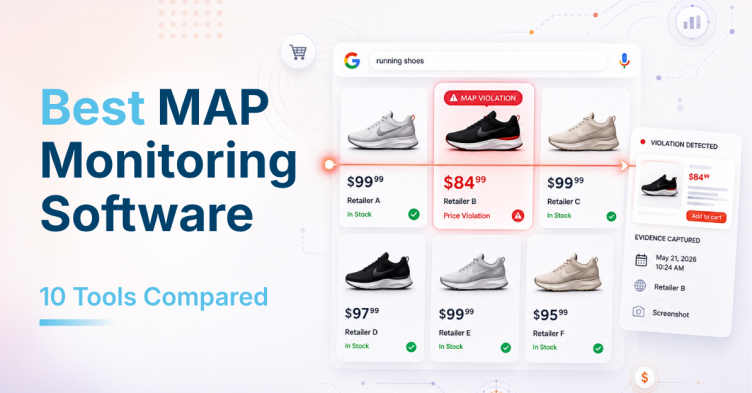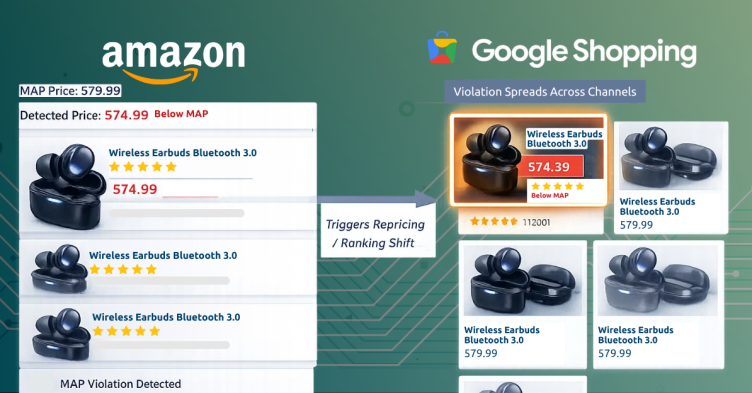

MAP monitoring is the continuous detection of Minimum Advertised Price violations across the retail channels where your brand is sold. A complete MAP monitoring program covers: (1) SKU-level price tracking across Amazon, Walmart, Google Shopping, and dealer websites, (2) screenshot-backed evidence capture, (3) classification of violation types (list price, coupon, bundle, cart), (4) automated alerts, and (5) enforcement workflow integration.
Table of Contents:
- How MAP Monitoring works?
- What are the Benefits of MAP (Minimum Advertised Price) Tracking for a Brand Channel Manager?
- How toNOTSelect the Wrong MAP Monitoring Tool?
- How is GrowByData’s Solution Designed to Make MAP Policy Enforcement Easy?
- How to Enforce MAP Pricing?
- How Does GrowByData’s Minimum Price Monitoring Software & Service Make Enforcement Easy?
- Conclusion
What is MAP (Minimum Advertised Price) Monitoring?
MAP monitoring is the process of tracking minimum advertised prices across marketplaces such as Amazon, Google Shopping to ensure your pricing policies are followed by authorized sellers and distributors. It is essential for brand value protection, avoiding violations on pricing, and maintaining healthy relationships with channels.
It helps brands:
- Identify unauthorized sellers
- Spot MAP violations in real-time
- Enforce MAP policy with Proofs (Screenshots)
You may wonder why MAP violations have been a persistent problem for years across many verticals. Kellogg School of Management paper ‘Determinants of MAP Violations‘ written by Ayelet Israeli, Eric T. Anderson, and Anne T. Coughlan, specifically notes “We find that higher prices, free shipping, larger assortment size, and authorization to distribute are associated with lower violation rates. In contrast, high distribution intensity is associated with higher violation rates. We also show that retailers are more likely to violate MAP when the policy is expected to expire soon. When a pricing violation occurs, we show that the extent of violation (offered price relative to MAP) is less when shipping is free, retailers are authorized, and distribution is more intensive.”
To simplify this complex repetitive MAP monitoring task and offer guidance on managing the MAP channel program, GrowByData offers an automated MAP monitoring and enforcement professionals service to support the brand’s or authorized wholesaler’s channel monitoring business. For enterprises managing this across hundreds of SKUs and resellers, see our enterprise guide to scalable MAP compliance.
How MAP Monitoring works?
MAP monitoring works by continuously tracking prices across marketplaces (Amazon, Walmart, Google Shopping), search engines and eCommerce sites and identifying instances where any listings fall below your minimum advertised price. With GrowByData, this process uses a hybrid model of AI-powered automation and human validation to deliver accurate, SKU-level matching even across complex product variants or bundles.
For a closer look at how a single violation spreads once a reseller cuts price, see our guide on detecting MAP violations across marketplaces.
What are the Benefits of MAP (Minimum Advertised Price) Tracking for a Brand Channel Manager?
- Track and Identify MAP Violations: GrowByData quickly identifies real-time violations by continuously monitoring retailer prices through our dashboard. This enables prompt detection and correction of MAP violations.
- Enable Data-Driven Decision-Making: It provides valuable insights into pricing trends and marketing dynamics of resellers, facilitating smart decision-making for channel management.
- Improve Relationships with Authorized Sellers: Proactively monitoring and enforcing minimum advertised price policies demonstrates a commitment to supporting authorized sellers and fostering positive relationships with them.
- Protect Your Brand Value: Breaching minimum advertised prices can negatively impact your brand’s value. Monitoring ensures authorized resellers adhere to MAP, reducing the risk of devaluing your brand. You can also find unauthorized sellers who may be carrying your products. You may also spot potentially fraudulent products.
See how MAP monitoring works across channels The same detection principles apply on Walmart, where MAP violations can cascade across resellers just as fast.
How to NOT Select the Wrong MAP Monitoring Tool?
Channel violators and marketing platforms are constantly changing. Hence, a one-size-fits-all tool will NOT serve your needs. So you need a customized MAP enforcement solution to constantly change and ensure you monitor and enforce MAP policies.
You also need a solution partner who is keen to understand your needs and adjust their tools and services to align with your channel requirements. If you don’t consider these, you may have more work to do enforce your MAP policy. You may see many wrong MAP violations and miss the fraudulent ones. We have learned these through our years of MAP monitoring across small, mid, and large brands across categories. Read more on GrowByData’s Guide on Mistakes that Buyers Make Before Purchasing MAP Monitoring Software.
When you’re ready to shop, our comparison of ten MAP monitoring tools covers what each one catches, what it costs, and where it comes up short.
How is GrowByData’s Solution Designed to Make MAP Policy Enforcement Easy?
GrowByData’s Map Monitoring Software ensures precise and proactive identification of MAP violations. What sets GrowByData apart from the other automated tools is that they may not account for your brand’s unique business model.
Before we dive into GrowByData Solution, here are some of our MAP success stories.
Here is an example of the MAP report you get to show violations by reseller by day.
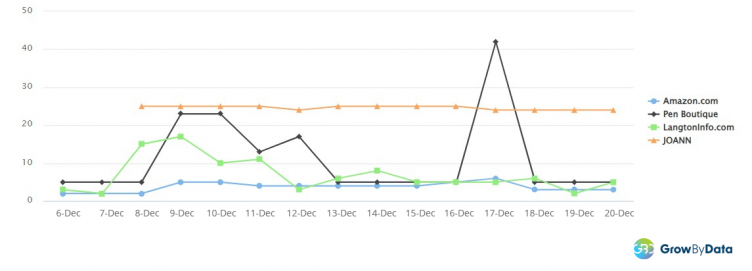
Here are 8 features of GrowByData’s Map Monitoring Solution –
- Accurate Product Discovery: Ensure precise matching of your products at the variant level across channels with –
- Auto-Matching
- Human Matching
- Hybrid – Auto & Human
- Easily Track Product SKUs/Controlled MAP Compliance Monitoring: Easily monitor product SKUs and control MAP compliance based on your business needs.
- Monitor by Authorized & Unauthorized Sellers: Track and differentiate between authorized and unauthorized sellers using our dashboard, pinpointing MAP violators with precise data for future actions.
- Identify New MAP Violators: Identify new MAP violators effortlessly through the GrowByData dashboard, allowing proactive measures against emerging MAP violations.
- Customized Weekly Summarized Findings include:
Weekly Insights to ensure you stay informed without having to log into the dashboard. See invaluable data such as –- SKUs with the Most MAP Violations
- Resellers (Authorized & Unauthorized) with most Violations
- Platforms (Google Shopping, Amazon, and others) with the most Violations.
- Countries with the most channel violations – US or Canada or Mexico
- MAP Violation Alerts: Get real-time MAP Violation Alerts for reported violations to brand owners and authorized dealers.
- MAP Violation Screenshots for Proof: Enforce map policies effectively with crucial MAP violation screenshots provided by GrowByData, that serve as evidence when issuing warnings and enforcing compliance.
- Offer MAP Holiday Pricing: Rely on the GrowByData MAP holiday feature that allows you to turn off monitoring and enforcement during major holidays like Black Friday, Cyber Monday, Memorial Day, etc, and then turn back on again. Benefit from the custom MAP monitoring to customize your outreach and enforcement without annoying your good resellers.
Learn Top Mistakes Buyers make Choosing MAP Monitoring Solution
How to Enforce MAP Pricing?
This involves channel managers and brand owners notifying authorized sellers to comply with established MAP prices. This includes detecting violators, communicating the MAP policy, and taking necessary actions such as banning non-compliant retailers. The brand or the wholesaler has the authority to implement the sales bans. Retailers can utilize our platform, analyze violation data, and promptly report violations, customizing the MAP enforcement service per their reseller nuances.
How Does GrowByData’s Minimum Price Monitoring Software & Service Make Enforcement Easy?
1. Sends Map Violation Email Alerts to Sellers
GrowByData Map Monitoring platform tactfully alerts authorized sellers about Minimum Advertised Price (MAP) violations, ensuring effective communication without irritating resellers. This approach maintains a positive relationship with authorized sellers while addressing necessary compliance issues respectfully. You might want to know more about Minimum Advertised Price Violations Free Email Template
2. Allows Sending Configurable Email Messages to Violators
GrowByData allows flexible configuration of email content and templates tailored for communication with both authorized and unauthorized MAP violators. For authorized sellers inadvertently violating MAP, communication can be informative and collaborative, seeking cooperation in rectifying pricing issues. Messages to unauthorized violators can be more direct, outlining consequences and necessary actions for compliance.
3. Offers Customized Follow-up Actions
GrowByData platform allows easy customization of follow-up actions for MAP violators based on specific needs. This customization can involve setting up automated follow-up processes (3 or more follow-ups) to address MAP violations efficiently. The platform empowers tailored responses to several violations, ensuring corrective actions align with brand policies and strategies.
4. Monitors the open rate of email alerts sent to MAP violators
With GrowByData, you can track the open rate of alert emails sent to MAP violators. This feature offers insights into how recipients, especially violators, interact with the communication, helping you analyze their engagement and assess the impact of your efforts in addressing MAP cosmpliance.
5. Provides Visual Proof of Violations
With the GrowByData Map tracking platform, brand owners and authorized dealers can use real-time screenshots as tangible proof of MAP violations. We know resellers may change prices back to the right number when you email them. However, the snapshot allows you to substantiate claims when addressing violations with sellers.
Conclusion
In today’s hyper-competitive eCommerce landscape, Map compliance monitoring is no longer optional, it’s a strategic necessity. Protecting brand equity, maintaining partner trust, and maximizing revenue all depend on your ability to enforce MAP policies effectively.
GrowByData helps brands simplify enforcement, gain visibility, and stop violations before they erode margins or relationships. Don’t settle for generic tools. Get the MAP monitoring and enforcement solution built for today’s digital complexity.
We are here to make MAP enforcement easy. Learn more about how our Enterprise MAP Monitoring Software Solution helps you enforce your MAP Price Policies. Please contact us today at info@growbydata.com to discuss your needs, and we will happily share our best practices and help!