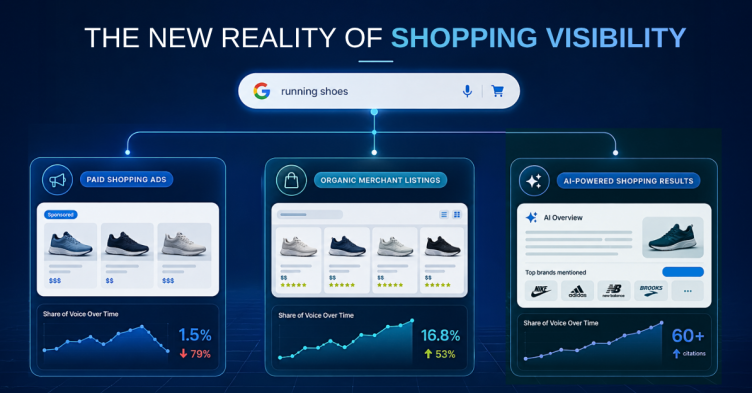


Google Shopping Ads remain one of the most valuable placements in search but they are also one of the most misunderstood.
Over the past year, many marketers have noticed a growing disconnect between what Shopping Ads should be doing and what third-party visibility tracking can reliably observe.
In many cases, the issue is not that ads have disappeared. It is that the environment used to observe ads has changed. Shopping Ads are auction-driven, context-dependent, and increasingly influenced by user signals meaning visibility measurement now depends heavily on how data is collected.
This article explains what has changed, why Shopping Ads are uniquely affected, what the data shows, and how marketers can make confident decisions as measurement approaches evolve.
Table of Contents: Show
- What Google Shopping Ads Are and Why They Matter in High-Intent Search
- Where Google Shopping Ads Appear in Today’s SERPs
- How Google Shopping Ads Are Served Across Devices, Contexts, and Users
- Why Shopping Ads Are Harder to Measure Than Other SERP Features
- Why Shopping Ads Visibility Measurement Has Changed
- What the Data Shows: Shopping Ads Visibility Depends on How SERPs Are Captured
- Why Exact SERP Replication Is No Longer the Right Goal for Shopping Ads
- What Full Shopping Ads Visibility Looks Like in 2025
- Common Myths About Shopping Ads Visibility Tracking
- How GrowByData Approaches Shopping Ads Visibility
- What Marketers Should Do Next to Measure Shopping Ads Confidently
- Conclusion: Adapting to the New Measurement Reality
What Google Shopping Ads Are and Why They Matter in High-Intent Search
Google Shopping Ads are paid product listings that appear across Google Search and related surfaces. They typically include a product image, title, price, merchant name, and additional attributes, and are triggered based on a combination of product data, bidding strategies, and user intent.
Unlike traditional text ads or organic listings, Shopping Ads are:
- Product-driven rather than keyword-only
- Auction-based and highly competitive
- Influenced by contextual signals such as device, location, and user behavior
They are most prominent in high-intent, commercial searches where users are actively comparing products or evaluating purchase options.
Where Google Shopping Ads Appear in Today’s SERPs
In 2025, Google Shopping Ads can appear in multiple locations across the search results page, including:
- At the top of the SERP above organic results
- Inline within the organic results
- In grid or carousel-style layouts
- On both desktop and mobile, often with different formats
Shopping Ads may also appear alongside merchant listings and other commerce-oriented SERP features. The exact layout a user sees can vary meaningfully based on device type, location, and personalization signals.
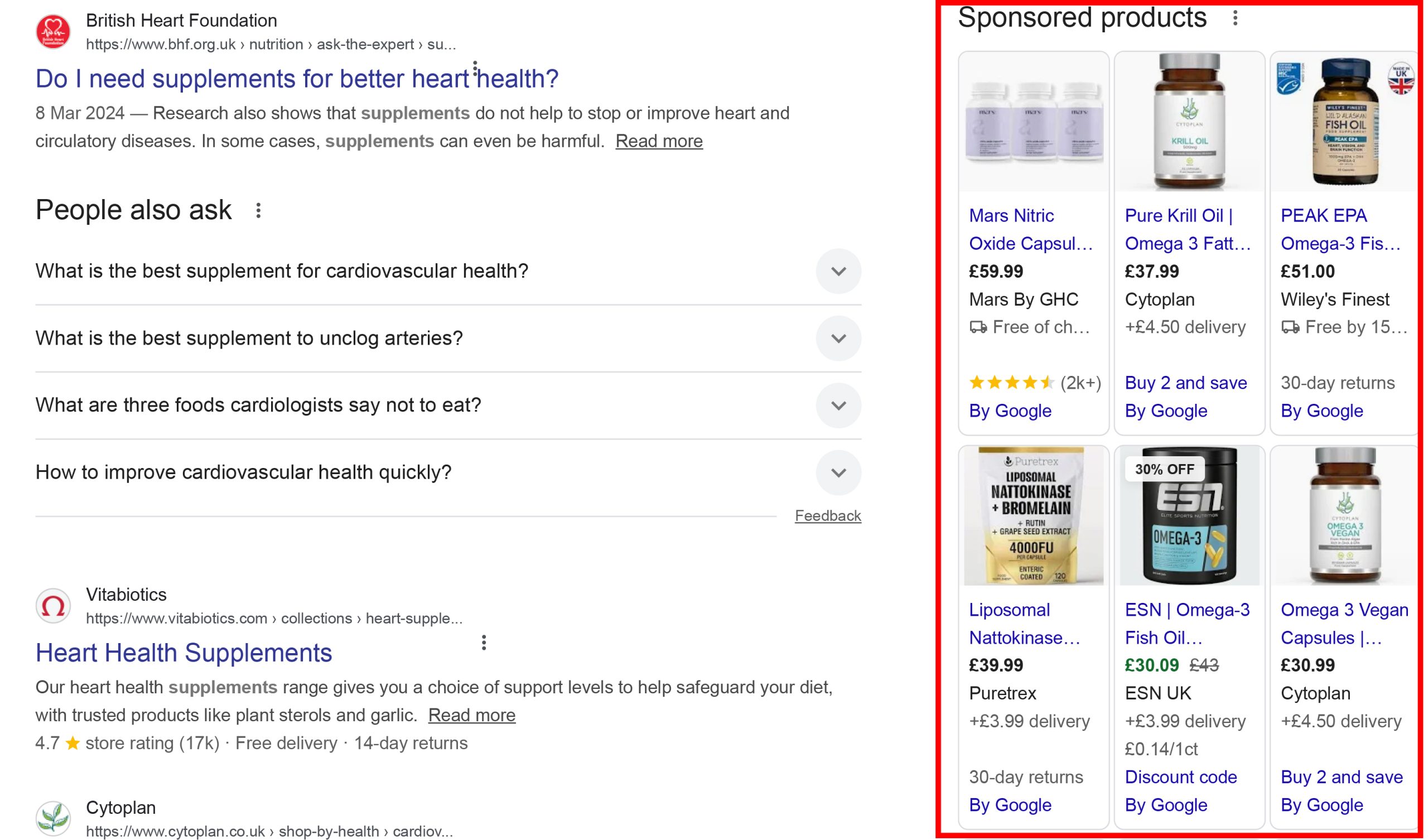
This variability is central to understanding why Shopping Ads visibility has become more complex to measure.
How Google Shopping Ads Are Served Across Devices, Contexts, and Users
These are not static placements. They are:
- Auction-driven, not static
- Highly personalized, influenced by user history and intent
- Context-dependent, varying by device, location, and login state
- Dynamically rendered, often later in the page lifecycle
As Google relies more heavily on authenticated and session-level signals, there is no single, universal version of ads. What one user sees may differ substantially from what another user or an automated system observes.
Why Shopping Ads Are Harder to Measure Than Other SERP Features
Unlike organic listings or more static SERP features, Shopping Ads are uniquely sensitive to how data is collected.
Traditional large-scale, non-personalized collection methods often operate in anonymous environments. These environments capture only a narrow slice of how Shopping Ads are actually served to real users.
As Google’s ecosystem has shifted toward richer context and personalization, anonymous collection increasingly underrepresents Shopping Ads visibility, not because ads have disappeared, but because the observation environment no longer mirrors real serving conditions.
Why Shopping Ads Visibility Measurement Has Changed
Over the past year, many marketers have noticed a growing disconnect between what Shopping Ads should be doing based on spend and performance, and what third-party visibility tracking can reliably observe.
This shift does not reflect simple volatility or noise. It reflects a structural change in how Shopping Ads are served and how different collection environments capture them.
Google Shopping Ads Visibility measurement now depends heavily on:
- Login state
- Device context
- Session signals
- Collection methodology
Understanding this change is critical to interpreting Shopping Ads data correctly.
Why Partial Visibility Creates Strategic Risk
If Shopping Ads visibility feels inconsistent in your reporting, this is often a signal of collection gaps rather than spend or performance issues.
What the Data Shows: Shopping Ads Visibility Depends on How SERPs Are Captured
To better understand how Shopping Ads visibility has changed, GrowByData analyzed ads presence across large-scale, non-personalized data collection throughout 2025 and compared it with controlled, logged-in collection methods.
Rather than attempting to replicate Google Ads impression data, this analysis focuses on a simpler and more defensible metric:
Shopping Ads yield – the percentage of scans in which Shopping Ads were observed.
Long-Term Trend: Non-Personalized Data Shows a Structural Decline
When collecting Shopping Ads data at scale using non-personalized methods, Shopping Ads were observed in approximately 2.5% to 3.0% of scans in early 2025. This level of visibility remained relatively stable from January through late August, with only minor week-to-week fluctuations.
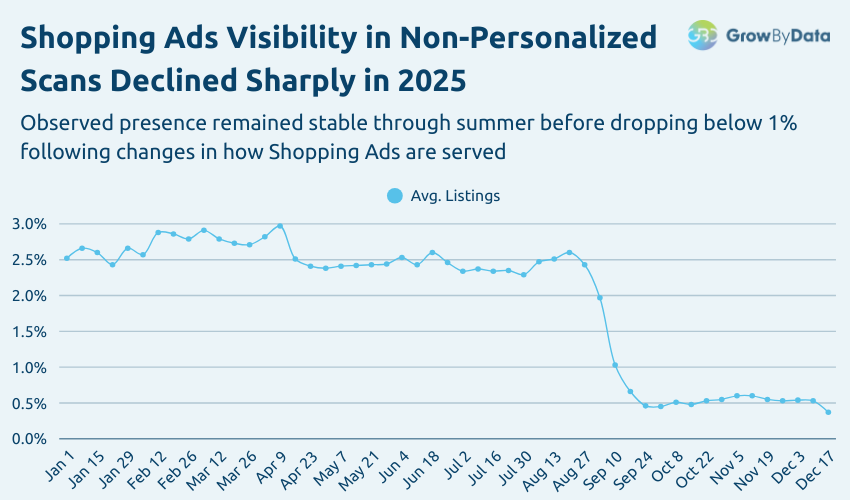
Beginning in early September 2025, a clear structural shift occurred. Shopping Ads presence in non-personalized scans declined sharply, falling below 2% and continuing to drop through the remainder of the year. By Q4, automated visibility stabilized at well under 1%, typically ranging between approximately 0.4% and 0.6%, and ending December at around 0.37%. This pattern does not resemble gradual erosion or normal volatility. It represents a step-change in what non-personalized, large-scale data collection is able to observe.
Logged-In Collection Reveals a Very Different Picture
When the same query sets were collected using controlled, logged-in methodologies, Shopping Ads visibility increased dramatically.
Across late November and early December 2025, logged-in collection methods observed Shopping Ads in approximately 65% to 90% of scans, depending on device and day. In practical terms, this represents 2× to 8× higher observed visibility compared to automated, non-personalized collection during the same period.
| Capability | Overall (Automatic) | Overall (Logged-In) | Desktop (Automatic) | Desktop (Logged-In) | Mobile (Automatic) | Mobile (Logged-In) |
|---|---|---|---|---|---|---|
| 28th November | 24.92% | 75.08% | 17.52% | 82.48% | 44.97% | 55.03% |
| 29th November | 34.01% | 65.99% | 28.46% | 71.54% | 48.19% | 51.81% |
| 30th November | 11.16% | 88.84% | 4.52% | 95.48% | 20.88% | 79.12% |
| 1st December | 15.55% | 84.45% | 6.71% | 93.29% | 22.70% | 77.30% |
| 2nd December | 15.11% | 84.89% | 5.83% | 94.17% | 26.41% | 73.59% |
For more details on Yield-Based Intelligence Restores Google Shopping Ads Control
What This Difference Means (and What It Does Not)
This data does not suggest that Shopping Ads stopped running in 2025. It also does not indicate that automated data is “wrong” or that logged-in data represents an absolute source of truth.
What it clearly demonstrates is that Shopping Ads visibility has become increasingly dependent on user context. As Google relies more heavily on authenticated signals, behavioral history, and session-level context, anonymous and non-personalized environments capture a much narrower slice of ad serving behavior.
Lower observed yield in automated scans often reflects how ads are being served, not whether ads exist.
Key Takeaways
- Shopping Ads visibility varies by collection method, not ad activity
- Non-personalized scans capture only a narrow slice of serving behavior
- Logged-in collection reveals materially higher presence
- Visibility gaps reflect context loss, not performance loss
Why Exact SERP Replication Is No Longer the Right Goal for Shopping Ads
Historically, many marketing teams expected third-party tools to reproduce the search results experience as seen by a user. For Shopping Ads, that expectation is increasingly difficult to meet because there is no single “correct” version of the page. Shopping Ads can differ meaningfully based on device, location, session signals, and whether a user is logged in.
In practice, high-quality Shopping Ads intelligence now depends less on pixel-perfect replication and more on consistent methods that enable reliable comparisons over time and across competitors.
What Full Shopping Ads Visibility Looks Like in 2025
In a more personalized and dynamic environment, “good data” is the data you can use to make confident decisions.
That typically means prioritizing:
- Directional trends rather than one-off snapshots
- Relative visibility rather than impression parity
- Consistency over time rather than isolated screenshots
- Methodological transparency rather than black-box precision
When data is collected and interpreted with these principles, Shopping Ads visibility insights remain highly actionable even as the SERP environment evolves.
GrowByData’s visibility methodology was built specifically for this environment, where confidence comes from consistency, normalization, and comparative insights rather than isolated snapshots.
Common Myths About Shopping Ads Visibility Tracking
- “If it isn’t visible in automated scans, the ads aren’t running.”
- “More crawling always means better accuracy.”
- “One device or one location reflects national visibility.”
The data above demonstrates why these assumptions do not hold consistently for Shopping Ads. Measurement outcomes vary meaningfully based on the collection environment.
How GrowByData Approaches Shopping Ads Visibility
GrowByData’s approach is designed for this newer measurement reality. Rather than promising pixel-perfect replication, the focus is on consistent, comparable monitoring of product listing ads that help teams understand patterns over time and benchmark performance in a way that supports decisions.
This includes clear confidence boundaries, transparent methodology, and an emphasis on trends and relative visibility instead of vanity precision.
What Marketers Should Do Next to Measure Shopping Ads Confidently
- Evaluate how your Shopping Ads data is collected before judging the results.
- Use Shopping Ads visibility data for comparison and direction, not exact forecasting.
- Combine first-party advertising insights with third-party visibility trends to validate movement and identify competitive patterns.
- Ask vendors to explain methodology and confidence boundaries, not just reporting outputs.
The practical takeaway is not that Shopping Ads measurement is broken, but that measurement expectations must evolve.
With the right methodology, ad intelligence can remain a reliable input for competitive decision-making.
Conclusion: Adapting to the New Measurement Reality
Shopping Ads are auction-driven and increasingly context-dependent. As a result, non-personalized, large-scale collection can observe a smaller and more volatile slice of the ad landscape. Logged-in, controlled collection methods often reveal materially higher and more consistent visibility.
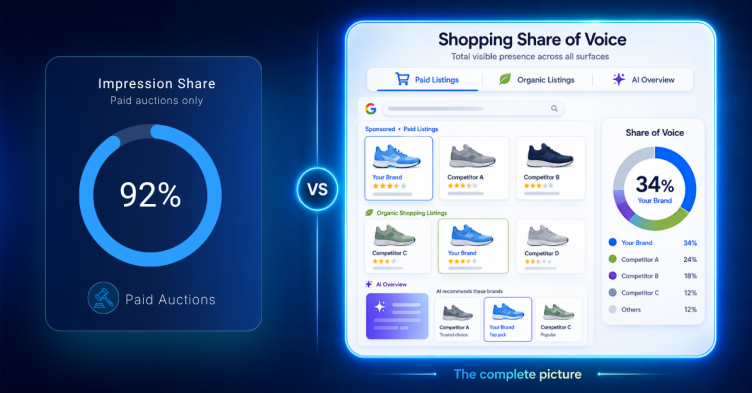
Impression share has its own blind spot, since it only counts auctions you entered, which is why Google Shopping share of voice is worth tracking alongside it.
Shopping Ads data is not useless nor is it a simple matter of “right” or “wrong.” It has evolved. The teams that adapt will focus on methodological clarity, trend confidence, and comparative visibility signals that support real marketing decisions.
See How Your Shopping Ads Visibility Looks in Today’s SERP Environment
If you want to understand how your Shopping Ads visibility compares across devices, competitors, and collection methods, request a personalized visibility assessment.