
Most rank trackers show you a blue line trending up or down. That’s not the whole story anymore. Featured snippets, People Also Ask boxes, local packs, video carousels, and AI Overviews now occupy real estate that used to belong to the ten blue links, and a tool that only tracks position ignores half of what’s actually happening on the page. SERP feature tracking tools solve a narrower, harder problem: which features show up for your keywords, who owns them today, and how that ownership shifts week to week. This guide compares eight platforms built for that job: where each one is strong, where it falls short, and what it actually costs.
Pricing and capabilities were checked against public vendor documentation, pricing pages, and reviews in August 2026. Vendors change features and pricing without much notice, so confirm current terms before you buy.
What Is SERP Feature Tracking, and Why Does It Matter Now?
SERP feature tracking is a distinct practice from rank tracking, even though the two terms get used interchangeably. Rank tracking tells you where your pages sit in the results. SERP feature tracking tells you which non-organic elements show up on that results page for a given keyword, and whether your brand or a competitor occupies them. For the fuller breakdown of that distinction, see SERP monitoring vs rank tracking.
The stakes went up fast. Moz’s STAT Search Analytics research on 200,000 tracked SERPs found the share of traditional organic results holding the number-one position on Google fell from 57% in January 2025 to 44% in January 2026. Position one used to mean the click. Now it’s a seat at a crowded table, shared with features that weren’t there two years ago.
That’s the gap a plain rank tracker can’t see. It tells you your keyword sits at position 3. It won’t tell you a competitor owns the featured snippet above you, or that an AI Overview is answering the query before anyone scrolls to organic results at all. Our breakdown of Google SERP features goes deeper on what’s currently in play across category SERPs, and competitive SERP analysis covers how to see that gap systematically, before you start comparing tools.
What to Look For Before You Buy
Not every “rank tracker” tracks SERP features the same way, and the differences matter more than the marketing pages suggest. Feature coverage is the first thing to check: some tools flag five or six feature types, others track 25 to 45, including AI Overviews and AI Mode. Competitor visibility is the second and more important one. Does the tool show only your own domain’s feature presence, or does it show which competitors are winning the features you’re not, the way Google Share of Voice does for organic rankings more broadly?
Update cadence and location granularity matter too, especially if your footprint needs local and international SERP monitoring down to city or ZIP level, not just a national average. And ask what happens after the data lands. A dashboard that just displays feature ownership is a report. One that connects a lost feature to a content gap or a competitor’s move is a workflow. For the practical mechanics of setting that up, see how to track SERP features, and once you know which features you’re missing, SERP feature optimization covers what to do about it.
How We Evaluated These Tools
This comparison is built from public product documentation, pricing pages, and verified reviews, not a side-by-side hands-on test of every platform. Vendors update features and pricing constantly, so treat what’s here as a starting point for your own evaluation rather than a final answer, and confirm anything that affects a purchase decision directly with the vendor.
We weighted eight things: how many SERP feature types each tool detects, whether it shows ownership for your brand and competitors, how far competitive visibility extends beyond your own domain, AI Overview and AI Mode coverage, location and device granularity, update frequency, historical data depth, and whether it connects to paid, Shopping, or broader AI visibility instead of staying siloed to organic.
8 SERP Feature Tracking Tools Worth Evaluating
1. GrowByData Compass
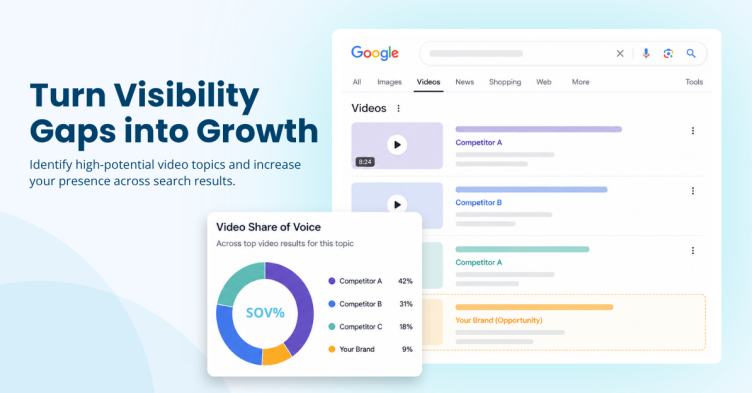
Every other tool on this list tracks SERP features for one domain, checked against Google’s results in general. GrowByData’s enterprise SERP tracking works differently: it tracks features as part of one competitive view spanning Google organic, paid, Shopping, SERP features, and AI visibility, all in the same dashboard, for your full competitive field, not just your own listings.
That AI layer covers LLM Intelligence across the platforms buyers actually use to research before they search Google at all: ChatGPT brand monitoring, Perplexity brand monitoring, and Google AI Mode monitoring, alongside AI Overviews. For the fuller picture of how that connects, see the AI search visibility guide.
That’s the gap enterprise ecommerce and retail teams hit most often. A SERP feature disappears from your organic listing, and every other tool on this list will show you that much. Few of them reliably show you which competitor picked it up, or whether it moved into a Shopping result instead. GBD tracks the keywords, markets, and devices you choose, daily, across the surfaces your buyers are actually searching.
See where your brand’s SERP feature ownership actually stands today, against the competitors who are winning it. Get Your Visibility Audit
2. Semrush Position Tracking
Semrush’s Position Tracking module reports SERP features per keyword, including featured snippets, People Also Ask, local packs, and AI Overviews, alongside daily rank data. Its Cannibalization tab also flags when your own pages compete for the same term, which is a nice bonus most standalone trackers don’t offer. It’s a strong generalist pick if you want SERP feature visibility bundled with keyword research and site audits in one platform.
The tradeoff: Semrush is built for broad SEO workflows first. SERP feature depth on the ecommerce side stays comparatively shallow next to dedicated Google Shopping monitoring, so if Shopping visibility matters as much as organic features, you’ll likely need a second tool to fill that gap.
3. BrightEdge Data Cube X
BrightEdge’s Data Cube X tracks 28 distinct SERP feature types across 24 countries, which is genuinely deep coverage. It’s built for large, multi-team enterprise organizations that need governance and reporting at scale, not quick answers on a single keyword.
That scale comes at a cost. Pricing runs on a credit-based model where each keyword-per-SERP check consumes a credit, so monitoring a large footprint across many markets adds up fast, and buyers routinely flag the learning curve and onboarding time in reviews.
4. seoClarity
seoClarity is built for teams tracking tens of thousands of keywords across daily or weekly refresh cycles, with SERP feature detection sitting inside the same platform as technical audits and content optimization. Its AI layer, Clarity ArcAI, extends into AI Overviews, AI Mode, and answer-engine visibility, and ClarityAutomate lets teams push some fixes live without waiting on a developer queue.
Pricing is quote-based, and published estimates vary a lot depending on the source, anywhere from roughly $300/month for the core platform up to $2,500 to $4,500/month once content and technical modules are added. There’s no trial period, and reviewers consistently mention a real learning curve, so budget onboarding time along with the keyword volume.
5. Pi Datametrics
Pi Datametrics is a London-based platform built specifically around SERP structure and feature ownership rather than general SEO workflow. Its SERP Feature Radar shows which features appear across a tracked keyword set and who currently holds them, extended into AI Overviews as part of its answer-engine tracking.
It’s a good fit for teams that want to evaluate visibility at the category or market level instead of keyword by keyword. Pricing isn’t published anywhere, so expect a sales conversation before you see a number, and a few reviewers mention the interface takes real ramp-up time before the SERP-level views make sense.
6. Moz STAT Search Analytics
STAT is Moz’s rank and SERP feature tracker for teams managing large keyword sets across markets and devices. Reviewers point to its historical SERP data and feature-tracking depth as a strength, particularly for spotting shifts after algorithm updates.
Entry pricing starts around $720 a month, which positions it for mid-market to large enterprise budgets rather than smaller teams testing the waters.
7. AccuRanker
AccuRanker’s pitch is speed. On-demand rank rechecks and daily SERP monitoring, with the vendor citing over 2 billion tracked keyword positions monthly across its customer base. SERP feature tracking is included from the Professional tier up, at $224/month for 2,000 to 5,000 keywords, though API access and AI-powered analysis sit behind the pricier Expert tier.
It’s a solid fit if your team needs to validate ranking changes immediately after a content or technical fix. It’s less of a fit if SERP features across a large multi-brand portfolio, rather than fast rechecks, are the primary use case.
8. SE Ranking
SE Ranking tracks 35-plus SERP feature types, including AI Overviews, at a meaningfully lower price point than Semrush or BrightEdge, with its Core plan running around $103 a month billed annually. White-label reporting is included rather than gated behind an add-on, which agencies managing several client accounts will notice.
The catch: the keyword database and backlink index are thinner than the premium platforms. If SERP feature tracking needs to sit inside a broader competitive intelligence picture, it’s a narrower tool than the pricing page suggests.
Two Tools We Left Off This List, on Purpose
Similarweb and SpyFu show up in almost every “best SEO tools” roundup, so it’s worth saying why they’re not here. Similarweb is a traffic estimation platform, strong on audience and market-share data, but it isn’t built to track feature-level SERP ownership the way the tools above are. SpyFu is a PPC research tool aimed at small and mid-market advertisers; its SERP visibility is shallow, and its focus sits on ad copy and keyword bidding, not organic feature tracking. Both are useful tools for other jobs. Neither is the right answer to the specific question this list is answering.
Which SERP Feature Tracking Tool Is Right for Your Team?
If you’re a solo practitioner or small in-house team watching a modest keyword set, SE Ranking or AccuRanker’s Professional tier will cover the basics without a five-figure contract. If you’re an agency reporting to multiple clients, AccuRanker or SE Ranking’s white-label options are built for exactly that.
If you’re running enterprise SEO across a large content footprint and content performance is the priority, BrightEdge, seoClarity, or Moz STAT are the incumbents built for that scale. The choice between them mostly comes down to whether you value seoClarity’s execution layer or STAT’s narrower, deeper SERP focus. If category or market-level visibility matters more than individual keyword reports, Pi Datametrics is worth a look.
And if you’re an enterprise retailer or brand where SERP features, Shopping, paid, and AI visibility all affect the same revenue line, that’s the specific problem GrowByData’s competitive market intelligence platform is built to solve. It’s worth a conversation before you sign a multi-year contract with a tool that only sees a slice of it.
Ask These Questions Before You Sign
A feature checklist won’t tell you whether a platform fits your program. Bring these into the demo, and ask the vendor to run them against your actual keywords, not a canned dataset:
- Does it show feature ownership, not just feature presence?
- Can you see every competitor in a feature, or only the ones you preselected?
- How does it handle an AI Overview citing five sources instead of one?
- Does it separate Shopping ads, Merchant Listings, and Popular Products, or lump them together?
- Can tracking go down to city or ZIP level, not just country?
- What’s the real refresh frequency for your priority keywords, not the number on the marketing page?
- What costs extra: more keywords, more markets, API access, historical data?
A generic product tour won’t answer any of that. A demo run on your own keywords will.
Frequently Asked Questions
What’s the difference between rank tracking and SERP feature tracking?
Rank tracking tells you where a page sits in the results. SERP feature tracking tells you what else is on that results page, featured snippets, AI Overviews, local packs, Shopping results, and who owns each one. You can hold a stable rank and still lose most of your visibility to the features around it.
Can Google Search Console show SERP features?
Not really. Search Console reports clicks, impressions, CTR, and average position, but it won’t tell you which features appeared alongside your listing or who else showed up in them. That’s what a dedicated SERP feature tool is for.
Which tools track AI Overviews and AI Mode?
Most of the platforms in this comparison track AI Overviews at some level, though depth varies widely. Some just flag that an AI Overview appeared. Others, including GrowByData, Semrush, seoClarity, and Pi Datametrics, go further into citations, competitor inclusion, and share of voice.
How often should enterprise teams check SERP features?
Daily is the right baseline for keywords tied to revenue. Save hourly or on-demand checks for high-competition terms, active campaigns, or the days right after an algorithm update, when the SERP is actually moving.
Can these tools show which competitor owns a feature?
Most of the tools on this list can, but confirm whether that means every domain appearing in the feature or just the handful of competitors you preselected. That distinction matters more than the feature-count number on the pricing page.
What SERP features matter most for ecommerce brands?
Shopping ads, Merchant Listings, Popular Products, and AI Overviews tend to carry the most weight for ecommerce queries, since they compete directly with organic listings for the same buying intent. Image and video results and People Also Ask boxes are worth watching too, but they usually affect research-stage traffic more than transactional traffic.
Not sure which tier fits your keyword volume and markets? Book a Strategy Session and we’ll walk through your actual SERP feature exposure on a live call, not a canned demo.