
Google Search is no longer a simple list of blue links. Today’s Search Engine Results Pages (SERPs) blend traditional organic listings with SERP features, commerce modules, community perspectives, local results, and AI-driven experiences.
For marketers, this evolution has fundamentally changed what visibility means. Success is no longer determined solely by ranking position, but by where, how often, and in what context a brand appears across the entire SERP.
This guide provides a complete, up-to-date explanation of Google SERP features in 2025, how modern SERPs are structured, and why SEO measurement must evolve in an AI-influenced search environment.
Table of Contents:
Show
- What Are Google SERPs and SERP Features?
- Common Google SERP Features at a Glance
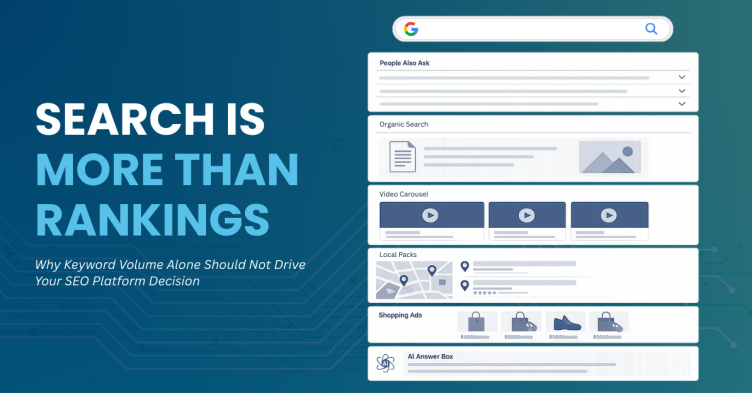
- How Google Search Results Are Structured Today
- Core Google SERP Features That Shape Search Visibility
- Commerce and Shopping SERP Features
- Community, Experience, and Perspective-Based Features
- Local and Contextual SERP Features
- AI-Driven Search Experiences Within SERPs
- What SERP Feature Distribution Reveals About Visibility
- How SERP Features Change SEO Measurement
- Monitoring SERP Features at Scale
- Preparing for the Future of Google Search
What Are Google SERPs and SERP Features?
A Search Engine Results Page (SERP) is the page Google displays after a user submits a search query. Historically, SERPs consisted primarily of ranked organic links.
Modern SERPs, however, include a wide range of SERP features, enhanced result formats such as Featured Snippets, People Also Ask, image and video packs, shopping modules, local maps, reviews, and AI-generated summaries, that influence how users discover, evaluate, and interact with information.
In simple terms, a SERP shows all the ways Google answers a query, not just websites.
Common Google SERP Features at a Glance
While Google continues to test and refine new formats, the most common and impactful SERP features today include:
- Organic results and sitelinks
- Featured Snippets
- People Also Ask (PAA)
- People Also Search and related searches
- Image and video packs
- Reviews and star ratings
- Shopping and product modules
- Local map results
- Top Stories and news features
- AI-generated summaries (AI Overviews)
Together, these elements define the modern SERP experience across the majority of queries.
How Google Search Results Are Structured Today
A modern Google SERP can be understood as a layered layout:
- Organic listings that provide ranked web results
- Discovery features that expand or refine user intent
- Commerce modules that support comparison and purchase behavior
- Local and contextual features that respond to geography or freshness
- AI-driven summaries that synthesize information across sources
Multiple layers often appear on the same page, both above and below the fold. As a result, visibility should be evaluated as presence across the SERP, not as a single ranking position.
This structural shift is the foundation of whole-SERP and AI visibility strategies.
Core Google SERP Features That Shape Search Visibility
Organic Results and Sitelinks
Organic listings remain the foundation of Google Search. However, they are increasingly surrounded and often displaced by other SERP features that compete for attention.
For branded and navigational searches, Google may also display sitelinks, which provide quick access to key sections of a website and reinforce brand authority.
Organic performance still matters, but it must be evaluated within the full SERP context.
People Also Search For and Related Searches
People Also Search and related search suggestions surface alternative or follow-up queries connected to the original search. These features play a critical role in intent expansion, guiding users toward comparisons, refinements, and adjacent topics.
Their influence is exploratory rather than click-driven, shaping discovery paths rather than immediate traffic.
People Also Ask (PAA)
People Also Ask boxes surface follow-up questions related to the original query and expand dynamically as users interact with them. PAA commonly appears for informational searches and reveals how Google understands topic depth.
Even when PAA does not generate direct clicks, it strongly influences user expectations and content discovery.
→ Learn about People Also Ask and how to optimize your content
Featured Snippets
Featured Snippets provide direct answers to specific queries and typically appear near the top of the results page. Although they occur less frequently than other features, their visibility is disproportionate when present.
Featured Snippets reinforce relevance and authority rather than volume-based traffic.
→ Learn about Featured Snippets and how to optimize your content
Knowledge Panels
Knowledge Panels appear for recognized entities such as brands, organizations, people, and locations. They consolidate factual information from trusted sources and support Google’s entity understanding.
For brands, Knowledge Panels are shaped by consistency, authority, and entity signals across the web rather than on-page optimization alone.
Image Results
Image results surface when Google detects visual or inspirational intent. They are common in ecommerce discovery, travel, lifestyle, and instructional searches.
As search behavior becomes increasingly visual and mobile-first, image visibility plays a growing role in brand discovery.
Video Results
Video results appear prominently for tutorials, demonstrations, reviews, and experiential content. While YouTube remains the dominant source, other platforms may appear depending on context.
Short-form video formats are typically surfaced within broader video modules rather than as standalone SERP features.
Commerce and Shopping SERP Features
Popular Products
Popular Products highlights frequently viewed or trending items related to a query. This feature blends discovery with social proof and signals that Google expects comparison behavior during the search journey.
It is now one of the most consistently visible commerce-related SERP features.
→ Learn about Google Popular Products and how to optimize your content
Shopping Results and Reviews
Shopping results surface product listings directly within SERPs and may include paid placements or organic product modules depending on eligibility and intent.
These results are often accompanied by reviews and star ratings, which add social proof and influence purchasing decisions. Shopping visibility frequently occurs below the fold, reinforcing the importance of scroll-based engagement.
Merchant and Multistore Listings
Merchant and multistore listings present structured retailer and product information, emphasizing availability, comparison, and choice. Variants such as multistore and marketplace views are best understood as extensions of the same commerce experience.
These modules are particularly important for large ecommerce sites and marketplaces.
Community, Experience, and Perspective-Based Features
Discussions and Forums
Discussion and forum results highlight community conversations and peer-driven insights. They commonly appear for troubleshooting, opinion-based, and experiential searches.
Their growing presence reflects Google’s emphasis on lived experience alongside authoritative content.
What People Are Saying
What People Are Saying aggregates commentary, reviews, and public sentiment from across the web. It provides experiential context and social validation, helping users assess credibility and consensus.
→ Learn about What People are Saying
Perspectives
Perspectives surface creator-driven, first-hand content. They are particularly relevant for lifestyle, discovery, and experience-oriented queries where authenticity matters as much as expertise.
Local and Contextual SERP Features
Maps and Local Results
Map-based results appear for location-driven searches and provide businesses alongside geographic context. Visibility is influenced by relevance, proximity, and prominence.
Local features remain among the few SERP elements that frequently command above-the-fold placement.
Top Stories and News Features
Top Stories surface timely news content for trending or current-event queries. These features prioritize freshness and authority and may appear temporarily depending on the topic lifecycle.
Things to Know
Things to Know provides structured background information for complex or unfamiliar topics. It supports learning and exploration rather than immediate answers and often appears when Google anticipates deeper informational needs.
→ Learn about Things to Know” SERP Feature
AI-Driven Search Experiences Within SERPs
AI Overviews
AI Overviews generate synthesized summaries directly within search results, drawing information from multiple sources. They reshape user behavior by reducing immediate clicks in some cases while increasing the importance of being referenced or cited.
AI Overviews should now be treated as a core visibility surface, not an experimental feature.
Learn about Google AI Overviews
AI Mode (Contextual Reference Only)
AI Mode represents a separate AI-first search experience focused on conversational exploration and synthesized responses. While covered in detail elsewhere, its presence signals Google’s broader shift toward AI-native discovery alongside classic SERP features.
Learn about Google AI Mode
What SERP Feature Distribution Reveals About Visibility
An analysis of SERP feature distribution across monitored queries shows how visibility is actually allocated on modern Google SERPs.
- We looked at SERP data of a single day, organic results accounted for roughly 20% of total SERP elements, placing them on par with interface-level controls and behind the combined influence of discovery, commerce, and AI-driven features.
- Exploratory elements such as People Also Search (16.9%) and People Also Ask (6.6%) appear at scale, reinforcing Google’s emphasis on guiding users through exploration rather than delivering a single definitive result.
- Commerce features are equally prominent. Popular Products alone represented more than 16% of observed SERP elements, highlighting how frequently product discovery and comparison are integrated directly into search results.
- AI-generated summaries are no longer marginal. AI Overviews accounted for over 6% of SERP elements, placing them nearly on par with long-established features like People Also Ask.
- Visual and experiential formats including Images (4.9%), Videos (2.3%), Discussions and Forums (1.8%), and What People Are Saying (1.5%) with further fragment attention across the page.
Individually, many SERP features appear at low percentages. Collectively, however, they dominate the search experience, pushing traditional organic listings further down the page and reshaping how visibility is earned.
The implication is clear: modern SEO success depends less on owning a single ranking position and more on consistent presence across multiple SERP features, both above and below the fold.
How SERP Features Change SEO Measurement
Traditional SEO reporting focused on rankings and clicks. In today’s environment, those metrics tell only part of the story.
When organic results represent only about one-fifth of SERP elements, effective measurement must account for:
- Presence across multiple SERP features
- Visibility above and below the fold
- Brand inclusion within AI-generated summaries
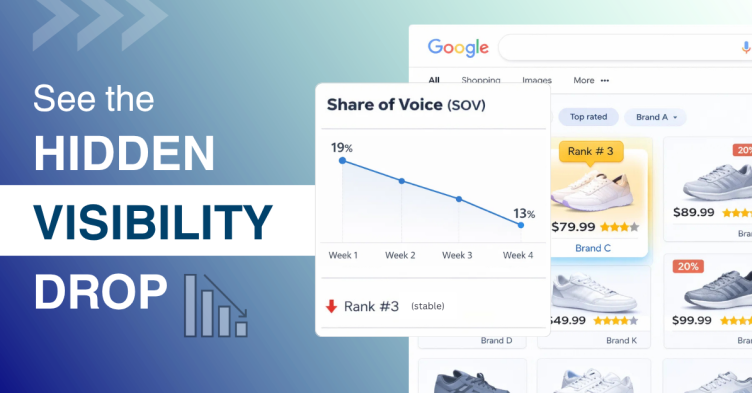
- Competitive share of voice across search experiences
In many categories, influence and exposure matter as much as traffic particularly when AI surfaces answer questions directly.
Monitoring SERP Features at Scale
SERP layouts change continuously. Features appear, disappear, move above or below the fold, and vary by query, device, and geography. Because of this volatility, manual spot-checking or rank-only reporting is no longer sufficient for understanding real search visibility.
Effective SERP monitoring requires a feature-level view of search results, tracking not just rankings, but which SERP features appear, where brands are visible within those features, and how competitors occupy SERP real estate over time.
At scale, this typically involves:
- Detecting which SERP features are present for each query
- Measuring brand and competitor presence across those features
- Tracking visibility shifts above and below the fold
- Comparing feature distribution trends across markets and time periods
As AI-driven search experiences become more prominent, SERP monitoring increasingly overlaps with AI visibility analysis. Understanding whether a brand is cited, referenced, or excluded from AI-generated summaries is now part of the same measurement challenge.
Search intelligence software such as GrowByData are designed to support this shift by combining SERP feature tracking, competitive visibility analysis, and AI answer monitoring into a unified view. This allows teams to move beyond anecdotal observations and quantify how visibility evolves across organic, commerce, community, and AI-driven search surfaces.
In practice, scalable SERP monitoring transforms SERP volatility from a source of uncertainty into a measurable signal helping teams understand not just where they rank, but where they actually appear across the modern search experience.
Preparing for the Future of Google Search
Google Search will continue to evolve. SERP features will expand, AI-driven experiences will mature, and traditional rankings will represent only one dimension of visibility.
Brands that succeed will be those that:
- Measure presence rather than positions
- Understand how AI surfaces reference information
- Treat search as an ecosystem, not a list
In 2025 and beyond, search visibility is defined not by where you rank but by where and how your brand appears across the entire SERP.
Last updated: 2025
Frequently Asked Questions
What is a whole-SERP SEO strategy?
A whole-SERP SEO strategy focuses on maximizing a brand’s visibility across the entire search results page, not just traditional organic rankings. Instead of measuring success by position alone, it evaluates where and how a brand appears across SERP features such as People Also Ask, Featured Snippets, shopping modules, local results, community features, and AI-generated summaries.
What are the key components of a whole-SERP strategy in SEO?
The core components of a whole-SERP strategy typically include:
- Understanding which SERP features appear for target queries
- Creating content that aligns with informational, commercial, and exploratory intent
- Measuring visibility across features above and below the fold
- Monitoring competitor presence across the same SERP elements
- Accounting for AI-driven search experiences alongside traditional results
Together, these components help brands understand their true search presence rather than relying solely on rankings.
How do SERP features affect website visibility and traffic?
SERP features can significantly influence how users interact with search results. While some features may reduce direct clicks to websites, they often increase brand exposure, authority, and early-stage discovery. In many cases, visibility within SERP features shapes user perception even when a click does not occur.
How can brands optimize content to appear in SERP features?
Optimizing for SERP features generally involves:
- Answering common questions clearly and concisely
- Structuring content to support scannability and clarity
- Using formats that align with visual, instructional, or comparison intent
- Ensuring content reflects expertise, experience, and credibility
Rather than targeting individual features in isolation, effective optimization focuses on aligning content with user intent and search behavior.
→ Lear more about Optimizing for 5 TOP SERP Features
How do SERP features and AI-generated results change SEO strategy?
AI-generated summaries and enhanced SERP features shift SEO strategy toward visibility, authority, and inclusion rather than rankings alone. Brands must consider whether they are referenced, cited, or excluded from AI-driven answers and how this affects overall exposure across search.
This evolution makes whole-SERP visibility and AI-aware measurement increasingly important for modern SEO programs.
Related GrowByData resources
- LLM Intelligence platform
- ChatGPT monitoring
- Perplexity AI monitoring
- LLM Intelligence access and trial