
AEO vs GEO vs SEO comes down to where you want to show up.
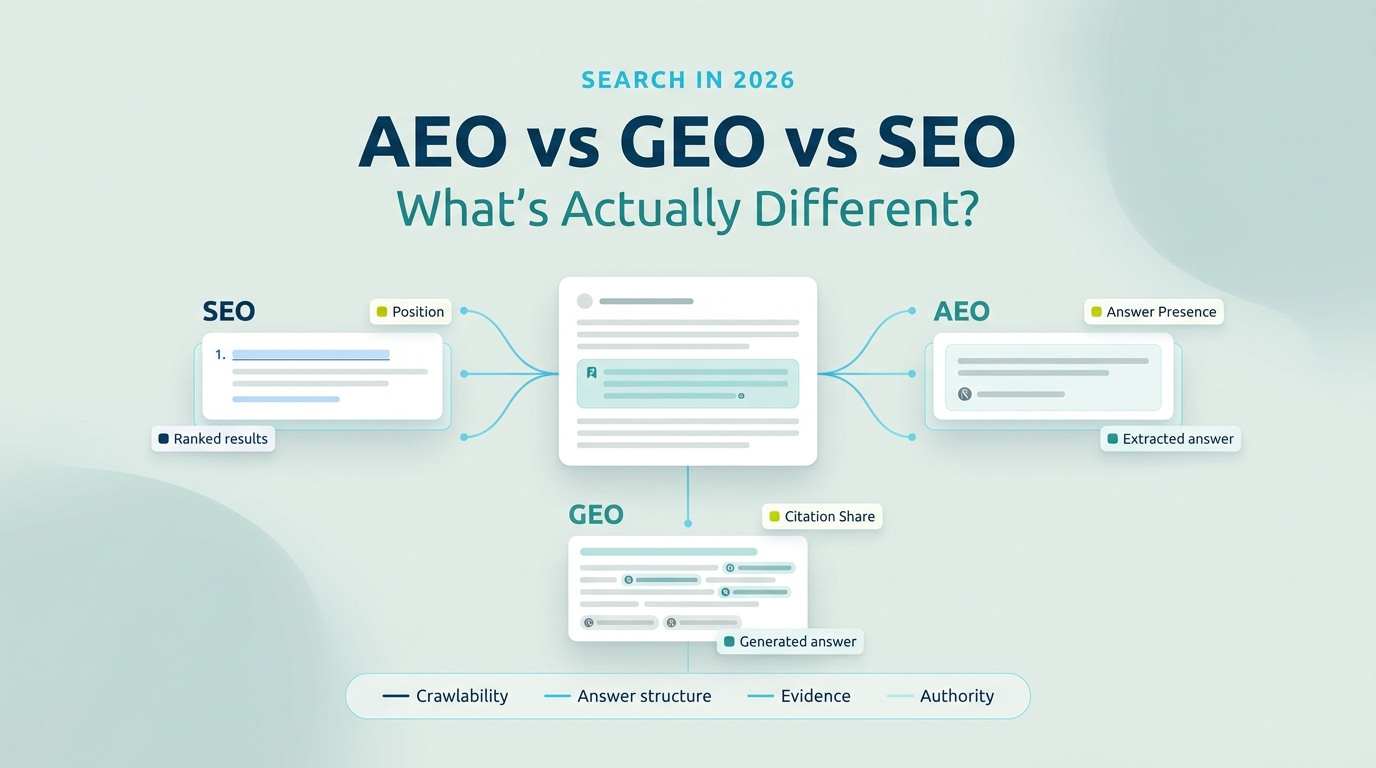
SEO gets your page ranked in search results. AEO (answer engine optimization) gets your content used as the direct answer to a question. GEO (generative engine optimization) gets your brand mentioned and your pages cited when AI tools like ChatGPT and Perplexity write a response.
Our view: you don’t need three search strategies. You need one strategy with three measurement layers.
| SEO | AEO | GEO | |
|---|---|---|---|
| Goal | Rank a page | Be the direct answer | Be mentioned or cited in an AI response |
| Primary examples | Google and Bing organic results | Featured snippets, People Also Ask, voice answers | ChatGPT, Perplexity, Google AI Mode |
| What helps most | Relevance, links, technical health | Clear, direct, well-structured answers | Sourced facts, clear entities, consistent coverage across the web |
| Main metric | Rankings, clicks | Snippet ownership, answer inclusion | Mention rate, citation share |
Overlap: Google AI Overviews sit across AEO and GEO. They give a generated answer and also select and cite supporting sources.
What is the difference between AEO, GEO, and SEO?
SEO, AEO, and GEO differ by the output they target. SEO aims for a ranked list of links, and AEO aims for a direct answer, such as a featured snippet or voice reply. GEO aims for a generated response that blends several sources, where your brand might be cited, mentioned, or missing.
Most articles skip an awkward fact: the industry doesn’t agree on where AEO ends and GEO begins.
Some teams use AEO only for featured snippets and voice search. Others use it for anything an AI tool answers. That confusion eats planning time, and it doesn’t need to.
The acronym doesn’t change what you do on Tuesday. What you measure does.
What is SEO?
SEO (search engine optimization) is the work of getting your pages to rank in Google and Bing organic results. It covers content, links, site structure, and technical health. Success shows up as rankings, impressions, and clicks, and on Google, the same index supplies the links in AI Overviews and AI Mode.
What is AEO?
AEO (answer engine optimization) is the work of making your content the clearest answer to a specific question. That answer might appear as a featured snippet, a People Also Ask result, a voice assistant reply, or a source inside a Google AI Overview.
The searcher often gets what they need without clicking.
What is GEO?
GEO (generative engine optimization) is the work of getting your brand mentioned and your pages cited when AI tools generate an answer. The term comes from a 2024 research paper by Aggarwal and colleagues, published at ACM SIGKDD. It tested how changes to page content affect visibility in generative engine responses.
You’ll also hear GEO called “AI SEO” or “LLM optimization.” Both describe the same work.
Are AEO and GEO different things?
Yes, but they overlap more than the acronyms suggest. AEO asks whether your content can directly answer a question, while GEO asks whether your brand and sources appear across generated answers. GEO also tends to reach beyond your own site, into reviews, directories, and third-party coverage that AI tools draw on.
Some AI visibility vendors argue AEO and GEO are simply two names for the same practice. That’s a fair reading of how the terms get used, and it’s why we care more about what you measure than what you call it.
A Google AI Overview is where the two meet. It’s a generated answer that often cites multiple supporting sources.
No industry standard draws the line between them, but this split works for most teams:
- AEO tends to focus on the answer. Can one page answer one question cleanly enough to be selected?
- GEO tends to focus on the brand across answers. Across hundreds of prompts, how do AI tools describe your company, and which sources do they cite?
That difference changes who’s involved. AEO usually sits with the content team. GEO often pulls in PR, product marketing, and whoever manages your review and G2 profiles.
AEO vs SEO: how is answer engine optimization different from traditional SEO?
Traditional SEO wins when someone clicks your ranked link. AEO wins when your content becomes the answer, even if nobody clicks, and that matters more each year because answers now sit above many organic results and absorb clicks that used to go to page one.
The click data shows why. Pew Research Center tracked the Google searches of 900 US adults in March 2025. Users clicked a traditional result in 8% of visits when an AI summary appeared, versus 15% without one.
Clicks on the summary itself were rarer still: just 1% of visits.
Ahrefs saw the same direction at larger scale. Its February 2026 update, using December 2025 data across 300,000 keywords, linked AI Overviews to a 58% lower click-through rate for the top-ranking page.
A number 1 ranking under an AI Overview isn’t the win it used to be. If your content isn’t part of the answer, you’re competing for a much smaller pool of clicks.
Is AEO or GEO replacing SEO?
No, AEO and GEO build on SEO rather than replacing it. Crawlable pages, clear relevance, useful content, and authority still do the heavy lifting. The link is most direct on Google, which says a page must be indexed and eligible to show with a snippet in Search to appear as a supporting link in AI Overviews or AI Mode.
ChatGPT and Perplexity work differently. They use their own retrieval systems and source mixes, so strong Google rankings help but don’t guarantee you’ll be cited there.
The research backs the “same foundation” view. In the GEO study by Aggarwal and colleagues (KDD 2024), adding statistics, quotations, and cited sources lifted visibility in generative engine responses by up to 40%. Keyword stuffing was among the methods that didn’t help.
That 40% figure needs context. It’s a best case from a controlled benchmark, not a promise for your pages. Treat it as direction, not a forecast.
The common mistake is spinning up a separate “GEO content” workstream with its own writers and pages. You’ll usually get more from fixing the pages you already have, so they answer clearly and cite their sources.
Not sure where your brand shows up in AI answers? Get an AI visibility audit. We’ll track your priority prompts across ChatGPT, Perplexity, Google AI Overviews, and Google AI Mode alongside your Google rankings, so you see all three layers in one view.
How do you measure SEO, AEO, and GEO?
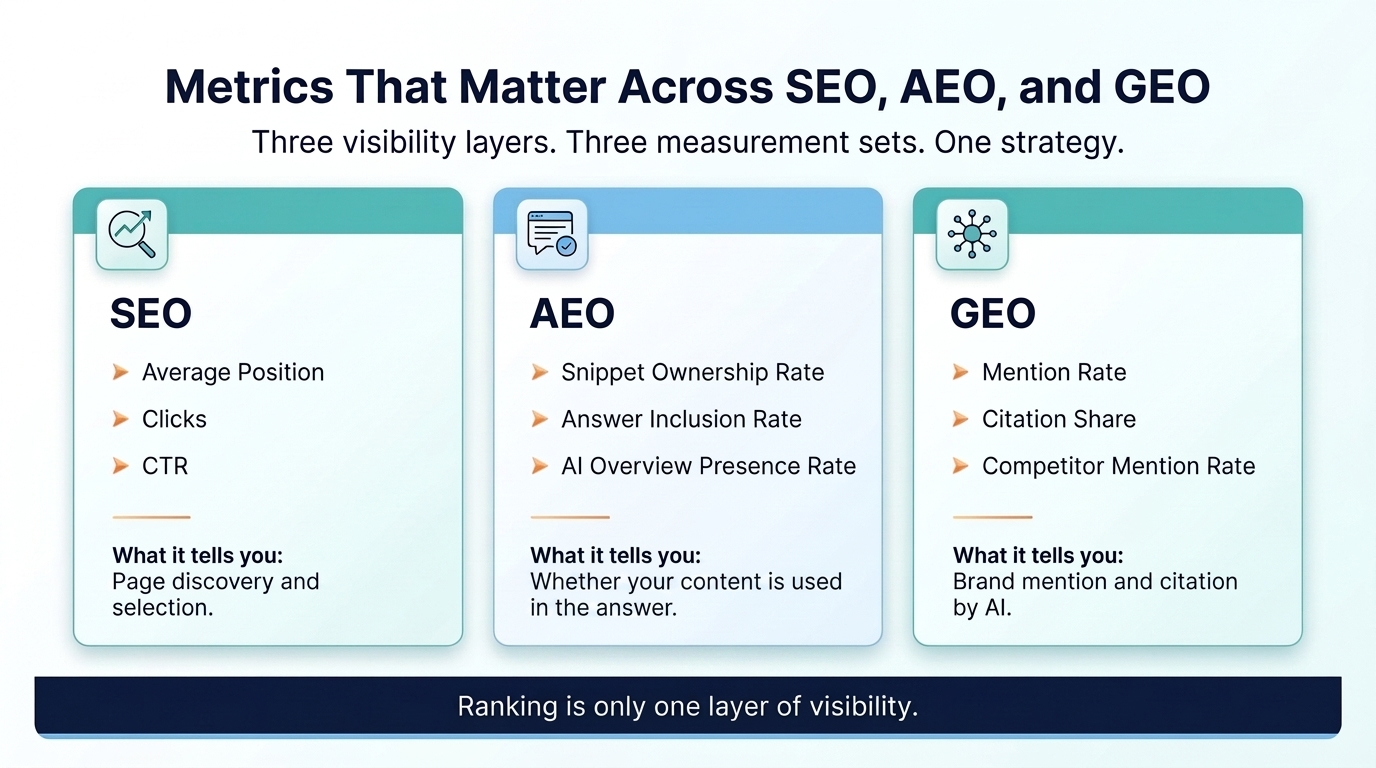
You measure SEO by rankings and clicks. You measure AEO by snippet ownership and answer inclusion: how often your content fills a featured snippet, or appears among the sources in an AI Overview. And you measure GEO by mention rate and citation share across a fixed set of prompts, tracked over time on each AI platform.
Start with what’s already in your own tools.
Google Search Console now has a generative AI performance report. It shows impressions from AI Overviews and AI Mode by page, country, device, and date, and it had rolled out to all sites worldwide by August 31, 2026. It doesn’t break out clicks.
Bing Webmaster Tools has a similar AI Performance report, currently in public preview. It shows citations across Microsoft Copilot, AI summaries in Bing, and select partner integrations.
Those reports are useful, but they mainly show your own domain within each company’s ecosystem. Neither gives you a dedicated view of ChatGPT or Perplexity, or tells you which competitors got named instead of you.
That’s the gap a measurement layer has to fill, and our roundup of the best LLM visibility tracking tools for enterprise compares the options. This setup works for most enterprise search teams:
- Pick one shared topic list. Use the same 50 to 200 topics for all three layers, so you can compare them. Write each one as a search keyword and as a natural-language prompt.
- Track SEO as you do today. Use enterprise SERP tracking to measure rankings, impressions, and clicks by keyword, across your chosen markets and devices.
- Track the answer layer. For each keyword, record whether a featured snippet, People Also Ask box, or AI Overview appears, and whether your domain is included. Check Search Console’s AI report for your own impression trend. Our guide on how to track SERP features covers the setup.
- Track AI mentions and citations. Run each prompt on ChatGPT, Perplexity, and Google AI Mode on a schedule. Record whether your brand is mentioned, whether your URL is cited, and which competitors show up. Our guides show how to track brand mentions in ChatGPT and track brand mentions in Perplexity AI.
- Report the gaps, not just the scores. The most useful view is the mismatch: topics where you rank on page one but never get cited, or where competitors get named and you don’t. It’s the logic of a competitive SERP analysis, extended to AI answers.
Expect the numbers to move at first. AI answers vary from run to run, so read trends over several weeks, not single checks.
What KPIs should you use for AEO and GEO?
The core AEO KPIs are snippet ownership for featured snippets and answer inclusion for AI Overviews, which usually cite several sources. The core GEO KPIs are mention rate, citation share, and competitor mention rate across a fixed prompt set. Together they show if your brand is part of the answer, and who’s there instead.
| Layer | KPI | What it tells you |
|---|---|---|
| SEO | Average position, clicks, CTR | Whether your pages are found and chosen |
| AEO | Snippet ownership rate | How often your page holds the featured snippet |
| AEO | Answer inclusion rate | How often your domain is among an AI Overview’s sources |
| AEO | AI Overview presence rate | How often Google answers above the organic results |
| GEO | Mention rate | How often AI tools name your brand |
| GEO | Citation share | How often your pages are among the cited sources |
| GEO | Competitor mention rate | Who AI tools recommend instead of you |
Why “inclusion” and not “ownership”?
Pew found that 88% of the AI summaries in its March 2025 sample cited three or more sources. You rarely own an AI answer. You’re one of several sources in it.
Citations aren’t pipeline: an example from our own site
GrowByData’s own data shows why citation volume needs its own scorecard. In the Bing Webmaster Tools AI Performance report we exported on June 22, 2026, growbydata.com had 14,727 citations. Only 219 of them (1.5%) came from queries Bing classified as commercial or comparison intent.
The other 98.5% came mostly from research, informational, and learning queries.
This is one site’s data, not an industry benchmark, and it partly reflects our own content mix, since most of our pages are educational. But it makes a clear point: AI citations mostly build awareness. Track them next to leads, not as a stand-in for leads.
For connecting visibility to revenue, see how enterprises measure ROI from AI search visibility.
Do you need separate strategies for SEO, AEO, and GEO?
No, you need one strategy with three measurement layers. Much of the same technical, content, and authority foundation supports all three. What changes is the page format (direct answers for AEO), the off-site work (reviews and third-party coverage for GEO), and the numbers you report to leadership.
For a typical enterprise search team, we’d divide the effort like this:
- Keep SEO as the base. Technical health, content depth, and links still decide which pages search engines trust, and Google uses that same index for its AI features.
- Reformat for AEO. Open your key pages with a direct answer, use question-based headings, and add tables and numbered steps, so they’re easier to pull into Google SERP features and AI answers. This is usually a rewrite of existing content, not new content.
- Extend for GEO. Make sure your brand is described accurately and consistently on review sites, category pages, and industry roundups, since AI tools draw on those sources too. Our brand guide to AI and LLM search visibility goes deeper.
The tradeoff is reporting load. Three layers mean more to explain, so pick a small set of KPIs from the table above and grow from there.
How GrowByData helps
GrowByData is a search and AI visibility intelligence company for enterprise brands, retailers, and agencies. GrowByData Compass tracks Google results and SERP features alongside brand visibility in ChatGPT, Perplexity, Google AI Overviews, and Google AI Mode, including which competitors appear.
That puts your SEO, AEO, and GEO layers in one competitive view, rather than in separate first-party reports.
- For AI visibility, LLM Intelligence shows where your brand is mentioned and cited, and who appears instead, with dedicated ChatGPT brand monitoring, Perplexity brand monitoring, and Google AI Mode monitoring.
- For Google’s answer layer, Google AI Overviews monitoring shows when AI Overviews appear for your keywords and which sources they cite.
- For the full strategy, our guide to AI search visibility covers the rest.
Frequently asked questions
Is AEO the same as GEO?
No, though they overlap: AEO focuses on making your content the direct answer to a question, as in featured snippets and voice replies. GEO focuses on getting your brand mentioned and your pages cited across AI-generated responses in tools like ChatGPT and Perplexity. Google AI Overviews involve both.
Which should I prioritize first: SEO, AEO, or GEO?
Keep SEO as the foundation, because Google only uses indexed, snippet-eligible pages as supporting links in its AI features. Then set a baseline for AEO and GEO on the same topic list. Let the gaps decide what to optimize first, rather than following a fixed order.
Are AEO and GEO just SEO rebranded?
Partly. The foundations, like crawlable pages, clear answers, and authority, are SEO work that’s been around for years, which is why many practitioners call AEO and GEO a rebrand. What’s new is where visibility happens and how you measure it, because mentions and citations inside AI answers don’t show up in rankings or click reports.
How do you track brand mentions in ChatGPT?
Run a fixed set of buyer prompts in ChatGPT on a regular schedule. Record whether your brand is mentioned, whether your pages are cited, and which competitors appear. First-party webmaster reports don’t give you a ChatGPT-specific view of mentions and competitors, so you’ll need a dedicated tool such as GrowByData Compass.
Is SEO dead because of AI search?
No, but the payoff has changed. Pew Research Center found users clicked a traditional result in 8% of visits with an AI summary, versus 15% without one (US, March 2025). SEO still earns visibility, but you now need to track whether that visibility turns into answers and citations.
One strategy, three layers: see them together
Most teams find out they’re missing from AI answers when a prospect mentions a competitor that ChatGPT recommended. You don’t have to wait for that call.
Get a live view of your rankings, AI Overview inclusion, and brand mentions in ChatGPT and Perplexity, tracked against the competitors and prompts that matter to your buyers.
Sources
- Pew Research Center, Google users are less likely to click on links when an AI summary appears in the results, July 22, 2025 (data: March 2025, 900 US adults, 68,879 searches)
- Ahrefs, AI Overviews click-through rate study, updated February 4, 2026 (December 2025 data, 300,000 keywords)
- Aggarwal, P. et al., GEO: Generative Engine Optimization, Proceedings of ACM SIGKDD 2024
- Google Search Central, AI features and your website
- Google Search Central Blog, Introducing Search Generative AI performance reports in Search Console, June 2026 (worldwide rollout noted August 31, 2026)
- Microsoft Bing Webmaster Blog, Introducing AI Performance in Bing Webmaster Tools Public Preview, February 2026
- GrowByData, Bing Webmaster Tools AI Performance report for growbydata.com, exported June 22, 2026