
MAP violations keep coming back when a program is built to find more alerts instead of reducing the violations that matter. Programs that work split broad discovery from focused enforcement, and they judge success by whether violations get less frequent and less concentrated.
Key takeaways
- Alert volume is the wrong scorecard. One crawl flagged 1,900 potential violations, and most of the review time went to small sellers.
- Rank violations by economic impact, and find the seller who moved the price first.
- Keep a timestamped screenshot with every record, so a seller can’t dispute a violation after fixing the price.
- Trace where violators get their inventory. Several storefronts often share one source.
- Monitor high-risk sellers daily and leave the rest to periodic discovery.
“It feels like whack-a-mole”
“It feels like whack-a-mole.”
A specialty products manufacturer, describing its MAP program
The company sells through dealers who buy direct and many more who buy through wholesalers. When a seller advertises below the Minimum Advertised Price (MAP), the brand sends a notice or adds the seller to a do-not-sell list, and the listing gets fixed. Then another storefront opens, sometimes a new seller and sometimes the same operation under a different name.
| What the brand did | What happened |
|---|---|
| Crawled as much of the web as possible every week | Broad coverage, including sellers the brand didn’t know about |
| Ran one crawl that flagged close to 1,900 potential violations | Every alert needed review, false-positive removal, seller research, contact details, and proof |
| Gave the program to one person | A task meant to take a small slice of the job started eating entire days |
The company had plenty of data. It didn’t have a practical way to turn that data into action, and that’s where many MAP programs stall.
Why do more MAP alerts create more work?
More MAP alerts create more work because every alert carries a manual review cost, and volume says nothing about which violations actually hurt revenue. A platform that finds 2,000 potential violations instead of 200 looks ten times more valuable. In practice, the team now has ten times as much to check before it can act on any of it.
Each alert raises the same three questions:
- Is it really a violation? The listing might be for the wrong variation, an older model, a used item, or a bundle that needs a closer look.
- Does an exception apply? A promotion may be allowed under the policy, or the price may have changed by the time the alert arrives.
- Who is the seller? If the violation is valid, the team has to identify the seller, check authorization, trace inventory through wholesalers, and find a reliable contact.
A big alert queue can look like control while the team spends most of its week on small sellers with a few units. Most days, that’s administration rather than enforcement.
For brands with mixed distribution networks, a more practical approach is to sort alerts by economic impact, keep the evidence with each alert, and look into likely inventory sources. Good MAP enforcement software should take much of that sorting off your team’s plate, and the sections below cover each step. If you’re new to the basics, our MAP monitoring guide covers how monitoring works end to end.
What should a MAP violation record include?
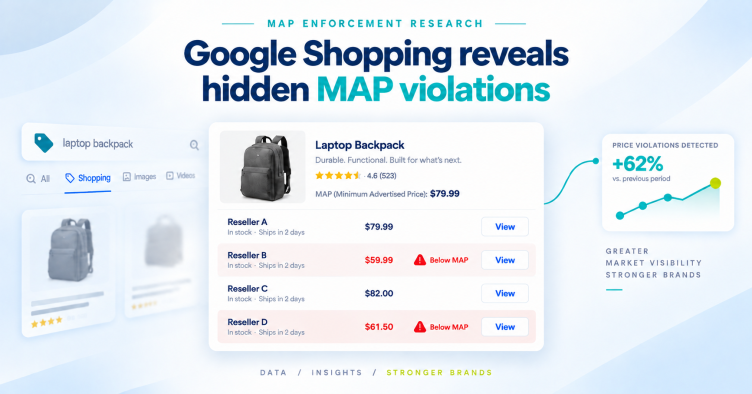
A MAP violation record should include enough detail for someone outside the team to understand and trust it, because sellers often fix the price and then dispute the notice. Without a timestamped screenshot, the brand ends up arguing about a listing that now looks compliant.
The manufacturer we spoke with ran into this constantly. Alerts arrived without reliable screenshots. A seller would get a notice, correct the price, and push back. The program manager said every response felt like having to “prepare for trial.”
First, confirm the listing is one of the MAP violations your policy covers. A usable record then contains at minimum:
- the product, including variation and model
- the seller and storefront name
- the advertised price as displayed
- the MAP price for that SKU
- the exact listing URL
- the date and time of observation
- a screenshot of the listing at that moment
The timestamp matters because online prices move fast. A seller can change a price in minutes and truthfully say, “Look at our site, we’re compliant now.” A screenshot changes the conversation: “The price has been corrected, but this is what was advertised at 7:00 p.m. on Sunday.”
Good records also protect your wholesaler relationships. Several of this manufacturer’s wholesalers were willing to back the MAP program hard, and some would stop selling everything to a repeat offender, not only the manufacturer’s products. Those partners need to trust the data. Send them enough false positives or claims you can’t back up, and even supportive distributors start to hesitate.
So here’s a useful test: how long does it take your team to pull a dated screenshot for a violation from three weeks ago? If it takes more than a quick lookup, that gap is weakening your position with the partners most willing to help.
Is the seller you’re chasing the real source?
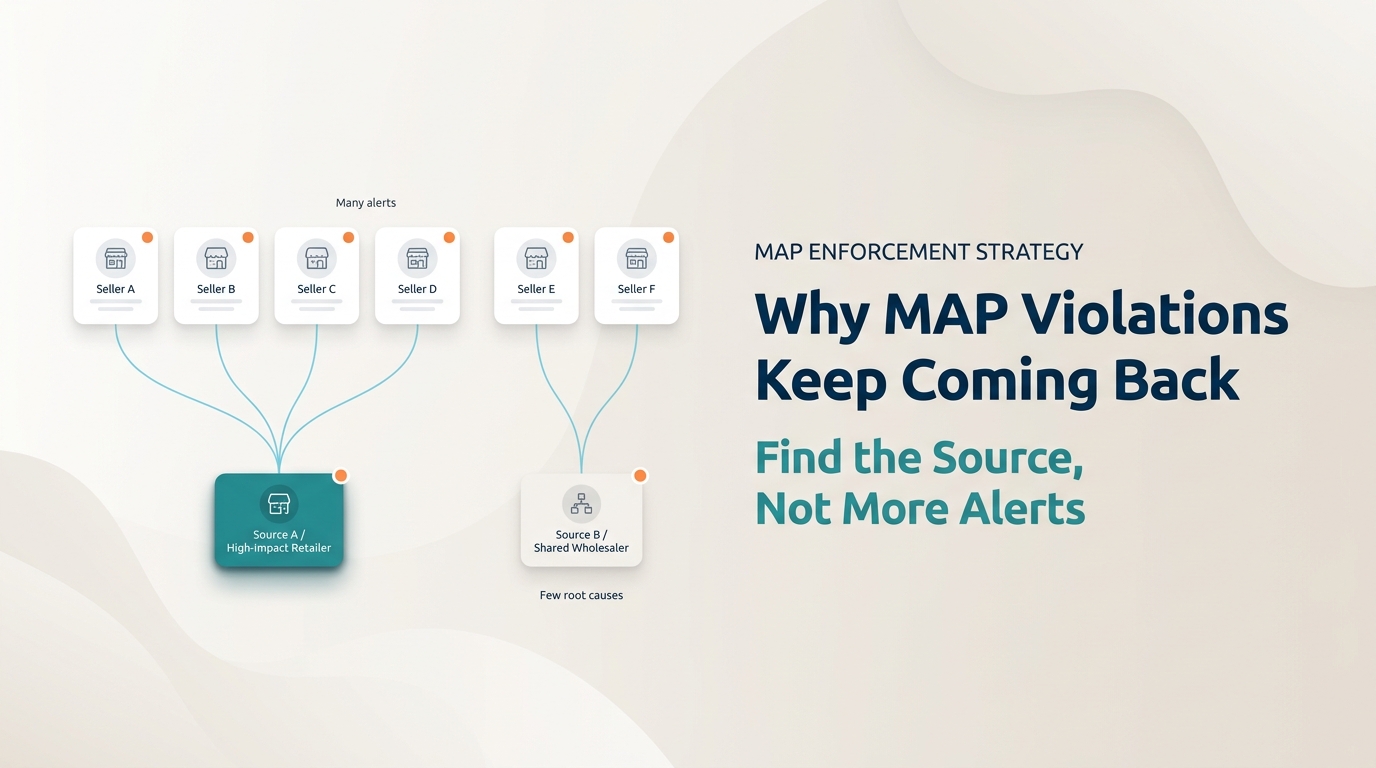
Often it isn’t. Several storefronts that look unrelated may be getting inventory from the same upstream source, so shutting down one listing doesn’t stop the supply. A new name appears a few weeks later and the cycle restarts.
Picture a large dealer or wholesaler that also runs several small online stores. One store gets flagged and shut down. Inventory keeps flowing through the same organization, and a different storefront pops up. The name changed. The source didn’t.
That’s why the better question is: how did this seller get the product?
Asking it moves the program from chasing symptoms to investigating the channel. A brand might have dozens of small violators while the inventory leaks through one or two wholesalers. If so, fixing behavior at the source will do more than any number of notices to individual stores.
Small sellers still matter. Treat each new one as a clue about how inventory is moving, not only as another enforcement case.
Serialized products make tracing easier
This manufacturer sells serialized products, which opens a more direct route. The brand can make a test purchase from a suspected offender, read the serial number, and trace the unit back to the wholesaler or dealer that first received it.
A test purchase can answer questions that website monitoring can’t:
- Which distribution partner supplied the product?
- Is one wholesaler repeatedly linked to unauthorized sellers?
- Are products meant for one region showing up in another?
- Is a direct account supplying secondary storefronts?
- Did the inventory enter the market recently, or has it been circulating for months?
Brands without serial numbers often have other options, including lot numbers, batch codes, distributor-specific packaging, regional SKUs, warranty registrations, and fulfillment records.
Some brands learn through controlled releases. Give a new SKU to one wholesaler, watch the market for two weeks, then release it through a second wholesaler. If a new group of unauthorized sellers appears soon after the second release, the timing is a lead worth following. It isn’t proof on its own, but it’s a much better starting point than a list of unknown storefronts.
Which MAP violations should you prioritize first?
Prioritize the MAP violations from sellers who can move the market: high-volume retailers, influential marketplace sellers, and repeat offenders. A seller with one discounted unit isn’t economically equal to a major retailer advertising hundreds of products below MAP, and treating them the same wastes the team’s limited hours.
A large retailer’s low price can reset what customers expect across the category. Authorized dealers see it, assume the brand isn’t enforcing, and discount their own listings to keep up.
On marketplaces the effect can be sharper, because many sellers use automated repricing tools. When one influential seller drops a price, other listings can follow without anyone making a decision. A compliant dealer can suddenly look like a violator.
The cascade usually runs like this:
- A large seller lowers its price on a popular product.
- The lower price shows up on a marketplace.
- Automated repricers react.
- Other sellers cut prices to compete for visibility or the Buy Box.
- The brand’s monitoring reports a wave of violations.
If the brand only responds to step 5, it sends notices to dozens of sellers and never finds the one who started it. The better question is: who moved first?
Finding and fixing that source can prevent many downstream violations. It also helps separate deliberate discounting from sellers caught in an automated response. Tracking who leads price moves is a core part of competitor price monitoring.
The money matters too. A $100 price cut by a low-volume seller may do little damage. The same cut by a retailer selling 1,000 units is a much bigger threat to revenue, margin, and channel confidence.
You don’t need a perfect scoring model to sort sellers. You need a consistent way to stop treating every alert as equal:
| Factor | What to look at | Why it matters |
|---|---|---|
| Violation frequency | How often the seller breaks MAP | Separates one-off mistakes from patterns |
| Products affected | Number of SKUs or product lines involved | Shows how wide the problem is |
| Discount depth | How far below MAP the advertised price sits | Points to the most damaging pricing |
| Seller visibility | Marketplace prominence or search visibility | Visible sellers shape what buyers expect to pay |
| Estimated sales impact | Seller or product volume, where you can estimate it | Ties enforcement to revenue at risk |
| Repeat behavior | Past warnings and corrections | Flags sellers who need escalation |
| Upstream connection | Dealer, distributor, or wholesaler relationship | Can reveal one source behind several violators |
Our own case studies show the pricing problem and the workload can shrink together. A US distributor of a French stationery brand cut MAP violations by 39.5% with SKU-level monitoring and reports that flagged its most violated products, its problem resellers, and its compliant resellers (GrowByData case study). A major retailer cut its MAP reporting time by 50% after automated weekly summaries, which ranked the worst offenders, replaced manual tracking (GrowByData case study). Both are single-client results, not benchmarks.
How often should MAP prices be monitored?
MAP monitoring frequency should depend on the seller, not the calendar. Major marketplaces, high-volume dealers, and repeat offenders justify daily checks, while lower-risk sellers can be checked less often. A predictable weekly crawl of everything can also leave blind spots, because sellers may discount between scans.
The manufacturer used to crawl weekly. That schedule came from scale: searching the whole web takes time, so weekly was the practical choice.
The catch is timing. If sellers learn that prices get checked on Tuesday, some may stay compliant on Tuesday and drop prices on Wednesday, or discount over the weekend and restore the price before the next scan. In that case, a weekly report can show compliance while the product sat below MAP for much of the week.
Daily monitoring of the right sellers catches short price drops, weekend activity, and repeat patterns. It also gives you a clean timeline when a seller disputes a violation.
A practical tiering looks like this:
| Seller type | Suggested check frequency | What it’s for |
|---|---|---|
| Major marketplaces, high-volume dealers, repeat offenders | Daily | Catch short price drops and build a dispute-proof timeline |
| Medium-risk retailers | Several times a week | Spot new patterns without daily review load |
| The broader web | Periodic discovery crawls | Find new sellers, storefronts, and possible gray-market activity |
These frequencies are starting points, not fixed rules. Sellers should move between tiers based on their behavior.
What happens after a MAP holiday ends?
After a MAP holiday ends, prices don’t all return to compliance at once. Some sellers forget to restore the regular price, some marketplace promotions run long, and some repricers keep reacting to competitors that are still discounted. The manufacturer we spoke with said post-promotion cleanup could last two to three weeks.
Treat the end of the holiday as part of the event, since your minimum advertised price policy applies again the moment the window closes. Know exactly when it ends and which SKUs it covers, increase monitoring right after it closes, and separate a short technical lag from a seller who stretches every promotion.
Can broad discovery and focused enforcement work together?
Yes. Brands often think they must choose between crawling the whole web (lots of noise) and watching a short list of known sellers (new storefronts slip through). Two-layer MAP monitoring gives each job its own layer, so discovery and enforcement can run side by side.
Layer one: discovery. Broad, periodic, and deliberately shallow. It looks for new websites, marketplace accounts, and possible gray-market activity. Gray-market sellers are a brand problem as well as a pricing one, so this layer often feeds enterprise brand protection work too. It answers one question: who’s selling our products?
Layer two: enforcement. Narrow, frequent, and deep. It watches high-impact sellers, captures evidence, tracks repeat violations, and looks for links between storefronts. It answers a different question: where will action produce the biggest result?
Sellers move between layers based on evidence. A storefront found in discovery moves into enforcement when its volume, behavior, or upstream connections justify it. Low-risk sellers stay in discovery and don’t need daily review.
You keep your view of the market, and the workload stays manageable. The tradeoff is setup effort: someone has to define the promotion rules between layers and revisit them as sellers change.
How should you measure a MAP program?
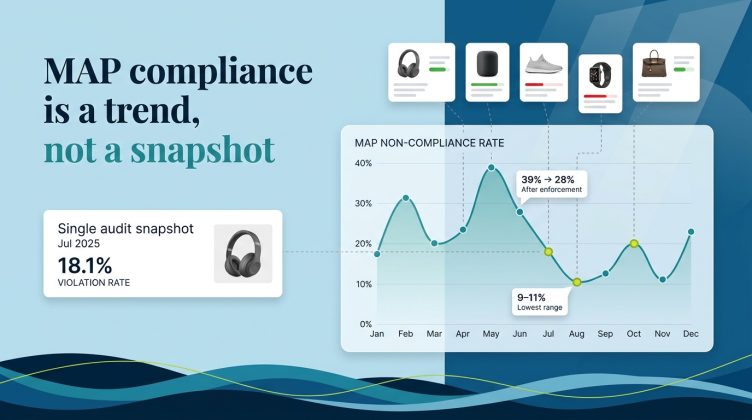
Measure a MAP program by whether it changes seller behavior, not by how many violations it finds. A high violation count can signal a real pricing problem, or it can signal a noisy monitoring setup. Behavior-based metrics tell you which one you have.
A scorecard worth tracking:
| Metric | What it tells you |
|---|---|
| Confirmed violation rate | How much of the alert queue is actually actionable |
| Repeat violation rate | Whether sellers change behavior after enforcement |
| Seller concentration | Whether a small group causes most of the problem |
| Product concentration | Whether the same SKUs keep getting hit |
| Time to evidence | How fast the team can back up a violation |
| Time to correction | How fast prices return to compliance, including after promotions |
| Upstream source concentration | Whether several violators trace back to one source |
| Staff time per alert | Whether the program is getting easier or harder to run |
| Wholesaler follow-through | Whether distributors trust and act on your reports |
Raw price observations only become price intelligence when they show patterns and causes. The scorecard also changes the question leadership asks. “How many violations did we find this month?” becomes “Are the sellers that matter violating less often?”
One metric deserves extra attention: how concentrated your violations are. If a small group of sellers drives most of the economic impact, you know where to start. If hundreds of small sellers trace back to one wholesaler, that’s even more actionable.
Where should you start?
If you already have months or years of monitoring data, you don’t need another crawl to start. You need to read the data you already have.
- Rank your sellers. Use the past six to twelve months and score each seller on how often they violate, how many products are affected, discount size, visibility, and estimated sales volume.
- Sort them into three groups. High-impact sellers get daily monitoring. Known sellers get periodic review. Low-volume and unknown sellers go to the discovery layer.
- Look upstream. For the high-impact group, check which sellers buy direct, which may share a wholesaler, and which storefronts seem to share ownership or inventory.
- Check your evidence. If the team can’t quickly pull a dated screenshot and a complete record, fix that before expanding coverage.
This review usually shows that a brand doesn’t have thousands of separate problems. It has a much smaller number of recurring patterns buried in thousands of alerts.
Get a seller concentration review on your own data
That exercise is worth doing, but many teams skip it because it can take a week of someone’s time.
GrowByData runs this review for brands with mixed distribution networks. Share six to twelve months of your existing violation exports, in the format your current platform produces, and we’ll return a seller concentration review showing:
- which sellers account for most of your economic exposure
- which storefronts show signs of sharing an upstream inventory source
- how much of your current alert volume is noise rather than enforceable violations
- where your evidence records have gaps that wouldn’t hold up in a dispute
It runs on data you’ve already paid to collect, with no new crawl and no platform switch. If the review says your current program is working, that’s useful to know too.
See where your MAP violations are concentrated
Stop counting moles. Find the tunnel.
MAP violations won’t disappear. Prices change constantly, new sellers enter, storefronts get renamed, promotions create confusion, and marketplace algorithms react to each other faster than most teams can investigate. Nobody can honestly promise perfect visibility or zero violations.
What brands can do is get out of the endless cycle of alerts and warning letters. That starts with better questions:
- Who moved the price first?
- Which violations carry the most commercial impact?
- Where did the inventory come from?
- Are several sellers tied to the same source?
- Can we prove what happened?
- Are we shrinking the problem, or just documenting it?
Crawling the web helps you find the moles. Lasting enforcement comes from finding the tunnel they keep using. If your team is buried in alerts and still seeing the same violations every month, talk to a GrowByData MAP expert about where your program’s time is going.
Frequently asked questions
Can serial numbers show who supplied an unauthorized seller?
Often, yes. A test purchase from the suspected seller lets the brand read the serial number and trace the unit back to the wholesaler or dealer that first received it. Brands without serialized products can sometimes narrow the source with lot numbers, batch codes, regional SKUs, or warranty registrations.
Why do MAP violations spike across many sellers at once?
Automated repricing is a common cause. When one influential seller lowers a price, competing marketplace listings can follow without any human decision. The resulting wave of MAP violations often traces back to one seller who moved first.
Why do the same MAP violators keep reappearing under new names?
A seller that gets shut down may still have access to the same inventory, often through a wholesaler or a related business, and can reopen under a new storefront name. Tracing where the product came from, through serial numbers, lot codes, or test purchases, targets the source instead of the storefront.
How long does MAP cleanup take after a promotional window closes?
It varies by brand and channel. One manufacturer we spoke with saw two to three weeks of noncompliance after each MAP holiday, driven by forgotten price restorations, extended marketplace promotions, and repricers still reacting to discounted competitors. Increasing monitoring right after the window closes can help catch stragglers sooner.
Should small MAP violators be ignored?
No. Small sellers can reveal how inventory is moving and can grow into bigger problems. The difference is priority: low-impact MAP violators can stay in the discovery layer until their volume, behavior, or connections justify closer enforcement.
Will wholesalers help enforce a MAP policy?
Some will. One manufacturer we spoke with had wholesalers willing to stop supplying repeat MAP violators, in some cases across every product they carried. That support depends on trust, so accurate, well-documented violation reports matter as much as coverage.
Sources
- GrowByData, MAP Monitoring Success Story: A Stationery Distributor, published March 2025, updated August 2026.
- GrowByData, MAP Compliance Success Story: A Leading Retailer’s Transformation, published March 2025, updated August 2026.