Key Takeaways
- Most “top MAP monitoring tools” roundups are written by one of the vendors listed, and that vendor is almost always ranked first — treat rankings, including this one, accordingly.
- Refresh frequency and product-matching accuracy are what actually separate real MAP monitoring platforms from tools that just claim “real-time.”
- The right fit depends on scale: small teams may do fine with a lean tool like Prisync, while enterprise brands with complex, multi-channel catalogs need deeper platforms.
Table of Contents:
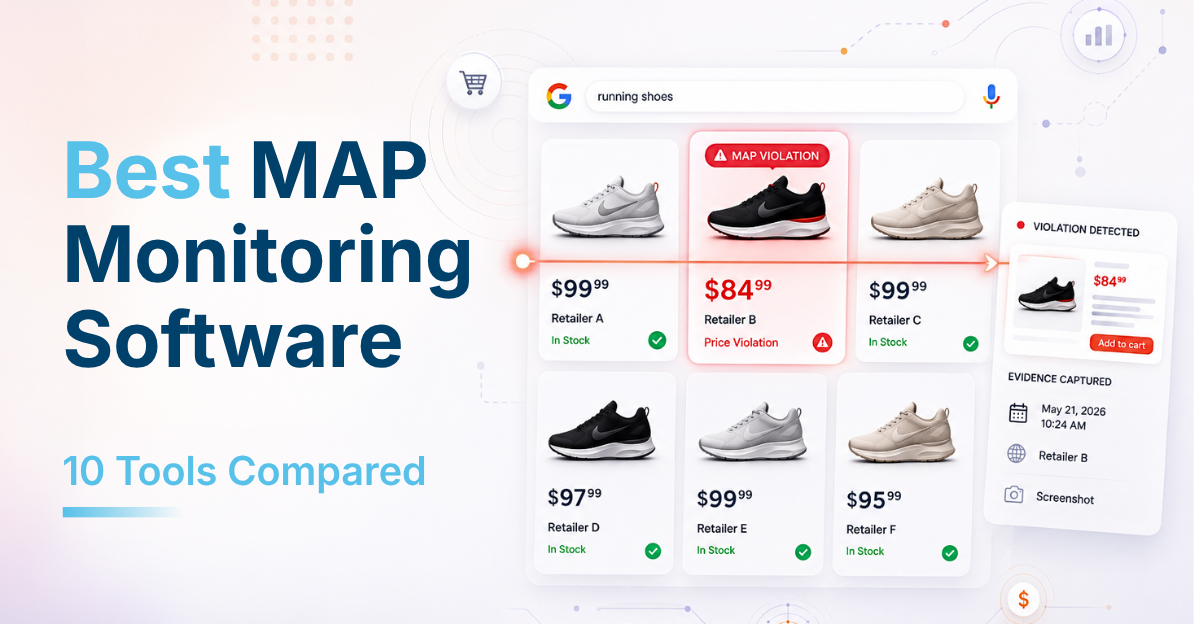
MAP price monitoring software tracks the advertised price of your products across retailers, marketplaces, and reseller listings, then flags where a seller has gone below your minimum advertised price. The good ones do more than flag. They capture dated evidence, identify who the seller actually is, and give your channel team something they can act on without a week of screenshotting.
One thing to sort out before you book five demos: enterprise platforms in this category almost all quote custom, while the self-service tools publish plans or a defined per-SKU model. Those are two different buying processes, and knowing which one you’re in changes how you should run the evaluation.
The comparison
| Platform | Pricing | Enforcement | Best for |
|---|---|---|---|
| GrowByData | Custom quote | Alerts plus managed enforcement support | Brands whose violations appear in Shopping and paid listings |
| Wayvia formerly PriceSpider |
Custom quote | Bulk notices and workflows | Large brands wanting MAP inside a full ecommerce suite |
| TrackStreet | Custom quote | Evidence-backed notices, repeat-offender escalation | Large reseller networks with formal enforcement processes |
| Wiser Solutions | Custom quote | MAP execution module | Teams buying pricing strategy and MAP together |
| Intelligence Node | Custom quote | Violation alerts, unauthorized seller identification | Global catalogs needing market-level accuracy |
| Price2Spy | Published plans from $157.95/mo |
Alerts and reports; customer-led | Mid-market catalogs on a defined budget |
| Trade Vitality | Flat monthly by SKU count | Customizable violation emails | Focused channel teams without a long-term contract |
| Prisync | Published plans | None; customer handles enforcement | Brands needing monitoring and reporting only |
| MapAuthority | Published plans | Preventive; blocks below-MAP listings on Amazon | Amazon-first brands that can enroll their retailers |
| Minderest | Custom quote | Alerts and compliance reporting | Global brands with significant European exposure |
How we built this list. Platforms are ordered by buyer profile, not scored or ranked. We reviewed publicly available vendor documentation, pricing pages, and product materials as of July 2026. We have not run head-to-head trials of every platform, so feature claims are vendor-reported unless noted. Channel coverage, evidence formats, and scan frequency should be confirmed in your own demo.
How do brands monitor MAP pricing violations online?
Most working MAP programs run the same five steps, regardless of which platform sits underneath:
- Match your SKUs to live listings. Your catalog gets mapped to retailer URLs, ASINs, and marketplace listings. This is where accuracy is won or lost, and it’s harder than vendors make it sound once bundles, variants, and child ASINs enter the picture.
- Scan advertised prices on a set cadence. Daily is standard. Intraday matters if you’re in a category where resellers drop price for a few hours and restore it, which is exactly what happens around MAP holidays and promotional windows.
- Compare against your MAP floor and flag deviations. Per SKU, per seller, per channel.
- Capture dated evidence. A screenshot with a timestamp, ideally packaged as a PDF you can attach to a seller notice. Without this, enforcement is your word against theirs.
- Send the notice and track the outcome. Whether that’s an automated email, a formal escalation, or a conversation your channel manager has on a Thursday afternoon.
Step four is where cheap tools fall over. An alert that says “violation detected” with no evidence attached is a task, not an outcome. Our MAP monitoring guide walks through what a usable evidence record should contain, and there’s a fuller breakdown of the detection side in how to detect MAP violations across marketplaces.
The 10 platforms
1. Wayvia (formerly PriceSpider)
PriceSpider introduced the Wayvia brand in July 2025. In November 2025 it launched the next generation of Prowl, its MAP product, adding AI-supported price intelligence and proactive enforcement workflows to existing monitoring and seller-discovery capabilities. If you’re reading older comparison posts, you’ll still see the PriceSpider name. Same company.
Prowl covers violation detection, unauthorized seller identification, and bulk violation notices, with a rebuilt capture system for proof of violations.
Limitations: Wayvia is a broad ecommerce data platform and MAP is one module inside it. Buyers who only need MAP should price the module separately and ask what portion of implementation time is spent on capabilities they won’t use.
Best for: Large brands that want MAP monitoring inside a broader ecommerce data platform.
2. TrackStreet
TrackStreet is built for brands running formal, documented enforcement programs. TrackStreet reports monitoring more than 185,000 websites and marketplaces and initiating over 1.2 million automated actions each month.
The enforcement workflows are the reason people buy it: evidence-backed violation notices, repeat-offender escalation paths, and documentation formatted to support a paper trail.
Limitations: Pricing is quote-based, so scope it early. Brands with a small authorized reseller list should confirm they’ll use the escalation machinery they’re paying for.
Best for: Brands with large reseller networks and a formal enforcement process already in place.
3. Wiser Solutions
Wiser sits in the broader pricing intelligence category with MAP as a dedicated execution module. The reporting is readable, which matters more than it sounds when a VP of Sales wants a one-page answer about which distributor is causing the problem.
It also handles dynamic pricing and in-store retail audits, so if pricing strategy and MAP compliance sit with the same team, there’s consolidation value.
Limitations: MAP is one capability within a wider suite. If enforcement workflow rather than pricing analytics is your bottleneck, ask to see the notice-and-escalation side specifically rather than the dashboards.
Best for: Teams buying pricing intelligence and MAP compliance together.
4. GrowByData
Many price monitoring platforms start from retailer and marketplace listing pages. They read the listed price on the product detail page and compare it to your floor. That catches a large share of violations, and for plenty of brands it’s enough.
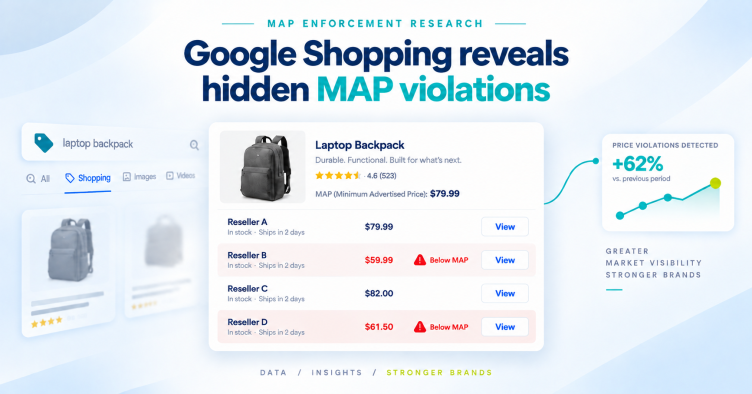
It may not be enough when a below-MAP price appears directly in an advertisement or a Shopping placement covered by your policy.
Minimum advertised price is violated wherever the price is advertised, and a growing share of that sits inside Google Shopping listings and sponsored placements. A reseller can hold your floor on their product page and break it in the Shopping feed. Whether a given platform sees that is worth asking directly, because coverage varies and few vendors volunteer the answer.
GrowByData runs Shopping Ads infrastructure as its primary business, so MAP violation monitoring spans Amazon organic, sponsored, and seller listing pages, plus Google Shopping, Walmart, eBay, and direct retail sites, across the US, Canadian, and Mexican markets. Amazon-specific coverage is detailed in our guide to Amazon MAP violations, and the Walmart equivalent is covered in Walmart MAP violations and enforcement. SKU matching runs on a hybrid of automation and human validation, which takes longer to set up and holds up better on bundles and variants.
Delivery is a service model rather than a tool handoff. You get the dashboard, the screenshot archive, and PDF evidence packs, plus reports that separate compliant resellers from repeat offenders. For enterprise channel structures, the approach is laid out in our guide to scalable MAP compliance.
Limitations: Coverage is North America focused. If your channel exposure is heavily European, look at Minderest or Intelligence Node. Onboarding runs through conversations rather than self-serve signup, which suits some teams and frustrates others. We’ve written up the cases where this is the wrong fit in 12 honest checks on whether GrowByData MAP monitoring is right for you.
Best for: Brands whose MAP violations show up in paid and Shopping listings, not only on product pages.
5. Intelligence Node
Intelligence Node positions its MAP product as monitoring, enforcement, and compliance software, with violation alerts, unauthorized seller identification, counterfeit detection, and monitoring down to postcode level. Its strength is geographic accuracy: it uses localized browsing infrastructure to see how your products are advertised in specific markets, which matters when a price looks compliant from a US IP and isn’t from a German one. The vendor reports 99% matching accuracy and refresh rates as frequent as ten seconds; both figures are vendor-reported.
Limitations: It’s a broad enterprise pricing-intelligence suite. Buyers focused specifically on MAP should confirm available evidence formats, seller-notice workflows, managed-service options, and total implementation cost.
Best for: Global catalogs where market-level accuracy is the constraint.
6. Price2Spy
Price2Spy publishes its plans, which alone puts it ahead of most of this list for buyers who need a budget number before a demo. Basic plans start around $157.95 a month, Premium moves to custom quote, and Premium supports price checks up to eight times daily. It captures screenshots when a product falls below a defined threshold, which is more than “monitoring only” implies.
Limitations: Enforcement is customer-led. Price2Spy supplies the data, alerts, and reports; contacting sellers and running notices is on your team.
Best for: Mid-market catalogs that need reliable monitoring and screenshot evidence on a known budget.
7. Trade Vitality
Flat monthly fee based on SKU count, no long-term contract. That pricing structure is unusual here and it’s the main reason to look at them. Coverage spans Amazon, Google Shopping, and Walmart, with customizable violation emails and violation logs.
Limitations: Ask about international coverage and integrations directly. The published material is focused on core North American channels rather than enterprise system connectivity.
Best for: Channel teams that want working enforcement without an enterprise contract.
8. Prisync
Prisync is a multi-channel price tracking platform with rule-based alerting that can be configured to surface suspected MAP violations. Published pricing, straightforward setup.
Limitations: Prisync states plainly that it does not contact retailers, issue seller notices, or enforce MAP policies. It supplies monitoring data, reports, dashboard notifications, and price-change alerts. Enforcement is entirely yours.
Best for: Brands that need monitoring and reporting and already have an enforcement process of their own.
9. MapAuthority
MapAuthority takes the opposite approach to everyone else here. Rather than detecting a violation and notifying you afterward, its patent-pending mechanism prevents retailers from listing below your MAP price on Amazon in the first place. Retailers are invited to review and accept your MAP agreement, and once enrolled, the price floor holds. Pricing is published, with monthly and annual options and a tier that adds hands-on support for identifying and removing unauthorized sellers.
Limitations: Amazon only, and enforcement depends on retailers enrolling and accepting your agreement. Violations on Google Shopping, Walmart, eBay, or direct retail sites fall outside its scope, and unenrolled sellers aren’t covered by the price-locking mechanism.
Best for: Amazon-first brands whose violation problem sits with authorized retailers they can enroll.
10. Minderest
Minderest monitors retailers, comparison-shopping sites, and marketplaces in any country, currency, or language, with geographic and postcode-level segmentation. Its European roots show in the depth of regional retailer coverage, which is useful if a meaningful share of your channel sits in the EU or UK.
Limitations: Enforcement is alert-and-report rather than managed. Confirm what evidence formats are available and whether seller-notice workflows are included or something your team builds around the data.
Best for: Global brands that need localized price monitoring, particularly those with European market exposure.
Not sure which channels your violations are actually coming from?
A MAP compliance audit shows you where your advertised price is breaking, across marketplaces, retailer sites, and Shopping listings, using your own SKUs.
What are the most common MAP policy violations, and how do brands enforce compliance across marketplaces?
The violations that cost the most money are rarely the obvious ones.
An unauthorized seller listing 30% below MAP on Amazon is easy to catch and easy to act on. Every platform on this list will find it. The expensive violations are subtler. A distributor who is compliant on their own site and non-compliant on their eBay storefront. A reseller who holds price for six days and drops it every Sunday. Coupon and strikethrough pricing that puts the effective advertised price below your floor while the listed price stays clean. Bundle listings that break the per-unit floor without ever showing a MAP-violating number. If you’re unclear on where the policy line actually sits, start with our breakdown of what counts as a MAP violation.
Then there’s the ad surface. Shopping listings, sponsored placements, and promotional ad copy all advertise a price, which means each can breach a minimum advertised price policy. Coverage of those surfaces varies widely by platform, and it’s worth asking about explicitly rather than assuming.
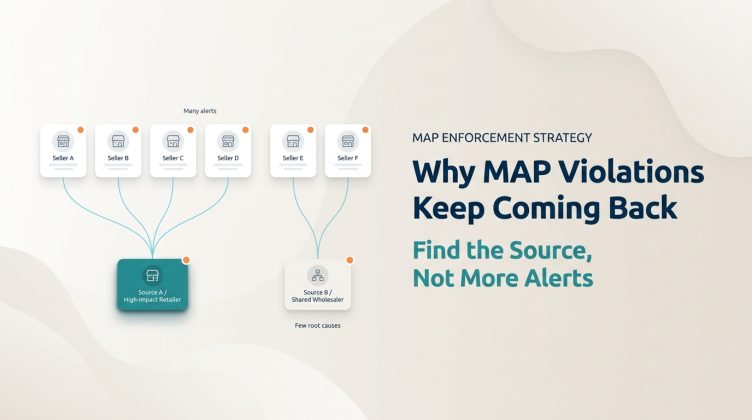
On enforcement, the pattern that works is boring and consistent. Document the violation with dated evidence. Send a notice that cites the specific SKU, seller, channel, and date, using a structured violation notice rather than an improvised email. Track whether it was resolved. Escalate on repeat offenses. Brands that treat enforcement as a workflow rather than an escalation event see violations fall. In one GrowByData case study, a distributor recorded a 39.5% reduction in detected MAP violations after implementing consistent monitoring, reporting, and reseller outreach.
The reward half matters more than most brands expect. If your only lever is a threat, your compliant resellers get nothing and your non-compliant ones get warnings they’ve learned to ignore. There’s a case for incentivizing sellers who comply alongside pursuing the ones who don’t, and it’s especially relevant if you run a dealer or distributor network where the relationship outlives any single violation.
How to choose MAP price monitoring software
Ask where they look, not just what they find. Get a specific answer on whether the platform monitors ad and Shopping surfaces or only product detail pages. This is the most commonly overlooked coverage question and almost nobody volunteers it.
Test SKU matching on your hardest products. Not your top sellers. Your bundles, your variants, your products with confusing child ASINs. Matching accuracy on easy SKUs tells you nothing.
Look at the evidence, not the alert. Ask to see an actual violation record. Does it include a dated screenshot? Can you export it as something you’d be comfortable attaching to a seller notice or handing to counsel?
Separate monitoring from enforcement. Several platforms here monitor well and leave enforcement entirely to you. Decide which half is your bottleneck before you shortlist. If your team already knows about the violations and can’t keep up with notices, buying better detection solves nothing. Our note on why MAP enforcement matters to sales and channel leaders is a useful frame if you need to build the internal case.
Check the cadence against your category. Daily scans are standard. If your resellers move price intraday, daily scanning will miss violations that are real and repeated.
Ask about the pricing model, early. Per SKU, per channel, per user, or flat. Custom quotes in this category vary enormously for similar scope, and the second demo is a bad time to discover the number.
Check that your policy is lawful in every market where you’ll enforce it. MAP rules differ significantly by jurisdiction. In the United States, independently adopted manufacturer policies may be permissible, though their design and application still matter. In the European Union, minimum advertised prices may be treated as resale price maintenance, which is viewed as a serious restriction. Get qualified legal advice before applying one enforcement model across multiple countries.
This article covers monitoring technology and operational workflows, not legal advice. Have your MAP policy and enforcement process reviewed by qualified counsel.
Frequently asked questions
How do I choose between MAP monitoring platforms?
Start with where your violations actually appear. If they surface on retailer product pages, most platforms here will find them. If they appear in Shopping listings, sponsored placements, or marketplace ads, coverage narrows sharply. Then decide whether you need detection only or detection plus enforcement workflow, since several platforms on this list do the first and leave the second entirely to you. Our MAP monitoring guide covers how the underlying process works.
Is MAP pricing illegal?
Not inherently, but it depends on jurisdiction and on how the policy is built. In the United States, the FTC treats manufacturer-imposed pricing requirements as potentially lawful when the manufacturer adopts and applies the policy independently, rather than agreeing on prices with retailers. In the European Union, minimum advertised pricing may be treated as resale price maintenance, which is viewed as a serious restriction on competition. The design and the enforcement practice both matter, so have counsel review your policy before you enforce it across borders.
Can you sell below MAP pricing?
A retailer can usually sell below MAP. What a MAP policy governs is the advertised price, not the transaction price. That distinction is why violations often appear in ads, Shopping listings, and promotional copy rather than at checkout, and it’s the reason monitoring that only reads product detail pages can miss real breaches.
How much does MAP monitoring software cost?
It splits by buying model. Self-service tools publish plans, with entry tiers starting near $158 a month for smaller catalogs. Enterprise platforms quote custom, and cost scales with SKU count, channel count, and scan frequency. Ask for the pricing structure on the first call rather than the second.
Can MAP monitoring software detect violations in Google Shopping ads?
Coverage varies significantly. Platforms built primarily around product detail page monitoring may not cover ad and Shopping surfaces. Ask the vendor directly, because a reseller can be compliant on their product page and non-compliant in their Shopping listing.
Does MAP monitoring work on Amazon?
Yes, though quality varies. The differences that matter are whether the platform tracks at child ASIN level, whether it covers sponsored listings as well as organic, and how it handles sellers who rotate listings. Our guide to Amazon MAP violations goes deeper.
Do I need separate software for unauthorized seller detection?
Usually not. Most platforms on this list identify sellers as part of violation detection. What varies is how much they help you determine who that seller actually is, which is the hard part.
Is MAP monitoring worth it for a mid-sized brand?
It depends on whether your violations are concentrated or spread out. A handful of repeat offenders can often be handled manually. Violations across dozens of sellers and multiple channels stop being tractable in a spreadsheet quickly. Our overview of modern MAP compliance practices covers where the line usually falls.
Where to start
If you already know you have a violation problem and you need enforcement machinery, shortlist TrackStreet and Wayvia. If MAP is one part of a broader pricing question, look at Wiser or Intelligence Node. If your problem is concentrated on Amazon with retailers you can enroll, MapAuthority is the most direct answer on this list. If budget is fixed and requirements are focused, Price2Spy and Trade Vitality are the honest picks.
And if you’ve been running MAP monitoring for a while and the violation numbers don’t match what your sales team is reporting from the field, the gap is usually the ad surface.
See what your current tool isn’t catching
Run a MAP compliance audit on your own SKUs across Shopping listings, sponsored placements, and marketplaces, then see the violations that never reached your dashboard.