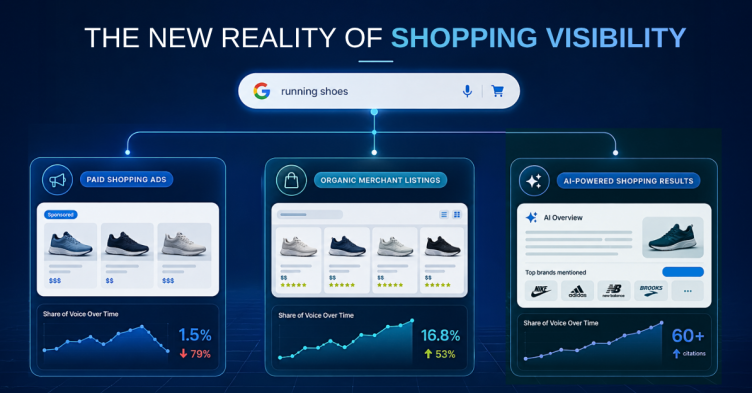


The Thanksgiving period remains one of the most dynamic stretches in the Google Shopping Advertising ecosystem. The competition activity builds steadily through October before accelerating sharply in mid-November, often reflected in rising CPCs, shifts in impression share, and increased auction volatility. These performance swings are rarely driven by account-level changes alone; they stem from broader marketplace and brands movements.
This report analyzes daily Google Shopping ads data from October 1 to November 30 across six major retail categories, capturing shifts in advertiser participation, listing volume, discount behavior, and visibility distribution. Together, these signals reveal how competition intensifies leading into Thanksgiving and which categories contribute most to rising auction pressure.
Key Insights from the Season
- Google Shopping Ads competition climbs in three clear phases, with the steepest rise occurring mid-November.
- Phase 1 (Oct 1 to Oct 20)
- Phase 2 (Oct 21 to Nov 9)
- Phase 3 (Nov 10 to Nov 30)
- Visibility becomes more concentrated in categories like Beauty, Music, and Furniture as the holiday approaches.
- Discount intensity increases sharply in the final stretch, especially in Apparel, Beauty, and Music.
- Some Industries are crowded with many promotional advertisers, while others are led by just a few brands that consistently show up more than everyone else i.e Target, Walmart and such.
- Thanksgiving week reflects the year’s highest auction density, producing the most pressure on CPCs and impression share stability.
→ What Brands Can Take Away From This Report
→ How GrowByData Helps Brands Navigate Google Shopping Advertising Dynamics
Google Shopping Advertiser Trend (Oct 1 → Nov 30)

This upward trend sets the competitive backdrop for all category-level behavior observed later in the season.
Daily Google Shopping Monitoring data shows how advertiser participation, catalog activation, and promotional strategies evolve across the season. What begins as a stable early-October environment becomes progressively more competitive as more advertisers activate listings and deepen promotions through November. This progression forms the context for the category-level visibility patterns presented in the following section..
Category-Level Visibility Patterns
Different categories in Google Shopping show very different visibility patterns during the Thanksgiving period. Some categories have many brands appearing regularly, while others are dominated by just a few strong players.
This creates unique visibility shapes for each industry.
Here is the Industry Wise Visibility Breakdown


Apparel and Furniture remain highly competitive and fragmented, while Beauty and Music show more concentrated visibility driven by a few recurring advertisers.
Explore Q3 Benchmark Reports in 2025 for Deeper Category Insights
Combined Shopping Ads Dynamics Interpretation
When we combine advertiser growth, discount activity, and visibility shifts, a clear three-phase seasonal pattern emerges:
Phase 1: Stable Market
- Competition is steady
- Discounts are limited
- Visibility is broadly distributed with minimal volatility
Phase 2: Rising Pressure
- Advertiser participation increases
- Catalogs expand as more brands activate products
- Overlap grows, creating tighter competition and more noticeable visibility movement
Phase 3: Peak Density
- Marketplace reaches its highest advertiser counts
- Promotions deepen sharply across multiple categories
- Visibility becomes concentrated and highly competitive
This three-phase pattern explains why many campaigns see sharper performance swings in mid-November, even when strategy has not changed, the market itself becomes more crowded and aggressive.
→ Notably, Amazon is almost entirely absent from our Thanksgiving Shopping Ads dataset, aligning with their broader pullback from Google Shopping placements.
See our full analysis of Amazon’s retreat.
The Rise of Competitors Heading Into Thanksgiving
Beyond category-level behavior, the number of advertisers active in the competition follows a three-phase progression:
| Phase | Date Range | Share of Total Unique Advertisers (%) | Advertisers with Discounts |
|---|---|---|---|
| Phase 1 | Oct 1 to Oct 20 | 21.31% | 212 |
| Phase 2 | Oct 21 to Nov 09 | 31.45% | 522 |
| Phase 3 | Nov 10 to Nov 30 | 47.25% | 1,491 |
The steepest competitive jump occurs after November 10, creating the highest auction density of the season.
What This Means for Brands
The rapid increase in advertisers and the even faster rise in discounting signals a marketplace where competition intensifies not in one sudden spike, but in clear, measurable waves. As more brands enter the auction and activate promotions:
- Maintaining visibility becomes harder as more advertisers activate campaigns.
- Impression share fragments across a larger pool of listings.
- Auction pressure increases, contributing to CPC volatility.
- Promotions shift from optional to essential in several categories.
- Late entrants face reduced efficiency compared to early-season participants.
How Discount Intensity Shifts Across the Thanksgiving Period
Promotional depth also follows a seasonal progression. Most categories deepen their discounts as Thanksgiving approaches, aligning tightly with marketplace crowding.
| Category | Phase 1 Oct 1 to Oct 20 |
Phase 2 Oct 21 to Nov 09 |
Phase 3 Nov 10 to Nov 30 |
Peak Discounts |
|---|---|---|---|---|
| Apparel & Accessories | 64% | 75% | 88% | 88% |
| Automotive | – | 50% | 20% | 50% |
| Beauty | – | 25% | 82% | 82% |
| Food & Beverage | 50% | 58% | 58% | 58% |
| Furniture | 69% | 77% | 87% | 87% |
| Music & Accessories | 33% | 54% | 80% | 80% |
Apparel, Beauty, Music, and Furniture show the strongest promotional escalation, while Food & Beverage remains steady.
The trends in this report show how the Google Shopping landscape shifts as Thanksgiving approaches. Rising advertiser activity and deeper promotions create marketplace conditions that directly influence visibility, CPC, and impression share.
Key takeaways for brands include:
- Competition increases in waves.
The Google Shopping auction tightens gradually across October and November, which affects both visibility and cost efficiency - Visibility becomes more volatile.
Even stable campaigns may experience impression share fragmentation simply because more competitors activate listings and promotions. - Promotional depth influences Shopping visibility.
Categories with faster or deeper discounting often show sharper changes in Shopping visibility. - Category behavior varies significantly.
Some verticals remain fragmented with many active advertisers; others consolidate around a handful of dominant players. Campaign performance should be interpreted through the dynamics of the specific Shopping category - Performance often reflects market shifts.
Changes in CPC, CTR, and ROAS commonly align with broader Google Shopping activity, not necessarily shifts in campaign execution.
For brands, these insights help separate true account-level issues from changes caused by competing advertisers, seasonal supply, and holiday-driven promotional intensity within Google Shopping.
The seasonal dynamics highlighted in this report reinforce the need for precise, daily visibility into Shopping competition. With GrowByData’s dedicated Google Shopping Ads Visibility solution, brands can diagnose and respond to these market-wide forces with::
- Daily competitor monitoring to identify which advertisers surge or retreat
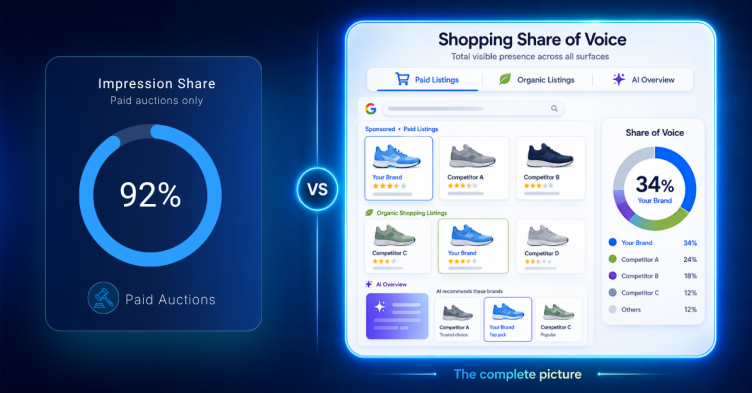
- Share of Voice diagnostics to quantify placement impact at the SKU, category, and keyword levels
- Listing-level visibility to pinpoint which products lose exposure as the auction tightens
- Promotional depth monitoring to detect when competitors increase discount intensity
- Full-funnel category benchmarking to understand where structural shifts in each category affect performance
The data shows that the Thanksgiving period is shaped by a progressive rise in market activity rather than a single spike. Competition increases in waves, first through catalog expansion, then through advertiser growth, and finally through intensified discounting. As these elements converge, the marketplace becomes denser and more competitive, driving sharper movements in visibility and auction outcomes.
Understanding these dynamics provides essential context for interpreting performance trends during the season. While campaign-level metrics show the symptoms of increased competition, the underlying causes stem from marketplace-wide behavior. By viewing the holiday period through a broader lens, advertisers gain a clearer picture of the forces shaping visibility during one of the most competitive stretches of the year.