Your rankings look fine. Your organic clicks are down 22% quarter over quarter. Both things are true and that’s the problem rank tracking alone can’t solve.
Table of Content: Show
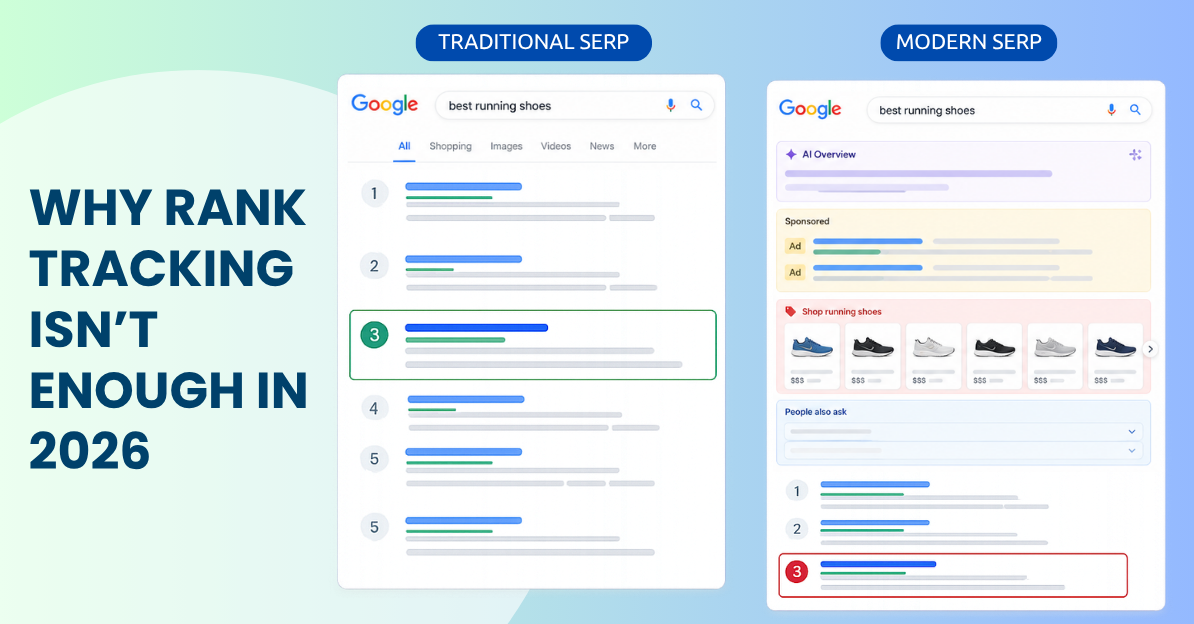
Last quarter, a mid-size retailer’s SEO team reported “stable” rankings across 400 priority keywords. Their weekly rank tracker dashboard was green. Meanwhile, their organic click share on those same keywords had dropped more than 20% over six months. The culprit wasn’t algorithm volatility, it was a structural SERP change their tools never surfaced. Google had inserted an AI Overview at position zero, expanded its Shopping carousel to six units, and a competitor had captured the Featured Snippet for three of their highest-converting informational terms. Position 3 was still position 3. But position 3 was now below the fold.
This is the gap between rank tracking and SERP monitoring and for enterprise teams operating in competitive categories, the difference is no longer academic. Understanding what your full search results page actually looks like is now a core requirement, not a nice-to-have. That’s the foundation of competitive SERP analysis.
What rank tracking does well
To be direct: rank tracking is genuinely valuable and isn’t going away. Tools like Semrush, Ahrefs, AccuRanker, and SE Ranking have built strong rank tracking capabilities for good reason knowing your keyword positions is foundational data.
Rank tracking gives you:
- Daily or near-real-time position data across a defined keyword set
- Historical trend lines to correlate ranking changes with content updates, algorithm updates, or technical fixes
- Segmentation by device, location, and search engine
- Automated alerting when rankings shift materially
- Organic visibility scores aggregated across a keyword portfolio
For a site with a tightly defined keyword set in a non-competitive category, rank tracking is often sufficient. It’s also the right operational metric for content teams running page-level experiments, it answers “did this change move the needle on position?” cleanly and at scale.
The problem is what happens when the SERP itself changes around your rankings. As we’ve covered in depth, keyword tracking alone is no longer enough for enterprise search visibility, the page your users see has far more moving parts than a position number can capture.
What rank tracking misses on a modern SERP
The Google SERP features landscape in 2026 looks almost nothing like it did in 2019. On a competitive commercial query, a user might scroll through an AI Overview, four paid ads, a Shopping carousel, a People Also Ask box, and a Local Pack before reaching a single organic blue link. Your position 3 ranking may have moved from the top third of the viewport to well below the fold without your rank tracker registering a single position change.
Here are the specific blind spots rank tracking doesn’t address.
AI Overviews
Whether a Google AI Overview appears for your target keywords, how often, what sources it cites, and whether your domain is included or excluded. On high-intent commercial queries, AI Overviews now answer queries directly reducing clicks to organic results regardless of where you rank.
Ad density and placement
How many ads appear above organic results, whether competitors are bidding on your branded terms, and how ad presence shifts by query variation or time of day. A query showing four paid ads before any organic result has fundamentally different click dynamics than one without but your rank report shows the same position number either way.
Shopping carousels
Which products and merchants appear in Google Shopping units, at what price points, and how that changes week over week. This is especially critical for retailers and brands trying to understand Google Shopping Ads competitive visibility and why standard reporting often misses what’s actually happening on the page.
Featured Snippets and People Also Ask
Whether a competitor owns the Featured Snippet for a query where you rank position 2, or has captured the People Also Ask boxes above your organic listing. These features capture clicks that never reach your URL even when you technically rank higher.
The position-vs-visibility gap
The most underreported metric gap in enterprise SEO. Your position is a coordinate. Your actual visibility, the share of real on-screen real estate your domain captures is a different number entirely. As GrowByData’s own data shows, rankings can stay flat while visibility drops materially and a rank tracker will never surface it.
None of these are edge cases. On transactional and commercial-investigation queries, exactly the keywords enterprise teams prioritize SERP feature density is highest and the position-visibility gap is widest.
What SERP monitoring adds
SERP monitoring operates at the page level, not the position level. Instead of asking “where do I rank?”, it asks: what does the entire search result page look like, who is winning visibility, and what has changed? This is exactly what enterprise SERP tracking is designed to answer.
The capabilities that distinguish true SERP monitoring from rank tracking:
Full-SERP capture
Recording the actual page layout which features appear, in what order, for what query variations and geographies. This requires real-browser data collection, not simulated incognito queries, which is why paid search intelligence based on incognito data is increasingly unreliable.
Feature-level tracking
Monitoring AI Overview presence and citation sources, Featured Snippet ownership, PAA content, Shopping unit composition, and Local Pack entries, all as trackable, trend-able signals over time. The top SERP features each behave differently and each require their own tracking logic.
Share of voice at the SERP level
Measuring what percentage of total SERP real estate your domain captures versus competitors, weighted by feature prominence and position. This is what Google share of voice actually means in practice, a metric that predicts traffic outcomes far better than a position number alone.
Competitor SERP footprint
Seeing the full picture of how competitors appear across all SERP features not just their organic positions. A competitor may rank position 8 but dominate the SERP through a Featured Snippet, a Shopping unit, and two PAA answers simultaneously. Only competitive SERP analysis at the full-page level surfaces this.
Volatility detection
Identifying when SERPs for key queries become unstable, a leading indicator of algorithm tests or feature rollouts before they settle into position changes. For teams managing multi-market programs, local and international SERP monitoring adds city and zip-code level capture to this picture.
The framing shift that matters: Rank tracking measures your performance in organic results. SERP monitoring measures what the user actually sees the full competitive landscape, including features, ads, AI, and organic results together. For teams accountable for traffic and revenue rather than rankings, SERP monitoring is the closer proxy to actual outcomes.
Rank tracking vs SERP monitoring: direct comparison
When do you actually need which?
Rank tracking may be sufficient if:
- You operate in a low-competition vertical with stable SERPs and minimal SERP feature saturation
- Your keyword set is small and well-defined (under 500 keywords)
- Your primary workflow is content optimization and you need position feedback loops
- You’re a smaller brand or agency client where granular SERP intelligence is cost-prohibitive relative to impact
- You don’t compete in Google Shopping or have paid search adjacency concerns
SERP monitoring is essential if:
- You’re an enterprise brand or retailer in a competitive category where AI Overviews and Shopping carousels are prevalent
- Your click share is declining despite stable or improving rankings
- You need to report organic performance to leadership where position alone doesn’t tell the story
- You run paid search alongside SEO and need integrated SERP visibility
- Competitor SERP behavior is a strategic input to your roadmap
- You’re responsible for SERP presence in multiple geographies or a large SKU catalog
[INSERT GBD DATA:] % of enterprise brands with stable or improving rankings who saw declining organic CTR year-over-year; correlation data between SERP feature density and click-share loss on commercial queries.
The apparel category is a useful reference point. As GrowByData’s 2026 apparel search visibility analysis shows, brands that held stable organic positions still saw material shifts in actual SERP presence as Merchant Listings and Shopping units reshaped the page.
How GrowByData approaches SERP monitoring
GrowByData’s Search Intelligence platform operates at the SERP-intelligence layer built for the depth of feature tracking and competitive visibility that rank trackers weren’t designed to provide.
Where it operates differently from a standard rank tracker:
- SERP feature depth: The enterprise SERP tracking tool monitors 20+ SERP features, AI Overview presence and citations, Featured Snippets, PAA ownership, Shopping carousel composition, ad units, all at keyword and domain level with full trend history.
- Google AIO monitoring: Google AI Overview tracking goes beyond flagging presence, it tracks which sources are cited inside AI answers and whether your domain is included, excluded, or displaced by a competitor.
- Full-SERP share of voice: The SEO Intelligence layer measures competitive visibility across all SERP features, not just organic positions giving a more accurate picture of who is actually winning a search results page.
- Google Shopping intelligence: Google Shopping monitoring tracks merchant presence, product pricing, and Shopping unit placement at SKU level critical for brands and retailers tracking competitor activity in Shopping carousels.
- Local and international coverage: Local and international SERP monitoring captures SERPs at city and zip-code level for enterprise teams managing multi-market programs.
- LLM visibility: The same position-vs-visibility problem is playing out inside AI answers. GrowByData extends SERP monitoring to ChatGPT brand monitoring, Perplexity citation tracking, and Google AI Mode monitoring.
This isn’t a replacement for rank tracking, it’s the intelligence layer on top of it, for teams that need to understand the full picture of what happens on the search results page.
Want to see what this looks like for your own category?
See your Overall SERP trends & SOV, competitor visibility gaps, and top threats.
Frequently asked questions
Is SERP monitoring the same as rank tracking?
No. Rank tracking measures where your pages appear in organic search results for a set of keywords. SERP monitoring captures the full search results page including AI Overviews, paid ads, Shopping carousels, Featured Snippets, People Also Ask boxes, and competitor presence across all features. Rank tracking tells you your position; SERP monitoring tells you what the user actually sees and who is winning the page.
Can my rank tracker show me AI Overviews and SERP features?
Most rank trackers flag some SERP features at a surface level particularly Featured Snippets and PAA. But few are built to track AI Overview presence systematically, monitor which sources appear inside AI answers, measure share of voice across features, or capture Shopping carousel data at SKU level. These require purpose-built SERP monitoring infrastructure, not a feature add-on to a rank tracker.
My rankings are stable but organic traffic is dropping. What is happening?
This is one of the clearest symptoms of the position-vs-visibility gap. Your position hasn’t changed, but the SERP layout around you has. Common causes include an AI Overview appearing above organic results and answering the query directly, increased ad density pushing your listing below the fold, a competitor capturing a Featured Snippet or Shopping placement, or a new PAA box increasing zero-click searches. SERP monitoring identifies which features have appeared, when they changed, and who is benefiting.